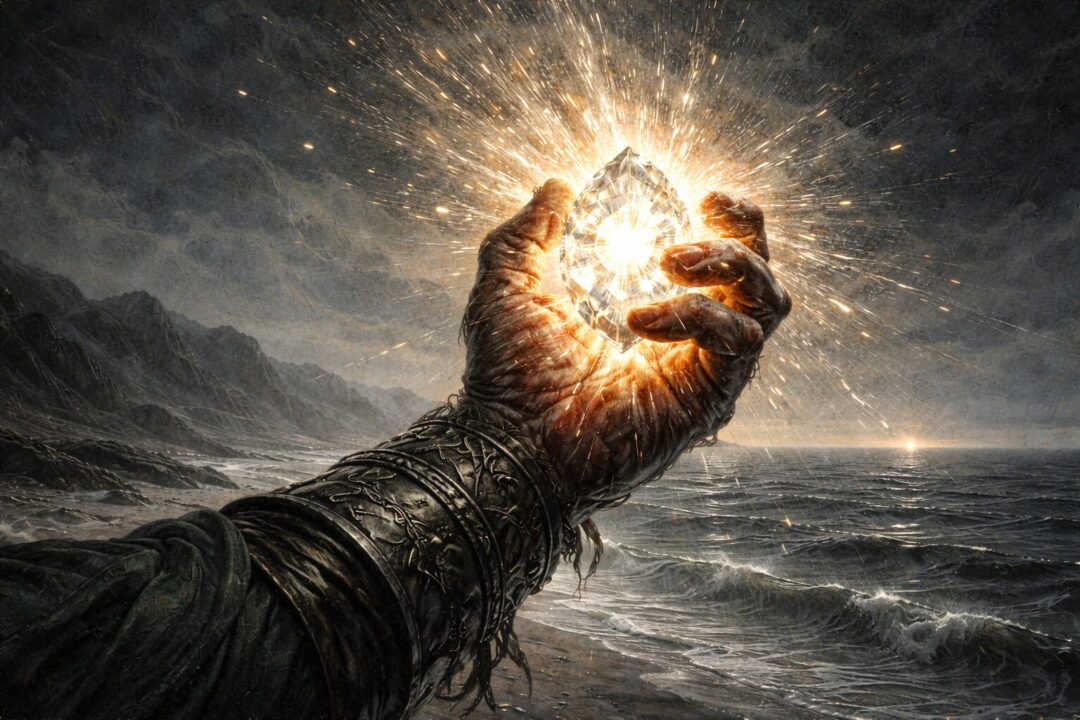
Maglor’s ending is one of the rare places where the First Age refuses to give you the comfort of a closed door.
Many characters fall with unmistakable finality: slain in battle, drowned, buried beneath ruin. Even when the grief is immense, the line is clear. A life ends. A chapter ends. The tale moves on.
But Maglor is not given that shape.
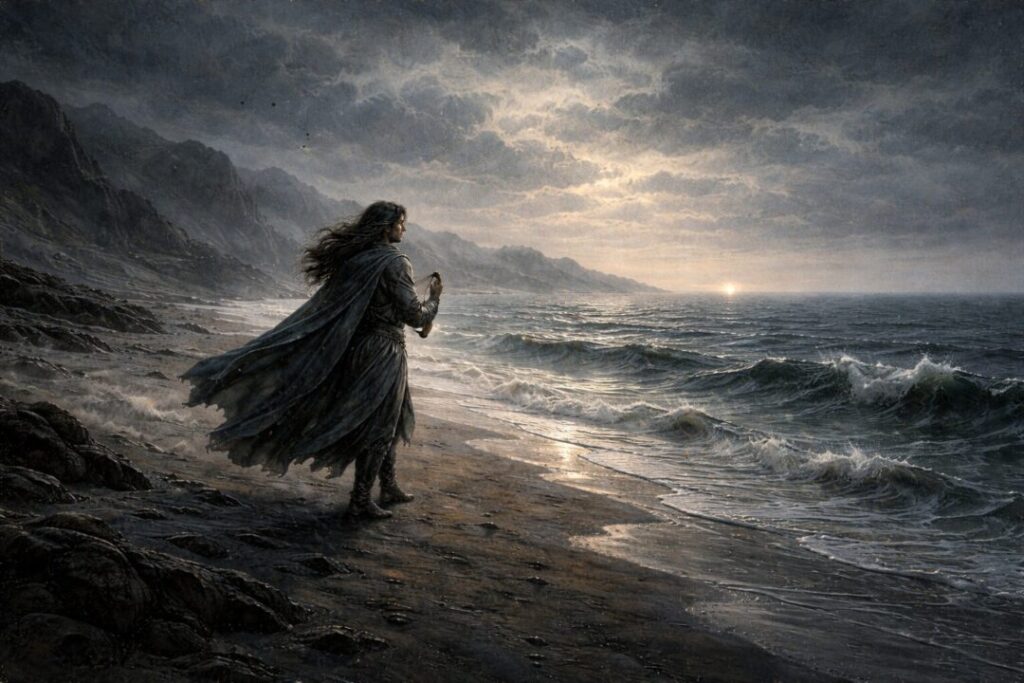
Instead, the texts leave him at the margin—where land breaks into water—walking the shore with a song that does not resolve.
And to understand why that matters, you have to start with the last moment the narrative allows you to see plainly.
The Last Two Sons, The Last Two Jewels
At the end of the War of Wrath, Morgoth is defeated and the Silmarils are taken from him. The great struggle that began with stolen light finally reaches its conclusion.
And yet, the doom of the House of Fëanor does not end when Morgoth falls.
Because the oath still exists.
By this point, only Maedhros and Maglor remain of Fëanor’s sons. They go to Eönwë—herald of Manwë—and demand the Silmarils. Eönwë refuses. He judges that their right to the jewels is void, because of the evil deeds done in pursuit of them.
This refusal is crucial. It is not merely political. It is moral.
The jewels were hallowed, and the oath-driven violence that followed them has made the claim poisonous. In other words, the story does not allow the Silmarils to function as “spoils” that can be seized and enjoyed at the end of a war. They are a judgment, and the hands that reach for them will be tested.
So the brothers do what their oath has trained them to do.
They steal the Silmarils anyway.
The Burn That Reveals the Truth
When Maedhros takes a Silmaril, the text is blunt: the jewel burns his hand in “pain unbearable.” In that moment he perceives that Eönwë spoke true, that his right has become void, and that the oath is “vain.”
That word matters.
Not “broken.” Not “fulfilled.” Vain—empty, futile, spiritually bankrupt. The oath is not simply difficult to keep. It is revealed as a trap that can no longer even pretend to justify itself.
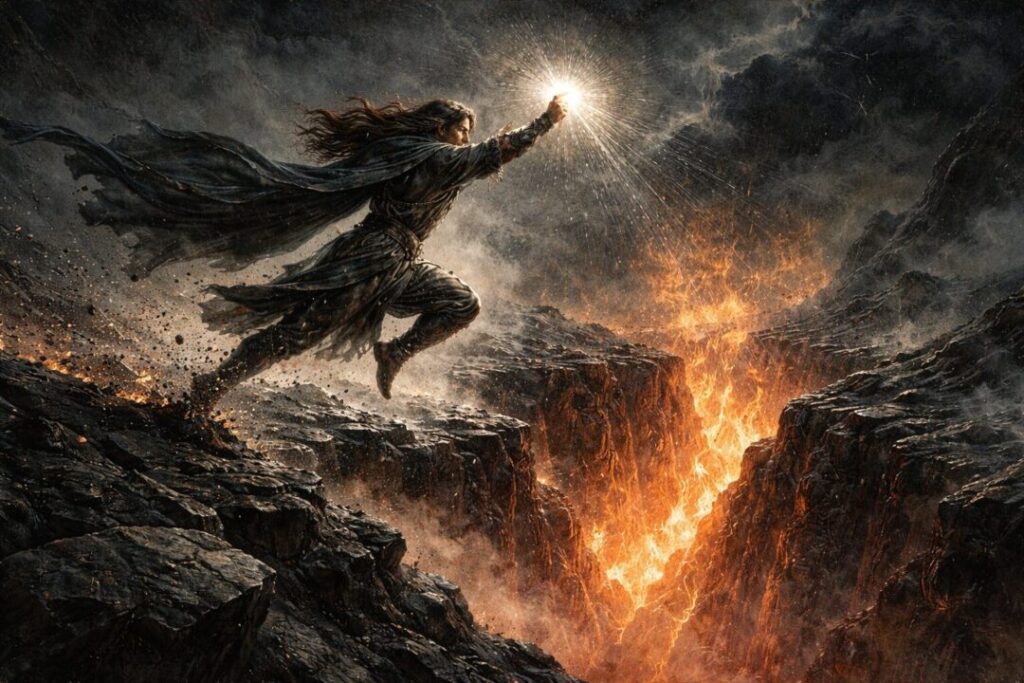
Maedhros answers with despair. He casts himself into a gaping chasm filled with fire, and the Silmaril he bore is taken into the “bosom of the Earth.”
This is an ending with full stop punctuation.
But Maglor’s is not.
Maglor’s Choice: Throwing the Silmaril Away
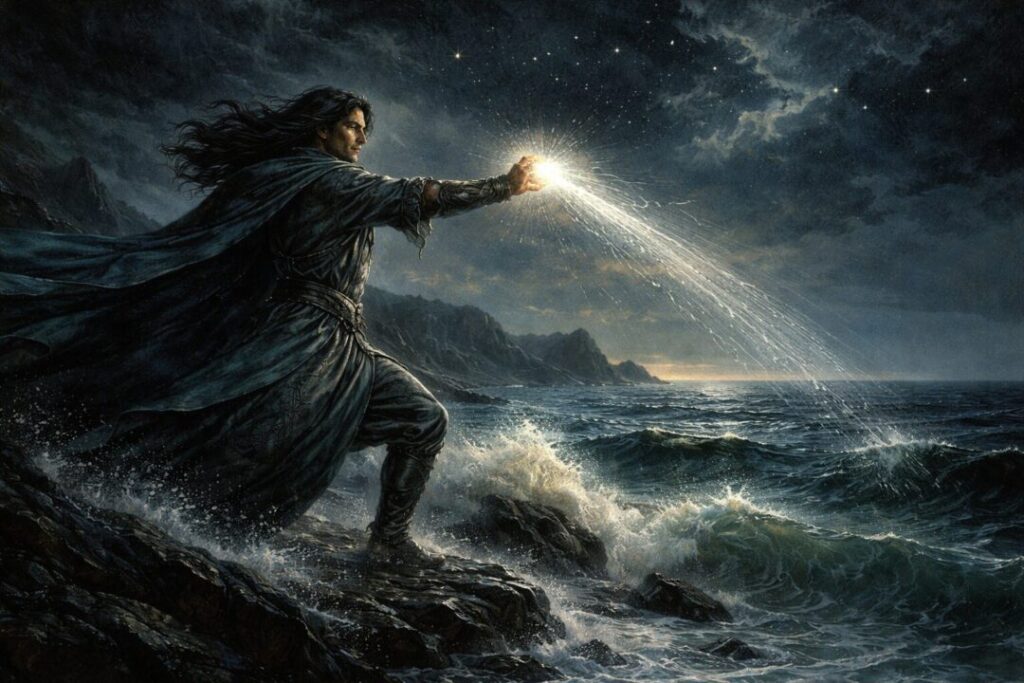
The text says Maglor cannot endure the pain with which the Silmaril torments him. He casts it into the Sea.
And then the narrative shifts into a register that feels almost like legend—half history, half lingering echo:
“thereafter he wandered ever upon the shores, singing in pain and regret beside the waves… but he came never back among the people of the Elves.”
This is where the story becomes strange.
Because it does not say he dies.
It does not say he is taken.
It does not say he repents and is forgiven, nor does it say he is hunted down and punished.
It says: ever upon the shores.
And it says: never back among his people.
That combination creates the tension that has haunted readers for decades: is this doom, or penance?
Doom: The Shore as a Sentence
If you read the line as doom, the shore-wandering becomes a kind of living exile.
Maglor is not merely sad. He is severed.
He is cut off from the Elves—“never back among the people of the Elves”—and left with a grief that cannot heal, because the oath has already burned away the shape of any return.
In this reading, the sea is not mercy. It is distance.
The Silmaril is not relinquished in freedom. It is thrown away because it cannot be held.
And the song is not a hymn of repentance. It is the sound of a man who finally understands what he has become—too late to undo it.
This interpretation fits the tone of the Doom of the Noldor: a long consequence that does not always require a dramatic execution. Sometimes the punishment is simply being left alive to remember.
But the text also gives you something else.
A sliver of choice.
Repentance: The Only Feanorian Who Lets Go
Maglor does one thing none of his brothers ever truly accomplish: he releases the object the oath demanded.
Yes, he releases it under torment. But he still releases it.
And that matters, because the story has already shown what oath-keeping looks like in the House of Fëanor: relentless pursuit, repeated kinslaying, and the willingness to destroy entire refuges of the innocent rather than yield the jewel.
Against that background, casting the Silmaril away is not nothing.
It is the first gesture that resembles renunciation instead of seizure.
The texts do not explicitly say, “Maglor repented.” They do not explicitly say, “He sought forgiveness.” But they do attach two words to his wandering that are not neutral:
“pain and regret.”
Regret is moral language. It implies recognition.
And the shore-wandering, in that light, can be read as penance: not a punishment inflicted by others, but a self-chosen refusal to return, because return would be a lie.
Not all exiles are chased away. Some exiles walk out into the margins because they no longer believe they deserve the center.
The Detail That Keeps the Door Open
There is a reason the Maglor passage keeps feeling unfinished.
It is unfinished.
The narrative does not provide the next step.
And later notes and summaries complicate the picture rather than settling it. A letter-summary cited in reputable lore references states that the last two sons of Fëanor are “destroyed” by the Silmarils, “casting themselves into the sea, and the pits of the earth,” and another version says they “perished each with a jewel: one in a fiery cleft… and one in the Sea.”
That tradition points toward an ending where Maglor ultimately dies in the Sea.
But the published narrative line—“wandered ever upon the shores”—is what many readers cannot forget, because it deliberately emphasizes continuance rather than conclusion.
So what can we say with confidence?
- We can say the Silmaril tormented Maglor and he threw it into the Sea.
- We can say the text describes him wandering “ever” upon the shores, singing in “pain and regret,” and never returning to the Elves.
- We can say later summarized traditions exist that describe him perishing in the Sea (but these do not erase what the main narrative emphasizes).
Everything beyond that must be framed carefully.
So… What Happened to Him?
The honest answer is: the texts leave Maglor as a living question.
Not because the author forgot him, but because Maglor embodies a theme the First Age does not easily resolve: what happens when someone recognizes evil only after they have helped make it irreversible?
If Maglor is doomed, he becomes the sound of consequence—an immortal sorrow that walks the coast until the world itself changes.
If Maglor is repentant, he becomes something even rarer: a figure who cannot undo the past, but refuses to pretend it was justified.
Either way, the shore matters.
It is the place between worlds: not fully within the lands of the Elves, not yet beyond them; the line where you can stare westward and still not be able to cross.
And that may be why the story leaves him there.
Because some endings, in Middle-earth, are not about who is punished or spared.
They are about who can still sing—and what it costs them to keep singing.
Sources & Notes
- J.R.R. Tolkien, The Silmarillion, "Of the Voyage of Eärendil and the War of Wrath" — Eönwë’s refusal, the burning of the Silmarils, Maedhros’s death, and Maglor’s shore-wandering in pain and regret.
- J.R.R. Tolkien, The Silmarillion, "Of the Flight of the Noldor" — the Oath of Fëanor and the Doom of Mandos as the moral frame for the sons’ later exile and ruin.
- J.R.R. Tolkien, The Silmarillion, "Of the Ruin of Doriath" and "Of the Voyage of Eärendil and the War of Wrath" — the repeated violence caused by the oath-bound pursuit of the Silmarils.
- J.R.R. Tolkien, The Letters of J.R.R. Tolkien, Letter 131 — Tolkien’s summary of the Silmarils’ final loss and the destructive end of Fëanor’s last sons.