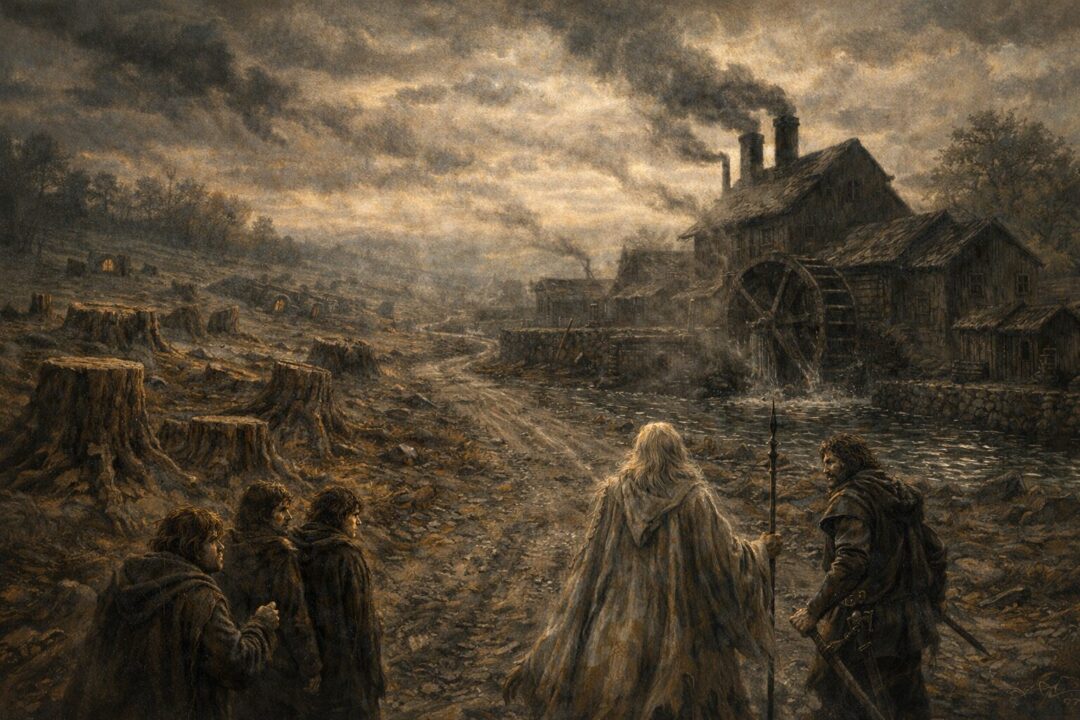
Saruman’s downfall feels like it should end at Orthanc.
His armies scatter. Isengard is drowned and broken. The tower is trapped inside a living fortress of trees. Gandalf takes away the last symbol of his office. The great voice that once dazzled kings is exposed as a tool for domination.
And yet Saruman is not killed.
He is left standing on the steps of Orthanc, and then—astonishingly—he is released.
Treebeard opens the door. Saruman and Wormtongue walk out. And the story keeps going.
That continuation matters, because it forces a question the narrative never answers directly with a neat sentence:
What did Saruman think he was going to do next?
Readers usually land on one of three instincts.
A petty tyrant, a failed would-be Dark Lord, becomes small and vindictive.
Or a fallen power tries to climb back up by any means available.
Or a defeated traitor runs to ground, trying to hide from the greater evil he once served.
All three are tempting.
But the clearest way to approach Saruman’s “plan” is to begin where the text is most solid: what happens, when it happens, and what Saruman still has left to use.
The one weapon Saruman keeps
By the time Saruman leaves Orthanc, he has lost nearly everything that made him formidable.
He has no army. He has no fortress. His staff is broken by Gandalf in a moment the text frames as a stripping of authority. And when the palantír is wrested out of Orthanc, Saruman also loses the tool through which he had been competing with Sauron.
But Gandalf’s warning is not “he is harmless now.”
It is almost the opposite: Saruman’s remaining danger is in persuasion.
Even late in the story, Saruman can still bend weaker minds, unsettle the confident, and stir desire and fear with carefully chosen words. This is repeatedly shown in the encounter at Isengard, where even those who know what he is must actively resist the pull of his voice.
So Saruman exits Isengard in a strange condition: diminished in “wizardly” power, but not stripped of the talents that made him corrupt in the first place.
That combination makes his next move more important, not less.
Where he goes tells you what he wants
We are not left guessing blindly about Saruman’s path.
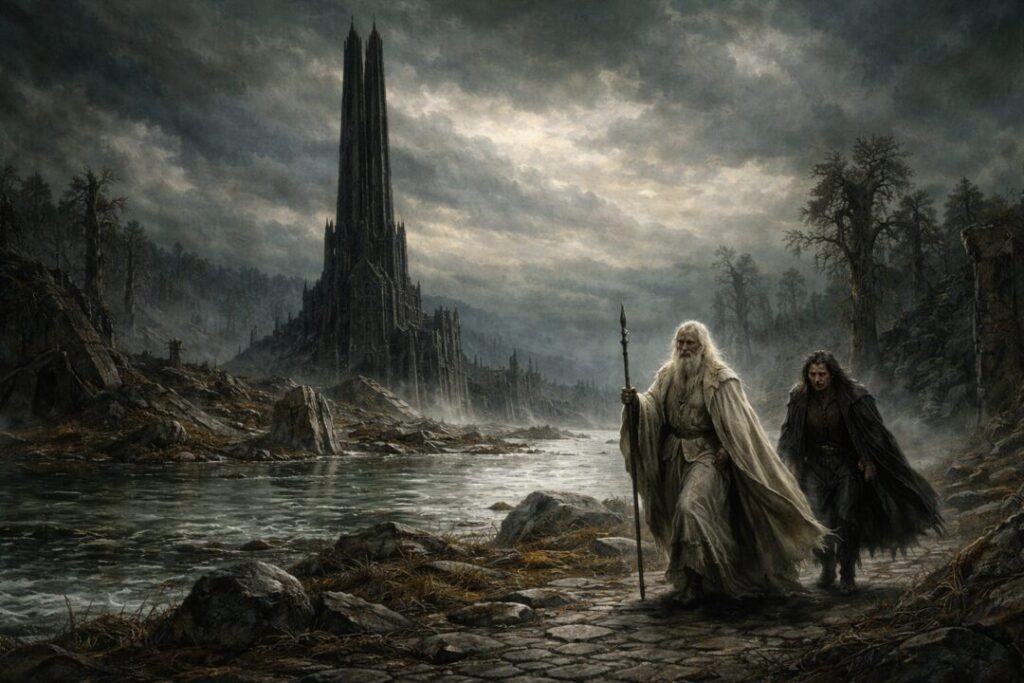
The chronology preserved with the story records that Saruman is released from Orthanc and later overtaken on the road—after which he turns toward the Shire.
That single turn is a heavy clue.
Saruman does not disappear into the wild. He does not seek some distant refuge. He chooses a direction.
And the Shire is not a random choice in the broader legendarium. A note preserved in Unfinished Tales (summarized in reputable references) indicates that Saruman had taken an interest in the Shire and pipe-weed well before the War reached its height.
So when Saruman heads for the Shire after Orthanc, he is not “discovering” it.
He is returning to a place he already knows is vulnerable—rich, orderly, and unarmed.
That makes it much harder to interpret his movement as mere flight.
Theory 1: Was he hiding from Sauron?
At first glance, this seems plausible.
Saruman has betrayed Sauron as well as the West. He used the palantír. He tried to seize the Ring for himself. If Sauron wins, Saruman is unlikely to be forgiven.
So you can imagine Saruman slipping away to somewhere small, hoping the Eye will never bother to look.
But the timeline complicates this.
Saruman is released from Orthanc months before the Ring is destroyed and Barad-dûr falls. That means: for a time, Saruman is indeed moving in a world where Sauron still exists and still threatens everything.
Yet Saruman does not run far.
He travels on roads where he can be overtaken. He remains close enough to the great movements of the Age that the King’s company crosses his path.
That behavior does not look like a man whose primary goal is to vanish.
It looks like a man who believes he can still operate.
So “hiding from Sauron” may explain Saruman’s need to avoid open confrontation, but it does not explain why he chooses a target, builds a system, and keeps trying to control others.
Fear may be part of the pressure behind his choices.
It does not look like the purpose.
Theory 2: Was he trying to return to power?
This is the more flattering interpretation—flattering, at least, to Saruman.
Saruman once aimed at something vast. He wanted to reshape the world, and the narrative strongly implies he desired the Ring for himself. When that fails, a reader might assume he immediately starts plotting a new ascent.
And in a limited sense, that is true.
Saruman does attempt to establish himself as “chief” again. Not among the Wise. Not in the councils of kings. But as the hidden master of a small country, ruling through intimidation, rules, and hired men.
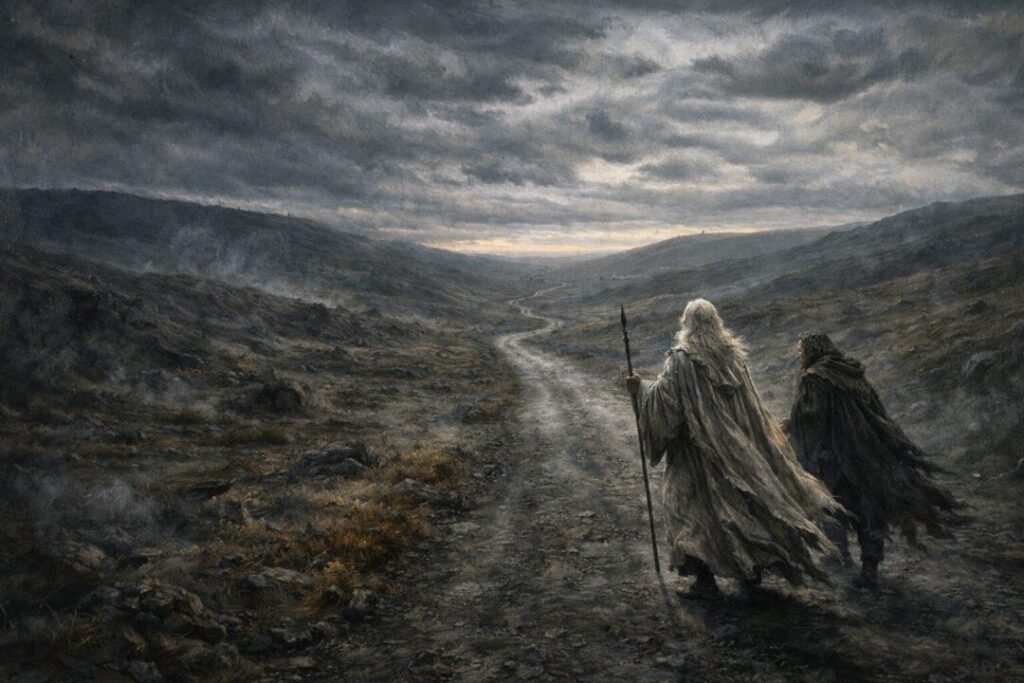
When the hobbits return home, they find the Shire under the control of ruffians led by a shadowy “Sharkey,” who is ultimately revealed to be Saruman.
That is power—real power, exercised directly over people’s homes and food and movement.
But it is also a grotesque comedown.
Because the Shire is not Minas Tirith, and Saruman is not building an empire. He is running an occupation: cutting trees, replacing old mills with machines, enforcing petty restrictions, and draining the life out of a place that once thrived.
If this is a “return to power,” it is a return in miniature: domination scaled down to match a diminished self.
Which raises a sharper question:
If Saruman could have tried to flee farther, or bargain, or seek mercy—why spend his last strength on this?
Theory 3: Was he simply a petty tyrant at the end?
The Shire chapters make one thing explicit: Saruman’s rule there is not an accident, and it is not clean.
It is spiteful.
Saruman does not merely take resources. He despoils. He scars. He tears down familiar things and replaces them with ugliness.
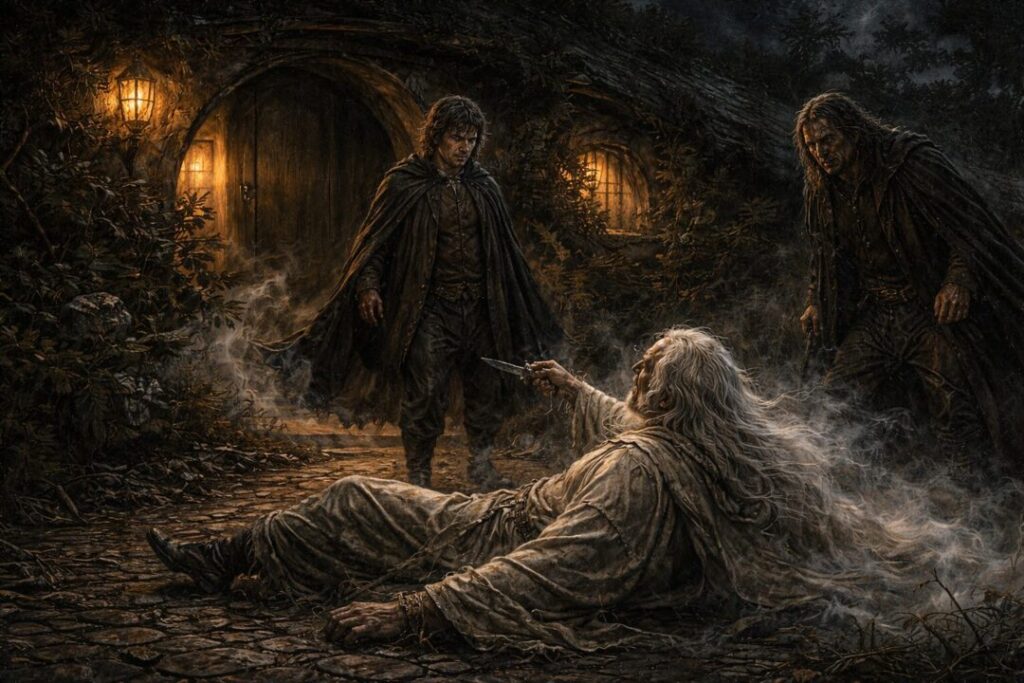
And when confronted, Saruman’s own words and actions point toward revenge rather than strategy. Even after everything, he tries to strike Frodo—only for the blade to snap against hidden mail.
This is not the behavior of a patient rebuilder carefully laying foundations.
It is the behavior of someone who wants to hurt what others love.
And the Shire is not an arbitrary “small realm.” It is the home of the very people Saruman blames for his humiliation: the halflings connected to the Ring, to Gandalf’s counsels, and to the unraveling of his plans.
That is why “petty tyrant” is not just an insult here. It is a description of scale and intent.
Saruman’s last dominion is chosen precisely because it is small enough to control with leftovers: a broken voice, a few armed men, and the willingness to bully civilians.
The most text-faithful answer is a blend
If you want the most conservative, text-grounded conclusion, it is this:
Saruman’s post-Isengard plan becomes the only kind of plan still available to him: a smaller, meaner form of rule driven by resentment.
He likely needs to keep out of the direct path of the great powers—Sauron while Sauron still stands, and later the renewed kingdom once it rises.
He also still craves control, because domination is the habit his corruption trained into him.
And he is bitter enough that, when he cannot seize the world, he chooses instead to wound a corner of it that mattered to his enemies.
The Shire becomes the perfect stage for that combination.
Small enough to bully. Hidden enough to delay attention. Symbolic enough to feel like revenge.
Why Saruman’s ending is meant to feel wrong
Saruman’s final act is not a grand duel with a worthy foe.
It is the occupation of a quiet land, followed by a confrontation where he is offered mercy and refuses it, and then is killed by the servant he has degraded for too long.
Even his “spirit” does not rise in triumph. The text describes a gray mist that dissipates, blown away and denied any return.
Everything about this is anti-climactic on purpose.
Because Saruman’s fall is not meant to be spectacular.
It is meant to show what evil looks like when it loses its glamour: not always a towering Dark Lord, but often an embittered mind turning to spite, industry, and coercion—ruining ordinary life because ordinary life will not bow.
So what was Saruman’s actual plan after escaping Isengard?
As far as the text lets us say with confidence:
He did not “disappear.”
He chose a place he already understood. He used the one weapon he still had—his ability to dominate lesser people—and he tried to make a small world ugly enough to feel like victory.
Not a return to greatness.
A decision to do harm where he still could.
And once you see that, Saruman’s road out of Isengard stops being a loose thread.
It becomes the final proof of what he had become.
Sources & Notes
- J.R.R. Tolkien, The Lord of the Rings, Book III, Chapter 10, “The Voice of Saruman” — shows Saruman stripped of his staff and authority, yet still dangerous through the persuasive power of his voice.
- J.R.R. Tolkien, The Lord of the Rings, Appendix B, “The Tale of Years” — records Saruman’s release from Orthanc, the travellers overtaking him on the road, and the later timing of his arrival in the Shire.
- J.R.R. Tolkien, Unfinished Tales, “The Hunt for the Ring” / “Concerning Gandalf, Saruman and the Shire” — gives the background to Saruman’s earlier interest in the Shire and its pipe-weed trade before his final move there.
- J.R.R. Tolkien, The Lord of the Rings, Book VI, Chapter 8, “The Scouring of the Shire” — reveals Sharkey as Saruman and depicts his petty rule through ruffians, restrictions, despoiling, and revenge against the Shire.
- J.R.R. Tolkien, The Lord of the Rings, Book VI, Chapter 8, “The Scouring of the Shire” — covers Frodo’s offer of mercy, Saruman’s failed knife-stroke, Wormtongue’s killing of him, and the grey spirit blown away.