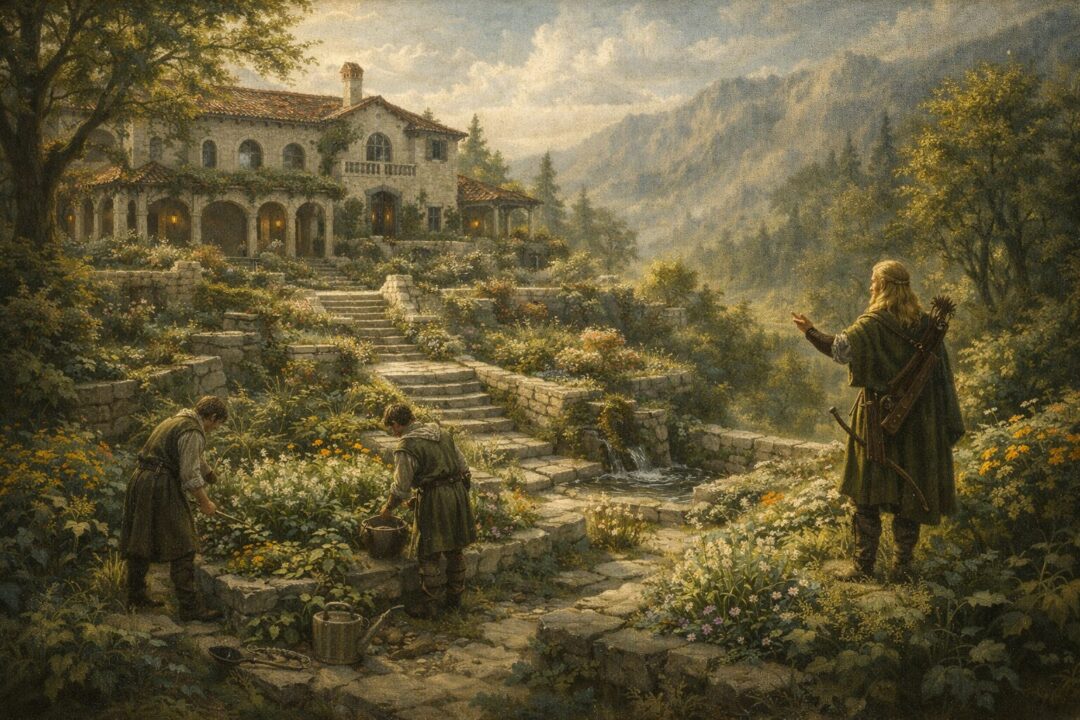
“Legolas founded an Elven realm in Ithilien” is one of those claims that sounds obvious the moment you hear it.
It feels neat. Symmetrical. Almost inevitable.
Gimli becomes lord in the Glittering Caves; Legolas, surely, must become lord somewhere too.
And Ithilien—green, sunlit, once a garden—seems like the perfect place to “start again.”
But the texts are both firmer and stranger than that.
They do tell us Legolas brought Elves into Ithilien after the war. They do tell us those Elves dwelt there. They even tell us the result: Ithilien becomes “once again the fairest country in all the west-lands.”
What the texts do not do is call it a kingdom.
They never give it a formal name, a title, a border, or a ruler’s seat.
So if we want to be lore-accurate, we have to ask a different question:
Not “Did Legolas found a realm?”—but “What kind of Elvish presence can exist in Ithilien after the Ring is destroyed?”
Because that question lands directly on the tension that defines the end of the Third Age:
fade versus renewal.
What the Appendices actually say
The most important statement comes from the post-war summary in the Appendices.
After Sauron’s fall, we are told that Gimli brought part of the Dwarf-folk south and became Lord in Aglarond, doing great works for Gondor and Rohan.
And then comes the matching line:
Legolas “also brought south Elves out of Greenwood, and they dwelt in Ithilien, and it became once again the fairest country in all the west-lands.”
That is not presented as rumor, nor as a legend of later days.
It is presented as a plain record of what followed.
Two things in that sentence deserve to be held carefully.
First: he brought Elves—plural, a movement of people, not a solitary wandering.
Second: they dwelt in Ithilien—not “visited,” not “camped,” not “passed through,” but dwelt.
Even if we refuse every extra layer readers like to add, we still have a real post-war settlement: a Silvan community in Ithilien.
So why do people call it a “realm”?
Because dwelling, in Middle-earth, is often the seed of a realm.
And because we are trained by earlier ages to think in that shape: a people gathers, they name a place, the place becomes theirs.
But the Fourth Age is not earlier ages.
And the texts warn us not to read it as if it were.
The line Legolas speaks that changes the mood
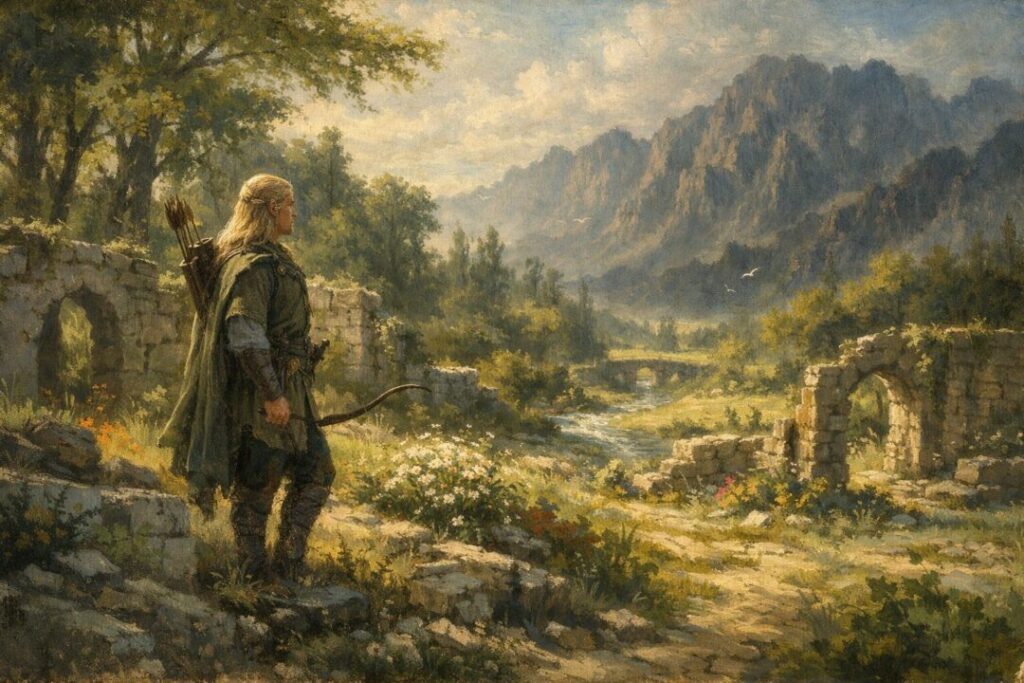
Long before any Elves “dwell” in Ithilien, Legolas stands on the victory field after the war and says something quietly decisive.
He tells the others he will walk in the woods of that fair land, and then adds:
“In days to come, if my Elven-lord allows, some of our folk shall remove hither; and when we come it shall be blessed, for a while.”
And then he presses the knife in deeper:
“For a while: a month, a life, a hundred years of Men.”
This is not a promise of permanence.
It is an Elvish definition of how temporary “renewal” now is.
Even if Ithilien becomes the fairest country again, Legolas speaks as if the blessing is timed.
Not because the land will fail.
But because the age is turning.
This is the difference between an Elven realm in the old sense—and an Elven dwelling in the new world.
A realm implies continuation.
A dwelling “for a while” implies something like a last flowering.
Why Ithilien matters as a test case
Ithilien is not just anywhere.
It is the borderland that most clearly shows what Sauron’s shadow did to a living place.
Before the war, it is described as fair, full of herbs and flowers, and yet constantly hunted: Rangers moving like ghosts, fires kept small, the land half-abandoned because survival is expensive.
After the war, Ithilien becomes the question of Gondor’s future in miniature.
Can a land be healed after it has been a battlefield?
Can a border become a garden again?
A king can decree peace.
He can rebuild Minas Tirith.
He can restore towers and roads.
But Ithilien is something else: it is growth. It is patient tending. It is time.
And that is exactly the kind of work the Elves are always associated with—especially the Silvan Elves, whose cultures are bound to woods, leaves, and living things rather than stone cities.
So when the Appendices place Legolas and Elves from Greenwood in Ithilien, it reads like deliberate thematic placement:
The new King rules the Age of Men.
But the “fairest country” is restored by those whose whole history is bound up with making the living world beautiful.
And it is restored without fanfare.
Almost as if the text wants you to notice that rebuilding is not only walls.
Was it “a realm”? What we can and can’t claim
If we keep strict claim-control, we have to say this:
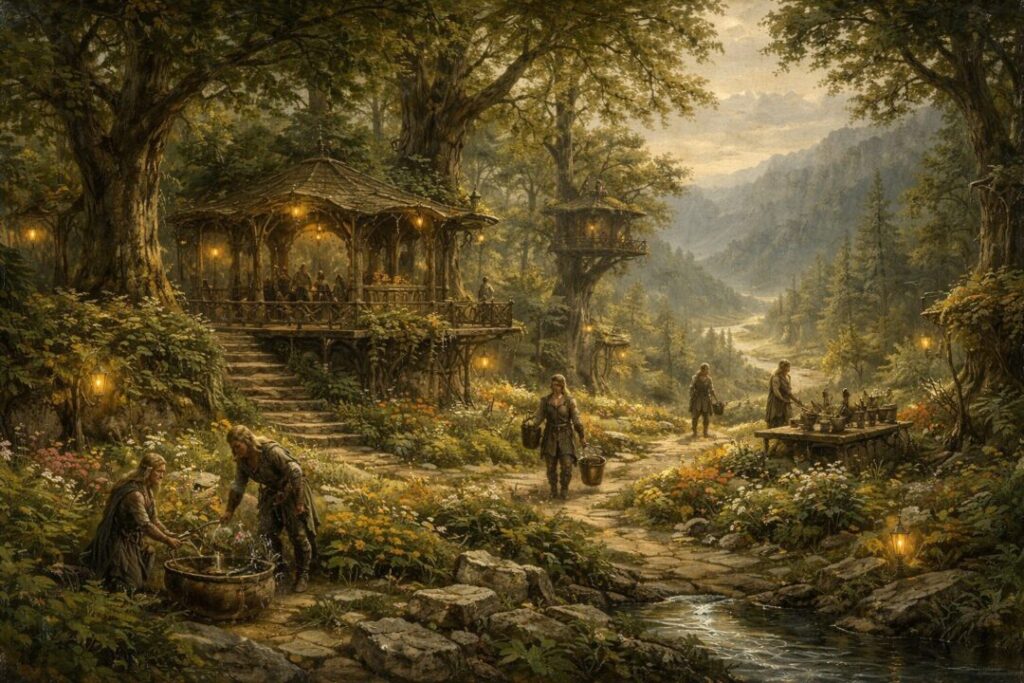
The texts confirm a post-war Elvish dwelling in Ithilien led by Legolas.
They do not explicitly confirm an independent Elven kingdom or realm.
No crown.
No named dominion.
No formal separation from Gondor.
In fact, everything around it points the other way.
Ithilien, after the war, is part of the Reunited Kingdom. Faramir is made Prince of Ithilien, and he and Éowyn dwell in Emyn Arnen.
And there is a further domestic detail preserved in the post-war notes: the gardens of that house were “devised by the Elf Legolas,” and they became renowned.
That matters because it situates Legolas’s work inside the restored order of Gondor, not outside it.
He is not described founding a rival seat of power.
He is described beautifying the life that is being rebuilt there.
So “realm” is likely too strong—unless one uses it loosely to mean “a place where Elves lived together.”
If someone means “an Elven kingdom like Lórien,” the texts do not support that.
If someone means “a settled Elvish community with its own ways,” the texts very likely do.
But the most interesting point is not political.
It is temporal.
Fade versus renewal: what Legolas’s Ithilien really represents
By the end of the Third Age, the Elves are leaving because the conditions that sustained their long “holding back” of time are ending.
The Rings lose their power. The great preservations fade.
So we are tempted to imagine only one motion: departure.
Legolas complicates that.
He does depart—eventually. The record later says that after King Elessar’s death, Legolas builds a grey ship in Ithilien and sails down Anduin and over Sea, and with him, it is said, goes Gimli.
But before that final leaving, he chooses something else:
A period of making Ithilien fair again.
That is not a reversal of fading.
It is a kind of grace given to Men while the Elves are still present.
A last transfer of craft, care, and memory into the world that will outlast them.
And the text frames it exactly that way: blessed “for a while.”
This is why the Ithilien dwelling is so loaded.
It is renewal—real, tangible renewal—happening at the very moment the Elves are also fading from the world.
Not eternal renewal.
Not the return of an Elven age.
But a final flowering that makes the new age less barren.
If you want an image for it, it isn’t a throne-room.
It’s a restored wood-path.
A place that used to be hunted ground, now quiet enough to plant.
And an Elf walking there, knowing he will not walk there forever.
So what should we say?
If you want the most accurate phrasing the texts allow, it’s something like this:
After the War of the Ring, Legolas led a group of Silvan Elves from Greenwood to dwell in Ithilien, helping to make it fair again; but the record does not describe this as an independent Elven realm, and Legolas himself frames the blessing as temporary—measured in the lifetimes of Men.
That is less catchy than “he founded a realm.”
But it is more revealing.
Because it shows the real post-war shape of Middle-earth:
The King’s peace holds.
The land heals.
Beauty returns.
And yet the ones most skilled at making that beauty are already halfway gone—working not to preserve their own dominion, but to leave something living behind.
And if you read Legolas’s “for a while” the way it asks to be read, the Ithilien dwelling becomes not a triumphant new beginning…
…but one of the most bittersweet renewals in the entire legendarium.
Sources & Notes
- J.R.R. Tolkien, The Lord of the Rings, Appendix A, “Durin’s Folk” — records that Legolas brought Elves south from Greenwood to dwell in Ithilien, making it again the fairest country in the west-lands.
- J.R.R. Tolkien, The Lord of the Rings, Book VI, Chapter 5, “The Steward and the King” — Legolas’s own hope that Elves would remove to Ithilien, and his “for a while” wording, frames the renewal as temporary.
- J.R.R. Tolkien, The Lord of the Rings, Book VI, Chapter 5, “The Steward and the King” — Aragorn makes Faramir Prince of Ithilien, supporting the article’s caution that Legolas’s settlement is not described as an independent Elven kingdom.
- J.R.R. Tolkien, The Lord of the Rings, Appendix B, “The Tale of Years” (Later Events) — after Elessar’s death, Legolas builds a grey ship in Ithilien and sails over Sea, with Gimli said to go with him.