Elrond is one of the few living bridges between ages.
In the Third Age he appears to many readers as a lord of counsel—grave, gentle, almost still—presiding over songs, lore, and a hidden house in a cleft of the mountains. But the texts do not allow you to mistake him for someone untouched by war.
Elrond himself reminds the Council of what he has done and seen.
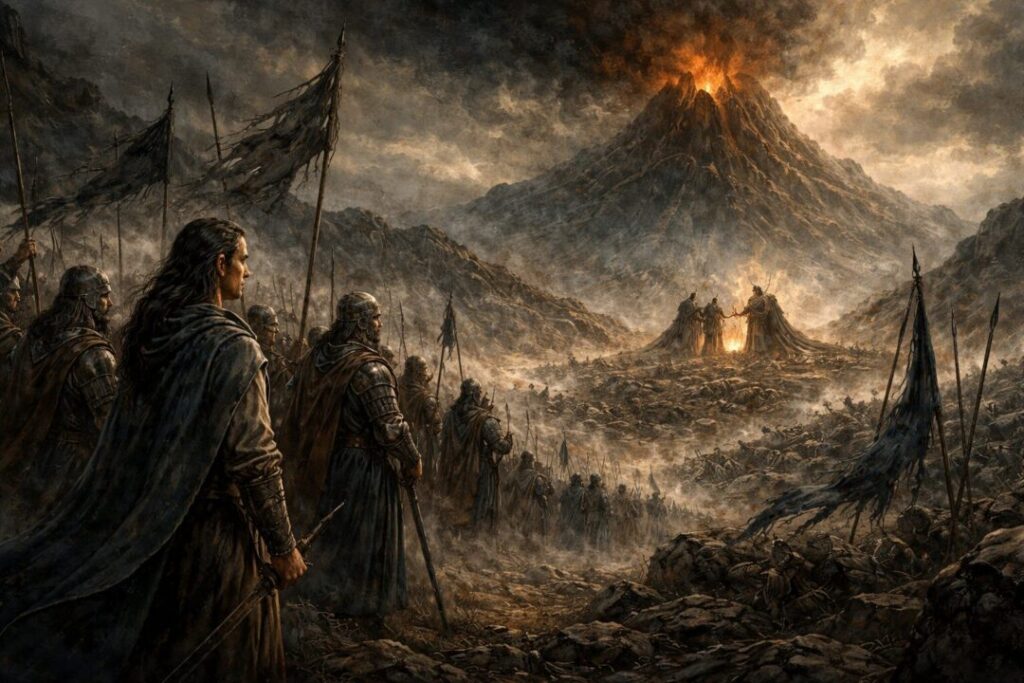
He does not speak in legend. He speaks as a man might speak who has outlived too many banners: “many defeats, and many fruitless victories.” Then he names the war that should have been the last of wars. He was the herald of Gil-galad. He marched with the host. He was at Dagorlad. And he “beheld the last combat on the slopes of Orodruin,” where Gil-galad died and Elendil fell, and Sauron was overthrown.
That is the context for the question.
If Elrond stood so near the end of the Second Age—if he saw the hinge of history with his own eyes—why does he not then become the great battlefield commander of the Third?
The simplest answer is also the most unsatisfying: the narrative rarely shows him doing it.
But the deeper answer is that the narrative is showing something else instead: a different kind of leadership, designed for a world in which victory is never clean—and survival itself becomes a duty.
Elrond after Orodruin: what the text actually says
When readers imagine “the leaders of the Last Alliance,” they often picture Elrond among them in the same way as Gil-galad and Elendil.
Yet Elrond’s own phrasing is careful. He identifies himself first as herald—an office of honor, closeness, and trust—rather than as king. And when the final combat comes, he does not claim to have fought Sauron hand to hand. He says he beheld it.
He was present. He was close. The words suggest witness at the heart of catastrophe—not the central duel itself.
And this matters, because it sets the pattern for his later life.
Elrond is not written as a figure who must always be the spearpoint. He is written as a figure who remains when spearpoints break.
Which raises a second question.
What does it mean, in Middle-earth, to remain?
Rivendell was built for war—and for what war leaves behind
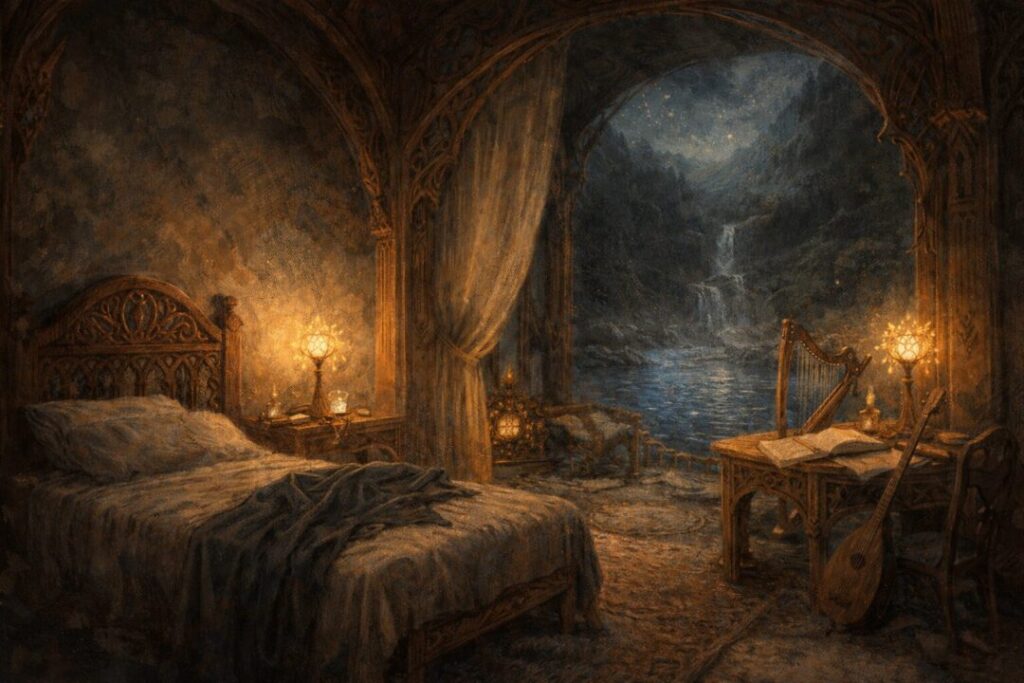
Rivendell (Imladris) is not introduced as a pleasant retreat invented for comfort.
Its origin is martial and urgent: it was established amid the War of the Elves and Sauron, as a refuge when Eregion was laid waste and Elrond’s people withdrew into a hidden valley.
That founding context changes how you read everything that comes after.
Rivendell is not a palace placed in a peaceful land. It is an outpost designed to survive when the West collapses—close to the passes of the Misty Mountains, hidden, defensible, and capable of sheltering what cannot be replaced.
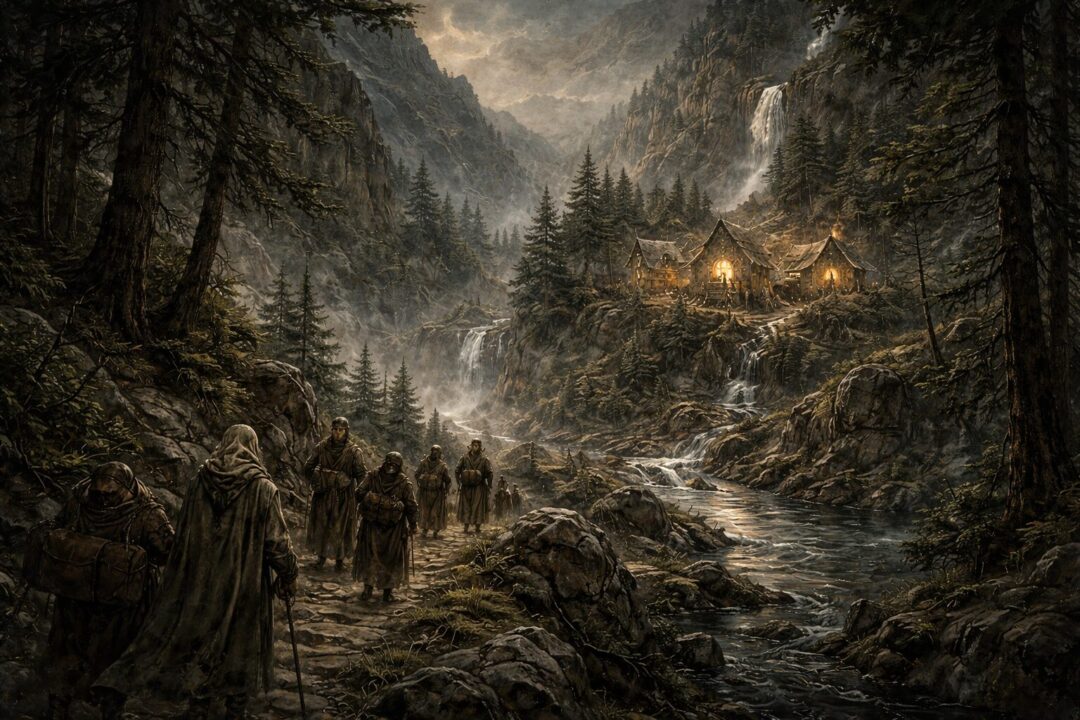
And in The Fellowship of the Ring, when Frodo finally arrives there, the narration does not emphasize towers or armies. It emphasizes relief:
“Merely to be there was a cure for weariness, fear and sadness… Evil things did not come into that valley.”
That is not a decorative description. It is a statement of function.
Rivendell is a place made to resist certain kinds of darkness—not only the kind that rides openly with banners, but the kind that follows defeat home and turns survivors into ruins.
If that is what Rivendell is for, then Elrond’s role begins to come into focus.
The weariness is not laziness—it is the long defeat
Elrond does not say, “I grew tired of fighting.”
He does say something more revealing: “many defeats, and many fruitless victories.”
A “fruitless victory” is one of the most painful phrases in the legendarium. It implies battles won that do not heal the world—wars that end, only for the same shadow to return in another shape, in another century, under another name.
That is the texture of Elvish experience in the later ages. The Elves do not merely risk death; they risk diminishing meaning. They can hold a line today and still watch tomorrow rot from within.
So when we speak of Elrond’s “weariness,” we have to be careful.
The texts support the idea that he has seen enough to know that defeating an enemy is not the same thing as restoring what was broken. But they do not present him as resigned or inert. He is active—just not always in the way readers expect.
His activity is the work of keeping something intact long enough for it to matter.
Custodianship: the war you fight by preserving
In the Third Age, Elrond is repeatedly connected to preservation.
Not preservation as clinging, but preservation as stewardship: the guarding of memory, healing, lineage, and counsel—things that cannot be reforged once shattered.
Rivendell is even named from the traveler’s perspective as the “Last Homely House” on one side of the wild. That is a threshold-image: beyond it, the world grows harsher, less ordered, more easily lost.
And inside it, decisions are made that move the entire age.
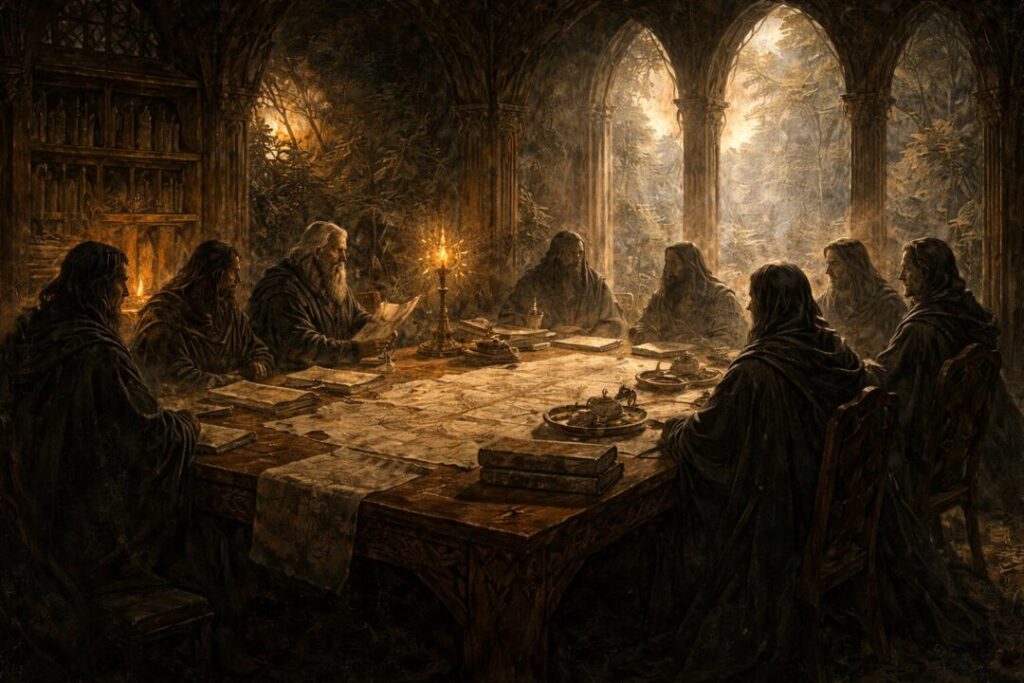
The Council that forms the Fellowship happens in Elrond’s house. The knowledge that clarifies what the Ring is and what must be done is spoken there.
If you measure leadership only by who rides at the front of an army, you miss what the story is actually doing.
Elrond leads by being the place where the war is understood.
And understanding, in Middle-earth, is not academic. It is survival.
Elrond still acts—just rarely as a battlefield centerpiece
It would be wrong to claim Elrond “never” participates in the conflicts of the Third Age. Even summary lore sources note that he fought against the Witch-king of Angmar and served in the White Council’s struggle against Sauron’s return.
But the primary narrative still tends to frame him as the one who sends, shelters, advises, heals—rather than the one whose personal blade is highlighted in the climactic charge.
That difference is not a demotion.
It’s a specialization.
In a world where Elves are fading, where their numbers in Middle-earth do not increase, and where every loss is permanent, the wise leader may not be the one most often risked at the front.
The texts never spell this out as a military policy. But they repeatedly show Elrond as too valuable to be squandered—and Rivendell as too central to be left without its keeper.
Why Rivendell needs its lord more than the battlefield does
Rivendell is not simply Elrond’s home. It is a strategic hinge between worlds.
It sits near the passes; it is close enough to the wild to be useful, and hidden enough to endure. It holds lore that cannot be recovered if it burns. It provides refuge to the hunted and the wounded.
And it holds something else: continuity.
One of the most significant “acts” Elrond performs in the late Third Age is not a battle at all, but guardianship over what the West will become when the Age of Elves ends.
If a king must return, if old lines must not fail, if hope must be kept alive through long generations of darkness—then someone has to keep that hope from being hunted down and extinguished.
The story repeatedly treats Elrond as that someone.
Not because he is unwilling to fight—but because his role is to make fighting meaningful.
The quiet logic behind Elrond’s absence from banners
So why didn’t Elrond personally lead more war efforts after the Last Alliance?
Because Middle-earth did not need him to be another spear.
It needed him to be a refuge that could not be conquered by ordinary means: a place where evil could not easily enter, where weariness could be cured, where counsel could be gathered, and where the long thread of the West could be kept unbroken.
And because Elrond himself seems to understand something the eager do not: that wars can be won and still be “fruitless,” unless someone preserves what is worth winning for.
In the end, Elrond’s story is not the story of a warrior who stopped fighting.
It is the story of a witness of Orodruin who chose, afterward, to fight a different battle—the one that lasts for thousands of years, and is almost invisible unless you know where to look.
And once you see that, you can’t help wondering:
If Rivendell is the answer… what, exactly, was Elrond guarding there that the Enemy could not be allowed to reach?
Sources & Notes
- J.R.R. Tolkien, The Lord of the Rings, Book II, Chapter 2, “The Council of Elrond” — Elrond identifies himself as Gil-galad’s herald, recalls Dagorlad and Orodruin, and gives the “many defeats and many fruitless victories” frame for his long memory of war.
- J.R.R. Tolkien, The Lord of the Rings, Book II, Chapter 1, “Many Meetings” — presents Rivendell as a healing refuge where weariness, fear, and sadness are relieved and where evil things do not enter the valley.
- J.R.R. Tolkien, The Silmarillion, “Of the Rings of Power and the Third Age” — describes Sauron’s war in Eriador, Eregion’s ruin, and Elrond’s establishment of Imladris as a stronghold and refuge.
- J.R.R. Tolkien, The Lord of the Rings, Appendix B, “The Tale of Years” — places Elrond in the Last Alliance and later records the White Council and the assault on Dol Guldur, supporting his continuing but mostly strategic role in the Third Age.
- J.R.R. Tolkien, The Lord of the Rings, Appendix A, “The Númenórean Kings” — shows Rivendell preserving the heirs of Isildur, especially Aragorn, making Elrond’s guardianship part of the survival of the West rather than a withdrawal from it.