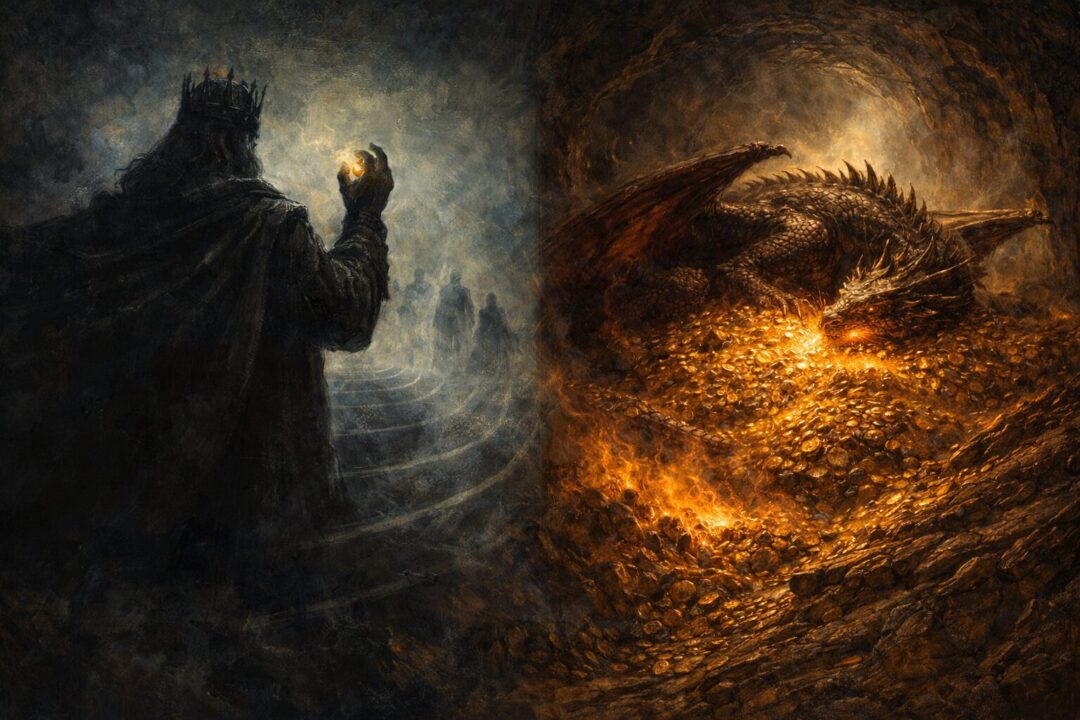
There is a strange sentence buried in the Ring-lore that can feel almost tossed off—until you notice what it implies.
In the histories of the Second and Third Ages, we are told that the Dwarf-lords once possessed Seven Rings. Sauron recovered three. The rest, Gandalf says, the dragons consumed.
That one word—consumed—is the spark behind a question readers keep returning to:
If Rings can change the fate of peoples, why don’t dragons wield them?
Why don’t they wear them, claim them, master them, and become something like living Dark Lords—great beasts with the power of domination added to their fire?
It’s a fair question, because Middle-earth trains you to fear objects that store will. The Ring is not just jewelry. It is power made portable. It can remake a person from the inside out.
So if a dragon has a Ring—especially one of the Seven—why does the story not turn into an age of Ring-wearing wyrms?
The answer begins with a more basic point: the texts never show a dragon using a Ring at all.
They show dragons doing something else—something very dragon-like.
They take hoards.
They brood on treasure for long years.
They steal gold and jewels “from men and elves and dwarves,” guard it for practically forever, and “never enjoy a brass ring of it.” That last line matters: dragons are not portrayed as connoisseurs of craft or as builders of civilizations. They are possessors. Weight, glitter, and ownership are the point.
Rings, on the other hand, are not made for possession.
They are made for use—and specifically for a kind of use dragons don’t seem interested in.
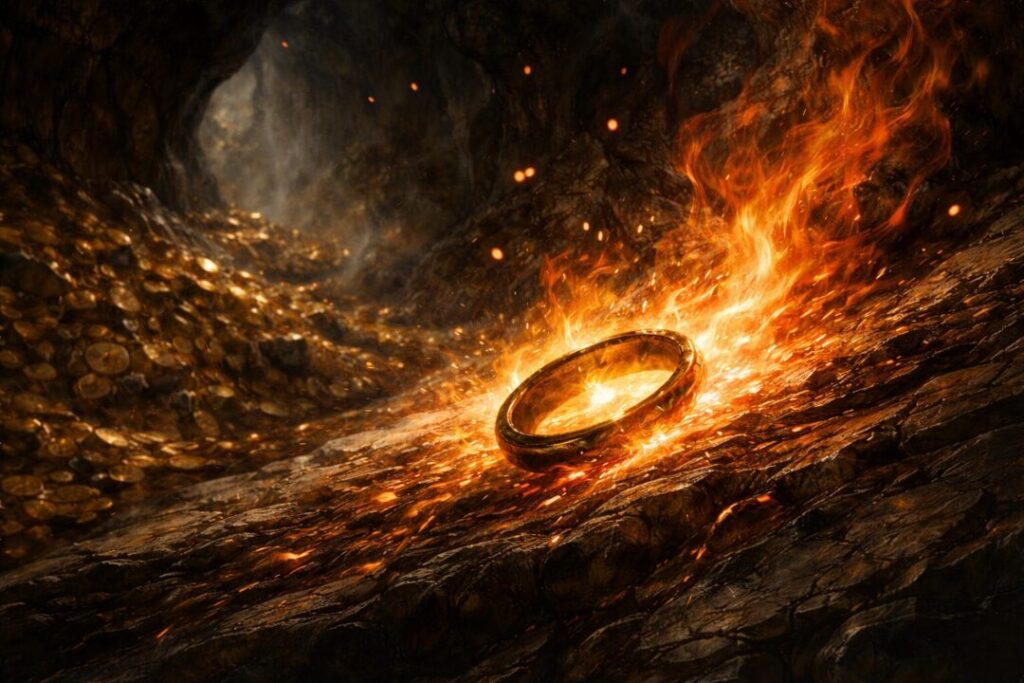
What Rings are actually “for”
When readers think “Ring power,” they often think “raw strength.”
But the Great Rings are repeatedly described as instruments bound up with dominion, influence, and the bending of other wills. Even when they grant invisibility or extend life, those effects are tangled with a deeper theme: power that changes the bearer, and power that reaches outward.
This is easiest to see with Men.
The Nine do not merely make their wearers harder to kill. They pull them into a long process of fading, until they become Ringwraiths—shadows under a greater Shadow.
That is the central horror of Rings for Men: not that they gain power, but that they become owned by it.
Now set that beside the most “practical” dragon behavior we are given.
Dragons do not seek to rule in the way Sauron rules. They do not gather subjects. They do not build systems of control. They do not cultivate kingdoms and demand oaths.
They terrify. They burn. They take.
They are closer to catastrophes with hunger than to kings with policies.
That difference matters, because Rings are political and spiritual tools, not simply upgrades.
And the kind of creature that benefits most from a Ring is the kind that wants to extend its will through networks of other wills: courts, armies, councils, fear that spreads by rumor, obedience that becomes habit.
Men can do that. Elves can do that. Dwarves can do that, in their own way.
Dragons—at least as the texts portray them—do not.
The Seven: wealth, hoards, and unintended consequences
The Seven are especially relevant here, because they do not work on Dwarves the way the Nine work on Men.
In the Ring-lore, Dwarves are described as “tough and hard to tame,” unable to be turned into shadows. Their Rings do not make them wraiths. Instead, the Rings inflame what is already there: wrath and an overmastering greed of gold.
And then comes one of the most revealing lines about how the Seven echo outward into history:
It is said that the foundation of each of the Seven Hoards of the Dwarf-kings of old was a golden ring.
That statement does two things at once.
It tells you how the Seven “worked” in practice—by accelerating wealth, concentrating treasure, deepening hoards.
And it also hints at why dragons enter the story at all.
Because in Middle-earth, a hoard is a beacon.
Smaug does not come to Erebor because he senses abstract evil. He comes because the Mountain becomes full of armor, jewels, cups, carvings—because wealth piles up until it becomes irresistible to something built to desire it.
This is the core pattern:
- A Ring contributes to the making of a hoard.
- A hoard attracts a dragon.
- A dragon takes the hoard.
So when we’re told the dragons consumed Rings, the text is showing you a collision between two different kinds of “treasure logic.”
Dwarves use Rings to get wealth. Dragons use wealth to… have wealth.
And that is already the answer to part of the question: a dragon does not need a Ring to become a dragon.
A dragon’s power is already expressed in the very thing the Seven produce: hoarded gold, gathered and guarded, heavy and useless except as proof of possession.
To a dragon, a Ring that generates hoarding is almost redundant. It’s like giving a storm permission to be windy.
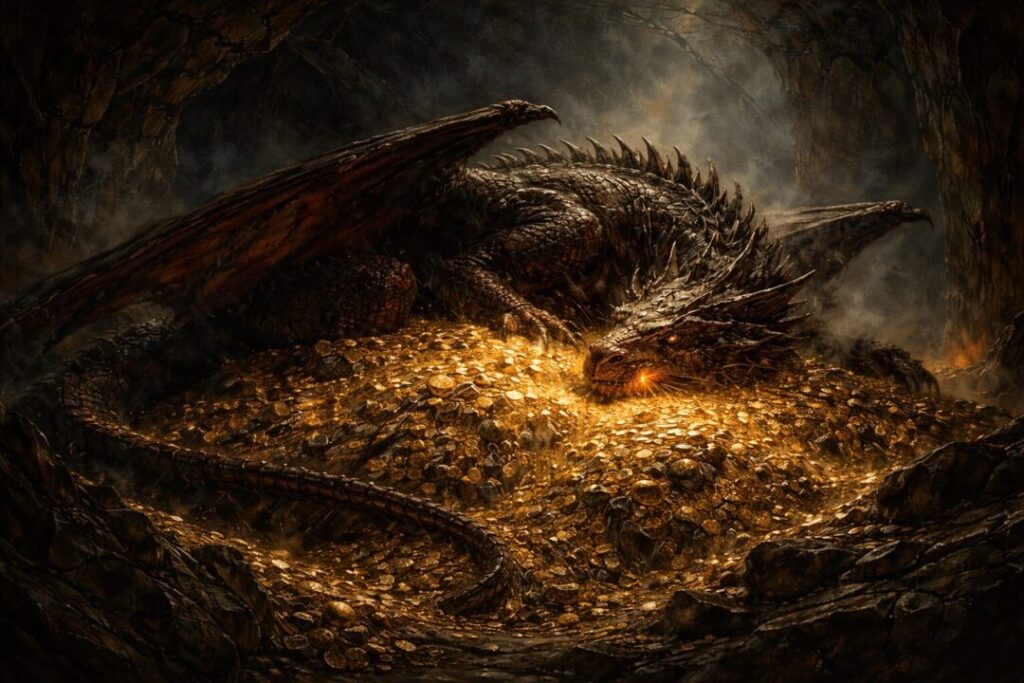
What does it mean that dragons “consumed” Rings?
Here we have to be careful, because the texts do not give us a detailed scene of a dragon chewing a Ring like a crust of bread.
We are given two related ideas:
- That “the others the dragons have consumed.”
- That dragon-fire has been said to “melt and consume the Rings of Power,” though no dragon—“not even Ancalagon the Black”—could have harmed the One Ring.
Those lines establish a hierarchy:
- The One Ring is uniquely resistant, bound to Sauron’s making in a way no other Ring is.
- Other Rings of Power are at least vulnerable in principle to dragon-fire.
So “consumed” can plausibly mean destruction by heat—melted down, burned away, ruined beyond recovery.
It can also mean something simpler and darker: that the Rings were lost inside a dragon’s hoard and never seen again, functionally “consumed” by the hoard itself.
The texts do not force us to choose a single mechanical explanation. They do not describe a recovered half-melted Dwarf-ring. They do not show a dragon coughing one up.
What they do show is the result:
Those Rings are gone.
Not inherited. Not wielded. Not turned into visible tyrannies.
Just removed from history the way dragons remove things from history—by burying them under a mountain of ownership, or by burning them into nothing.
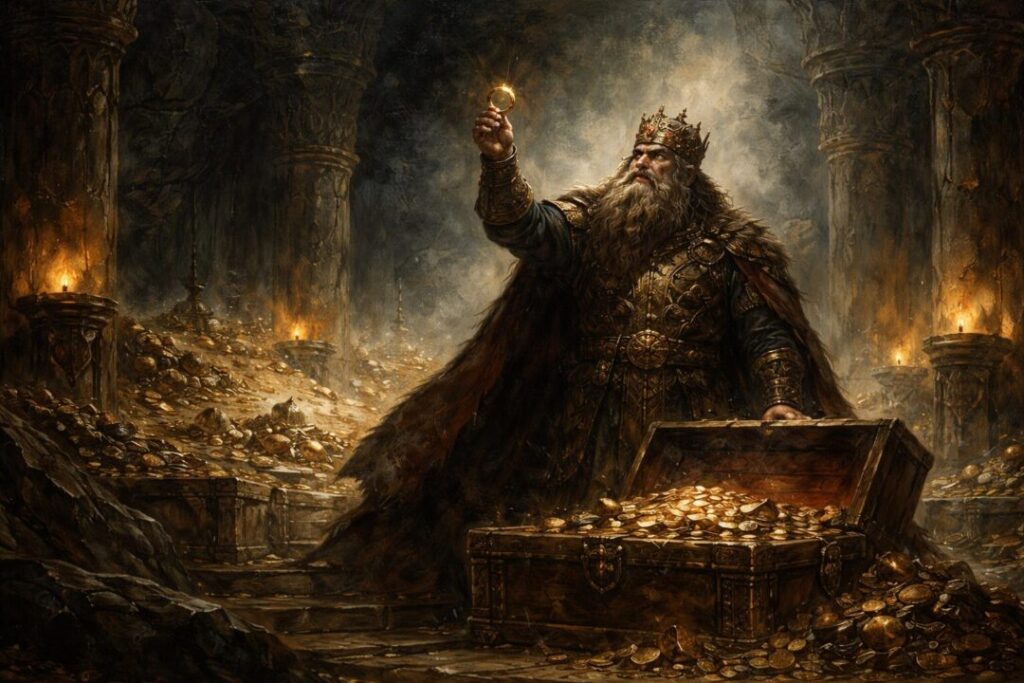
Why dragons don’t wield Rings like Men
Now we can return to the original fan question with a clearer lens.
“Why didn’t dragons use Rings the way Men did?”
Because Men “use” Rings in a particular way: as instruments of extension—power reaching through time, through societies, through the invisible world.
Men are susceptible to the Ring’s slow promises: longer life, hidden movement, increased presence, a sense of rightness in domination.
Dragons don’t need longer life in the same narrative way; they already persist as terrors across ages. They don’t need invisibility; their power is spectacle. They don’t need to govern other wills; they govern space by fear and flame.
Most of all, Men can be turned into servants. The Nine show that clearly.
Dragons, in the texts, are not shown entering that kind of servitude to another will through an artifact. They are shown serving Morgoth as bred weapons in the First Age, yes—but that is a different kind of relationship, and the stories don’t present it as “Ring-style” corruption.
So if you imagine a dragon with a Ring, you’re imagining a creature that would want what a Ring is best at: influence, domination, long-range control.
But the dragons we meet are not strategists of empires.
They are lords of hoards.
And here is the quiet irony the lore is offering:
A Ring is meant to be worn—used—turned outward.
A dragon hoard turns everything inward.
Rings are tools. Hoards are graves for tools.
That is why “consumed” feels so fitting.
A dragon does not transform a Ring into a new era.
It transforms a Ring into treasure—just another piece of swallowed history under the weight of gold.
And that may be the most unsettling part: dragons don’t need to “use” Rings to do damage.
They only need to do what they always do—take what others made for power, and bury it so deep that power never gets the chance to act.
Which means the real danger of dragons in Ring-lore is not that they become Ring-lords…
It’s that they can erase Ring-lords from the board without even meaning to.
Sources & Notes
- J.R.R. Tolkien, The Lord of the Rings, Book I, Chapter 2, “The Shadow of the Past” — Gandalf says the Seven are mostly lost because Sauron recovered some and dragons “consumed” the rest, and explains that dragon-fire could melt Rings of Power but not the One Ring.
- J.R.R. Tolkien, The Lord of the Rings, Appendix A, “Durin’s Folk” — describes the Seven Rings among the Dwarves: they did not make Dwarves wraiths, but inflamed wrath and greed and helped found the great hoards that drew disaster.
- J.R.R. Tolkien, The Silmarillion, “Of the Rings of Power and the Third Age” — gives the larger pattern of Sauron’s Rings, the Nine enslaving Men, and the Seven failing to dominate Dwarves in the same way.
- J.R.R. Tolkien, The Hobbit, Chapter 1, “An Unexpected Party,” and Chapters 12–14 — presents dragons as hoard-takers and hoard-keepers, with Smaug as the clearest example of possessive dragon treasure-lust rather than political Ring-rule.
- J.R.R. Tolkien, The Letters of J.R.R. Tolkien, Letter 131 — frames Sauron’s Ring-project as a technology of domination and control, useful background for contrasting Ring-lordship with dragon hoarding.