The departure of the Elves is often remembered as a single closing scene: white ships, grey water, a fading song.
But The Lord of the Rings never frames the end of the Elves as one clean exit. It frames it as a long unmaking—measured in choices, delays, and a kind of slow consequence that Middle-earth lays upon immortals who remain.
So when readers ask, “Where did the Elves go if they never sailed West?” they’re usually asking two different questions at once:
- Which Elves actually stayed behind?
- What happens to an Elf who stays in Middle-earth into the Dominion of Men?
The texts answer both—carefully, and not always in the places people expect.
The first misunderstanding: “the Elves” were never one group
Even before the Third Age ends, “the Elves” are not a single unified people moving with a single will.
In the earliest history, there are Elves who begin the Great Journey toward the West—and Elves who refuse it. In Tolkien’s terminology, those who refused the summons are the Avari, “the Unwilling.” The narrative does not follow their kingdoms with the same detail it gives the Noldor and Sindar, but the category matters because it proves something essential:
From the beginning, not all Elves were destined to sail.
Some Elves were always going to remain in Middle-earth, far from the Sea, far from the Havens, far from the great turning points that later histories center.
And that makes the later question sharper. Because the Elves who stay at the end of the Third Age aren’t only the ones who missed the boats.
Some are choosing a path as old as Cuiviénen: the path of remaining.
The second misunderstanding: “staying” doesn’t mean “nothing happens”
If an Elf refuses the Sea, the lore does not say they simply continue as before.
Galadriel, in The Fellowship of the Ring, gives the clearest statement of the dilemma. She tells Frodo that if the Quest succeeds, Lothlórien will fade, and then she names the two options: “We must depart into the West, or dwindle to a rustic folk of dell and cave, slowly to forget and to be forgotten.”
That line is one of the most important “end of the Elves” passages in the entire legendarium, because it does three things at once:
- It makes departure a choice, not an instant inevitability.
- It describes an alternative future—dwindling—for those who do not depart.
- It shows that the fading of Elven realms is tied to the loss of the preservative power that held back time.
So “where did they go?” is not mainly a geography question.
It’s a fate question.
Who are the Elves most likely to have stayed?
The texts don’t give us a census. They do, however, give us categories—patterns of belonging.
1) The Avari and the far East
The Avari are the oldest answer to the question. They are, by definition, Elves who did not go West in the first place. The published narratives do not trace what becomes of every Avarin people in later Ages. What they do establish is that not all Elves were ever part of the Westward movement, and not all Elven history ends at the Grey Havens.
If some Elves remained in regions beyond the familiar maps of the War of the Ring, that would not contradict anything in the texts. It’s simply territory Tolkien chose not to narrate in detail.
This is one of the rare cases where silence is itself meaningful: Middle-earth is larger than the stories we’re told.
2) Silvan and Sindarin Elves rooted in Middle-earth
The Elves most clearly shown as “at home” in Middle-earth are not the High-elves of the West, but the woodland peoples—those of Greenwood, Lórien, and other forest-realms.
They are not described as ignorant of the Sea. They are described as attached to their lands.
This matters because the end of the Third Age does not erase that attachment. Even when the Three Rings lose their power, the love of place does not vanish overnight.
So it is reasonable—within the text’s own logic—to imagine many of these Elves leaving slowly, over time, or lingering in diminished communities.
But “reasonable” is not the same as “explicit.” The safest phrasing is this: the story shows some Elves departing soon after the Ring’s destruction, and also describes a lingering alternative—dwindling—for those who remain.
3) The “Exiles” in the strict sense: Noldor who remained long after the First Age
When people say “exiled Elves,” they often mean the Noldor who left Aman after the rebellion and returned to Middle-earth.
The end of the First Age includes a pardon and an invitation to return for those who will accept it; many do, and the great Noldorin presence in Middle-earth begins to ebb. The late First Age and Second Age already contain the pattern we see at the end of the Third: some depart, some remain.
And that remaining is often tied to unfinished purposes, pride, grief, or simply an unwillingness to abandon the Hither Lands.
Here the texts get complicated, because different late writings give different emphases for individual motivations (Galadriel’s are the famous example). But you do not need to pin every motive down to see the larger truth: the Exiles did not all return at once, and some remained in Middle-earth far longer than the First Age’s ending.
What actually happens to Elves who remain?
This is where the lore becomes quietly relentless.
The legendarium describes a process often called “fading.” One of the clearest explanations appears in Tolkien’s later writings on the nature of Elves: over immense time, the Elvish spirit (fëa) increasingly “consumes” the body (hröa), until the body becomes more like a memory of habitation than a substantial physical thing—so that Elves become, in effect, invisible to ordinary mortal eyes.
That is not presented as a sudden curse that strikes in a year.
It’s presented as a slow law of being in a world that changes, wears, and moves toward an Age not made for them.
And this is exactly why the end of the Third Age feels like an ending even without a final battle:
The victory over Sauron does not restore the world to a state where the Elves can keep their realms “unstained” by time.
It releases time.
“Dwindle” is not the same as “die”
Galadriel’s phrase is sometimes misread as a poetic way of saying the Elves will die out.
But Tolkien’s metaphysics is more precise than that.
Elves can be slain, and their spirits do not simply vanish. The lore describes their spirits as enduring, and their fate is tied to Mandos rather than to the Gift of Men. (The full complexities are explored in the writings that discuss Elvish death and the severance of spirit and body.)
“Dwindling,” on the other hand, is about what happens without violent death: the diminishing of visible presence, the retreat from open history, the slow loss of power to shape the world in ways mortals can see.
So when you ask where they went, one honest answer is:
Many did not “go” anywhere at all. They remained—until remaining turned them into something the Fourth Age no longer noticed.
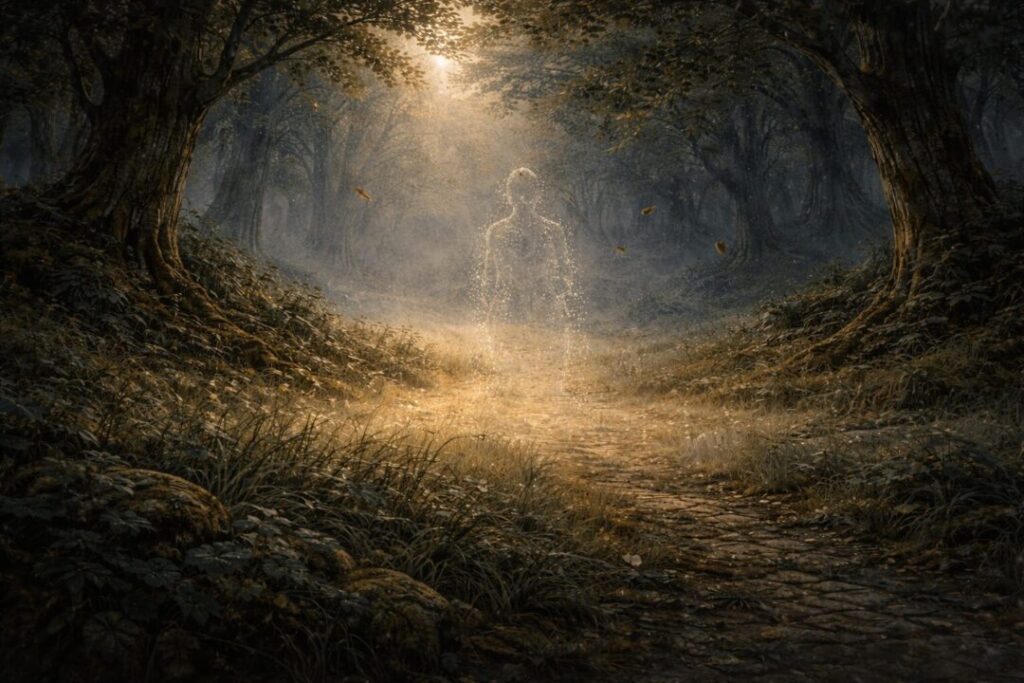
The last thing the texts will let us say with confidence
The Lord of the Rings is very clear that the Third Age ends not only with Sauron’s fall, but with the passing away of the Three Rings and the closing of the Eldar’s tales in Middle-earth.
That sentence is easy to glide past. But it’s doing heavy work.
It doesn’t say every Elf is gone.
It says their Tales draw to their close.
That is the true shape of the transition into the Dominion of Men: not a world emptied in a single season, but a world where the immortal peoples no longer remain publicly present in the same way—either because they sailed, or because they dwindled into secrecy and memory.
So where did they go?
If you want an answer that is faithful to the texts and not built on invention, it looks like this:
- Some Elves sailed West, quickly after the War of the Ring, and others later.
- Some Elves likely lingered in Middle-earth for a time—especially among woodland peoples—because the text explicitly names “dwindling” as an alternative to departure.
- Some Elves had never been part of the Westward movement at all (the Avari), and their later history is largely outside the narrative focus.
- For those who remained long enough, the lore’s trajectory is fading: a diminishing of physical presence and of visible power in the mortal world.
And that is why the mystery keeps returning.
Because the end of the Elves is not framed as a clear evacuation. It’s framed as something more haunting:
A world that still contains them, in theory but no longer contains them in the way stories need.
And once you see that, the Grey Havens stop being the only “door” out of Middle-earth.
They become the only door we can still watch.
Sources & Notes
- J.R.R. Tolkien, The Silmarillion, “Of the Coming of the Elves and the Captivity of Melkor” — the summons to Aman and the Avari, the Elves who refused the westward journey.
- J.R.R. Tolkien, The Lord of the Rings, Book II, Chapter 7, “The Mirror of Galadriel” — Galadriel’s warning that Lórien must either depart into the West or “dwindle” and be forgotten.
- J.R.R. Tolkien, The Lord of the Rings, Book VI, Chapter 9, “The Grey Havens” — the Ring-bearers and the Keepers of the Three sail, marking the visible passing of the Eldar from Middle-earth.
- J.R.R. Tolkien, The Lord of the Rings, Appendix B, “The Tale of Years” — the Third Age ends, the Three Rings pass away, and the Dominion of Men begins.
- J.R.R. Tolkien, Morgoth’s Ring, “Laws and Customs among the Eldar” — Tolkien’s late account of Elvish fading, as the fëa increasingly consumes the hröa over long ages.