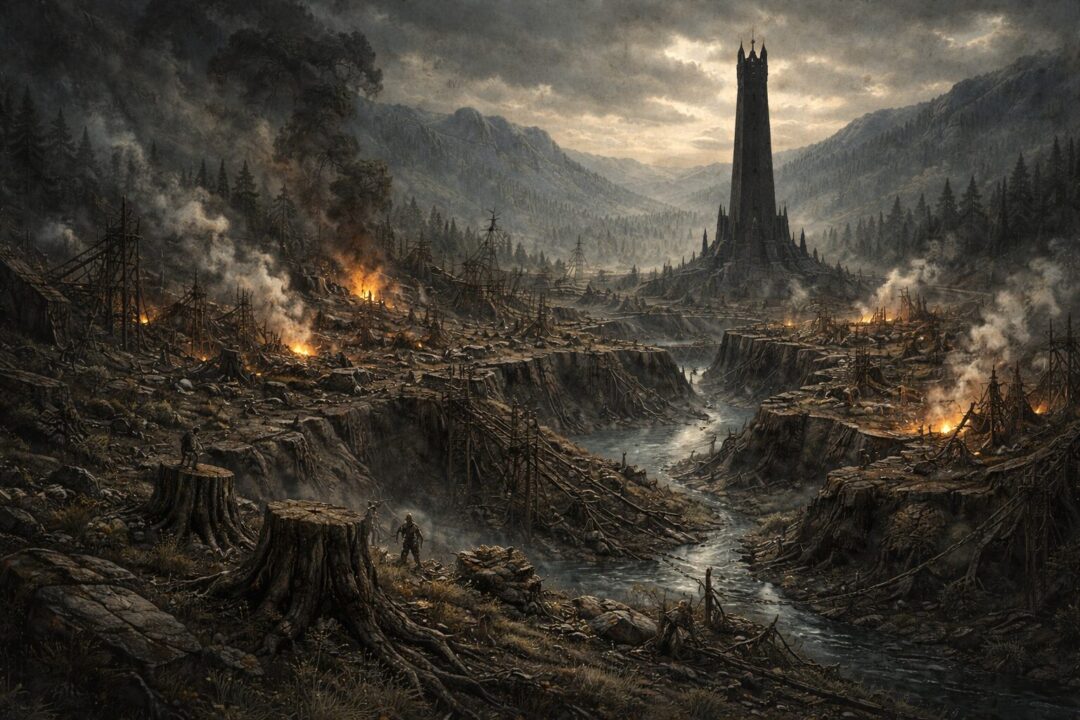
Isengard is easy to remember as a villain’s fortress.
A ring of stone. A black tower. A white hand on a gate. An ugly place that deserved to be broken.
And then the Ents broke it.
They tore down the Ring-wall, wrecked Saruman’s works, and flooded the pits and tunnels where the smoke of his industry had risen.
So the War ends, and many readers assume the matter ends with it: Isengard is destroyed; Saruman is defeated; the story moves on.
But the text doesn’t treat it as finished.
Because one thing remains untouched.
Orthanc stands.
And Orthanc forces a different kind of question—one Middle-earth asks again and again, in quieter ways than battle.
When evil has been beaten, what do you do with what it built?
The problem Orthanc creates
The Ents can ruin Isengard, but they cannot break Orthanc. The stone is too hard for them to damage.
That detail matters, because it means the War leaves behind something rare: a hostile stronghold still structurally perfect.
And Orthanc is not a minor tower. It is the center of the old fortress of Isengard, set in the Wizard’s Vale (Nan Curunír), placed at the northwestern edge of Rohan near the Gap—an approach route between regions that have already proven vulnerable to invasion and raiding. The story does not pause to give a military lecture, but the geography is obvious enough: whoever controls Orthanc controls a hard point in the west.
So the end of Saruman’s rule doesn’t erase the usefulness of the place.
It only raises the stakes of deciding what happens next.
The keys, and the first decision
When the Company returns north late in the year, they do not find a wasteland.
They find a garden.
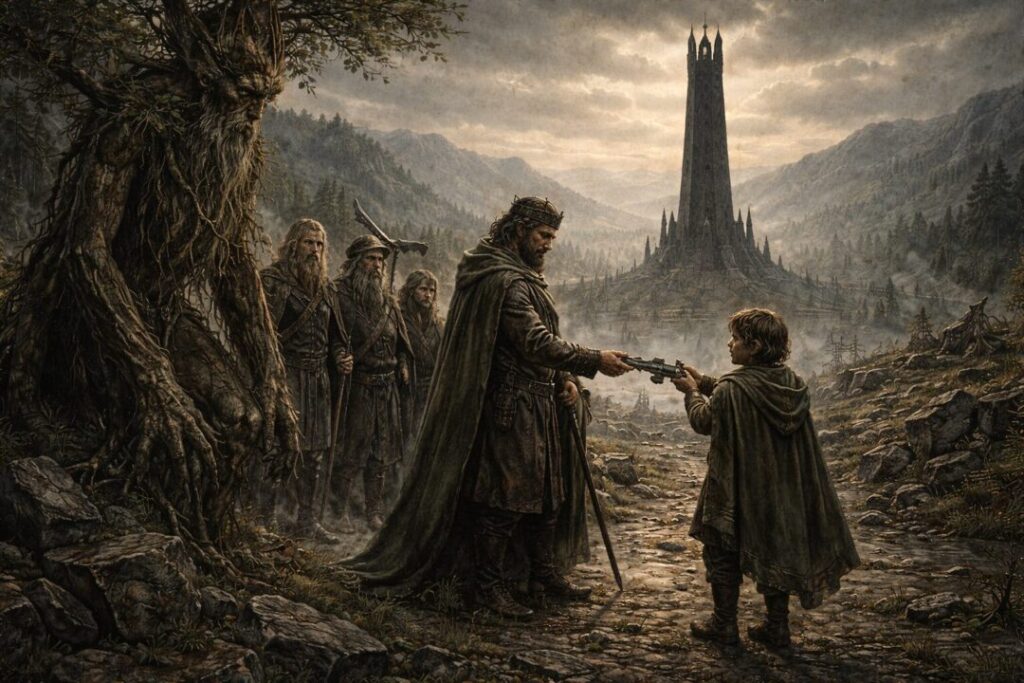
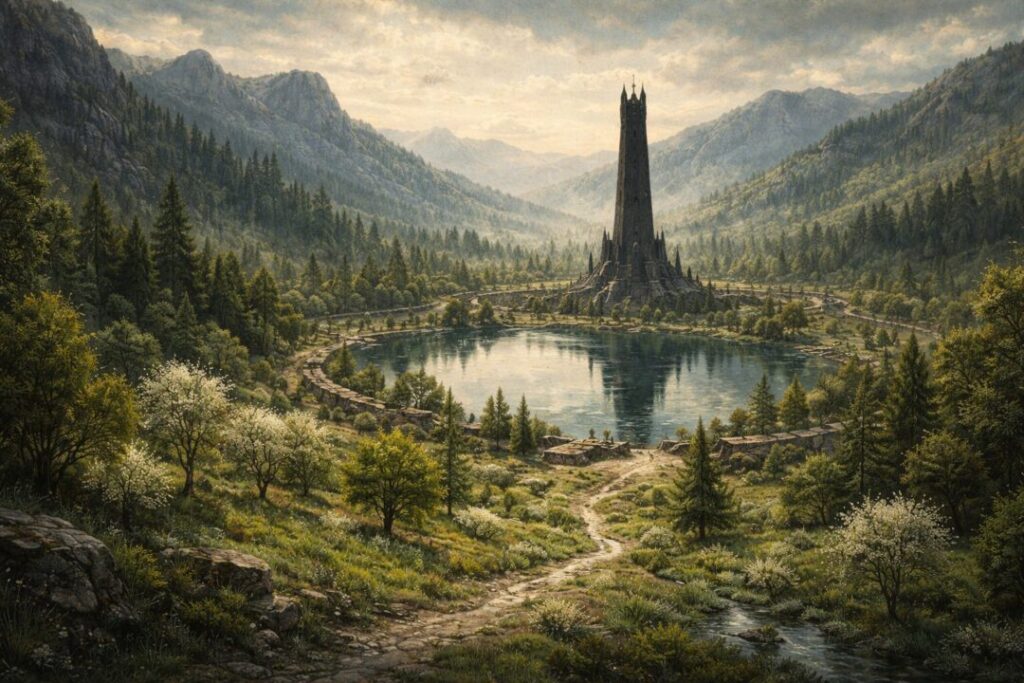
Treebeard greets them with the words: “Welcome to the Treegarth of Orthanc!” The ring has been thrown down; a lake lies where the pits were; and trees stand again in the valley.
This is the first clue to what “after the War” really means for Isengard: it is not simply abandoned. It is actively remade.
But Saruman is gone.
Treebeard admits he let Saruman and Wormtongue depart—because he hates keeping living things caged.
And here the text gives you something extremely specific: before Saruman was allowed to leave, Treebeard made him lock Orthanc and surrender the keys.
This is not merely symbolic.
It is a transfer of control.
The tower is now closed, and Saruman no longer holds the means to open it.
Then Aragorn makes his first formal move: he grants the valley—Nan Curunír—to Treebeard and the Ents, but sets a strict condition about the tower. In the retellings and references that point back to the chapter, the command is consistent: keep Orthanc locked; do not let people enter.
So what happens to Isengard after the War?
The answer begins with a division.
- The land becomes the Ents’ realm to govern.
- The tower returns to the King’s authority—but is kept closed.
That split is the core of Aragorn’s policy.
He does not treat Isengard as a prize to occupy in the usual way.
He treats it as a place that must be healed and contained.
Why give the valley to the Ents?
The Ents do not want a stone fortress. They want living things.
And Isengard, under Saruman, was the opposite of that: trees felled, earth gouged, smoke rising from machinery and furnaces.
The Treegarth is a reversal.
It is the valley reclaimed by growth—orchards, trees, water, and the slow work of making a scar into a garden.
Aragorn’s grant recognizes that the Ents are not simply allies who helped in war. They are, uniquely, the people most suited to undo what Saruman did to the land.
And it keeps that work local.
Instead of sending Gondor’s soldiers and administrators to manage the ruin of Isengard, the King acknowledges the Ents’ claim to reshape it—under their own governance.
That decision also removes a temptation.
A ruined industrial complex is full of salvage: metal, stone, old stores, half-collapsed tunnels. It invites the wrong kind of curiosity—especially in a world where many people have just learned how close power and machinery can sit together.
By making the valley an Entish realm, Aragorn effectively places the place of Saruman’s industry under the care of creatures who are least likely to imitate it.
Why keep Orthanc?
If the valley is healed, why not dismantle the tower?
Because the tower is not merely Saruman’s.
Orthanc predates him. It is older than his betrayal and sturdier than his voice. In the War, Saruman uses it as a prison and as a seat of power, but the tower itself is not described as his creation. Its stone is famously unyielding.
So Orthanc becomes something else after the War: not a villain’s trophy, but an artifact of the West that has been misused.
And the text supports that shift by showing what happens next.
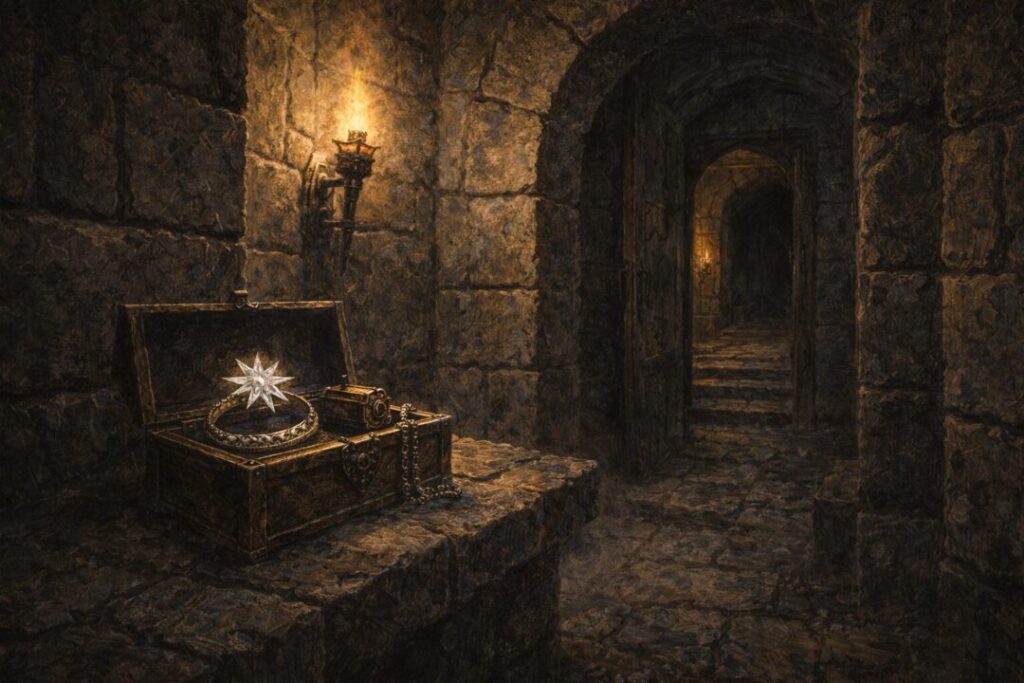
In the Fourth Age, one of King Elessar’s early tasks is the restoration of Orthanc, including returning the palantír recovered from Saruman to the tower. Then the tower is searched, and “many secrets” are revealed—hoarded items and hidden things Saruman kept within.
The most important discovery is not a weapon.
It is a pair of heirlooms: a small golden case on a chain that had once held the One Ring, and the Elendilmir—the white star of crystal on a fillet of mithril—long lost since Isildur’s death.
The implication drawn in the same cluster of references is grim but carefully phrased: Saruman had found relics connected to Isildur, and the search suggests he had been prying into the past as part of his hunt for the Ring.
So Orthanc is not empty.
It is a vault of history—some of it noble, some of it disturbing.
That is another reason the tower cannot simply be ignored or left to rumor. If the King is restoring the realm, he must restore the custody of its past as well.
Orthanc becomes, in this sense, a recovered stronghold: brought back under lawful authority, cleared, searched, and put in order.
But it is still treated with caution.
It was a seat of corruption once. It held a seeing-stone. It was the place from which Saruman’s voice reached outward to bend others. Even after the War, it remains a reminder that the danger is not only armies—it is access.
A tower like Orthanc is safest when it is watched, locked, and understood.
And that is exactly the arrangement Aragorn creates.
Isengard as a strategic asset—without repeating Saruman
If you look at the decisions together, a pattern emerges.
Aragorn does three things at once:
- He prevents Orthanc from becoming a vacuum.
A power-center left empty in a contested region invites the next ambitious claimant. Returning Orthanc to the authority of the Reunited Kingdom avoids that. - He prevents Orthanc from becoming a temptation.
By ordering it kept locked and controlling access, he refuses the idea that every fortress must be immediately used. - He ensures the valley heals in the opposite direction of Saruman’s rule.
Giving the land to the Ents makes Isengard’s future visibly unlike its recent past: a living forest around a silent tower.
That combination is what makes the outcome so unusual.
Isengard becomes both contained and redeemed.
It is not simply “rebuilt.” It is not simply “punished.” It is re-ordered.
And Orthanc, the hardest thing in the place, becomes a kind of lesson in stone:
Not everything that was used for evil must be destroyed.
But anything that was used for evil must be guarded.
The quiet ending inside the answer
If you only remember Isengard as Saruman’s workshop of war, the Treegarth can feel like a footnote—an oddly peaceful stop on the road home.
But it is one of the clearest images of what the King’s return actually means.
Not triumph. Not conquest.
A policy.
A boundary.
A refusal to let the world slide back into the same pattern—where power takes a fortress, strips a valley, and calls it progress.
So what did Aragorn do with Isengard after the War?
He did not treat it like an ending.
He treated it like a test—of whether the new age would merely inherit Saruman’s tools, or choose a different shape of strength.
And the most telling detail is this:
The place is no longer named for iron and engines in the way we remember it.
It is remembered as a garden.
The Treegarth of Orthanc.
Sources & Notes
- J.R.R. Tolkien, The Lord of the Rings, Book III, Chapter 10, “The Voice of Saruman” — describes Isengard after the Ents’ assault, the ruin of the Ring-wall, the flooding, and Orthanc’s unbreakable stone.
- J.R.R. Tolkien, The Lord of the Rings, Book VI, Chapter 6, “Many Partings” — Treebeard’s “Treegarth of Orthanc,” Saruman’s departure, and Aragorn’s settlement of Nan Curunír with Orthanc kept under royal authority.
- J.R.R. Tolkien, The Lord of the Rings, Appendix B, “The Tale of Years” — places Isengard and Orthanc within the post-war transition into the Fourth Age and Elessar’s restored kingship.
- J.R.R. Tolkien, Unfinished Tales, “The Disaster of the Gladden Fields,” Appendix: “The Sources of the Legend of Isildur’s Death” — recounts the later search of Orthanc and the recovery of Isildur-related heirlooms there.
- J.R.R. Tolkien, Unfinished Tales, “The Palantíri” — gives the wider history of the Orthanc-stone and why Orthanc’s custody mattered beyond Saruman’s fall.