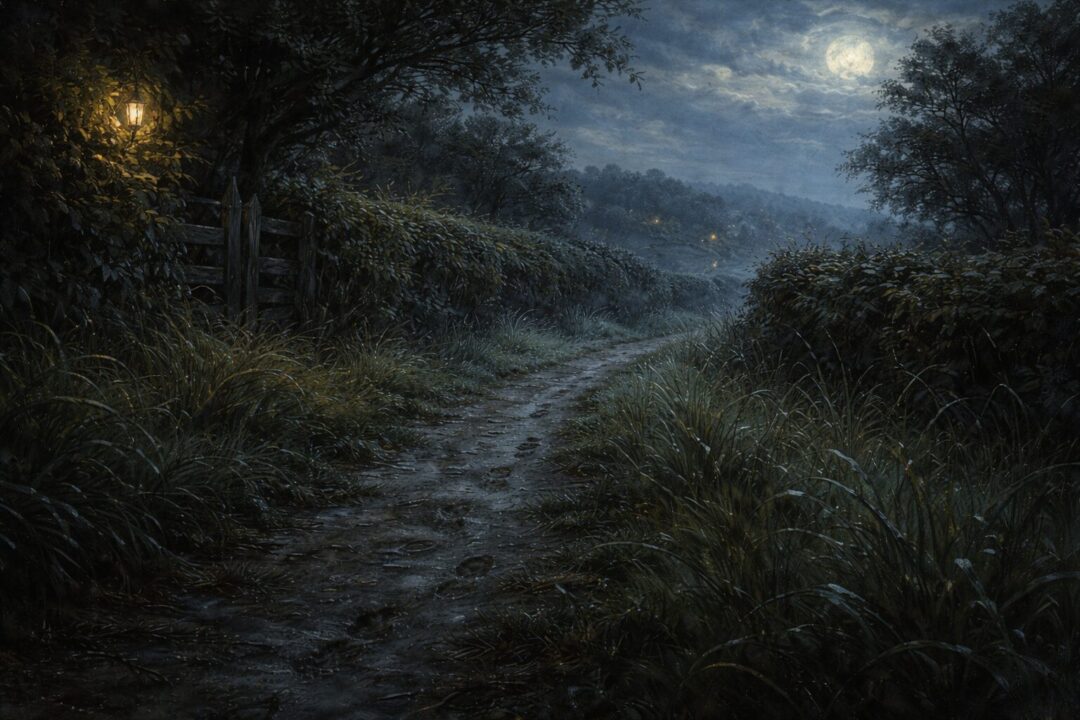
Bilbo Baggins almost doesn’t do it.
That’s the first detail people sand down when they remember the beginning of The Fellowship of the Ring: the version where Bilbo throws a party, makes a joke, leaves a gift, and everything slides neatly into place.
But the book gives you something sharper.
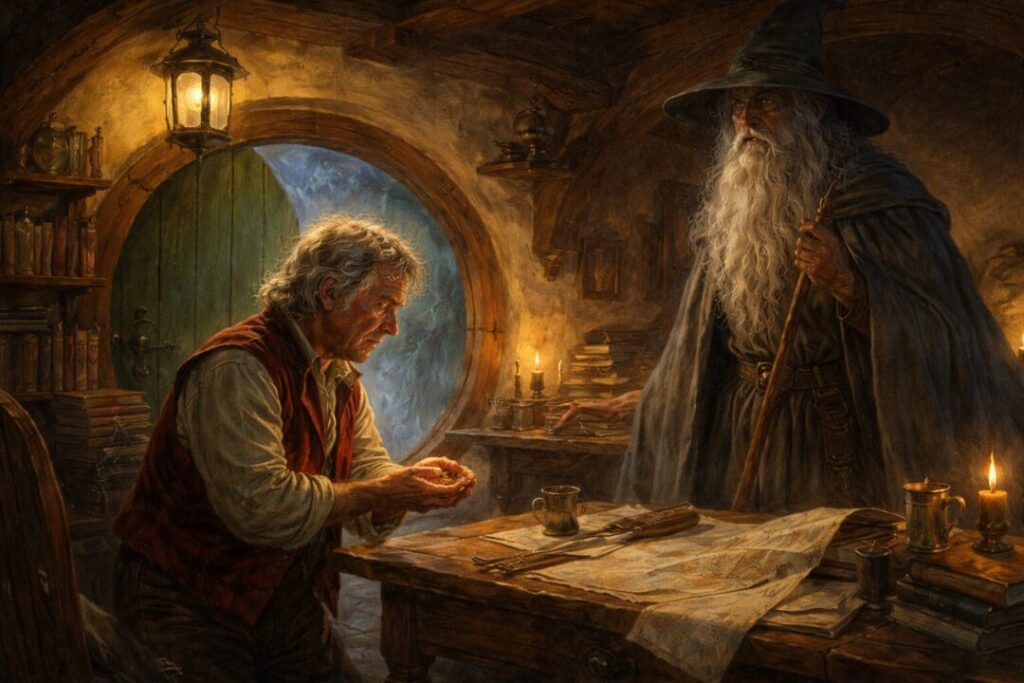
Bilbo’s farewell is not simply a decision. It is a moment of resistance—brief, intimate, and revealing. He calls the Ring “mine.” Then “precious.” And when Gandalf answers, the air changes: this is no longer about property, or sentiment, or even a magic trinket. It is about grip.
Gandalf later describes Rings of Power with a kind of grim clarity: the keeper does not simply abandon such a thing. At most he toys with the thought—early—before it truly begins to hold. And even Bilbo, exceptional as he is, needed help.
So the “what if” here isn’t random. It’s close to the surface of the text.
What if Bilbo refused?
What if, instead of dropping the Ring and walking out into the night, he did the most natural, most dangerous thing a frightened bearer could do?
What if he put it on—
and vanished into the wild?
This is where the community argument tends to split.
One camp says: second Gollum. Same end, different hole.
Another says: no. Bilbo is Bilbo. Something else would happen—something quieter, stranger, maybe even sadder.
The answer the texts allow is not a simple label. But the consequences are there, and they are surprisingly consistent once you keep one rule in mind:
The Ring does not just make you invisible. It makes you thin.
The Ring’s first promise is escape
If Bilbo refuses in Bag End, the immediate temptation is obvious: use the Ring to get away from Gandalf, from the awkwardness, from the “badgering,” from the pressure of letting go.
In other words: to escape.
And the Ring is excellent at that.
It gives concealment. It gives distance. It lets a small person slip past bigger wills—at least for a time.
But Gandalf’s description of the price is explicit: a mortal who keeps one of the Great Rings does not gain more life; he merely continues, until weariness becomes minute-by-minute. And if he often uses the Ring to become invisible, he fades—becoming permanently unseen, walking in the twilight under the Dark Power that rules the Rings.
That’s the hidden trap inside the “vanish into the wild” scenario.
The wild is not neutral ground. The Ring turns “hiding” into a direction of travel: away from ordinary life, toward the Unseen.
So if Bilbo runs, the question becomes less “where would he go?” and more:
how often would fear make him use it again?
Because the more he relies on it, the less he returns.
The Ring does not love solitude—but it uses it
There’s another quiet rule Gandalf states later, and it matters here.
The Ring “looks after itself.” It may slip off treacherously. The keeper does not simply throw it away. And crucially: it was not Gollum who decided to lose it—“the Ring itself… decided things. The Ring left him.”
That does not mean the Ring is a person with plans in the modern sense. The text doesn’t require you to imagine conscious conversation or elaborate strategy.
But it does require you to treat it as active in a limited, terrifying way: it moves toward being found, toward being used, toward returning to the power that made it.
So if Bilbo vanishes into the wild with the Ring, one possibility is immediate and bleak:
The Ring may not cooperate with long-term hiding.
Not because it can hop out of his pocket at will whenever it likes—but because it creates the conditions that lead to exposure: dependence, risk, repeated use, and eventually the thinning that makes a bearer easier prey for darker senses.
That’s the part the “something else” camp sometimes misses.
Yes, Bilbo is gentler than Sméagol. Yes, he has pity in him, and the narrative treats that moral difference as real weight.
But the Ring’s effect is not only moral. It is also metaphysical.
It wears you down.
And a worn-down bearer is not safe just because he is kind.
Would Bilbo become “a second Gollum”?
Not quickly.
That’s the most text-faithful correction to the common fear.
Gollum’s relationship with the Ring is defined by obsessive possession over centuries, by isolation, and by the Ring’s imprint on a life already narrowed into hunger and secrecy. Bilbo’s history is different: he lived openly for decades, used the Ring sparingly, remained capable of friendship, jokes, gifts, and departure—difficult as it was.
So if Bilbo runs into the wild, it is unlikely—at first—to look like a mirror-image of Gollum in the Misty Mountains.
But the texts also show something else: Bilbo is not immune to the Ring’s hunger.
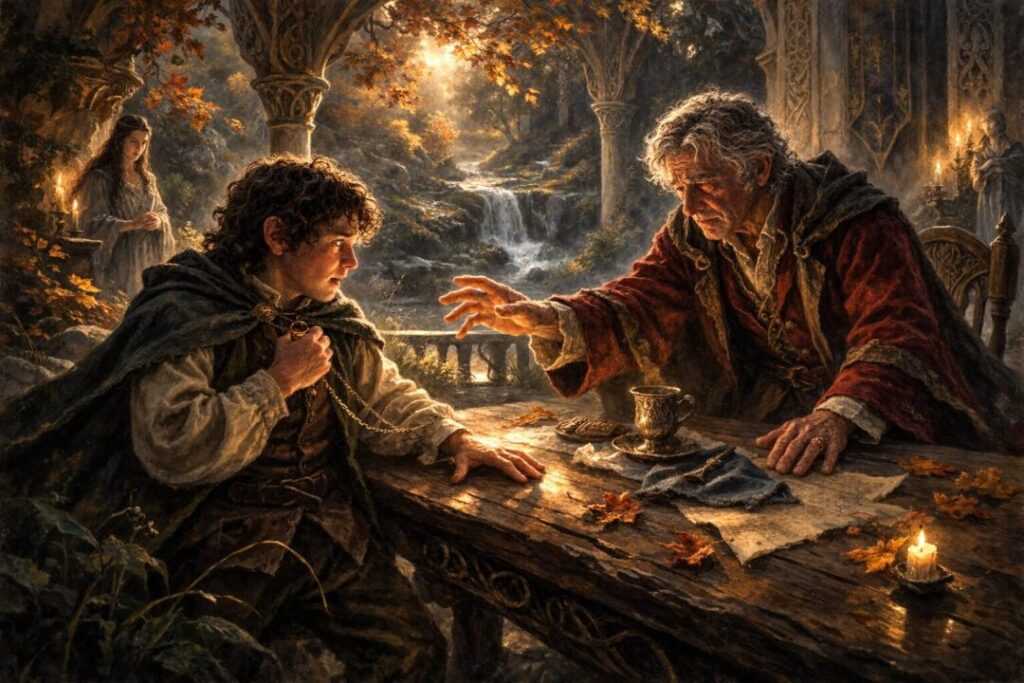
In Rivendell, long after he has surrendered it, he asks Frodo to see it “for a moment.” Frodo draws it out. Bilbo reaches—then Frodo suddenly perceives “a little wrinkled creature with a hungry face and bony groping hands,” and feels a shock of violent impulse. The moment passes, but it is there, and it is meant to disturb you.
That scene does not prove Bilbo would become Gollum.
But it does prove the Ring can still produce the shape of Gollum-like hunger in him—instantly—when the object is present.
So the honest answer is this:
Bilbo might not become a second Gollum in outward behavior right away…
but the trajectory is the same kind of slope.
A slower descent is still a descent.
What changes if Bilbo disappears before handing it to Frodo?
Here the story becomes structurally dangerous.
Because the handover to Frodo is not just a convenient inheritance. It is the hinge that allows the Ring to leave Bilbo’s private life and enter the larger currents of the War.
If Bilbo runs, several consequences follow naturally from what the text establishes—without needing invented events.
1) Gandalf’s alarm becomes immediate pursuit.
Gandalf’s reaction in Bag End is not casual curiosity. He is “startled and indeed alarmed” when Bilbo speaks the Ring’s possessive language.
If Bilbo vanished with the Ring in that moment, Gandalf would treat it as a crisis, not a family quarrel.
We cannot claim a specific chase route (the book doesn’t give one), but we can say with confidence that Gandalf would not shrug and wait for letters. The Ring is too dangerous, and Bilbo too vulnerable to it.
2) The Shire becomes unsafe sooner in a different way.
A Ring-bearer who disappears creates stories. Rumors. Movement. And movement attracts attention—even without Nazgûl on the road yet.
The text emphasizes that the Ring’s history is defined by being found in unlikely ways. A vanishing hobbit is exactly the kind of unlikely disturbance that can ripple outward.
3) The Ring’s “wild” phase becomes a pressure-cooker.
This is the part that matters most for the “second Gollum vs something else” question.
If Bilbo is alone, frightened, and relying on invisibility, he will use the Ring more often. And Gandalf’s rule about fading is not gradual folklore; it is stated as the end of repeated use.
So Bilbo’s refuge becomes the mechanism of his undoing.
Not because the wild corrupts him morally—but because it makes the Ring his only tool.
The likeliest end is not dramatic. It is diminished.
Readers often imagine this scenario ending in a confrontation: Bilbo versus Nazgûl, or Bilbo versus some great threat, or Bilbo marching invisibly into legend.
But the text points toward something quieter.
A mortal who “merely continues” does not become more heroic. He becomes more tired. Weariness becomes constant. The world narrows.
And if Bilbo often uses the Ring to hide, he fades into the twilight where the Dark Power can see.
That last line matters because it suggests the most chilling possibility of all:
Bilbo does not need to be “caught” in a cinematic sense to be lost.
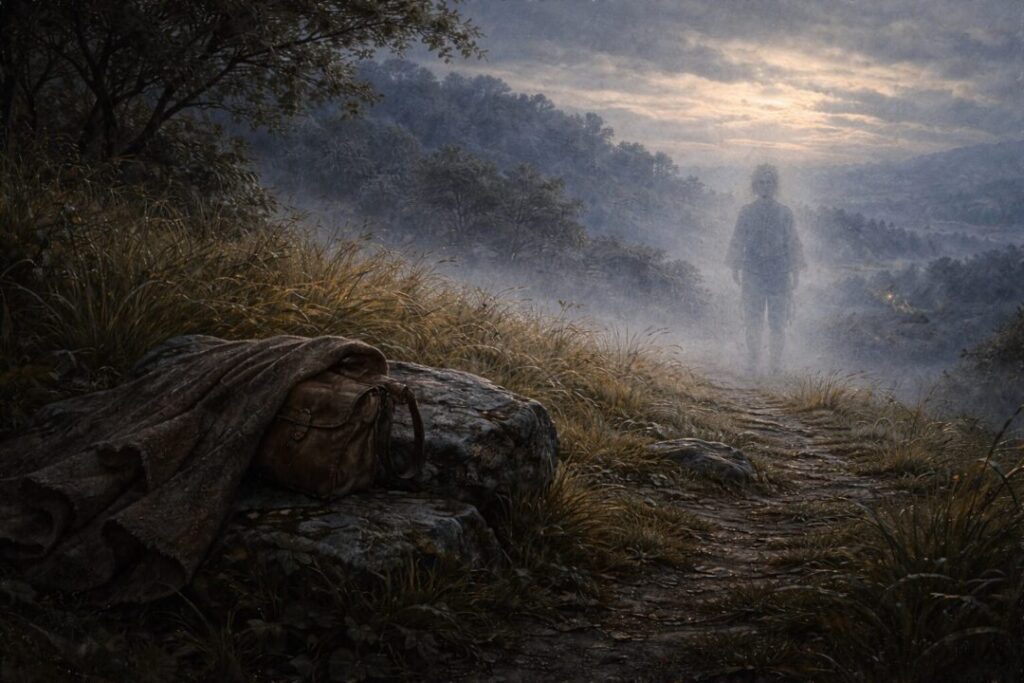
He can be lost while still walking.
He can be lost while still breathing.
He can become a creature who avoids daylight, avoids voices, avoids touch—because the Ring has trained him into a life where everything except the Ring feels like threat.
That is not exactly “a second Gollum.”
It is, in some ways, worse—because it could happen while parts of Bilbo remain gentle enough to feel the tragedy of it.
So… second Gollum, or something else?
If you want the most text-faithful answer, it’s this:
Bilbo would not become Gollum overnight.
His temperament and history strongly suggest a slower, less violent outward decline.
But the Ring’s rules do not allow a stable middle state forever.
If Bilbo refuses to give it up and vanishes into the wild, the texts point to three outcomes—each consistent with what Gandalf says:
- Increasing dependence (more use, more fear, more secrecy)
- Increasing thinning (fading into the Unseen)
- Increasing vulnerability to the Dark Power that rules the Rings
That arc doesn’t require Bilbo to become murderous or cruel to end badly.
It only requires him to keep choosing the Ring as his escape.
And that is the one choice Gandalf is trying to prevent in Bag End—because once the Ring becomes the answer to fear, it stops being something you carry…
and becomes something that carries you.
Which means the real question is not whether Bilbo becomes “another Gollum.”
It is whether Middle-earth ever gets the chance to put the Ring into anyone else’s hands at all.
Because if Bilbo disappears with it—frightened, fading, and alone—then the story’s most unlikely mercy might never happen:
not the finding of the Ring but the surrender of it.
Sources & Notes
- J.R.R. Tolkien, The Lord of the Rings, Book I, Chapter 1, “A Long-expected Party” — Bilbo’s possessive language around the Ring and Gandalf’s intervention at Bag End.
- J.R.R. Tolkien, The Lord of the Rings, Book I, Chapter 2, “The Shadow of the Past” — Gandalf explains that a mortal bearer who keeps and uses a Great Ring is stretched, wearied, and may fade into the Unseen.
- J.R.R. Tolkien, The Lord of the Rings, Book I, Chapter 2, “The Shadow of the Past” — the Ring is said to “look after itself,” and Gandalf frames Gollum’s loss of it as the Ring leaving him.
- J.R.R. Tolkien, The Lord of the Rings, Book II, Chapter 1, “Many Meetings” — Bilbo’s brief desire to see the Ring again appears to Frodo as a sudden, Gollum-like hunger.
- J.R.R. Tolkien, The Hobbit, Chapter 5, “Riddles in the Dark” — Bilbo’s encounter with Gollum establishes both the Ring’s use for escape and Bilbo’s crucial pity toward its former bearer.