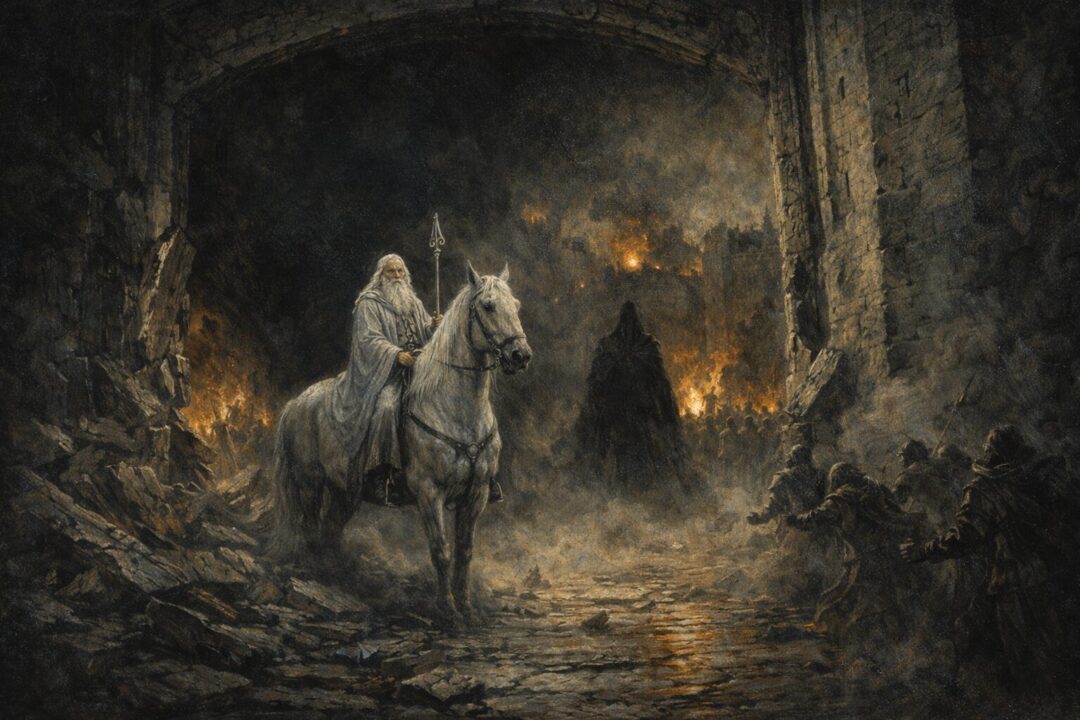
The “spell” on the Gate of Minas Tirith is one of those details that almost everyone remembers—yet very few people remember it from the text.
Most of us remember it as a single decisive act: a dark lord of sorcery speaks, the Gate explodes, the City is breached.
But in The Return of the King, the writing is more careful than that. It gives you power in the scene—real power—but it does not give you a tidy explanation of how that power works. It gives you something else: phrasing that sounds like certainty until you notice what it actually says.
And that difference matters, because it changes what you’re allowed to claim as fact.
The easy mix-up: a “spell” that looks like a special effect
When people say “the spell on the Gate,” they often mean a visible, cinematic event: a clear magical blast that destroys the doors.
The book does give you lightning. It does give you a word of “spell.” And it does give you a figure whose entire presence is terror.
But it does not present a clean, mechanical sequence like:
Witch-king casts spell → Gate shatters.
Instead, it builds the moment in stages—and it keeps the crucial piece just slightly out of reach.
What the Gate is in the text: not stone, not enchanted—just formidable
The first anchor is the Gate itself.
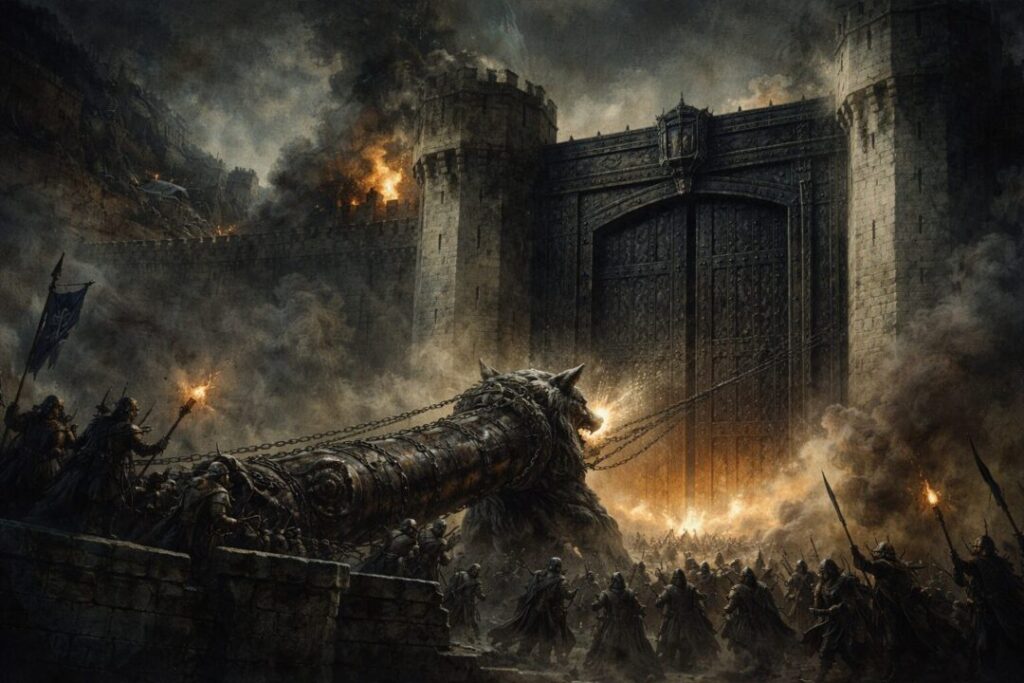
When the ram reaches it, the narrator pauses to tell you what resists the blow: “the doors of iron and posts of steel withstood the stroke.”
That line does two things at once:
- It reminds you the Gate is meant to be hard to break.
- It frames what follows as a change in the situation, not a flimsy defense that was always doomed.
This is not a delicate door with a magical lock. It’s an engineered barrier. And for a moment, it does its job.
The “spell” begins with language, not light
Then the Witch-king acts.
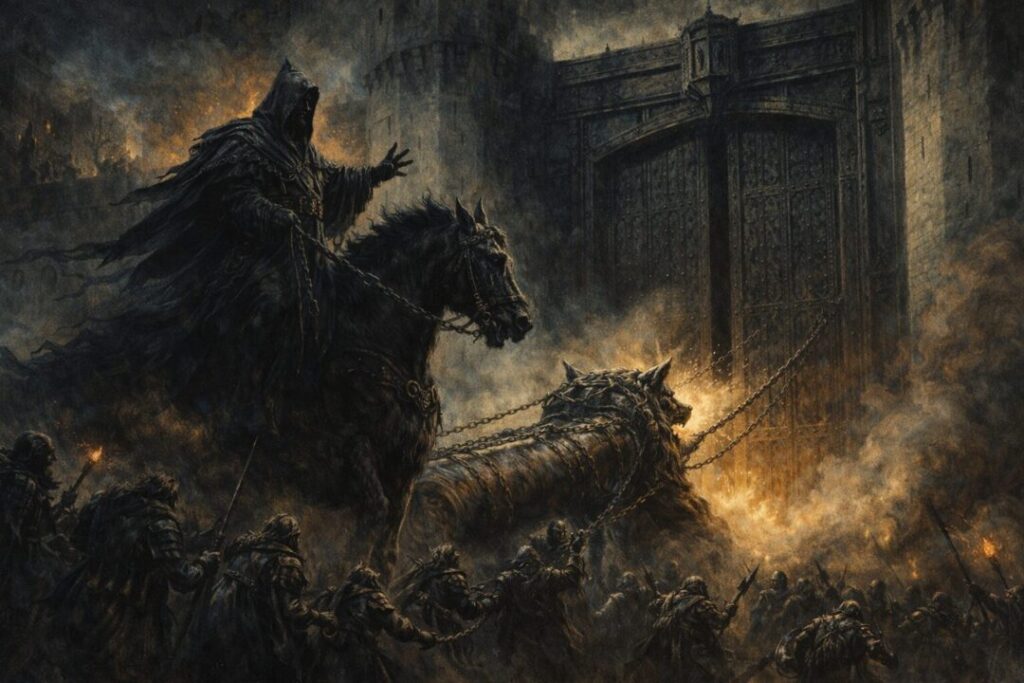
He rises in his stirrups and cries aloud “in a dreadful voice,” speaking in “some forgotten tongue”—and the text names what those words are meant to do: they are “words of power and terror,” meant “to rend both heart and stone.”
That is the most direct statement we get about the “spell”: it is spoken, it is powerful, it is intended to break things, and it is frightening.
But the text never identifies the language. It never repeats the words. It never tells you whether the power is a learned craft, an inherent ability of the Ringwraith’s nature, or something amplified by his master’s will.
All it does is show you the effect in the moment: the Witch-king cries out three times.
And then the ram strikes three times.
The crucial phrasing: “as if stricken by some blasting spell”
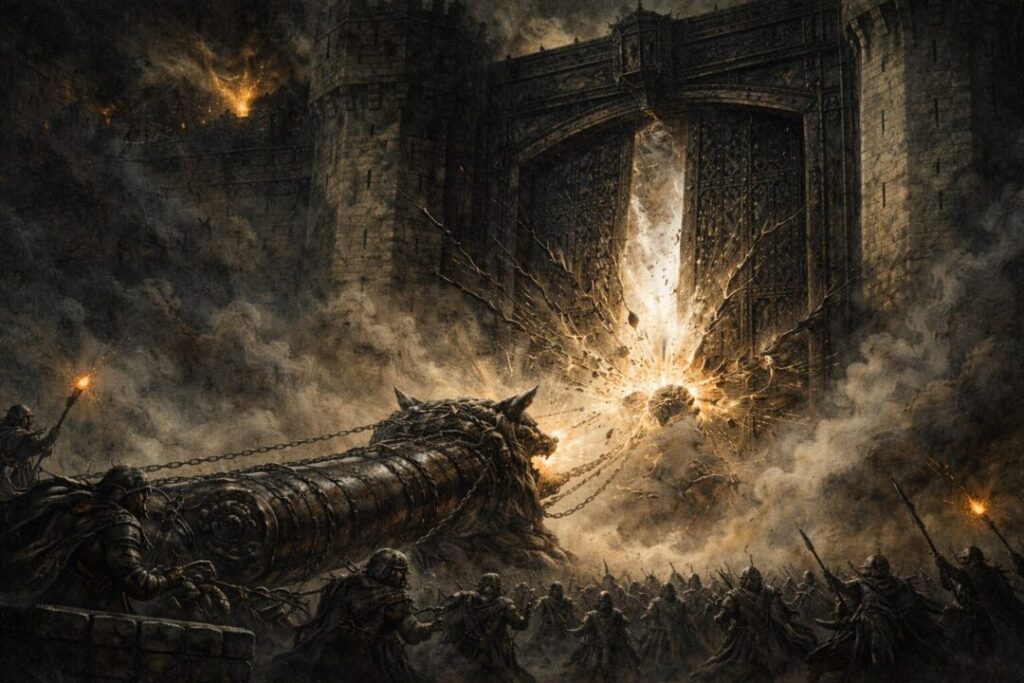
On the last stroke, the Gate breaks. And here is where the most-misremembered line appears.
The book does not say: The Witch-king’s spell blasted the Gate open.
It says the Gate broke “as if stricken by some blasting spell.”
That “as if” is not decoration. It is a boundary.
It tells you the narrator is describing what the breaking resembled, not necessarily what it was in a simple, labeled way. The Gate bursts asunder, there is “a flash of searing lightning,” and the doors tumble down “in riven fragments.”
So what can we say with confidence?
- The Gate breaks under the coordinated moment of three cries and three blows.
- The Witch-king’s speech is presented as “words of power.”
- The breaking is described as resembling a “blasting spell,” and it is accompanied by lightning.
What we cannot say as fact (because the text does not say it) is the neat mechanical explanation: that the spell alone destroyed the Gate, or that it was a visible projectile, or that it worked like a modern “magic attack.”
The writing doesn’t give you that.
It gives you a deliberately half-veiled act of dread: words spoken in an unknown tongue, and a breach that feels unnatural—even if it happens through a physical ram.
Was the “spell” on the Gate itself?
This is where readers often drift into assumptions, because the phrase “spell on the Gate” sounds like a magical seal placed on the doors.
But the text never states that the Gate of Minas Tirith was enchanted beforehand, nor that it carried a specific protective spell that had to be undone. It simply says it was strong—and that it held.
The “words of power and terror” could be aimed at the Gate. They could also be aimed at the defenders: “to rend both heart and stone” does not restrict the effect to metalwork. In the same breath, the language links fear and fracture.
And that pairing is very characteristic of how this world treats “magic” in general: not always as fireworks, but as authority, presence, domination, and spiritual pressure that becomes physical consequence.
Still, to stay honest to the text, we have to keep the scope limited:
- The Witch-king speaks words intended to break and terrify.
- The Gate breaks in a way compared to a “blasting spell.”
- The mechanism is not explained.
That is the boundary the book sets.
Why three cries and three strokes?
The repetition is not accidental. The Witch-king cries three times; the ram booms three times.
The text does not explicitly tell you why three matters here, so any symbolic reading has to be labeled as interpretation. But we can still say what the narrative effect is: it builds ritual.
It turns a siege action into something like a ceremony of dread—an ordered sequence in which sound, language, and force are bound together.
And when the Gate finally goes, it feels less like ordinary engineering failure and more like a moment where the world’s rules have been bent.
That is likely why people remember it as a “spell” even when the text hedges the claim.
The lightning: what it proves—and what it doesn’t
A “flash of searing lightning” is one of the most vivid details in the passage. It makes the breach feel violent and supernatural.
But lightning in the description does not automatically prove a specific magical “bolt.” It could be the visible sign of the Witch-king’s spoken power interacting with the blow. It could be a metaphor made physical in the moment. It could be something like a shock of energy released as the iron breaks.
The text does not tell you which.
What it does tell you is how it felt: the Gate didn’t simply splinter. It “burst asunder.”
That language is why the “spell” discussion exists at all.
The most overlooked proof that this moment matters: Gandalf’s stance
Right after the breach, the narrative drives a stake into the ground:
The Lord of the Nazgûl rides in “under the archway that no enemy ever yet had passed,” and everyone flees.
Everyone except one figure.
Gandalf is already there, silent and still, on Shadowfax—Shadowfax alone among the free horses of the earth endures the terror “unmoving, steadfast as a graven image.”
This matters because the “spell” is not just a trick to open a door. It is the threshold between fear and resistance.
The Witch-king has performed an act that breaks the City’s main barrier and the will of most who see it. And Gandalf answers—not with an explanation, not with a counter-spell described in technical terms—but with a command:
“You cannot enter here.”
Whatever the Witch-king did at the Gate, the book’s focus immediately shifts from mechanics to authority: whose will can stand, and whose will makes others scatter.
That is the real shape of power in this scene.
So what exactly was the “spell”?
If we’re strict—text-strict—the safest answer is also the most honest:
The book describes the Witch-king speaking words of power in a forgotten tongue immediately before the ram’s final blows. The Gate breaks under that combined moment, and the breaking is compared to being struck by a “blasting spell,” with a flash of searing lightning.
That’s what the text gives you.
Everything beyond that—exact language, exact magical system, whether the words were aimed at the Gate, the ram, the defenders, or the very air—belongs in interpretation.
And the most interesting thing is that the scene is built to produce that tension on purpose.
It wants you to feel the breach as unnatural without giving you a neat label you can hold in your hand.
Because at the Gate of Minas Tirith, the story isn’t really teaching you how spells work.
It’s showing you what it feels like when dread speaks—and stone listens.
Sources & Notes
- J.R.R. Tolkien, The Lord of the Rings, Book V, Chapter 4, “The Siege of Gondor” — Grond strikes the Gate while the Witch-king cries aloud in a forgotten tongue, with “words of power and terror” aimed “to rend both heart and stone.”
- J.R.R. Tolkien, The Lord of the Rings, Book V, Chapter 4, “The Siege of Gondor” — the Gate breaks “as if stricken by some blasting spell,” with searing lightning and riven fragments; the simile is the key textual limit.
- J.R.R. Tolkien, The Lord of the Rings, Book V, Chapter 4, “The Siege of Gondor” — after the breach, the Lord of the Nazgûl enters beneath the archway and Gandalf alone withstands him, shifting the scene from mechanics to authority and terror.