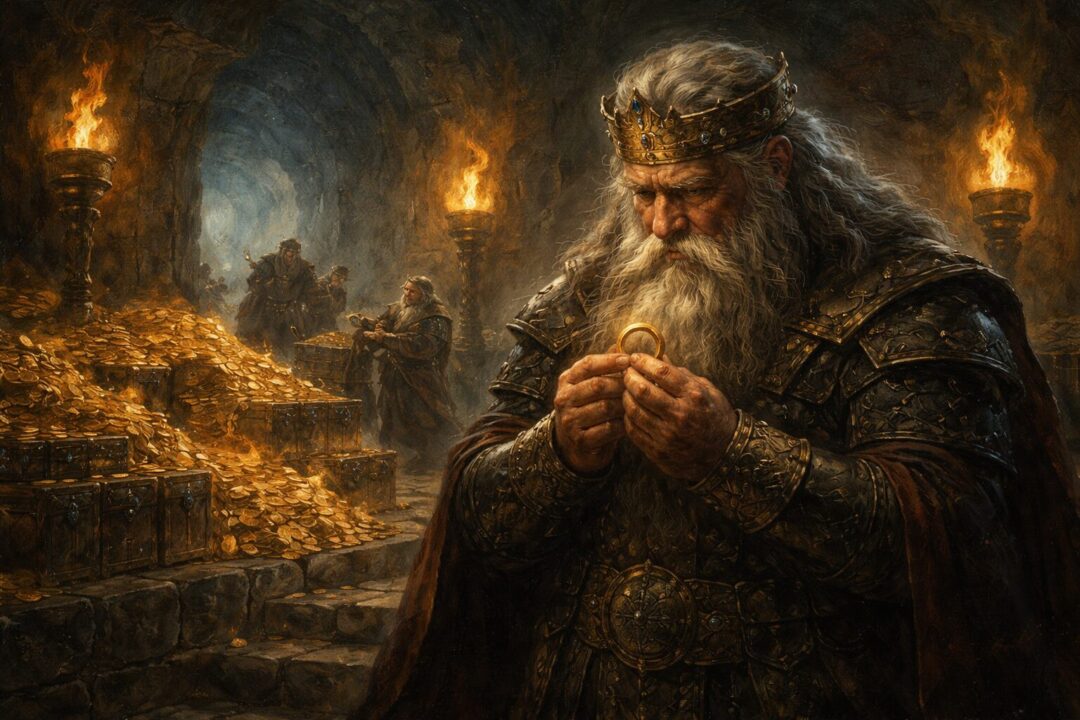
“Dragons consumed rings” is one of those Middle-earth phrases that people repeat because it sounds vivid—until you slow down and ask what it actually implies.
Because “consumed” is not a metaphor if you take the legendarium seriously.
It is a mouth.
A furnace-belly.
A creature made to desire, to gather, to smother bright things under itself and call that possession.
And it is also—quietly—one of the few times the texts place the Rings of Power in direct contact with something that is not a Man, an Elf, a Dwarf… or a hand.
So what would happen if one of the Seven Dwarf-rings ended up with a dragon?
Would it do anything to the dragon at all?
The honest answer is: the texts do not give us a scene where a dragon becomes a “Ring-bearer” in any clean, testable way. But they do give us enough hard edges to make the puzzle concrete—and to cut away several popular assumptions.
Let’s start with what we can say confidently.
What the texts actually say about the Seven and dragons
Across the core sources, three points show up again and again:
- The Seven were given out as part of Sauron’s distribution of the Rings of Power, and they had real effects—especially on Dwarves and their relationship to wealth.
- The Seven did not turn Dwarves into wraiths, and they did not make them easily dominated in the way Men became dominated through the Nine. This is stated in the lore summaries and grounded in the same tradition that distinguishes the Dwarves’ resistance to that kind of “fading.”
- Some of the Seven were ultimately lost to dragons—described as being “consumed,” and specifically connected to dragon-fire being able to melt or consume Rings of Power (though not the One).
That last point matters because it puts us on firm ground:
A dragon’s fire can destroy at least some Rings of Power.
Not the One—but Rings of the same general “class” as the Seven.
So if you want the most conservative, most text-supported outcome for “a Dwarf-ring meets a dragon,” it is simply this:
Sometimes the dragon destroys it.
Not morally. Not symbolically.
Physically.
And that already answers a lot.
But it does not answer the question people really mean when they ask this. They’re not asking, “Could a ring melt?” They’re asking:
If the ring survives—if it is swallowed, hoarded, hidden under coils of treasure—does it do anything?
To get there, we need to be precise about what the Seven are described as doing.
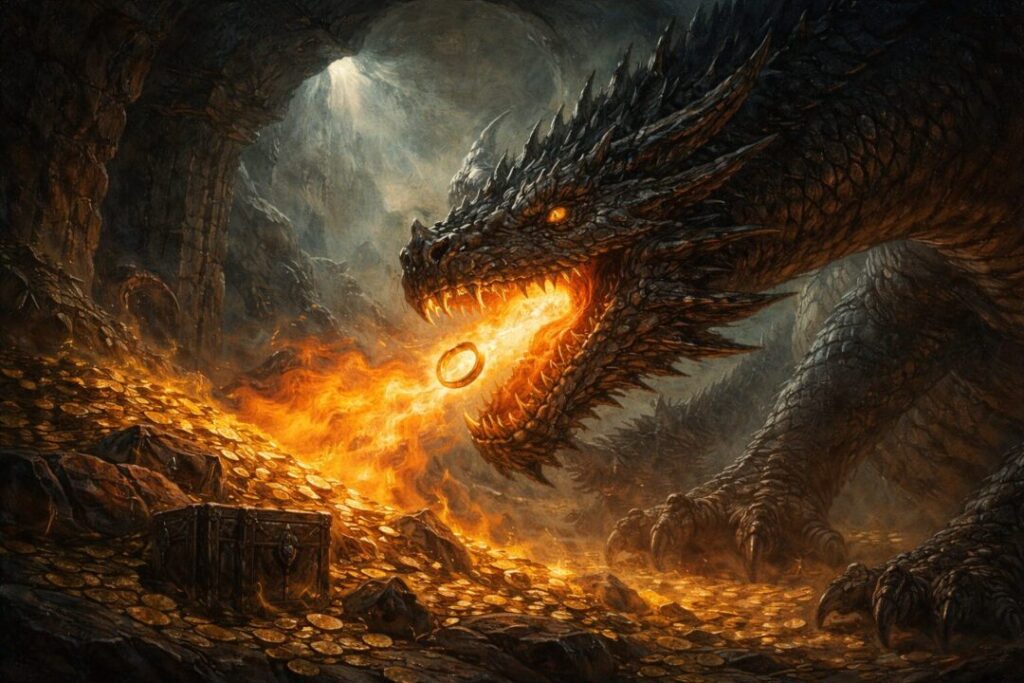
What the Seven actually do to Dwarves
The popular shorthand is: “They made Dwarves greedy.”
That is not wrong, but it’s incomplete in a way that matters for dragons.
The tradition about the Seven emphasizes that they were used for the gaining of wealth, and that they stirred up desire for gold and the making of hoards.
In other words, the Seven are associated with:
- an intensifying hunger for riches (especially gold),
- the growth of treasure-hoards,
- and the conflicts that follow hoards—plunder, war, and ultimately dragons.
This is where the famous “dragon puzzle” becomes more than trivia. The texts link these ideas as a chain:
Ring → hoard → attention → ruin.
And then they add the brutal punchline: the hoards are plundered; dragons devour; the rings are consumed or recovered.
So the Seven are not merely “temptation objects.” They are hoard-engines—tools that intensify accumulation in a world where accumulation is a beacon.
But now look at the other side of the meeting.
What a dragon is in this legendarium
Dragons in Middle-earth are not neutral animals that happen to like shiny things.
They are enemies: bred for devastation, associated with ruin, and defined—again and again—by possessive hunger.
Even without inventing extra psychology for them, the texts make one thing clear:
A dragon’s defining behavior is not “wearing.”
It is “having.”
A dragon takes a place, takes treasure, takes safety away from others—and then lies on the result.
So if someone imagines a ring “not working” because a dragon can’t put it on a finger, they’re starting from the wrong assumption.
Because in the stories, possession itself can matter.
Bilbo does not need to wear the One constantly for it to shape his life. It enters his story by being taken, kept, hidden, and guarded. And the lore around the Rings regularly treats “holding” and “keeping” as real forms of ownership and influence.
So the interesting question isn’t “can a dragon wear it?”
It’s:
Can a dragon keep it in a way that lets it act?
The texts don’t give us a direct experiment. But they do give us three concrete scenarios that don’t require inventing new rules.
Scenario 1: The simplest outcome—dragonfire destroys the ring
This is the most text-supported answer because it is explicitly stated that dragon-fire could melt or consume Rings of Power, and that several of the Seven were “consumed.”
So if a dragon “consumes” a ring in the straightforward sense—swallows it, breathes upon it, bakes it in the furnace of its body—the ring may simply cease to exist.
And if that happens, there is no lingering “effect on the dragon.” The ring is not an active tool anymore. It is slag, or nothing.
This already makes the old phrase feel different.
The Dwarf-lords didn’t merely lose rings.
Some of them were swallowed into a kind of annihilation that only a dragon could provide.
But not all the Seven are described as destroyed. Some were recovered.
So we should consider the survival case.
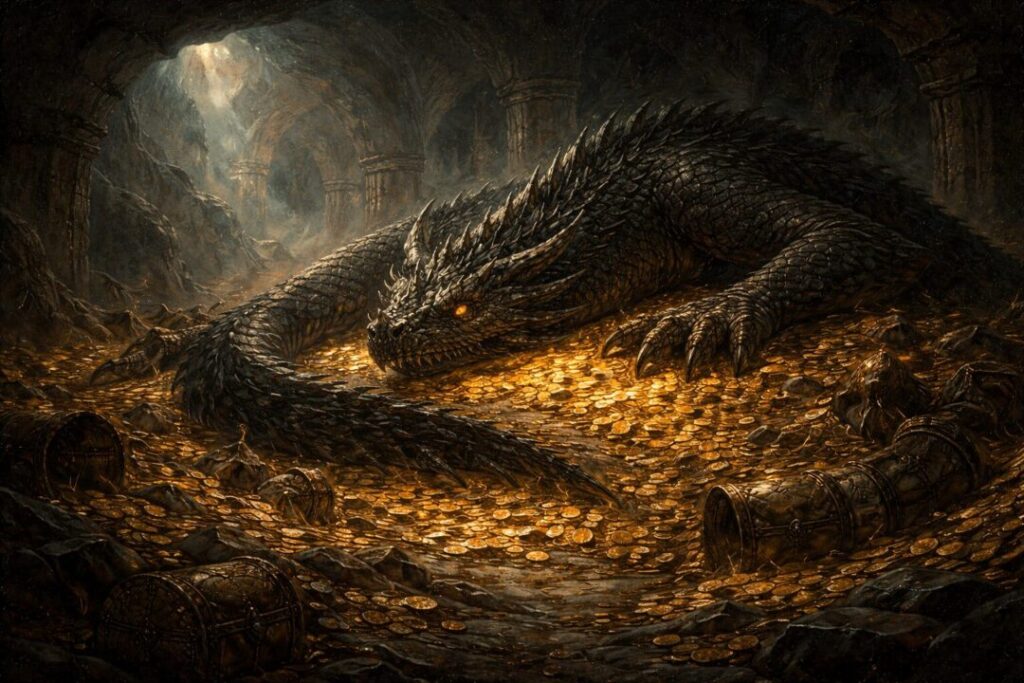
Scenario 2: The ring survives—but becomes just another piece of hoard
If a ring is not destroyed, the next most conservative option is also simple:
A dragon keeps it like any other treasure.
And here is the uncomfortable implication:
A Dwarf-ring’s most obvious “power” is to intensify hoarding behavior in beings already inclined to build wealth.
But dragons do not need help with hoarding.
They are already the end-point of that impulse.
So if the ring’s chief outward expression is “more gold, more gathering, more possessiveness,” then placing it into a dragon’s possession may change nothing we could observe—because dragons are already at the maximum setting.
This is one reason the texts can mention “dragons consumed them” without pausing to describe a transformation.
There may be no transformation worth describing.
The ring does what it does: draws wealth toward a hoard and makes the hoarder cling harder.
But a dragon is already the embodiment of clinging.
So what would look different?
Maybe nothing.
And that is a real answer.
Scenario 3: The ring survives—and the ring is the thing that changes, not the dragon
This is the scenario the texts point toward most sharply, without ever spelling it out in a neat sentence.
Because we are told two things side by side:
- Dragon-fire can consume Rings of Power.
- The One Ring is not vulnerable to any dragon’s fire, even the greatest.
That distinction matters.
It implies a hierarchy of durability tied to making and power: the One is singular; the others can be unmade by forces in the world that are terrible but not “ultimate.”
So when a Dwarf-ring meets a dragon, the story is not “a dragon becomes enchanted.”
The story may simply be: the ring meets something that can end it.
And that reframes the whole “consumed by dragons” line as the final humiliation of the Seven.
They were meant to be instruments—treasure-making engines, lures, chains of influence.
But the world contains creatures who do not get chained.
They just eat the chain.
Could a dragon become wraith-like, dominated, or “enslaved” by a Dwarf-ring?
This is where we have to be strict.
There is no textual statement that a dragon becomes invisible, fades, becomes wraith-like, or falls under the same kind of domination described for the Nine.
Even with mortals, the “wraith” outcome is particularly tied to Men and the Nine over time, and the Dwarves are explicitly said not to be turned into such shadows by the Seven.
Dragons are not described as experiencing that same kind of “fading” at all.
So any claim like “Smaug would become a Ringwraith-dragon” is not lore.
At best, you could call it speculation—and it would be speculation with no direct textual support.
The most we can safely say is narrower:
- If a ring survives, it may still be a ring of power—still an object with some potency.
- But the texts do not show that potency rewriting a dragon’s nature.
And perhaps that is the point.
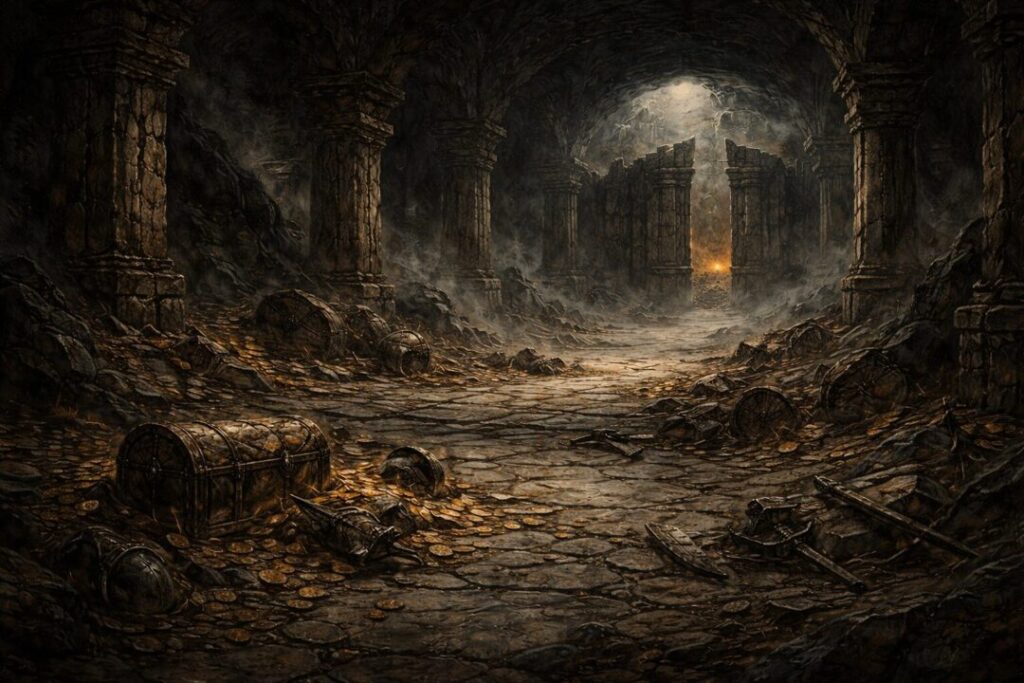
The concrete answer hiding inside the “puzzle”
When you make the question literal—when you stop treating “dragons consumed rings” as flavor text—the answer becomes almost harshly grounded.
A Dwarf-ring meeting a dragon does not have to produce a magical new hybrid outcome.
It can produce something more Middle-earth-like:
A beautiful, potent artifact is swallowed by a creature of ruin… and is either destroyed, or buried into a hoard so completely that the world never sees it again.
And that fits the larger pattern.
In Middle-earth, the grand objects of power don’t always get grand endings.
Sometimes they end in dark places, under heavy things, without any witness.
So what would a Dwarf-ring do to a dragon?
If you demand only what the texts support, you end up with an answer that is almost disappointing—and therefore more believable:
Probably very little to the dragon.
But potentially everything to the ring.
And once you see it that way, the line stops being trivia.
It becomes a quiet warning about hoards, about hunger, and about the one kind of fire that can erase even “power” from the world—leaving only a dragon, sleeping on what used to matter.
Sources & Notes
- J.R.R. Tolkien, The Lord of the Rings, Book I, Chapter 2, “The Shadow of the Past” — Gandalf states that dragon-fire could melt and consume Rings of Power, though not the One Ring itself.
- J.R.R. Tolkien, The Lord of the Rings, Appendix A, “Durin’s Folk” — gives the Dwarven tradition of the Seven Rings: their use in gathering wealth, the failure to dominate Dwarves as Men were dominated, and the losses to dragons or Sauron.
- J.R.R. Tolkien, The Silmarillion, “Of the Rings of Power and the Third Age” — summarizes Sauron’s distribution of the Seven and Nine, the Dwarves’ resistance, their increased desire for gold, and the ruin that followed their hoards.
- J.R.R. Tolkien, The Hobbit, Chapters 12–14, “Inside Information,” “Not at Home,” and “Fire and Water” — Smaug’s possessive hoard-lust and devastating fire provide the clearest narrative picture of dragon behavior around treasure.
- J.R.R. Tolkien, Unfinished Tales, “The Quest of Erebor” — adds Gandalf’s strategic fear of Smaug and the Lonely Mountain, useful context for why a dragon-hoard in the Third Age is more than a private treasure problem.