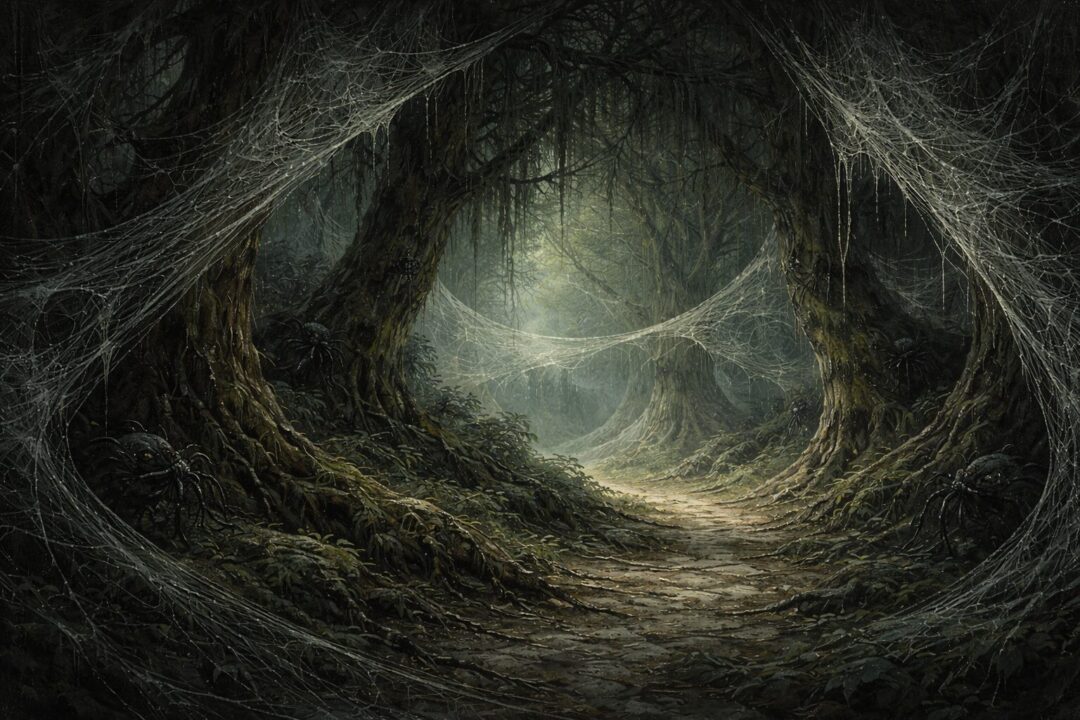
Mirkwood is one of the strangest locations in The Hobbit because it does not feel like a place you can fight.
It feels like a condition.
The Company enters a forest—and gradually loses their bearings, their hope, their appetite, their sense of time. Even their language changes. The woods are not merely “thick.” They are dark. The shadows are not merely present. They are deep. And the one thing everyone agrees on—within the story and outside it—is that a “Shadow” has fallen there.
But what is that Shadow?
Is it simply Sauron, reaching out from Dol Guldur like smoke from a fire?
Or is it something more complicated: a darkness that includes Sauron, but isn’t reducible to him alone?
The texts answer this—quietly, across multiple books—and the answer is sharper than most summaries.
Greenwood, and the moment it breaks
The first thing to understand is that Mirkwood is a renamed forest.
In the Tale of Years (Appendix B) the record is plain: around the Third Age “a shadow falls on Greenwood, and men begin to call it Mirkwood.”
That line matters because it tells you the Shadow isn’t just a “vibe” in Bilbo’s day. It is a historical event: something changes the forest’s identity so deeply that people stop calling it what it was.
And the same tradition gives you the next key piece: the Shadow is linked to the rise of a stronghold in the south of the wood—Dol Guldur—first suspected by the Wise to be a Ringwraith, later understood as something worse.
So yes: the Shadow is connected to the return of the Dark Lord.
But Tolkien’s world (and the internal logic of the stories) rarely allows a single cause to fully explain a living place. That is where Mirkwood becomes interesting.
“Whence it came few could tell…”
When the later tradition speaks more openly, it gives you the clearest identification of all:
“Whence it came few could tell… It was the shadow of Sauron and the sign of his return.”
And then it describes how that return worked: he comes “out of the wastes of the East,” takes up his abode in the south of the forest, and “slowly… took shape there again,” making a dwelling in a dark hill and working sorcery there—so that “all folk feared the Sorcerer of Dol Guldur,” even before they understood how great the peril was.
This does two things at once.
It confirms what The Hobbit only hints: the Necromancer of Dol Guldur is not a random local monster, but the returning Enemy.
And it shows what the Shadow is in its most literal sense: the outward consequence of a power taking root in a place.
Not an abstract darkness. A real one—anchored.
The Hobbit’s version: the Shadow you can feel
Now go back to The Hobbit and notice what it does with the idea.
It almost never explains. It lets you experience.
Beorn warns the Company that Mirkwood is “dark, dangerous and difficult,” and he points to specifics: scarce wholesome food, a black stream that carries “a great drowsiness and forgetfulness,” and “dim shadows” where even hunting feels suspect.
Then the narration gives you that small phrase at the threshold: the ponies gladly put their tails “towards the shadow of Mirkwood.”
Bilbo steps just inside and describes it as dark “even… in the morning,” with “a sort of watching and waiting feeling.”
That’s the Shadow in The Hobbit: an atmosphere that behaves like attention.
And it’s important that this is not framed as a single event at Dol Guldur. The Company is traveling well north of the fortress, yet the experience is already oppressive. The forest itself feels altered.
So how much of that is Sauron?
Dol Guldur: a center, not a border
By the time of Bilbo’s journey, the Necromancer is not a rumor confined to the deep south. Gandalf has been inside his “dungeons.”
And near the end of the book, Bilbo overhears that the White Council has at last driven the Necromancer from his “dark hold in the south of Mirkwood,” and Gandalf adds: “Ere long now… the Forest will grow somewhat more wholesome.”
That line is easy to skim.
But it is one of the most revealing sentences Tolkien ever gives Mirkwood.
Because it implies the Shadow is not merely metaphorical. It is a condition that can be relieved when a particular power is removed. The forest can become “more wholesome” again.
So yes: a major portion of the Shadow is Sauron’s doing, radiating from Dol Guldur and sustained by sorcery, fear, and the creatures that gather under that influence.
But “more wholesome” is not the same as “healed.”
And this is where the careful answer begins.
What Sauron does—and what the wood becomes
The texts make Sauron the source of the great turning: the Shadow is “the sign of his return,” and the Sorcerer’s dwelling is the engine of dread in the southern forest.
Yet The Hobbit repeatedly shows that Mirkwood is not simply “occupied.”
It is changed.
You see it in the way the path becomes a kind of moral instruction: don’t leave it, don’t drink the wrong water, don’t trust what you see in the dark.
You see it in the way the Company’s minds begin to slip—fatigue, irritability, hallucination-like lights and feasts.
And you see it most clearly in the spiders: a long-term infestation that has made parts of the forest unlivable.
The texts do not require you to claim that the spiders were “created” by Sauron (they don’t say that), or that every evil thing in Mirkwood is directly commanded from Dol Guldur (they don’t say that either).
What they do support is something more realistic—and more frightening:
When a great evil power settles in a place, it draws compatible life toward itself and teaches the land a new normal.
Sauron doesn’t need to invent every horror.
He only needs to deepen the night until the horrors that already exist can thrive.
That is one of the consistent patterns in Middle-earth: evil does not only attack. It corrupts conditions.
Mirkwood is the environmental version of that truth.
So what is the “Shadow,” finally?
If you want a lore-accurate definition that doesn’t overreach, it looks like this:
The Shadow in Mirkwood is the spreading dread, corruption, and darkening of Greenwood the Great associated with Sauron’s return and his long habitation of Dol Guldur in the south—experienced in the narrative as enchantment, hostile creatures, and an oppressive “watching” atmosphere.
How much is Sauron’s doing?
Enough that when the Necromancer is driven out, Gandalf expects the forest to grow “somewhat more wholesome.”
But not so neatly that you can reduce every shadowed bough to a single hand.
Mirkwood is what happens when an ancient forest endures a long occupation by a returning Dark Power: the Shadow begins with a will—then becomes a world.
And that is why the Company’s worst enemy in that chapter is not claws or poison.
It’s the feeling that the forest has started to look back.
Sources & Notes
- J.R.R. Tolkien, The Lord of the Rings, Appendix B, “The Tale of Years” — dates the Shadow falling on Greenwood, the forest being called Mirkwood, and the Wise later identifying the power in Dol Guldur.
- J.R.R. Tolkien, The Silmarillion, “Of the Rings of Power and the Third Age” — identifies the darkness in Mirkwood as the shadow of Sauron and the sign of his return, with Sauron taking shape again in Dol Guldur.
- J.R.R. Tolkien, The Hobbit, Chapter VII, “Queer Lodgings” — Beorn’s warnings establish Mirkwood as dark, dangerous, short of wholesome food, and haunted by the enchanted black stream.
- J.R.R. Tolkien, The Hobbit, Chapter VIII, “Flies and Spiders” — gives the lived texture of the Shadow: darkness, disorientation, oppressive watching, spider-haunted forest, and peril away from the path.
- J.R.R. Tolkien, The Hobbit, Chapter XIX, “The Last Stage” — links the White Council’s driving out of the Necromancer with Gandalf’s hope that the forest will become “somewhat more wholesome.”