There is a moment on the Pelennor Fields that feels like it should end a story.
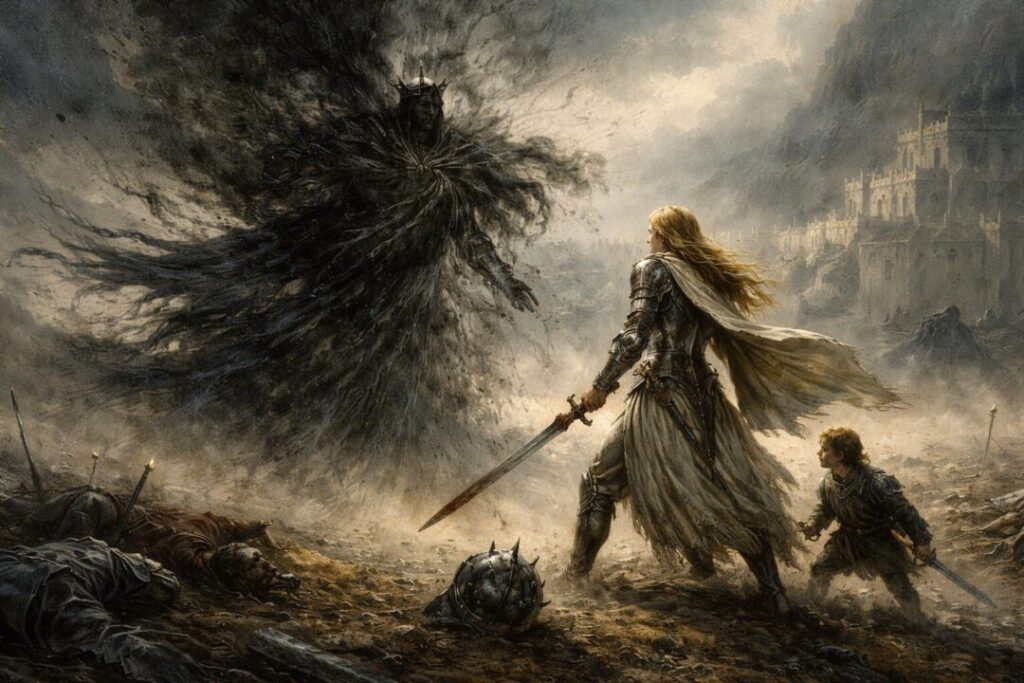
The Lord of the Nazgûl—captain of terror, breaker of gates, the shadow at the head of the Black Riders—falls at last. His voice is silenced. The dread he carried into Minas Tirith collapses into nothing. And the great war moves on without him.
It is the sort of death that invites a simple, physical aftermath.
A crown rolling in the grass.
A sword left behind.
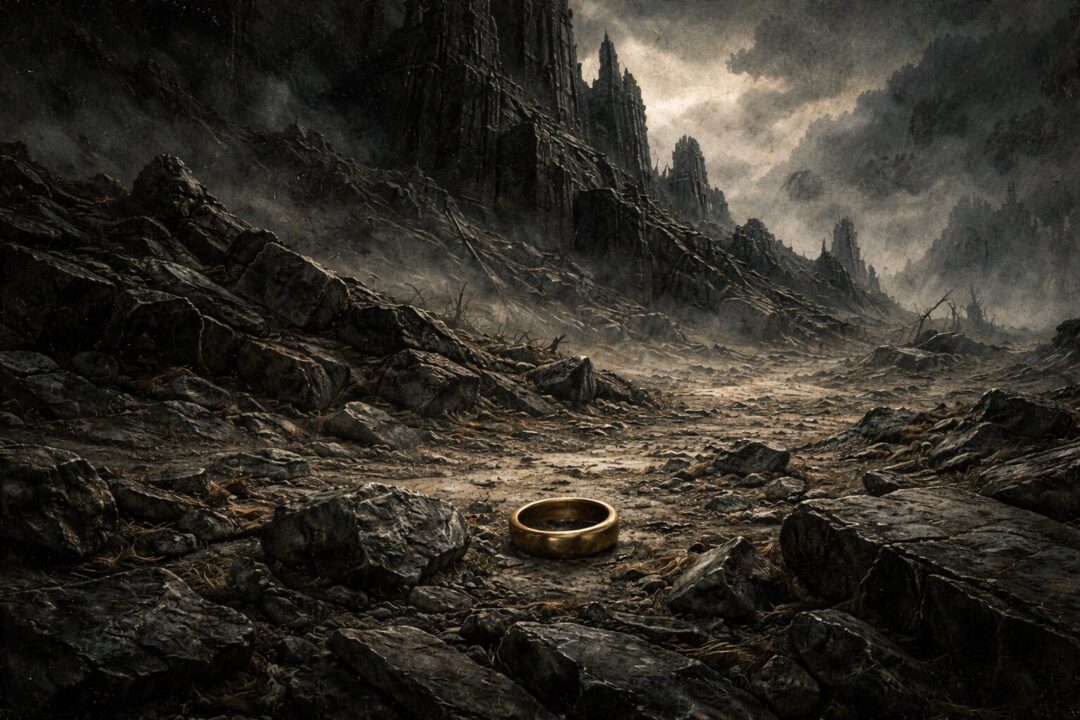
A Ring—glinting, waiting, claimable.
But The Lord of the Rings does not give you that scene.
In the text, the Witch-king does not die like a mortal king. When the spell unravels, there is no mention of a body to search, no treasure to seize, no object recovered from the wreck. There is only the sudden absence: a cry, a collapse, and then—nothing where he stood.
So if the Witch-king was, in some sense, a “Ring-lord,” what happened to his Ring?
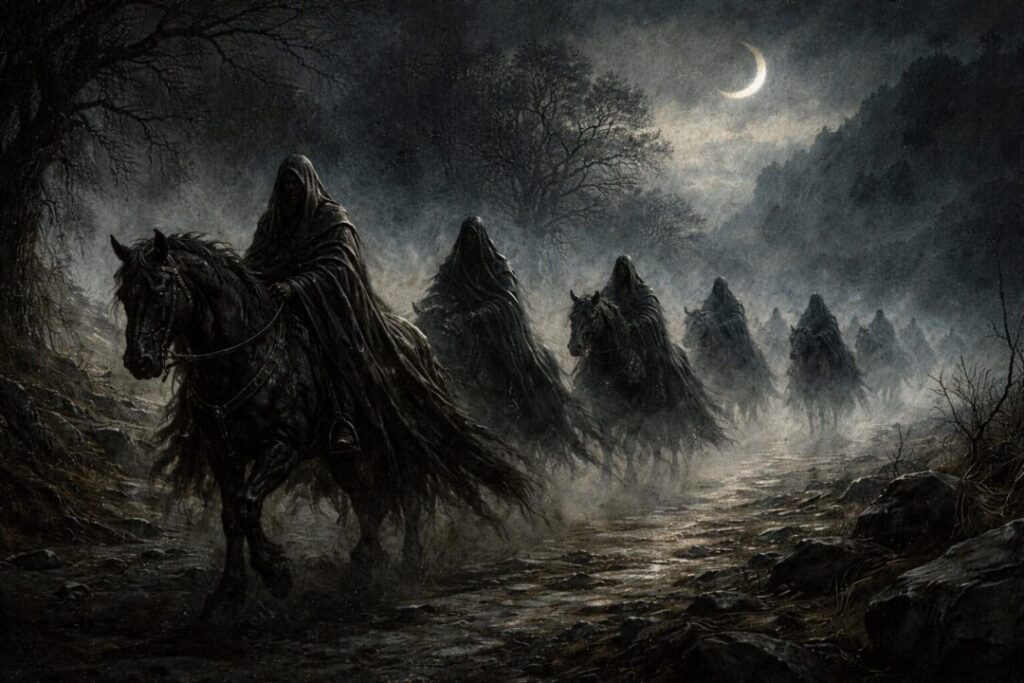
To answer that honestly, you have to start by correcting the picture many readers carry without realizing it: the Nazgûl are not described as wearing their Rings during the War of the Ring. In fact, the text points the other way.
The crucial clue: who “holds” the Nine?
Early in The Fellowship of the Ring, Gandalf explains the larger situation of the Rings. In doing so, he drops a line that is easy to skim past because it sounds like background—and because it is spoken with the calm finality of someone stating a settled fact:
“So it is now: the Nine he has gathered to himself.” (The Shadow of the Past)
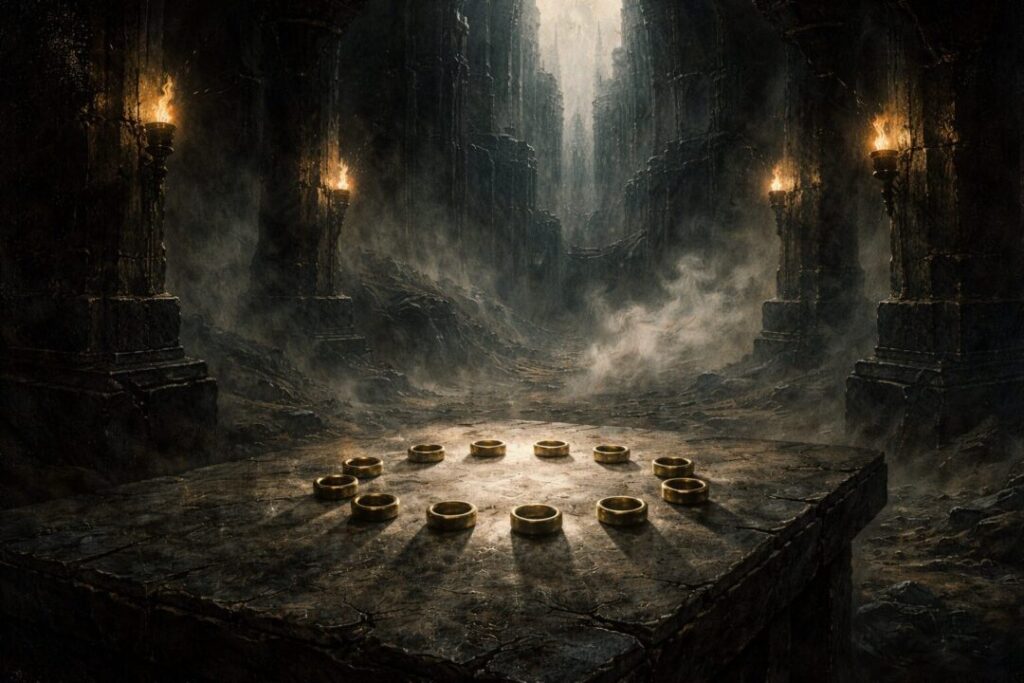
The plain sense of the sentence is not complicated. The Nine Rings are not out in the world. They are not distributed among their enslaved bearers. Sauron has gathered them back.
Later, in Lothlórien, Galadriel reinforces the same idea from a different angle. She speaks of:
“the Eye of him that holds the Seven and the Nine.” (The Mirror of Galadriel)
Again, the phrasing is specific. Sauron holds them.
If you take those two lines seriously, they change the entire framing of the Witch-king’s “Ring.” The Ring does not have to be on his hand to bind him. The binding can be maintained by the one who possesses the Ring—because the Ring has already done its work.
The Witch-king was made into what he is over a long process: the Nine Rings were given to Men, those Men became enslaved, and in time they “faded” until they were wraiths—beings whose presence in the visible world is thin, sustained, and dominated by another will.
By the time of the War of the Ring, the Nazgûl are not presented as rulers with personal artifacts. They are presented as servants—weapons shaped long ago and now wielded.
Why the Ring doesn’t “drop” when he falls
This is where the Pelennor scene becomes clearer.
If the Witch-king is not wearing his Ring, then his death cannot produce a lost Ring on the battlefield. There is nothing to recover, because the object is elsewhere.
And the text gives you a strong narrative reason to accept that: Sauron is cautious with power. He does not casually place high-value instruments into the hands of servants who might lose them, be captured, or be intercepted.
Even in the War of the Ring, Sauron’s most important tools are guarded, concealed, centralized. He relies on fear, on speed, on overwhelming force—not on handing out irreplaceable artifacts in a way that risks losing them.
So the Witch-king dies, and the Ring does not fall—because the Ring was never there.
That leaves the real question:
If Sauron held the Nine, what happened to the Witch-king’s Ring after the Witch-king was destroyed?
What the books do say we can conclude
We can say a few things with confidence, because the text supports them directly.
1) The Witch-king’s Ring was in Sauron’s possession during the War of the Ring.
That is the most straightforward reading of “the Nine he has gathered to himself” and “him that holds the Seven and the Nine.”
2) The Witch-king’s death does not free the Ring into the world.
Nothing in the Pelennor passage suggests a recovered object. The entire scene emphasizes the unmaking of a wraith—something that dissolves rather than something that can be looted.
3) The Ring’s fate is therefore tied to Sauron’s fate, not to the Witch-king’s.
If the Ring is in Sauron’s keeping, then it remains in his keeping when the Witch-king falls. The Witch-king’s unmaking removes a servant; it does not automatically remove Sauron’s store of Rings.
That last point matters, because it prevents a common misconception: that the Nine Rings function like personal batteries each wraith must “wear” to operate.
The text implies something more disturbing and more absolute: once the enslavement is complete, the wraith is bound. The Ring’s location is no longer the same as the servant’s location.
What happens to the Nine when Sauron falls?
Here we arrive at the edge of what the narrative states outright.
When the One Ring is destroyed, Sauron’s power collapses. Barad-dûr falls. The Nazgûl perish—each of them—because the power that sustained and governed them is broken.
But the books do not give a catalog of artifacts recovered from the ruins of Mordor. They do not describe Aragorn’s men discovering a locked chest of Rings. They do not tell you, “and the Nine were melted” or “and the Nine were cast into the Sea.”
So we should be careful.
What we can say, conservatively, is this:
- The Nine Rings were instruments of domination bound into Sauron’s ring-lore and his long strategy.
- When the One Ring is destroyed, Sauron is reduced to impotence—unable to take shape, unable to rebuild his power.
- The Nazgûl are destroyed at that moment, suggesting the system that sustained them is finished.
From that, many readers infer a reasonable conclusion: the Nine Rings would be effectively worthless afterward—their “purpose” gone, their master gone, their ability to enslave no longer anchored by Sauron’s will.
But that last step—the exact mechanics of how their power would behave after Sauron’s final downfall—is not described in a neat rulebook.
So we should label the next part clearly:
Interpretation: what most likely became of the Witch-king’s Ring
If Sauron held the Nine in or near Barad-dûr—an inference that fits the language of “gathered to himself” and the general logic of how he guards power—then the most likely outcome is that the Ring was buried or lost in the ruin of his realm when the Dark Tower collapsed.
That does not require the Ring to be physically destroyed (though it could have been damaged in the cataclysm). It only requires that, after the fall, Mordor becomes a wasteland of wreckage and ash—and that no one is shown undertaking a successful salvage mission deep into the most cursed place in the world.
Could the Ring have survived intact somewhere in the debris, a small circle of gold lost under black stone?
Yes—as a possibility. But it would be a possibility without a textual scene to confirm it.
And even if it survived, the larger point remains: the Witch-king’s Ring would no longer have a Witch-king to return to. The wraith is unmade. The servant is gone.
Which brings us back to the question that started all this—and why it feels so eerie when you think about it.
The Witch-king is called a Ringwraith because a Ring enslaved him. But by the end of the Third Age, he is no longer the “owner” of anything. He is not a king with a treasure.
He is a shadow whose leash is held elsewhere.
So when he dies, the Ring does not become a relic you can claim. It becomes something colder:
an artifact that outlived its wearer—already taken from him long ago—waiting in the hands of the one who truly possessed it.
And then, when that final master falls, the story does not linger on the Ring at all.
It simply ends the age.
Which might be the most telling answer of all: in the end, these Rings were never meant to be heirlooms. They were meant to be chains.
And chains are not remembered for where they are buried—only for what they once did.
Sources & Notes
- J.R.R. Tolkien, The Fellowship of the Ring, Book I, Chapter 2, “The Shadow of the Past” — Gandalf says Sauron has gathered the Nine Rings to himself.
- J.R.R. Tolkien, The Fellowship of the Ring, Book II, Chapter 7, “The Mirror of Galadriel” — Galadriel speaks of the Eye of him who holds the Seven and the Nine.
- J.R.R. Tolkien, The Return of the King, Book V, Chapter 6, “The Battle of the Pelennor Fields” — the Witch-king’s fall leaves no recovered body or Ring described on the field.
- J.R.R. Tolkien, The Silmarillion, “Of the Rings of Power and the Third Age” — the Nine enslave mortal Men, making them Ringwraiths under Sauron’s rule.
- J.R.R. Tolkien, The Return of the King, Book VI, Chapter 3, “Mount Doom” — Sauron’s fall destroys the Nazgûl and ends the power sustaining them.