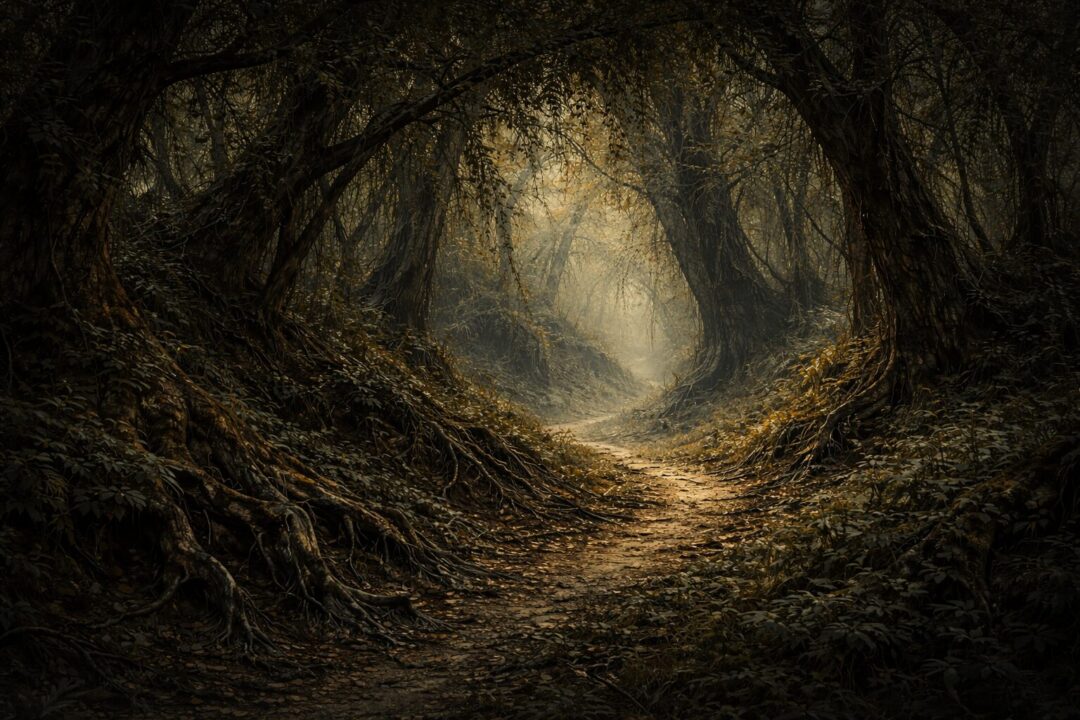
It’s tempting to read the end of The Lord of the Rings as a kind of universal thaw.
The Ring is destroyed. Barad-dûr collapses. The Nazgûl pass away like smoke. The great fear that lay on lands and hearts is lifted, and the world seems to breathe again.
So readers sometimes assume the Old Forest should change too.
But the Old Forest never behaves like a province of Mordor. It does not feel like Sauron’s reach stretching into Eriador. It feels like something adjacent to history—something that has been brooding for a very long time, and has its own reasons for hostility.
And that distinction matters, because the text gives you enough to see why the Old Forest stayed dangerous even when Sauron fell: its malice is local, ancient, and—crucially—rooted in memory and injury rather than allegiance.
The Old Forest is hostile before Sauron matters to Hobbits
When Frodo and his companions enter the Old Forest, the danger is immediate, but not in the way of a battlefield.
There are no banners. No sentries. No clear “enemy.”
Instead, the land itself seems to resist them.
The paths feel unreliable. The trees appear to crowd together. The Forest presses travelers inward and southward, away from the borders and toward the Withywindle valley. Merry warns Frodo that the Old Forest has long been considered “queer” by the Bucklanders, and he speaks of rumors that the trees can move.
The detail is easy to skim past on a first read. On a second, it becomes one of the strangest warnings in the book.
Because this isn’t “spooky forest” atmosphere for its own sake. It’s a direct claim—within the story—that the Old Forest has agency enough to act, however slowly and strangely that action works.
And that agency exists regardless of the War of the Ring. This is happening on the very edge of the Shire, far from Mordor, before the Fellowship even reaches Bree. If you’re looking for Sauron’s hand, the narrative does not point you there.
It points you to Buckland.
The High Hay wasn’t built against Orcs
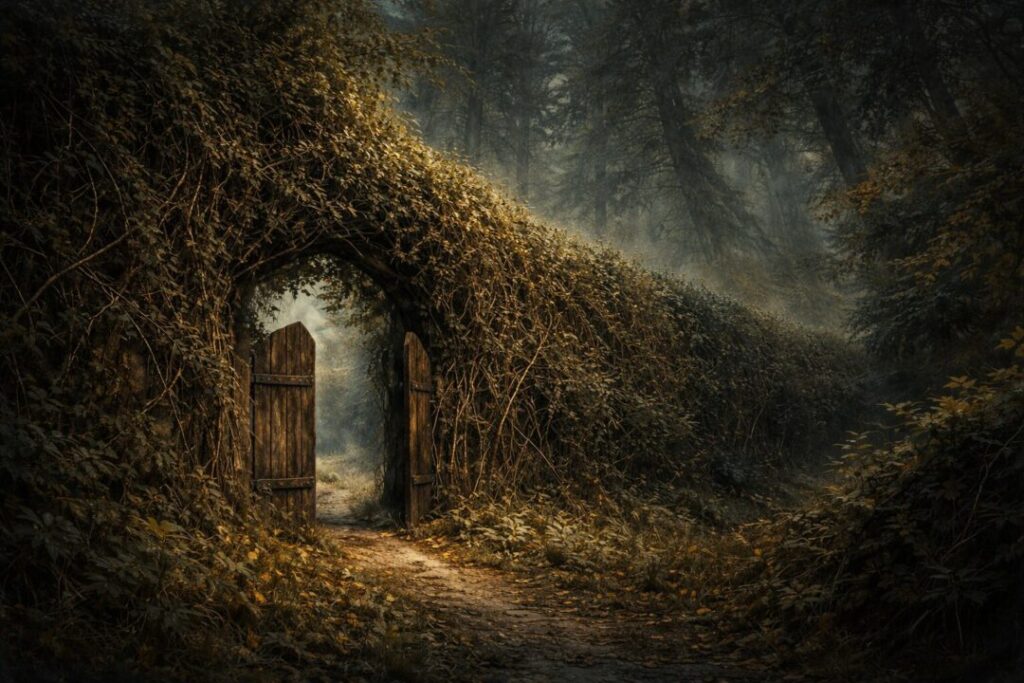
One of the clearest signals that the Old Forest’s hostility is not “Mordor spilling over” is the simplest defensive structure in the entire Shire: the High Hay.
Buckland’s eastern border is not guarded by soldiers. It is guarded by a hedge—high, thick, and carefully maintained. And the reason is not speculative: the Hobbits of Buckland fear the Old Forest itself.
Merry recounts that “long ago” the trees seemed to “attack” the Hedge—crowding up to it, leaning over it. Whether you take that literally as movement, or as the creeping pressure of a living wood that does not want boundaries, the Hobbits interpreted it as aggression.
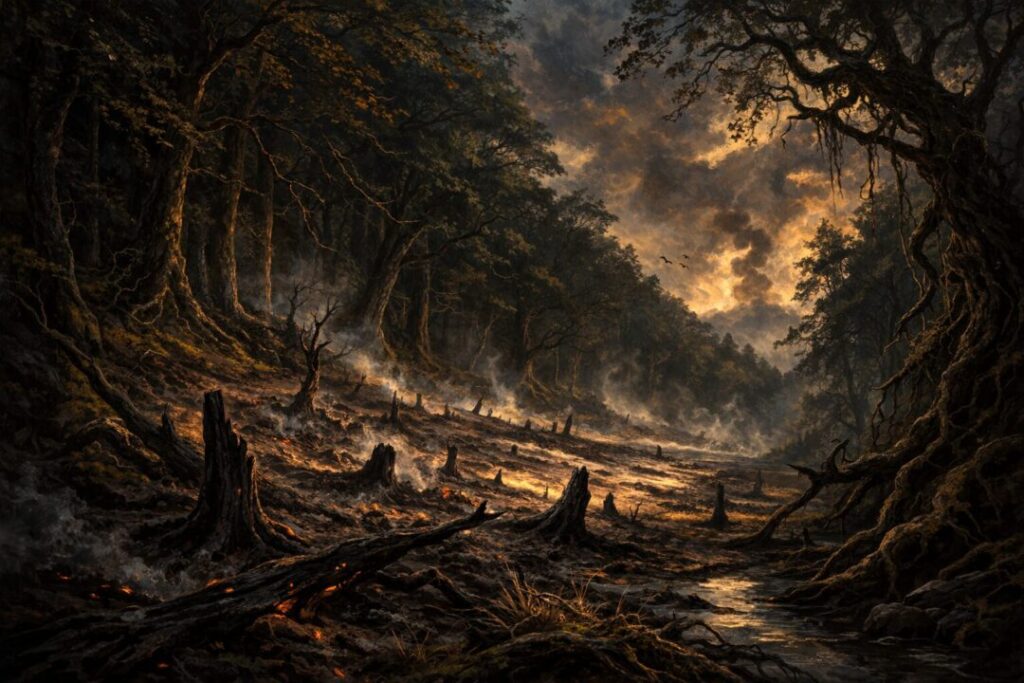
And their response was not subtle. They felled a great number of trees and burned them in a vast fire, making the Bonfire Glade.
This is one of the most important facts in understanding the Old Forest: the Bucklanders did not merely avoid it. They actively harmed it, and they did so at scale.
That harm doesn’t explain every danger in the Forest, but it explains the emotional logic the text repeatedly returns to: the Forest “remembers.”
In other words, the hostility is not presented as a spell that can be broken by removing a Dark Lord. It is presented as a wound with a long memory.
Old Man Willow is not framed as Sauron’s creature
Then the story pushes you deeper, into the Withywindle valley, and the Old Forest stops being merely “unfriendly” and becomes intimate.
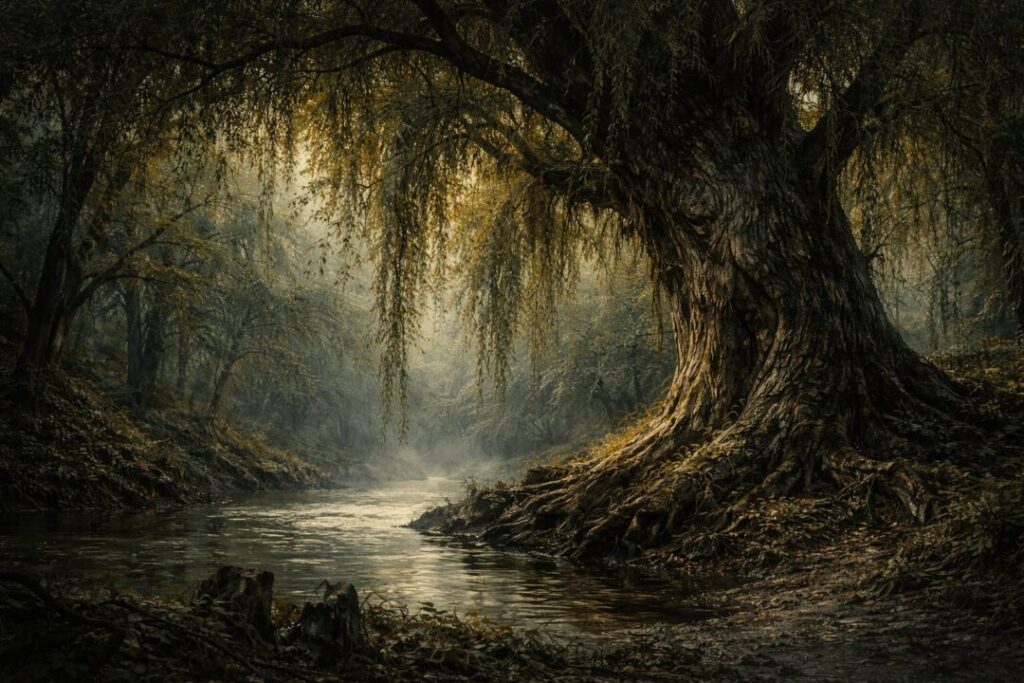
Old Man Willow is not a distant menace. He doesn’t threaten armies. He targets travelers one by one—drowsing them, trapping them, crushing them. He is the first truly personal evil the Hobbits meet after leaving the Shire.
And after Tom Bombadil rescues them, he describes the Great Willow in terms that are strikingly independent of Sauron.
Bombadil speaks of “bad” trees in the Old Forest and says none are more dangerous than the Great Willow, whose “heart was rotten” though his strength was green, and whose thought and song ran through the woods.
The emphasis is not on command or service. It is on influence—dominion in the literal sense of one will spreading through roots and branches, bending other trees to its mood.
That makes Old Man Willow frightening in a way that Sauron’s servants are not.
Orcs, Nazgûl, even Saruman’s forces: they are attached to a war. They rise and fall as the war rises and falls.
Old Man Willow feels like a corruption that has simply grown where it stands.
The text does not give you a clean origin story for what he is. It does not identify him as a spirit bound to Sauron, or a lesser shadow sent from Mordor. If anything, the story suggests he is older than Hobbits’ fear—and perhaps older than Hobbits themselves.
So when the Ring is destroyed, nothing in the narrative implies that Old Man Willow is automatically “freed” or cleansed. He is not wearing Sauron’s collar.
He is part of a different problem.
Tom Bombadil’s presence explains why the Forest survived—not why it became safe
Tom Bombadil complicates everything, because his existence proves there are powers in Middle-earth that do not align neatly with the War of the Ring.
He can command Old Man Willow to release the Hobbits. He can break the Barrow-wight’s spell with song. He is completely unthreatened by the Ring.
And yet the Old Forest is still hostile.
That pairing is telling.
Bombadil’s authority in his land is real, but the story does not portray him as a gardener of universal peace. He does not “fix” the Forest so that no danger remains. Old Man Willow still exists when the Hobbits enter; the Barrow-wight still haunts the Downs beyond.
Bombadil seems to restrain certain evils rather than erase them. And even that restraint appears bounded by his own nature: he is master within his country, not a conqueror marching outward, not a ruler reshaping the world.
So if you imagine that Sauron’s fall should make the Old Forest gentle, you are imagining the Old Forest as a war-zone that will be “liberated.”
But the text frames it more like an ancient wild place with ancient wounds—watched over by an ancient figure who does not behave like a king.
That is why the Old Forest can remain dangerous even in the same chapter where the Hobbits also find the safest house they will see until Rivendell.
Compare Mirkwood: some places are explicitly “healed,” and the Old Forest isn’t one of them
The clearest way to stay honest with the evidence is to compare how the book treats other lands after Sauron’s fall.
Mirkwood is an obvious example, because it is directly tied to Sauron’s power through Dol Guldur. After the War, the Shadow is driven out, and the forest is renamed—its darkness lifted.
That pattern exists in the text: when a place is explicitly under the dominion of a Shadow, the removal of that Shadow can bring restoration.
But the Old Forest is never described as being under Sauron’s dominion.
It is feared for its own behavior. It is bordered by a hedge built in response to trees. It contains a great willow whose malice is described as internal and spreading.
So the absence of an “and then it was cleansed” passage matters.
The story does tell you when lands change after the War. When it does not say the Old Forest changed, the responsible reading is not to assume it did.
Victory does not erase every older peril in Middle-earth
There is also a broader thematic point the text quietly supports: the end of the War does not mean the end of all peril.
Even after Sauron falls, the Hobbits return to find the Shire harmed by human cruelty and petty tyranny. The final movement of the story insists that evil can arise in smaller forms, closer to home.
The Old Forest fits that pattern, but in a stranger register.
Its hostility is not political. It is not a regime to be toppled. It is a resentful wildness and a concentrated local malice that predate the War and do not depend on it.
If the Old Forest is hostile “because of the memory of many injuries” (a formulation preserved outside the narrative but entirely consistent with what the story shows), then the fall of Sauron does not touch the cause.
Memory is not defeated by a battlefield victory.
A wounded land does not become un-wounded because a Dark Lord is gone.
So why did it stay hostile?
Because the Old Forest’s hostility is not presented as an extension of Sauron’s Shadow.
It is presented as the product of two things the War does not undo:
- A long history of harm and fear at the border of Buckland, answered with axes and fire, and
- A local, concentrated malice in Old Man Willow, whose influence runs through the Forest like a mind in the roots.
And perhaps that is the most unsettling part: the Old Forest suggests Middle-earth contains dangers that are not “the Enemy.”
Some are simply ancient. Some are simply wounded. Some are simply rotten at the heart, green with strength, and still there—standing beside a quiet river—when the great towers fall.
Sauron’s defeat ends a war.
It does not rewrite the oldest memories of the woods.
Sources & Notes
- J.R.R. Tolkien, The Lord of the Rings, Book I, Chapter 6, “The Old Forest” — gives Merry’s account of the High Hay, the trees’ pressure against Buckland, and the Bonfire Glade made by the Hobbits.
- J.R.R. Tolkien, The Lord of the Rings, Book I, Chapter 7, “In the House of Tom Bombadil” — describes the Old Forest’s deep-rooted hostility to two-legged creatures and Old Man Willow’s powerful, rotted heart.
- J.R.R. Tolkien, The Lord of the Rings, Book I, Chapter 8, “Fog on the Barrow-downs” — shows Tom’s power as local and bounded, ending with the Hobbits leaving his country rather than the peril being permanently erased.
- J.R.R. Tolkien, The Lord of the Rings, Book II, Chapter 2, “The Council of Elrond” — frames Bombadil as master within his own bounds, not a power set to conquer or reorder the wider world.
- J.R.R. Tolkien, The Lord of the Rings, Appendix B, “The Tale of Years” — contrasts the Old Forest with Greenwood/Mirkwood, where Dol Guldur is cast down and the wood is explicitly renewed after the War.