When danger rises in Middle-earth, the stories do not usually turn to innovation.
They turn backward.
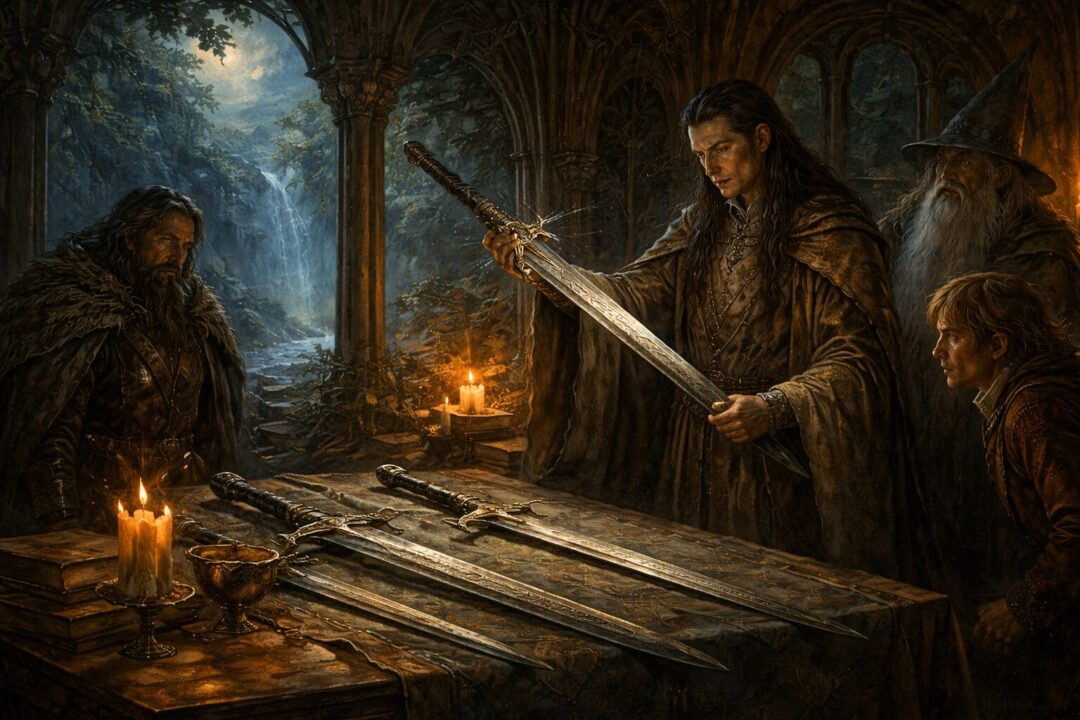
Again and again, when the decisive blow is near, the weapon that matters is ancient: a sword forged in Gondolin, a dagger from Westernesse, a blade broken centuries earlier and preserved long after its first age of glory has passed.
At first glance, this can look like atmosphere.
Ancient weapons are more poetic than new ones. They carry names, songs, and lost kingdoms. They make the world feel deep.
But the pattern in the texts is stronger than that.
Old weapons in Middle-earth are not merely decorative relics. Very often, they preserve something the present age lacks: older craft, older knowledge, older memory, and sometimes a very specific fitness for a very specific enemy.
That is why they matter.
Old Weapons Are Usually Tied to Older Wars
The first thing to notice is that ancient blades are not ancient by accident.
They come from earlier struggles.
When Tom Bombadil gives the hobbits the blades from the Barrow-downs, he explains that they were forged long ago by Men of Westernesse against the evil of Angmar. The text stresses both their age and their origin. These are not random old knives dug from the earth. They were made in a kingdom that stood against a particular form of darkness.
That matters because Middle-earth is a world in which evil returns in altered forms, but not in total discontinuity.
The Witch-king who rules at Minas Morgul is the same great enemy once opposed in the North. So a weapon born out of that older war carries a relevance that newer weapons may not. The present is not disconnected from the past. It is haunted by it.
This is one of the deepest habits of the legendarium.
The world does not simply progress.
It remembers.
And what is remembered sometimes becomes the only thing that still fits the danger at hand.
Merry’s Blade Is the Clearest Proof
No example is stronger than the fall of the Witch-king.
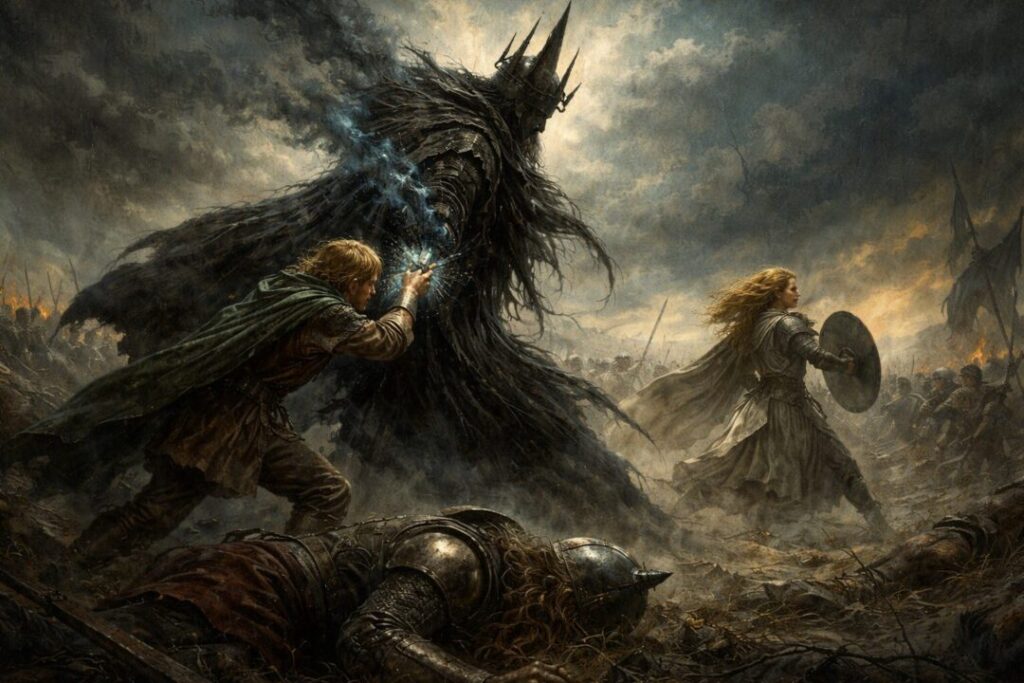
Popular retellings often focus almost entirely on prophecy and on Éowyn’s revelation that she is “no living man.” That moment does matter. But the text also gives a second and crucial explanation: Merry’s strike with the Barrow-blade was uniquely effective because of what that blade was.
The narration says this plainly.
After the Witch-king falls, we are told that no other blade, “not though mightier hands had wielded it,” would have dealt that enemy such a bitter wound, breaking the spell that knit his unseen sinews to his will. This is not vague symbolism. It is a direct statement about the weapon itself.
And that changes the whole scene.
The point is not simply that an ancient blade looks noble in a great battle.
The point is that a blade made long ago in the wars against Angmar still carried a power or suitability that an ordinary contemporary weapon did not. Exactly how that work was accomplished is not fully explained in mechanical terms, and the text is wiser than modern fantasy in leaving some of that mysterious. But the result is explicit. The old weapon mattered in a way the new ones could not.
This is the strongest evidence for the article’s central idea.
Old weapons are not just older.
Sometimes they are truer to the enemy.

The Swords of Gondolin Carry a Lost World Forward
A different version of the same pattern appears in The Hobbit.
When Thorin and company recover the swords in the trolls’ hoard, they do not yet understand what they have found. Elrond later identifies Glamdring and Orcrist as blades of Gondolin, and the goblins recognize Orcrist at once with fear and hatred, remembering the deaths it dealt in the Elder Days.
This is striking for several reasons.
First, these swords still matter after immense stretches of time. Gondolin is gone. Its king is gone. Its age is over. Yet the blade remains dangerous in the Third Age because the excellence of its making has not been erased. Second, the hatred of the goblins shows that these weapons carry historical memory. They are not anonymous pieces of metal. They are survivors from an older and greater conflict.
Even Sting, the smallest of them, follows the same pattern.
It is not a newly made hobbit weapon. It is an old Gondolin blade, small only because it was made for larger hands in another age. Yet in Bilbo’s and Frodo’s hands, it becomes one of the most memorable weapons in the story. Its value is not diminished by its age. Its age is part of its value.
The implication is hard to miss.
The later age does not surpass the earlier one in craft.
It inherits fragments from it.
Narsil and Andúril Show That Age Also Means Lineage
The Barrow-blade shows an old weapon as a specialized answer to an old enemy.
The swords of Gondolin show old weapons as preserved excellence.
Narsil shows something else again.
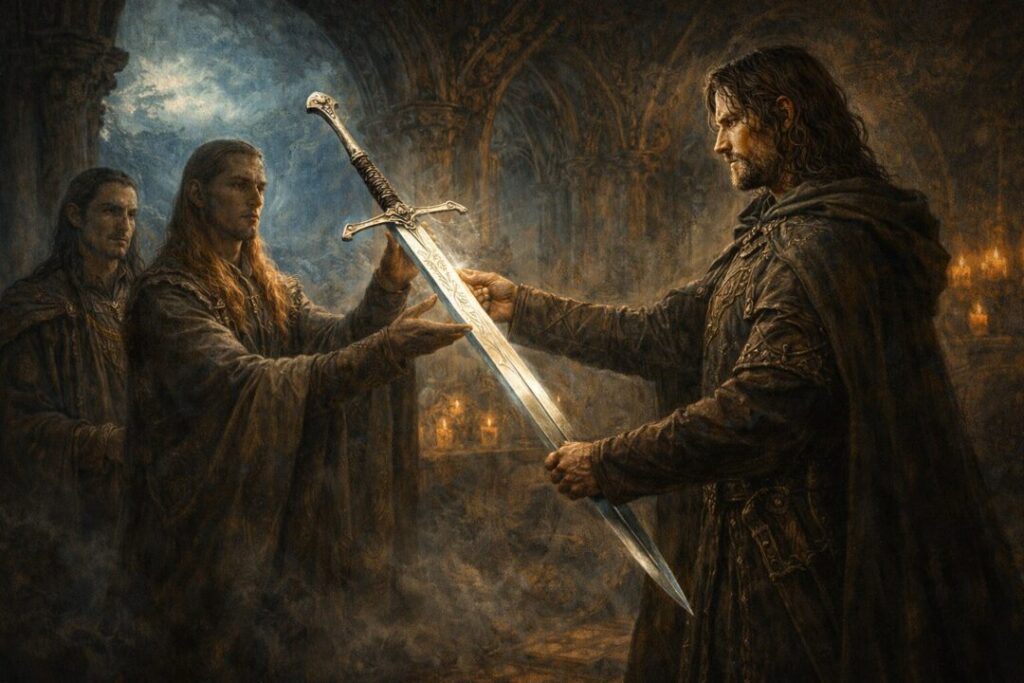
It shows that an ancient weapon can matter because it carries authority, continuity, and rightful memory across ages. Narsil was forged long ago, probably in the First Age, by Telchar of Nogrod. It later became the sword of Elendil, broke beneath him, and was preserved by his heirs until it was reforged as Andúril for Aragorn.
That preservation is central.
Aragorn says the Sword that was Broken “has been treasured by his heirs when all other heirlooms were lost,” and that it was spoken of old that it should be made again when the Ring was found. In other words, the blade matters not only as a weapon, but as a continuity of identity.
This is why the reforging is so important.
Andúril is not presented as a replacement for something obsolete. It is the return of something rightful. The old blade is not discarded so that a better modern one can take its place. Instead, the old blade is restored, and in that restoration a kingship becomes visible again.
So here too, oldness is not weakness.
It is legitimacy.
Middle-earth Does Not Treat History as Dead Weight
One reason modern readers can miss this pattern is that many modern stories assume newer means better.
Middle-earth usually does not.
Its world is shaped by loss, fading, and survival after diminishment. By the Third Age, many of the greatest realms are long fallen, and even Tolkien Gateway summarizes the age as one marked by decline and the waning of earlier greatness. That is not just background color. It affects how objects function in the story.
This does not mean that no one living in the later ages can make anything fine. The texts do not support so crude a rule. There are still skilled smiths, noble peoples, and worthy arms. But the stories repeatedly attach singular weight to preserved things from older ages, especially when those things come from Númenórean or First Age craft.
So the deeper pattern is not “new weapons are useless.”
It is that Middle-earth is a world where some of the highest making is already behind the characters, and where the surviving artifacts of that making still carry force into the present.
Why This Matters Beyond Weapons
Once you see this, the weapons stop being just props.
They become part of the moral structure of the world.
Ancient blades matter because Middle-earth is not built on the fantasy of endless replacement. It is built on inheritance, stewardship, memory, and the long afterlife of old deeds. A sword can carry a kingdom. A dagger can carry a forgotten war. A broken blade can carry a claim that has not died.
That is why the old weapons matter more than the new ones.
Not because the stories are merely sentimental about the past.
But because in this world, the past is still active.
Its enemies remain.
Its wounds remain.
Its promises remain.
And sometimes the only thing that can answer the darkness of the present is something forged against it long ago.
The Real Pattern
The clearest way to say it is this:
Old weapons matter in Middle-earth because they are rarely just old.
They are concentrated history.
They preserve forgotten skill.
They outlast fallen kingdoms.
They carry memory into ages that have grown thinner.
And in some of the most important moments in the story, they are not merely more beautiful than newer weapons.
They are more fitting.
That is why a small blade from Westernesse can help undo the Witch-king.
That is why swords from Gondolin still inspire fear thousands of years later.
And that is why the Sword that was Broken does not remain a relic.
It returns.
Sources & Notes
- J.R.R. Tolkien, The Lord of the Rings, Book I, Chapter 8, "Fog on the Barrow-downs" — Tom Bombadil arms the hobbits with blades made by Men of Westernesse in the wars against Angmar.
- J.R.R. Tolkien, The Lord of the Rings, Book V, Chapter 6, "The Battle of the Pelennor Fields" — Merry’s Barrow-blade is singled out as uniquely fitted to wound the Witch-king.
- J.R.R. Tolkien, The Hobbit, Chapter 3, "A Short Rest" — Elrond identifies Glamdring and Orcrist as swords from Gondolin, preserving the craft and history of the Elder Days.
- J.R.R. Tolkien, The Lord of the Rings, Book II, Chapter 3, "The Ring Goes South" — Narsil is reforged as Andúril, turning a preserved heirloom into Aragorn’s active sign of return.
- J.R.R. Tolkien, The Silmarillion, "Of the Rings of Power and the Third Age" — Narsil’s breaking and Isildur’s stroke against Sauron give the sword its long historical weight.