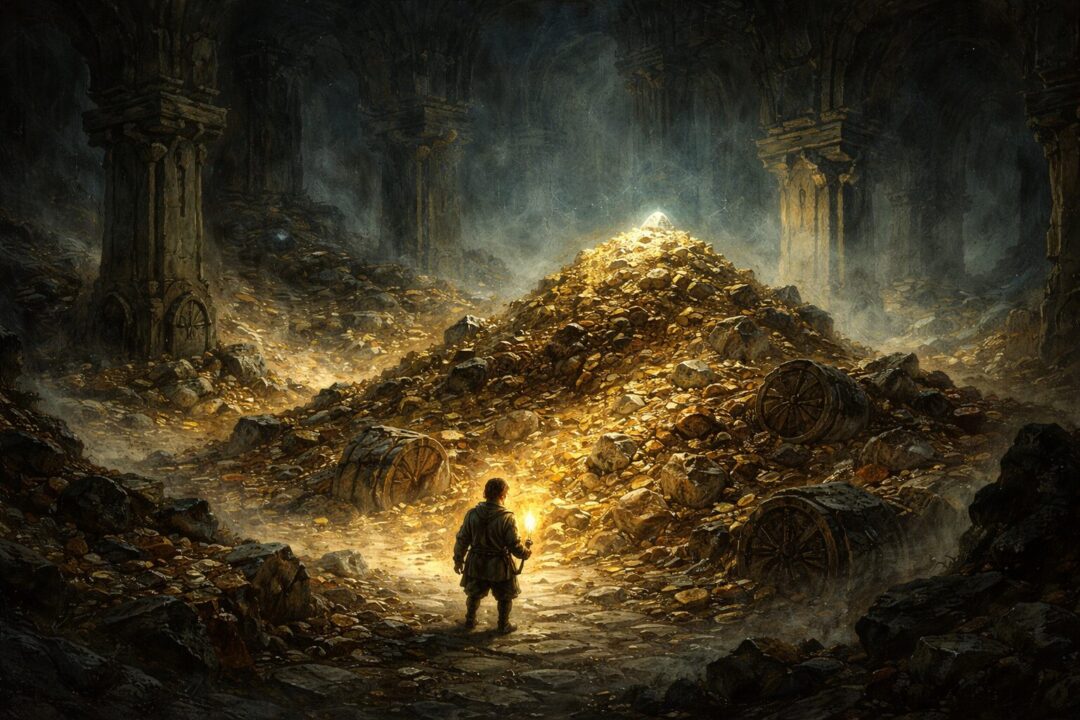
When people talk about lost relics in Middle-earth, they often imagine the problem in very simple terms.
Find the ruin.
Survive the danger.
Take the object.
Bring it home.
But that is not how these stories usually work.
Again and again, the texts show something much stranger.
Ancient relics are rarely just missing objects waiting to be reclaimed by the right hand. By the time anyone reaches them, they have already become entangled in memory, kingship, possessiveness, oath, grief, disaster, or competing claims so old that no clean solution remains.
In other words, the real difficulty is usually not locating the relic.
It is everything the relic already means.
A relic in Middle-earth is never just an object
This is one of the deepest patterns behind treasure and heirlooms across the legendarium.
The object itself may be beautiful, ancient, or politically important. But the story almost never treats it as neutral.
A relic gathers history.
Sometimes that history is noble. Sometimes it is tragic. Sometimes it is binding. And sometimes the texts imply that the longer the object survives, the more impossible it becomes to separate its beauty from the consequences attached to it.
That is why “recovering” such a thing rarely restores a simple earlier order.
The relic has lived through too much.
By the time it is found again, kingdoms have fallen, blood has been shed, or the people seeking it no longer agree on what rightful possession even means.
The Arkenstone is not a treasure pickup
The Arkenstone is one of the clearest examples.
On the surface, it sounds simple enough: a royal jewel of Erebor lies in the treasure beneath the Lonely Mountain, and Thorin Oakenshield wants it back.
But the moment the story actually reaches the Mountain, recovery becomes morally unstable.
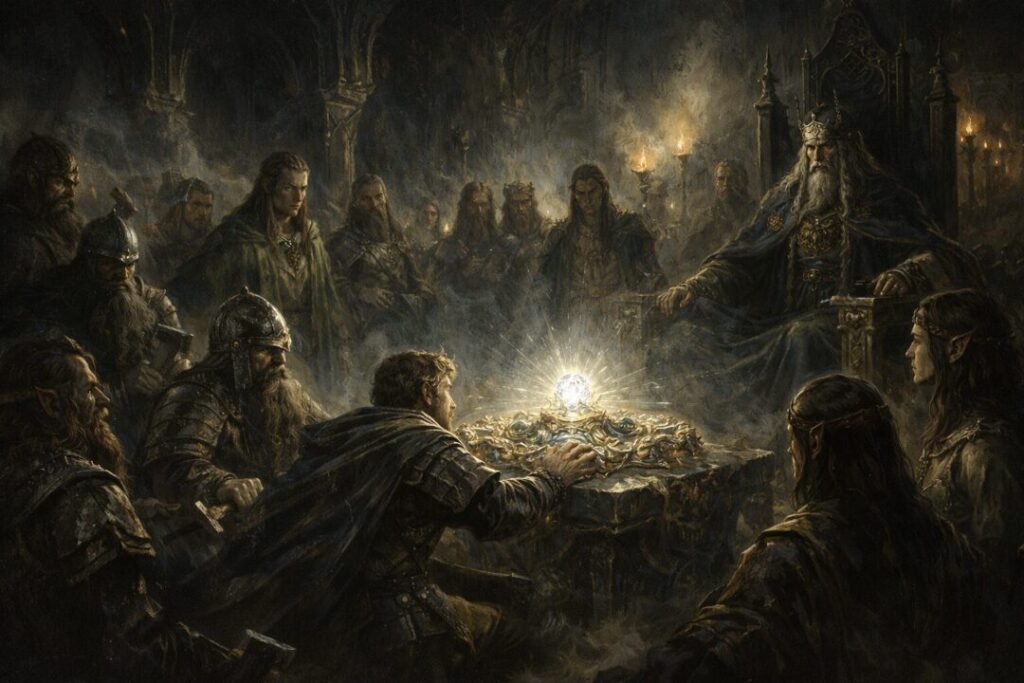
The stone is not resting safely in an abandoned hall. It lies buried within Smaug’s hoard, inside a kingdom broken by dragon-fire and death. Bilbo can physically retrieve it, yes. But possessing it does not restore order. Instead, it becomes leverage in a political crisis among Dwarves, Men, and Elves after Smaug’s fall.
That matters.
The difficulty is not merely that the Arkenstone is hard to reach. The deeper problem is that once it returns to the world, it revives competing ideas of inheritance, kingship, debt, and ownership. Thorin’s attachment to it is not presented as simple justice. The text deliberately places its recovery beside the larger moral danger surrounding dragon treasure and possessiveness.
So the relic is recovered.
And everything becomes harder.
The Silmaril proves recovery can trigger fresh ruin
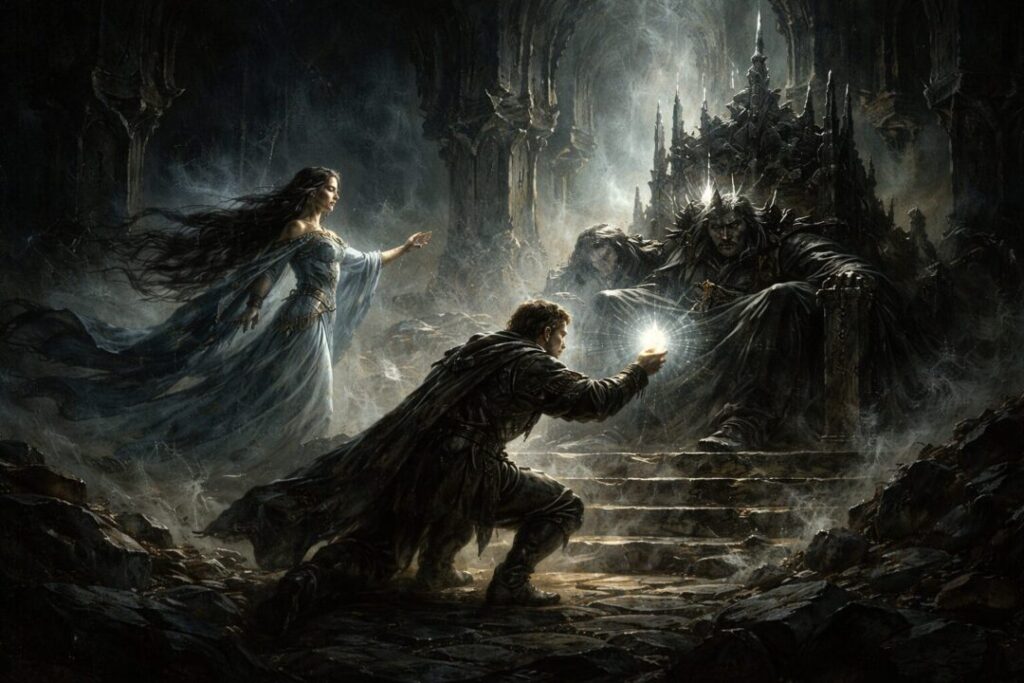
If the Arkenstone complicates recovery, the Silmaril taken by Beren and Lúthien makes the point even more sharply.
This is one of the most famous recoveries in all of Middle-earth. A jewel is taken from the Dark Lord’s crown itself. It would be easy to treat that as the triumphant end of the story.
It is not.
Even in the immediate tale, the recovery comes through impossible peril and mortal cost. And beyond that first victory, the Silmaril does not bring peace to those who touch the history around it.
Later, when the jewel is set in the Nauglamír in Doriath, it becomes the center of renewed greed, contention, killing, and finally the ruin of Thingol’s realm. The point is not that the Silmaril is “evil” in the same way as the One Ring. The texts do not present it that way.
The point is that an object of overwhelming beauty and sanctity can still move through a fallen world in ways that expose pride, covetousness, and unresolved claims.
That is why relic recovery in Middle-earth so often feels unstable.
Winning the object does not end the danger.
Sometimes it gathers the next disaster around itself.
Dragon-hoards are never neutral after dragons
The legendarium is especially clear on one recurring problem: treasure that has passed through dragon possession is not treated as simple wealth.
This is most obvious in The Hobbit, where the treasure of Erebor becomes morally dangerous after Smaug’s long occupation. The idea commonly called dragon-sickness is tied to precisely this atmosphere of corrupted possessiveness around recovered hoards.
But the pattern is older than Thorin.
The hoard of Scatha, once recovered by Fram, does not settle into clean ownership either. Instead it becomes the source of dispute between the Éothéod and the Dwarves, and the tradition preserves the memory of insult, conflict, and possible revenge.
That is important because it widens the pattern beyond a single story.
A dragon’s death does not simply free treasure for rightful use.
The treasure returns carrying appetite, memory, claim, and bitterness with it.
So even when the monster is gone, recovery has only entered its next stage.
Some relics can only be borne, not casually used
Another misconception fans often bring to these objects is that once a relic is found, it should function immediately.
Middle-earth resists that idea too.
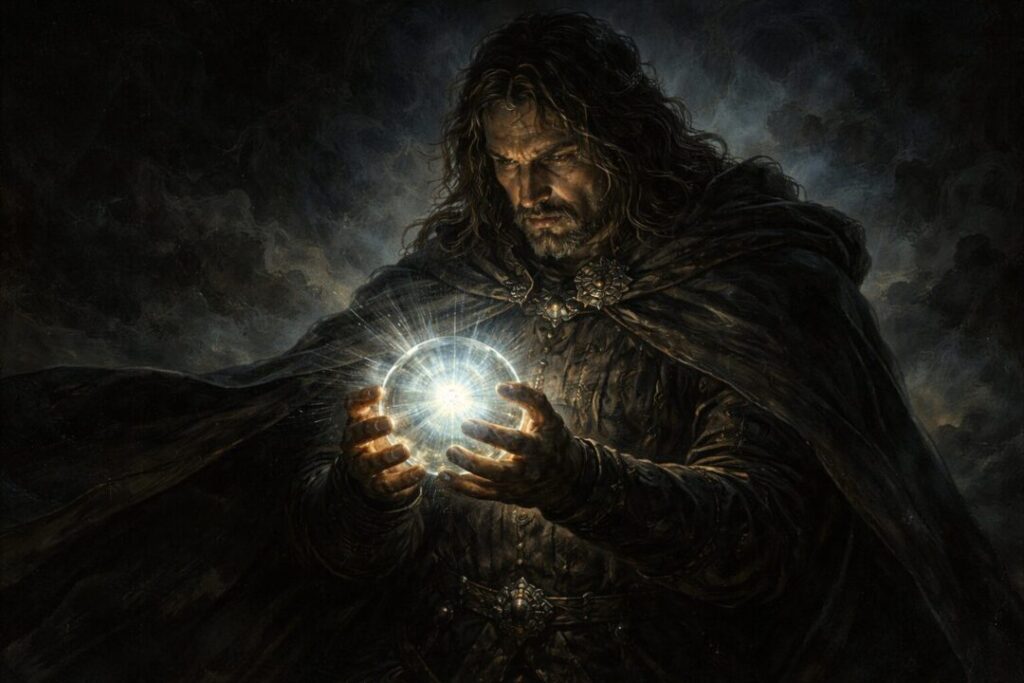
The palantír of Orthanc is “recovered” almost by accident when it is thrown down from the tower. But this does not make it safely usable by whoever happens to hold it. Pippin’s contact with it is perilous. Saruman had already been ensnared through his dealings by means of the stone. Aragorn, by contrast, can use it only because he has the strength and the rightful standing to challenge Sauron through it.
That contrast matters.
The obstacle is not only physical access. It is fitness.
A relic may exist in the world again, yet remain dangerous, unreadable, or politically charged in the hands of the wrong person. The story repeatedly distinguishes between touching an object and being able to bear what comes with it.
The same idea appears, in a different register, in the shards of Narsil.
They are not hidden in some lost cave. They have been preserved for generations in Rivendell. Yet they are not casually reforged at any random moment. Their restoration belongs to a particular time, lineage, and need. The blade that was broken is not merely repaired as an act of craftsmanship. Its return marks the re-emergence of a king and the renewal of an older order in the face of war.
So here again, “recovery” is not simple possession.
It is timing, legitimacy, and burden.
In Middle-earth, rightful claim is rarely uncomplicated
This may be the deepest reason ancient relics are hard to recover in these stories.
The question is almost never just: who found it?
The harder question is: who can truly claim it now?
The Arkenstone belongs to the royal house of Erebor, yet its recovery unfolds amid legitimate demands from others after the fall of Smaug.
The Silmaril recovered by Beren does not cease to stand within the long catastrophe of the Oath of Fëanor.
The treasure of Scatha is disputed even after the dragon is dead.
The palantíri belong to a tradition of stewardship and authority that not everyone can safely exercise.
And Narsil’s shards remain meaningful because they are not merely old metal. They are dynastic memory preserved until the world is ready for what they signify.
This is why relic stories in Middle-earth feel older and heavier than ordinary fantasy treasure hunts.
Ownership is not reduced to possession.
History keeps speaking.
Recovery often reveals character more than success
Another striking pattern is that these relics often matter less for what they are than for what they reveal.
The Arkenstone reveals Bilbo’s moral subtlety and Thorin’s possessiveness.
The Silmaril reveals the difference between holy beauty and the pride of those who contend over it.
The Orthanc-stone reveals the peril of curiosity without strength, and strength without humility.
The shards of Narsil reveal that some inheritances are not privileges but responsibilities.
This is why the objects feel so alive in the narrative even when they do not speak and do not act.
They test.
Not always in the manner of the Ring, but still unmistakably.
They uncover what already exists in the hearts, loyalties, and limitations of the people around them.
Why fans imagine it as easier than it is
Part of the misunderstanding comes from how modern fantasy often trains readers to think about relics.
A relic is hidden.
A quest retrieves it.
The item is restored to its rightful place.
The story moves on.
Middle-earth is rarely that tidy.
The older an object is, the more likely it is to have passed through loss, oath, ruin, greed, exile, and changing realms. What appears to be a straightforward recovery is often the moment when all of that buried history suddenly rises back to the surface.
So fans imagine the problem as distance.
The texts usually present it as inheritance.
And inheritance is much harder.
The real problem is not finding the relic
Ancient relics in Middle-earth are never as easy to recover as fans imagine because the world does not allow old things to remain simple.
The past clings to them.
A dragon may sleep on them.
A kingdom may define itself through them.
An oath may still pursue them.
A curse, a claim, or a line of kings may still be attached to them.
That is why recovery is almost never the end of the story.
It is the point where the true weight of the object begins to appear.
And once you start reading the relics of Middle-earth that way, they stop looking like treasure.
They start looking like history made visible.
Sources & Notes
- J.R.R. Tolkien, The Hobbit, chs. 12–15 and 18 — the Arkenstone is recovered from Smaug’s hoard but becomes bound up with Thorin’s claim, Bilbo’s bargaining, and the dispute over Erebor’s treasure.
- J.R.R. Tolkien, The Silmarillion, "Of Beren and Lúthien" and "Of the Ruin of Doriath" — the won Silmaril brings heroic victory, then renewed contention when set in the Nauglamír.
- J.R.R. Tolkien, The Lord of the Rings, Appendix A, "The House of Eorl" — the hoard of Scatha remains disputed after the dragon’s death, preserving old claims between Fram, the Éothéod, and the Dwarves.
- J.R.R. Tolkien, The Lord of the Rings, Book III, ch. 11, "The Palantír," and Book V, ch. 2, "The Passing of the Grey Company" — the Orthanc-stone shows that recovery and safe use are very different matters.
- J.R.R. Tolkien, The Lord of the Rings, Book II, ch. 2, "The Council of Elrond," and Book V, ch. 6, "The Battle of the Pelennor Fields" — Narsil’s shards and Andúril connect inheritance, timing, and kingship rather than simple possession.