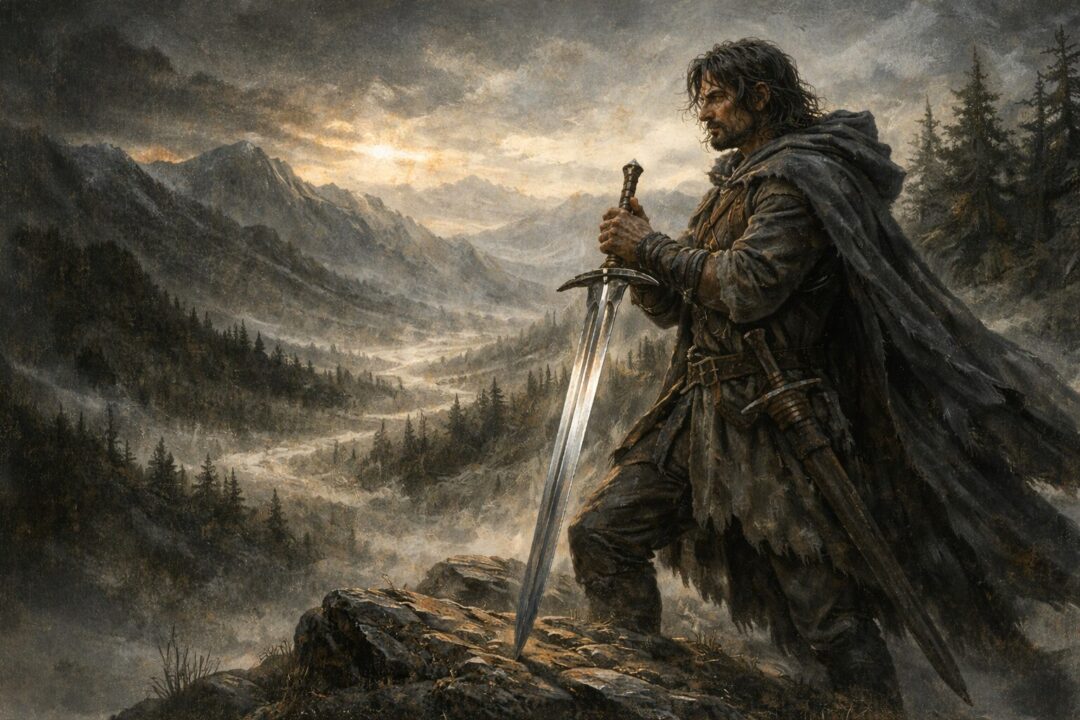
Most people think an heirloom is supposed to do one thing.
It is supposed to connect you to the past in a way that feels steadying. It should carry honor, memory, continuity. It should tell you who you are.
In Middle-earth, that is often true.
Ancient objects preserve lineage. They carry names, histories, and the memory of older days. A house that has lost almost everything may still keep one thing that proves it once stood in greatness.
But Aragorn’s greatest heirloom does not feel comforting in that way.
It feels heavy.
Because what he inherits is not a sign that the past has been preserved safely. It is a sign that something went terribly wrong and has remained unresolved for generations. When Aragorn reveals the blade in Bree and later at Rivendell, it is not whole. It is the Sword that was Broken.
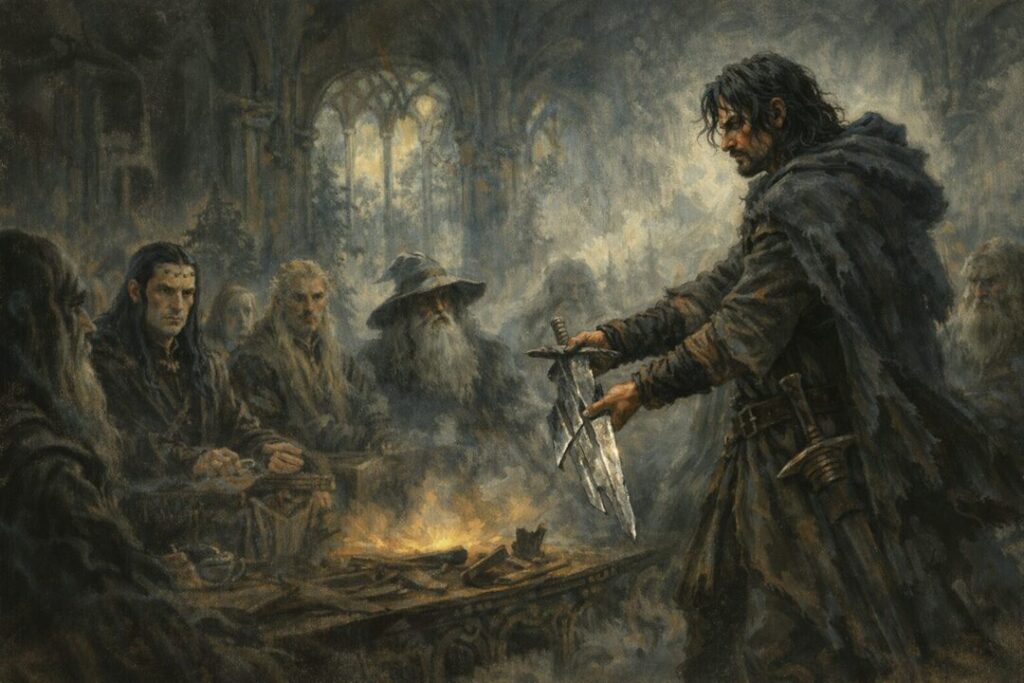
The heirloom is broken before the man who inherits it can use it
That detail matters more than it first appears.
Aragorn does not inherit Narsil as a triumphant royal weapon. He inherits its shards. The sword had broken beneath Elendil in the Last Alliance, and Isildur used the hilt-shard to cut the Ring from Sauron’s hand. After that, the pieces were preserved by the heirs of Isildur. Aragorn himself says the sword had been treasured by his line when all other heirlooms were lost.
That means the object he carries is already marked by catastrophe.
It comes down to him not as a completed inheritance, but as a remnant of defeat.
That is the first reason it feels more like a burden than a gift.
A gift can be enjoyed at once.
A burden demands something first.
And the sword demands restoration before it can become what it is meant to be.
Aragorn does not inherit comfort, only unfinished duty
The texts are careful about how Aragorn is presented.
He is the heir of Isildur, but he is not living like a king. He is a Ranger, weather-stained, suspicious to others, wandering far from any throne. When Boromir doubts him, Aragorn does not deny the greatness of his ancestry, but he answers in a strikingly restrained way: “I am but the heir of Isildur, not Isildur himself.” He then speaks of a hard life and a long one.
That is not the voice of a man cushioned by inheritance.
It is the voice of someone whose inheritance has given him responsibility long before it has given him any visible reward.
This is what makes the shards of Narsil such an unusually powerful heirloom. They do not simply prove descent. They embody everything that has not yet been repaired.
The North-kingdom is gone.
The line has dwindled.
The heir lives in labor and obscurity.
The object itself remains broken.
In other words, Aragorn does not receive an inheritance that says, “This greatness is yours.”
He receives one that says, “This loss is now yours to answer for.”
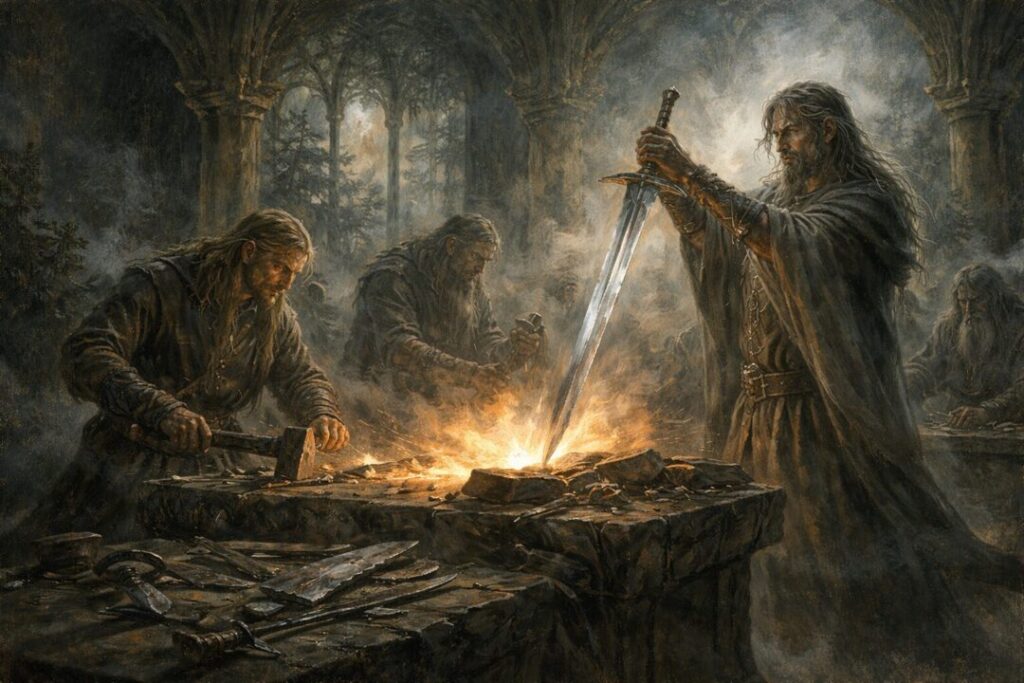
The sword carries memory, but also pressure
Middle-earth often treats memory as sacred.
But memory is not always gentle.
In Aragorn’s case, the sword preserves not only the memory of Elendil’s stature, but also the memory of failure, fall, and delay. The line of Isildur endured, but it endured without a crown. The heirloom survived, but the kingdom it symbolized did not. Even the old rhyme associated with Aragorn points forward, not backward: the blade that was broken must be renewed, and the crownless must become king.
That future tense is important.
The heirloom is not saying that the past was glorious.
It is saying that the past has placed a claim on the future.
And that is exactly how burdens work.
They do not merely sit in memory. They create obligations.
Aragorn cannot inherit the shards innocently. To bear them is to bear the knowledge that his line’s story is still unfinished, and that the unfinished part now rests with him.
Even love is delayed by the burden of inheritance
One of the clearest signs that Aragorn’s inheritance is a weight rather than a privilege appears in the tale of Aragorn and Arwen.
When Elrond perceives Aragorn’s love for Arwen, he does not treat it as a private matter detached from lineage and destiny. He warns Aragorn that a great doom awaits him, that many years of trial lie ahead, and that he shall neither have wife nor bind any woman to him in troth until his time comes and he is found worthy of it. Tolkien Gateway’s quotation page preserves this wording from Appendix A, and the summary tradition of the tale consistently reflects the same condition: Aragorn must rise to his full inheritance before the union can be fulfilled.
That means the burden reaches far beyond politics.
It shapes his personal life.
It delays joy.
It turns inheritance into discipline.
Aragorn does not simply possess a noble line. He has to live up to it under conditions that cost him decades.
That is why the broken sword is so fitting a symbol for him.
His inheritance is not only ancient.
It is suspended.
Everything in his life is waiting for a restoration that has not yet come.
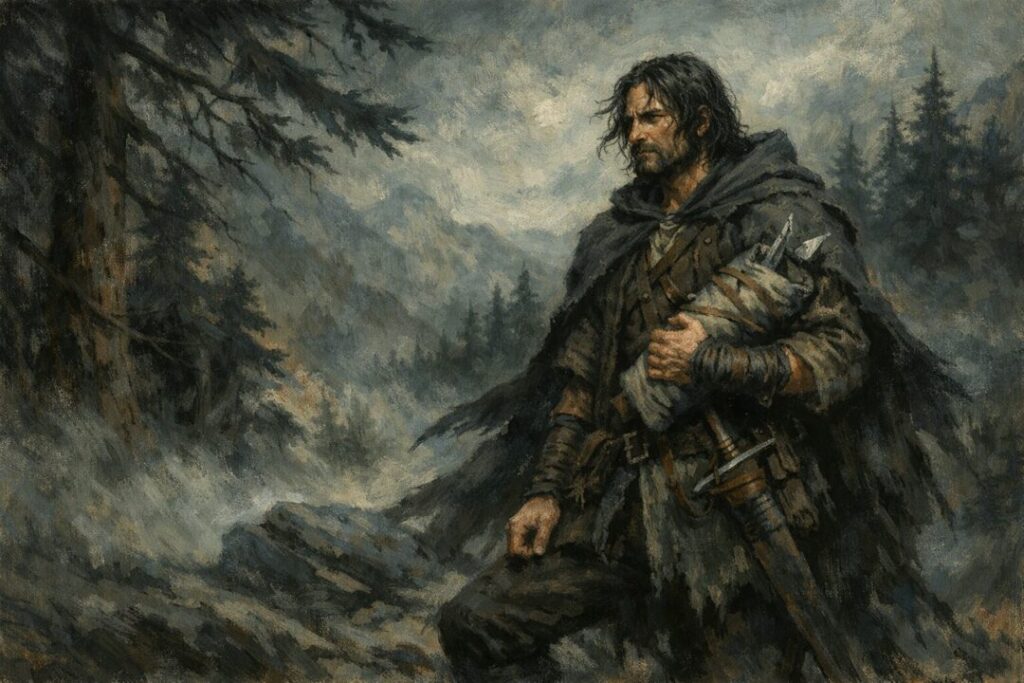
The sword is almost useless until the hour of testing arrives
At Bree, Aragorn even acknowledges the practical strangeness of carrying it. When he draws the broken blade, he says, “Not much use is it, Sam? But the time is near when it shall be forged anew.”
That line tells us something important.
The sword is not being carried because it is presently useful in the ordinary sense. It is carried because of what it means, and because of what it awaits.
That makes it unlike a normal inheritance.
A normal inheritance secures the present.
This one waits for a crisis.
It belongs to prophecy, to memory, and to identity under pressure. Aragorn later says that it was spoken of among his people that it should be made again when the Ring, Isildur’s Bane, was found. The sword is therefore tied not just to ancestry, but to the re-emergence of an old evil and to the last chance of answering an old failure.
So the heirloom does not let the past sleep.
It wakes when danger returns.
And when it wakes, it calls the heir to become more than a keeper of relics.
It calls him to act.
Reforging does not erase the burden — it fulfills it
When Narsil is reforged into Andúril, the story does not suddenly reveal that the old burden meant nothing.
It reveals that the burden had a purpose.
The sword becomes whole only when the world enters its decisive hour. Aragorn openly identifies himself with the reforged blade before Éomer, declaring that this is the Sword that was Broken and is forged again. The object becomes public proof that hidden inheritance has moved into visible responsibility.
But even here, the emotional logic stays the same.
The sword is not a luxury.
It is the moment when long obligation finally becomes unavoidable.
Aragorn’s claim is no longer something he can carry privately through the wild. It must now be tested in war, in healing, in judgment, and in whether he can actually be the king the broken line has been waiting for.
The gift, if it can be called that, comes only on the far side of immense cost.
Why this heirloom feels so different from ordinary treasure
Many treasured objects in Middle-earth are beautiful because they preserve a world.
The shards of Narsil are different because they preserve a wound.
They do not represent a house safely continuing in strength. They represent a house surviving in diminishment until the right person can bear the cost of renewal. That is why Aragorn’s inheritance feels so emotionally sharp. He is not being handed prestige in finished form. He is being handed fracture, expectation, and memory that has not yet found rest.
This is also why the object suits his character so perfectly.
Aragorn is not a man who begins in possession. He begins in endurance.
He wanders.
He serves in secret.
He waits.
He refuses to force what has not yet ripened.
The broken sword mirrors all of that.
It belongs to a story where inheritance is real, but not easy.
Where legitimacy exists, but cannot be cheaply claimed.
Where the past gives not only honor, but debt.
The deeper meaning of the broken sword
In the end, Aragorn’s heirloom matters because it expresses one of the deepest patterns in Middle-earth:
the right to inherit does not remove the need to suffer, wait, or prove faithful.
Sometimes the object passed down through generations is not there to make life easier.
Sometimes it exists to remind the heir that something remains undone.
That is what makes the shards of Narsil feel less like a gift and more like a burden.
They do not tell Aragorn to admire his fathers.
They tell him to answer for them.
And only when he does does the inheritance become whole.
That is why the Sword that was Broken is one of the most powerful heirlooms in Middle-earth.
Not because it is ancient.
Not because it is royal.
But because it shows, with unusual clarity, that some inheritances do not arrive as comfort.
They arrive as a call.
Sources & Notes
- J.R.R. Tolkien, The Lord of the Rings, Book I, Chapter 10, “Strider” — introduces Aragorn at Bree as the heir carrying the Sword that was Broken, including his rueful “Not much use is it, Sam?” before its renewal.
- J.R.R. Tolkien, The Lord of the Rings, Book II, Chapter 2, “The Council of Elrond” — gives the history of Narsil: broken beneath Elendil, used by Isildur against Sauron, and treasured by Elendil’s heirs when other heirlooms were lost.
- J.R.R. Tolkien, The Lord of the Rings, Book II, Chapter 2, “The Council of Elrond” — Aragorn’s “I am but the heir of Isildur, not Isildur himself” supports the article’s distinction between inherited claim and completed kingship.
- J.R.R. Tolkien, The Lord of the Rings, Book II, Chapter 3, “The Ring Goes South” — the shards are reforged in Rivendell as Andúril, showing the heirloom becoming usable only when the Ring-quest begins.
- J.R.R. Tolkien, The Lord of the Rings, Appendix A, “The Tale of Aragorn and Arwen” — Elrond’s condition that Aragorn must be found worthy and rise to his full inheritance shows how lineage delays personal happiness as well as politics.