Helm’s Deep is usually treated as the moment Rohan finally meets the war.
But Rohan does not enter that gorge as a whole people answering a clear call.
It arrives already damaged.
This is why the book-version of Helm’s Deep feels so tense even before the first ladder goes up: the defenders aren’t simply facing a large enemy. They are facing an enemy who has already pushed through the outer guard, struck the homes behind it, and forced the Rohirrim to fight while still trying to understand how the war even started.
The missing piece sits west of Edoras, near Isengard, at the place where a river becomes a border.
The Fords of Isen.
They are easy to overlook because they do not get a long, cinematic chapter in The Two Towers. You don’t “watch” them unfold the way you watch the Deeping Wall.
Instead, you see what comes after—and if you follow those traces carefully, they explain almost every desperate compromise Rohan makes on the road to the Hornburg.
Why the Fords matter
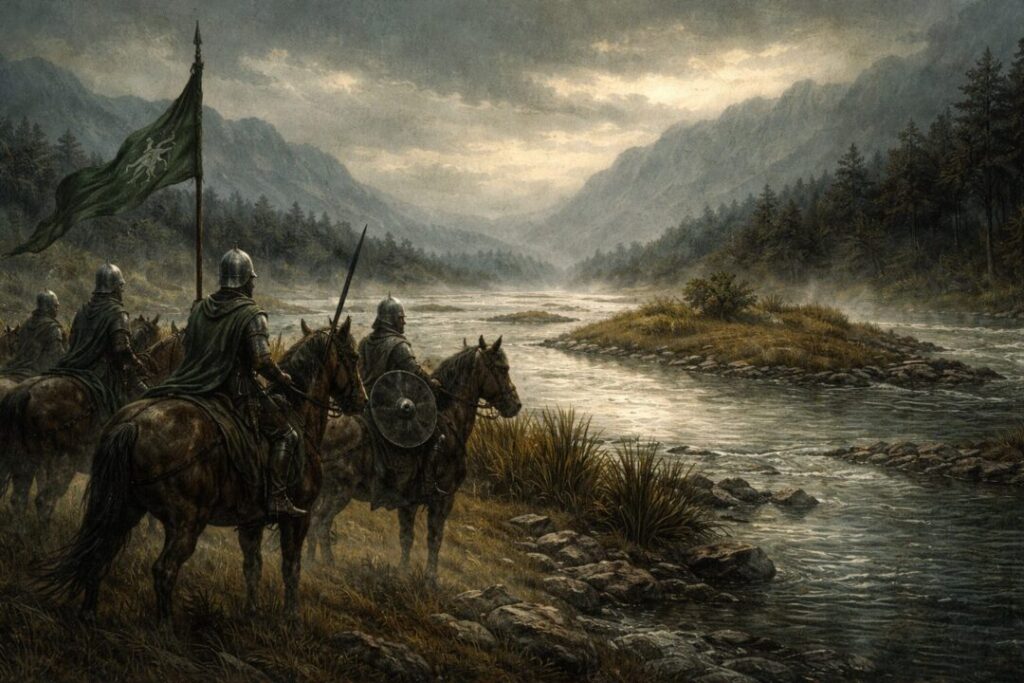
The Isen (Angren) runs down from the Misty Mountains and forms a natural boundary between Rohan and the lands around Isengard and Dunland.
The Fords are the usable crossing-point.
Hold them, and you slow anything coming out of Isengard into the Westfold.
Lose them, and you don’t just lose a skirmish—you lose time. You lose coordination. You force your defense to collapse inward, valley by valley, until only the mountains give you an edge.
That is what makes the Fords so revealing: they are not “a battlefield.”
They are a door.
And in the War of the Ring, that door is attacked twice.
Two battles, not one
This is the part many readers miss on a first read, because the main story is moving quickly and your attention is pulled toward Gandalf’s return, Théoden’s awakening, and the rush toward Helm’s Deep.
But the campaign against Rohan begins at the river.
There are two engagements at the Fords of Isen, close together—one in late February and another at the beginning of March.
The first battle costs Rohan something it cannot easily replace: Théodred, Théoden’s son, falls there.
If you only know the story through the main narrative, Théodred can feel strangely distant—important, but offstage.
That distance is exactly the point.
His death is not used as a standalone tragedy with a long mourning scene. It is used as a strategic wound. It happens at the frontier, and then the frontier begins to fail.
In Unfinished Tales, the account is expanded into a fuller military narrative (marches, commands, timing, confusion). Even if you treat that chapter as supporting detail rather than required reading, its existence tells you something important: Tolkien knew this battle was structurally significant enough to deserve a proper explanation.
What the main text shows you instead: the aftermath
In The Two Towers, the Fords appear most vividly not as action—but as burial.
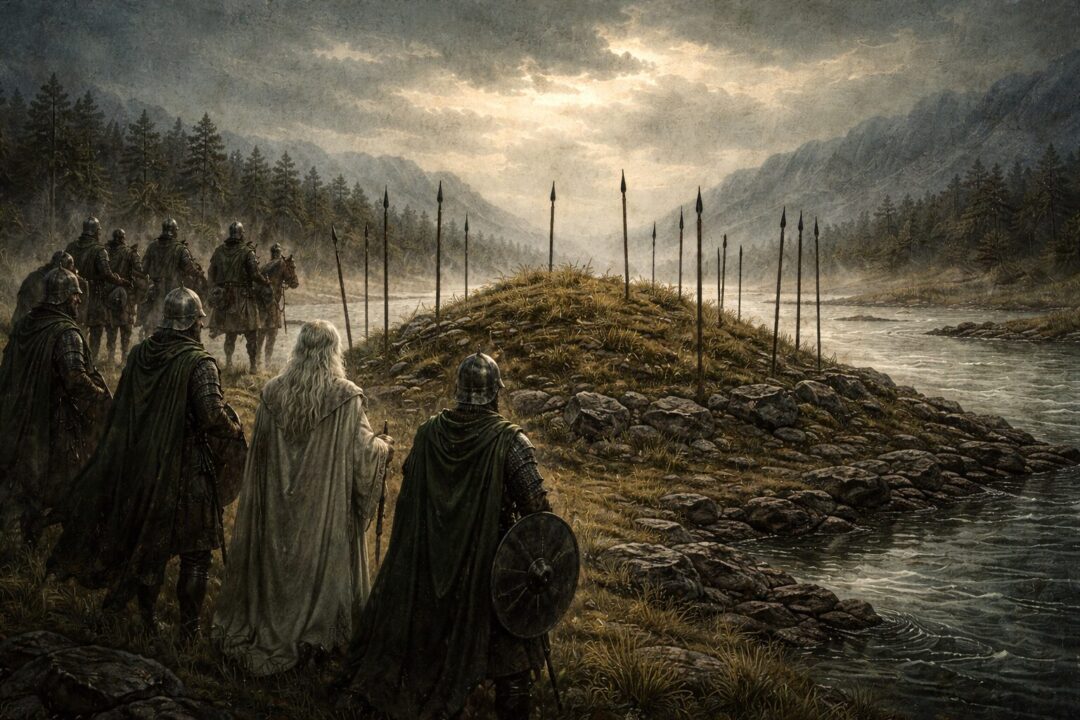
After the victory at Helm’s Deep, Théoden rides with Gandalf toward Isengard. And on the way, they come upon a raised mound at the crossing, ringed with spears:
“Here lie all the Men of the Mark that fell near this place,” said Gandalf.
“Here let them rest!” said Éomer. “And when their spears have rotted and rusted, long still may their mound stand and guard the Fords of Isen!”
This is not a casual detail.
It means the dead are not gathered up and taken home. They are left where they fell—because the place itself is part of the defense, part of the memory, part of the line that should not have broken.
And notice something else: the mound is spoken of as if it will “guard” the Fords when living men could not.
That is how thin the line has become.
Why Helm’s Deep is chosen at all
Once you recognize that the Isen has already been fought over—twice—the logic of Helm’s Deep sharpens.
Helm’s Deep is not “the plan.”
It is the place you fall back to when the wider Westfold can’t be held in the field.
In the book, Théoden is not confident about it. He is moving because he must. The Westfold-men are already part of the fighting force, already marching, already carrying the weight of attack.
And after the battle, we are told directly that Théoden considers Saruman’s actions a “great injury” to him and to the land.
This matters because it frames Saruman’s war the way it actually functions in the story: as a rapid, border-breaking assault that forces Rohan to respond while half-ready.
If the Fords had held, Théoden might have had more than “caves and walls” as his best option.
But the war reaches the farms and valleys before the king can properly gather strength.
The other half of the mystery: where did Gandalf’s reinforcements come from?
One of the most satisfying reveals in Helm’s Deep is the dawn-arrival:
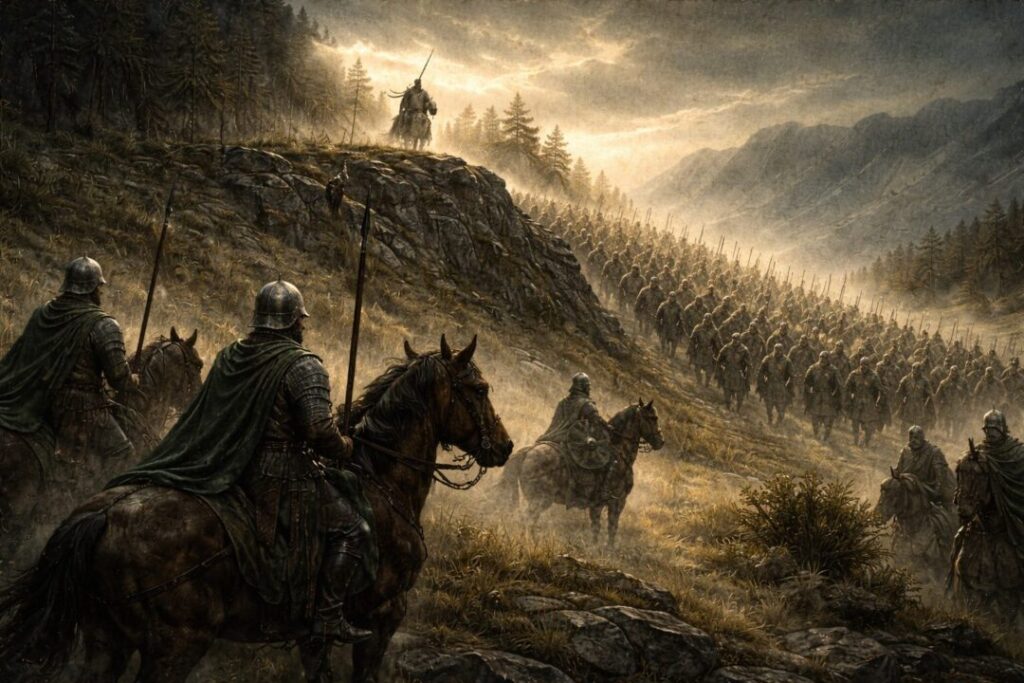
A rider in white appears on a ridge.
Horns sound.
And behind him come a thousand men on foot.
Among them is Erkenbrand, and the Riders shout his name.
In a lesser story, this would be a convenient “save.”
In this story, it is a consequence.
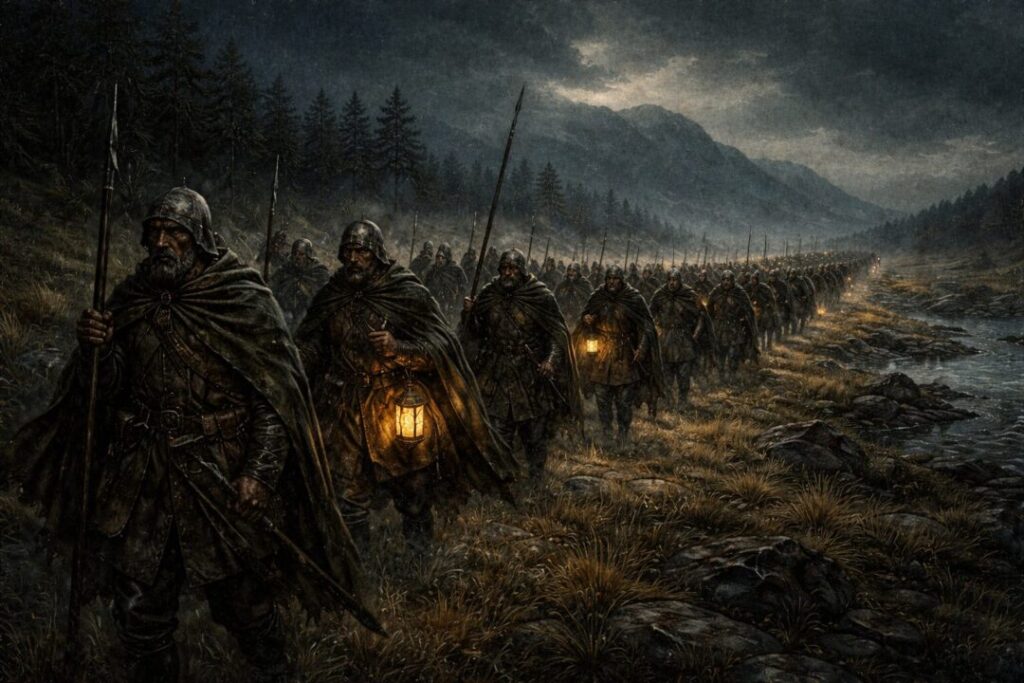
Those footmen are not a random army. They are Westfold-men—survivors and gathered companies—pulled together under pressure, after the frontier has already been contested.
The book even emphasizes their marching through the night as part of what makes the victory possible.
Once you put the Fords back into the sequence, the dawn-arrival stops looking like luck and starts looking like the last successful act of Rohan’s shattered defense: scattered strength, re-formed just in time.
And that tells you what the second battle at the Fords really did.
It didn’t merely “happen.”
It scattered Rohan.
The emotional effect: why the siege feels so grim
The deeper reason the Fords matter is not just military.
It’s tonal.
If Helm’s Deep were the first blow, it would feel like a heroic stand by a fully gathered kingdom.
But it isn’t.
It is the stand made by a people whose prince has already fallen, whose border has already been forced, whose homes are already in danger, and whose king has had years of delay pressed onto him by Wormtongue’s influence (a separate thread, but one that makes the timing even more painful).
By the time Théoden is making decisions in the open air again, Saruman’s war has already moved.
That is why everything is urgent.
That is why the Mark can’t “wait for a better moment.”
And it’s why the Fords of Isen—barely shown, mostly mourned—are one of the most important “unseen” battles in the whole Rohan arc.
What Unfinished Tales adds (and what we should be careful not to overstate)
If you read the chapter “The Battles of the Fords of Isen” in Unfinished Tales, you get what the title promises: a more tactical, sequential explanation of how these clashes unfold and why the defense fails.
But even without quoting it line by line, the main conclusion aligns with the signals in The Two Towers:
- The Fords are contested more than once.
- Théodred’s death happens there, early, and the Mark pays for it.
- Westfold-men end up fighting as infantry at Helm’s Deep, and their presence is portrayed as hard-won, not leisurely assembled.
- The dead at the crossing are memorialized where they fell, as if to hold the line in memory when the living could not.
That is enough to restore the missing fight to its proper place in the story.
The quiet conclusion: the war begins where Rohan is weakest
Helm’s Deep is famous because it is dramatic.
The Fords of Isen are important because they are diagnostic.
They reveal where Rohan is exposed: at the western crossings, close to Isengard, close to long hostility with Dunland, and close to a king who has been slowed at the worst possible time.
If you want to understand why Rohan rides to the Deep with such urgency—why the defense is half-field, half-refuge—don’t start at the Hornburg.
Start at the river.
Because by the time the ladders rise at Helm’s Deep, the real question is no longer “Can Rohan win a battle?”
It is:
How much of Rohan is still intact enough to be saved?
Sources & Notes
- J.R.R. Tolkien, Unfinished Tales, “The Battles of the Fords of Isen” — extended account of the two fights at the crossing, Théodred’s death, and the failure of Rohan’s western defense.
- J.R.R. Tolkien, The Lord of the Rings, Appendix B, “The Tale of Years” — dates Théodred’s fall at the First Battle of the Fords of Isen and the renewed fighting before Helm’s Deep.
- J.R.R. Tolkien, The Lord of the Rings, Book III, Chapter 7, “Helm’s Deep” — shows the Hornburg as Rohan’s refuge under Saruman’s assault and Gandalf’s return with Erkenbrand and Westfold men.
- J.R.R. Tolkien, The Lord of the Rings, Book III, Chapter 8, “The Road to Isengard” — Théoden’s company passes the mound of the Rohirrim who fell near the Fords, fixing the battlefield as both frontier and memorial.