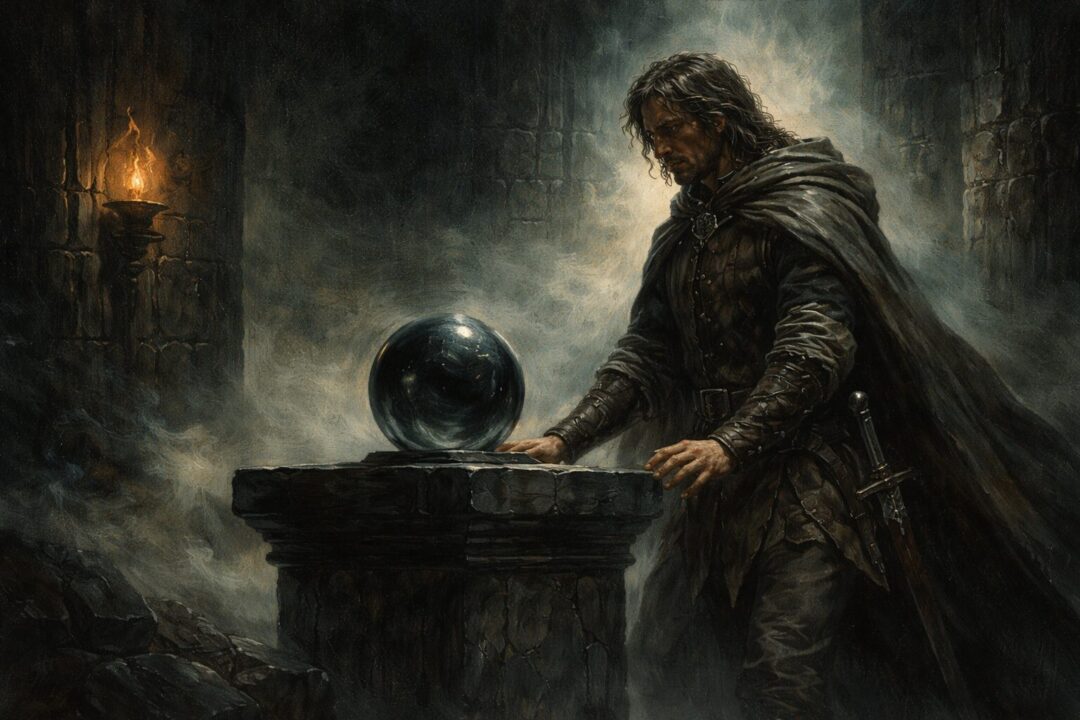
The palantír feels, at first glance, like the closest thing Middle-earth has to a perfect solution.
Distance collapses. Messages travel without riders. The gaze passes through stone and mountain. A king can sit in a tower and look out across lands he has not walked in years.
So when Aragorn takes the Orthanc-stone and masters it, it is natural to ask the next question:
If he could see so far—and if he could connect mind-to-mind—could he have used that same Stone to find the other palantíri that were “lost”?
The short answer is that the texts make this unlikely—not because it is forbidden, but because the palantíri are not built to behave like a seeking device. They do not “ping” one another. They do not reveal their own locations on demand. And the very conditions that made several Stones lost in the first place are the same conditions that would make them almost impossible to recover by sight.
But the real answer is more interesting than a simple no.
Because to understand why Aragorn probably could not do it, you have to understand what a palantír actually is in the lore: what it shows, how it is directed, what limits it, and what “lost” means in each case.
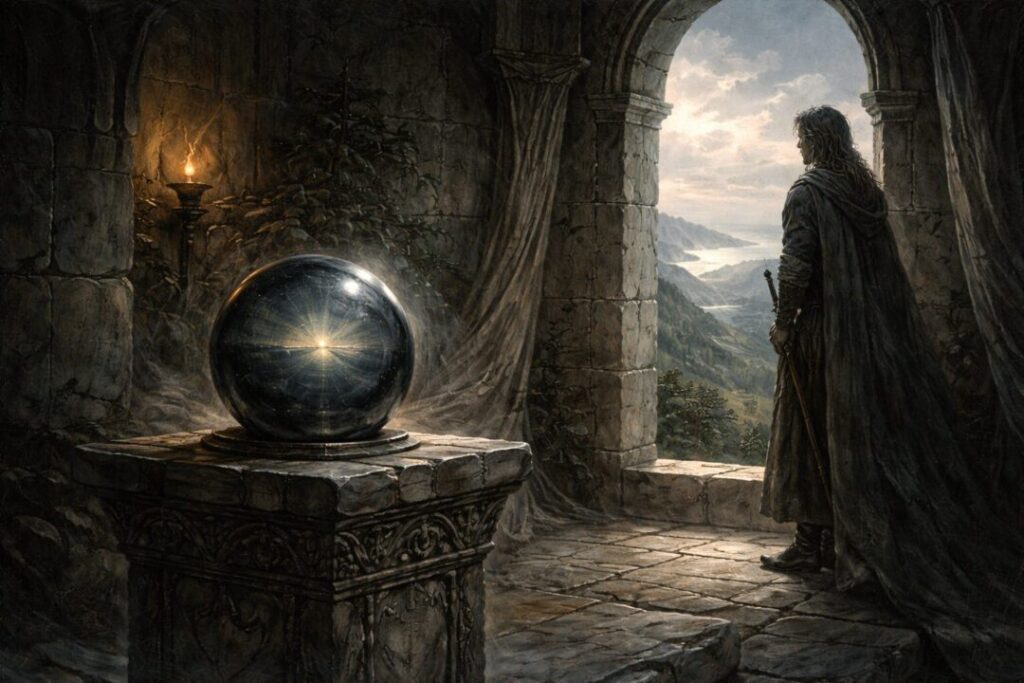
What a palantír can actually do
The palantíri have two main functions in the texts:
- Communication (mind-to-mind contact through paired Stones)
- Seeing afar (visions of places at a distance)
Both functions depend on the will of the user. A palantír is not a passive crystal ball that simply reveals whatever you want. The Unfinished Tales material emphasizes that a surveyor can concentrate the vision onto a particular point—but that this concentration is tiring and can become exhausting. The visions are not effortlessly precise; they can be a “welter” of sights from which the user must pick out what matters.
That matters immediately for our question.
Finding a lost Stone is not like looking for a city, a mountain range, or an army on the move. It is looking for a small object that may be buried, submerged, shrouded, or simply in darkness.
And the palantíri have a crucial limitation:
They cannot provide light.
They can see through physical obstacles, but the texts indicate that darkness hinders or blocks the vision. This is why the palantír is terrifying in war—because it can look through walls or rock—yet still limited if what you seek lies in unlit places.
“Lost,” for several Stones, effectively means “lost into darkness.”
The seven Stones in Middle-earth—and what “lost” means for each
In the late Third Age, the palantíri are not all in play.
Some are accounted for; some are ruined; some are missing in ways that are more final than they sound.
The Orthanc-stone (Isengard)
This is the Stone Aragorn uses.
It is not the largest, but it is usable, and Aragorn can wrest it to his will. This alone tells you something: mastery is possible for a rightful, strong-minded user.
But it does not tell you that mastery grants omniscience.
The Anor-stone (Minas Tirith)
Denethor uses this Stone, and it contributes to his despair. After his death, the palantír remains, but the text tradition indicates it is effectively “burned” in the sense that it is no longer useful for wide vision—its images are trapped in a final, destructive fixation.
So even one of the Stones that is not physically lost becomes, in practice, unusable.
That alone should warn us against imagining palantíri as stable tools that always behave the same way.
The Ithil-stone (Minas Ithil / Minas Morgul)
When Minas Ithil falls, the Stone is long assumed destroyed. But Unfinished Tales makes clear that it was possible it was seized and came into Sauron’s possession—and the story strongly implies that this is exactly what happened, because Sauron uses a palantír against Saruman and Denethor.
Could Aragorn use the Orthanc-stone to locate the Ithil-stone?
Only if the Ithil-stone were being used, or if Aragorn could direct the vision to wherever it was kept—and even then, what would he be looking for? A Stone may show what lies near another Stone, but that is not the same as revealing the Stone itself like a beacon.
And after the fall of Barad-dûr, the fate of Sauron’s palantír is not cleanly narrated as a recovery. If it survived, it may be buried in ruin or hidden away—again, “lost” into darkness and rubble.
The Osgiliath-stone (lost in the Anduin)
This is one of the clearest examples of why “just look for it” fails.
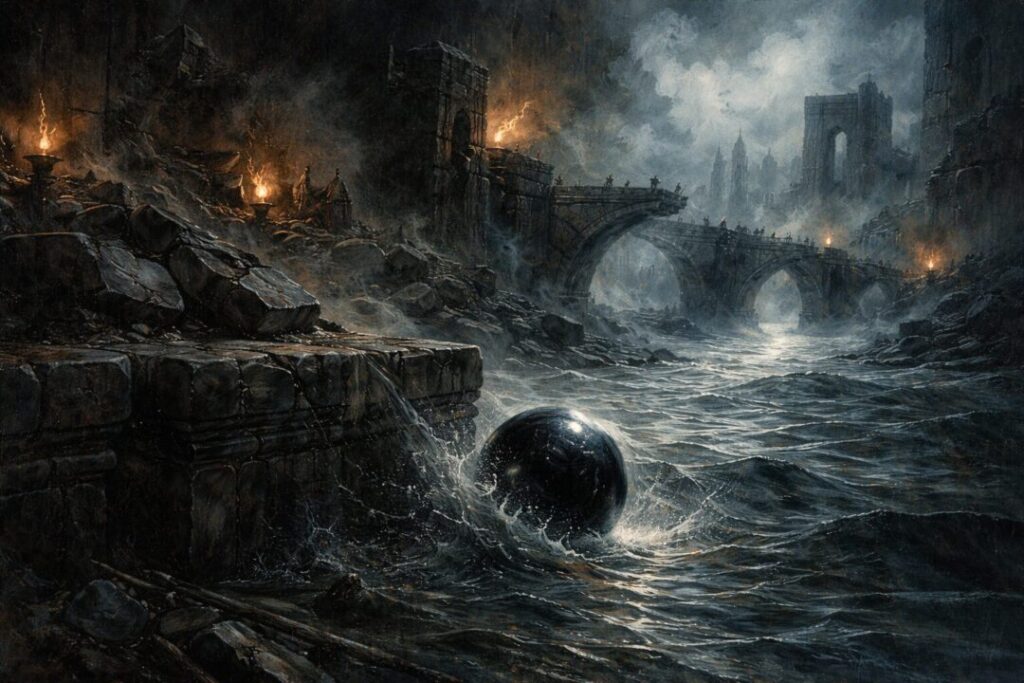
Appendix A records the loss of the palantír in the burning of Osgiliath during the Kin-strife. The Stone is effectively swallowed by the Anduin.
Now ask what that means for a palantír-user trying to find it.
If it lies under water, it lies under darkness. Even if the palantír can see through substances, the texts still make light a requirement for meaningful vision. A riverbed is not a well-lit hall. It is a dim world of shifting silt and shadow.
So even if Aragorn turned his will to the Anduin and tried to “concentrate” his sight, he would be searching for something that might not present itself visually at all.
He could stare into the Stone and see… a darkness that refuses to become a picture.
The Stones of Annúminas and Amon Sûl (lost with Arvedui)
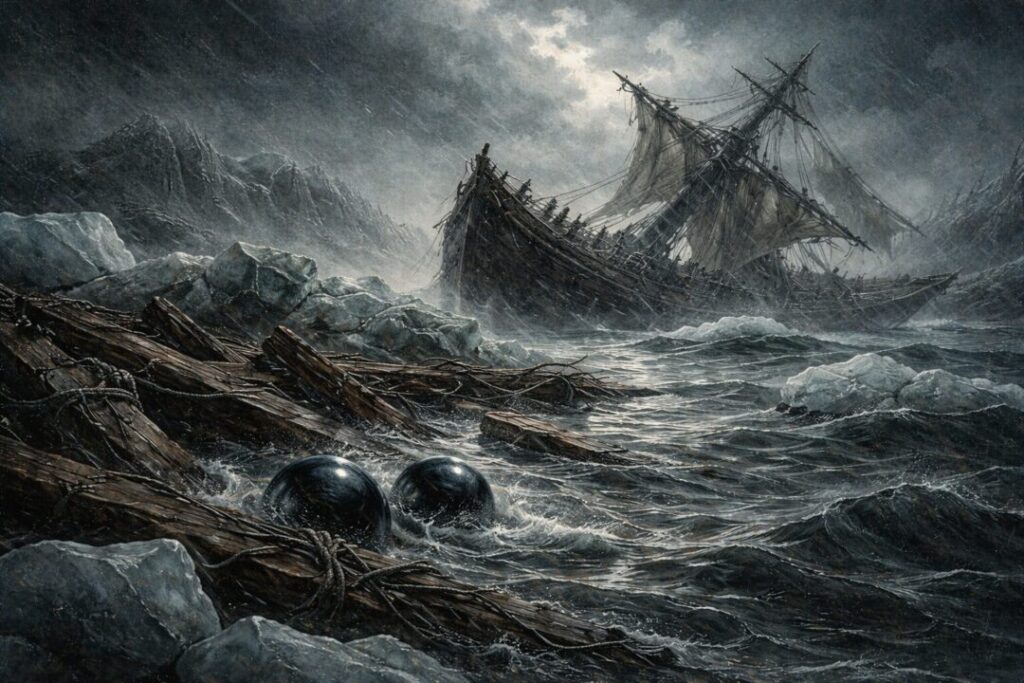
Appendix A records that Arvedui drowned in the Bay of Forochel, and with him the palantíri of Annúminas and Amon Sûl.
These Stones are not lost in a ruin you can excavate.
They are lost in ice and sea.
Even if the shipwreck’s location were known approximately, a palantír does not give you a bright outline of a sunken hull. And if the Stones lie deep, they lie again in unlit places.
This is the pattern that keeps repeating:
The Stones are not “lost” like a misplaced crown in a treasury.
They are lost like something that has fallen out of the world’s visible layer.
The Elostirion-stone (Tower Hills)
This Stone is the exception that proves the rule.
Appendix A notes that the Stone in the Tower Hills remained guarded by the Elves and was taken aboard the ship that bore the Ring-bearers west. But the lore tradition also makes clear that this Stone does not function like the others: it looks only West, toward the Straight Road and the Undying Lands.
So even if Aragorn had access to it (he does not), it would not help him find lost Stones in the sea or river.
It is a palantír with a purpose that is not “search,” but “longing.”
The hidden problem: range, orientation, and effort
Even if we set aside darkness, the lore still places friction in the act of seeing.
The Unfinished Tales discussion gives the idea of “proper distance” for the lesser Stones. The palantíri are not all equal; some are greater, some lesser. Their effective use over long distances is not simple.
A user must also orient the Stone and direct the gaze. This is not a satellite camera with a coordinate grid. It is closer to standing at a high window with an impossibly powerful lens and trying to find, in a vast world, the one detail you care about—without knowing exactly where it lies.
And the lore emphasizes fatigue.
This matters because a recovery attempt would not be one clean look.
It would be hours of exhausting concentration aimed at places where the result may be nothing but shadow.
So could Aragorn have done it?
If we speak conservatively, the texts support this conclusion:
Aragorn could not reliably use the Orthanc-stone to “find” the lost palantíri in the way modern readers imagine searching.
He could use the Stone to see afar. He could potentially direct his gaze toward known regions—Osgiliath, the Anduin, the Bay of Forochel—and hope chance and skill revealed something. But the conditions of loss (submersion, burial, ruin, darkness) are precisely the conditions that make palantír-vision least useful.
The palantír is not a finder.
It is a window.
And windows do not help you locate what has fallen into the dark underworld beneath the surface of history.
That is why the lost Stones stay lost—not because Aragorn lacked the right, but because the world had already swallowed them in the one way even Númenórean craft could not easily undo.
And once you see that, you start to understand the palantíri’s deeper role in the story:
They do not exist to solve Middle-earth’s problems.
They exist to show you how knowledge—partial, exhausting, vulnerable to manipulation—can become as dangerous as ignorance.
Because even Aragorn, rightful heir and strong of will, cannot turn a seeing-stone into certainty.
And that may be the most unsettling thing the lore is quietly saying.
Sources & Notes
This article is based on close reading and interpretation of Tolkien's published works and related source material where relevant.