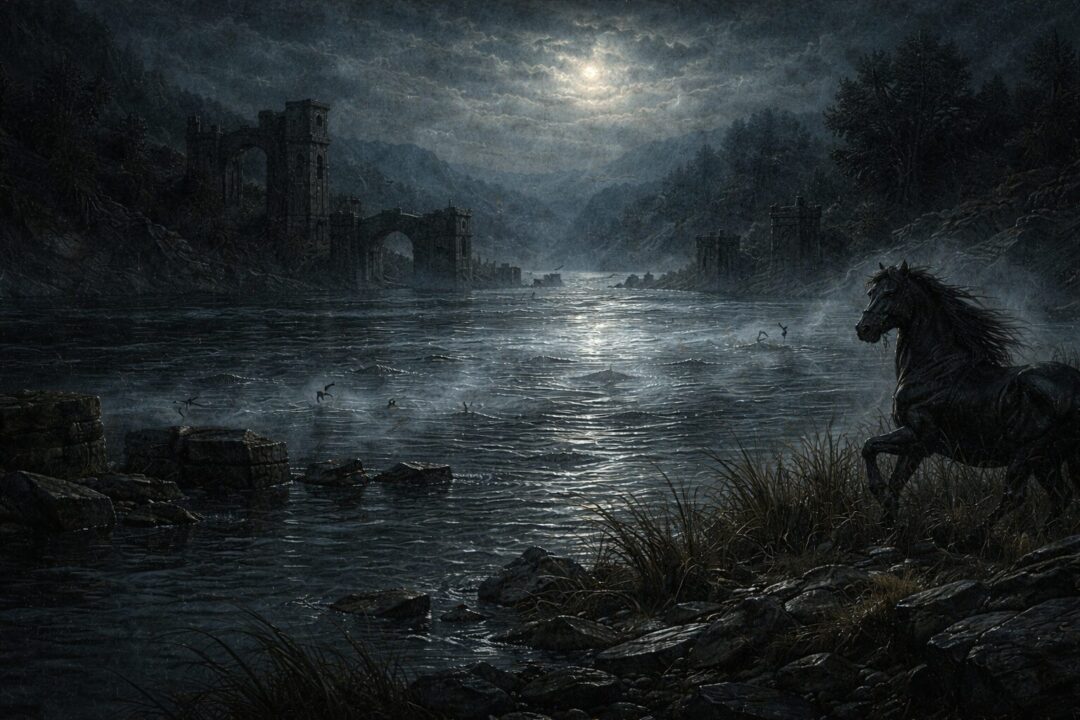
The Nazgûl are easy to remember as riders.
The Black Captain at the head of an assault. The nine shapes on the road. The fear that enters a room before they do. In The Lord of the Rings, they feel immediate—present, stalking, almost constant.
But Middle-earth is not mostly “War of the Ring.”
Most of its long Third Age is distance and delay: watchfulness, fading kingdoms, slow recoveries, and threats that gather strength offstage. And in that longer history, the Ringwraiths are not always visible at all.
That absence can mislead readers into imagining inactivity—centuries where the Nine did nothing, slept, or waited like props in storage.
The texts do not support that picture.
What they do support is something colder: long periods where the Nazgûl are present but withheld—kept in reserve, hidden, stationed, and used only when their particular function is needed.
Because the Nazgûl are not generals in the ordinary sense. Their greatest weapon is not tactics.
It is fear.
And fear works best when it is timed.
After the Last Alliance: disappearance is the point
The appendices place the first appearance of the Nazgûl around the middle of the Second Age, and Tolkien Gateway summarizes the same chronology: “About this time the Nazgûl… first appear.”
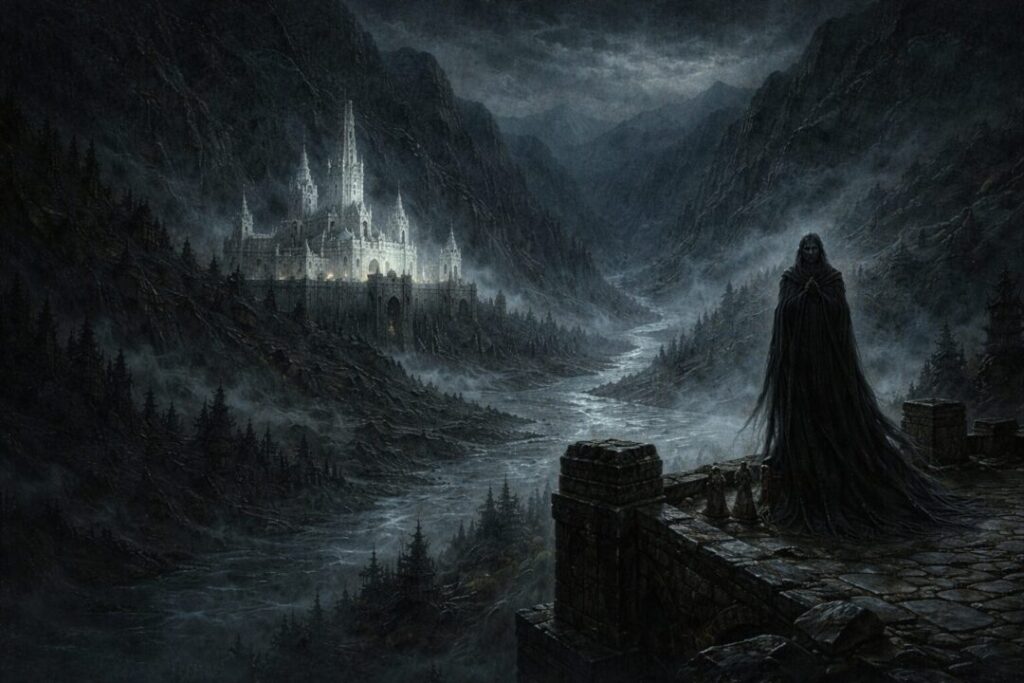
But the more important hinge is later: after Sauron’s overthrow at the end of the Second Age, the Ringwraiths do not stride into the Third as open tyrants. The tradition recorded in secondary summaries (drawing from the appendices) is blunt: when Sauron fell, “the wraiths faded into the shadows.”
That phrase matters because it describes a mode, not a single event.
The Nazgûl are tied to Sauron’s condition. When he cannot act openly, they do not act openly. When his strength is low or concealed, theirs is muted and concealed.
So the early “quiet centuries” are not a mystery to solve with invented missions. They are an intended strategic condition: the Nine are not absent so much as unrevealed.
The long return: from hidden terror to northern war
When the Nazgûl re-enter history, they do so through a familiar pattern: the Witch-king appears, gathers power, and builds a realm of dread rather than a normal kingdom.
The timeline tradition places the Witch-king’s rise in the north with the founding of Angmar around T.A. 1300. Tolkien Gateway’s Nazgûl article presents this as the period where the Ringwraiths “definitely reappeared” and the Witch-king founded Angmar as a war-machine against Arnor.
This is not “between wars” in the sense of peace—it is war, stretched thin over generations.
But notice what it implies about the Ringwraiths’ function. They are used where Sauron needs a slow destruction at distance: weakening kingdoms that might otherwise unify, breaking lines of descent, and turning politics into exhaustion.
Then, after the fall of the North-kingdom, the Witch-king vanishes from that theater. The texts do not give a detailed campaign journal of where he went day by day.
They do give one of the most telling single-line entries in the Tale of Years tradition: in T.A. 1980, the Witch-king comes to Mordor and “there gathers the Nazgûl.”
That entry is the sound of a door shutting.
Not a dramatic battle. A gathering.
A consolidation.
Minas Ithil: the war that creates a “quiet” stronghold
What follows is not subtle.
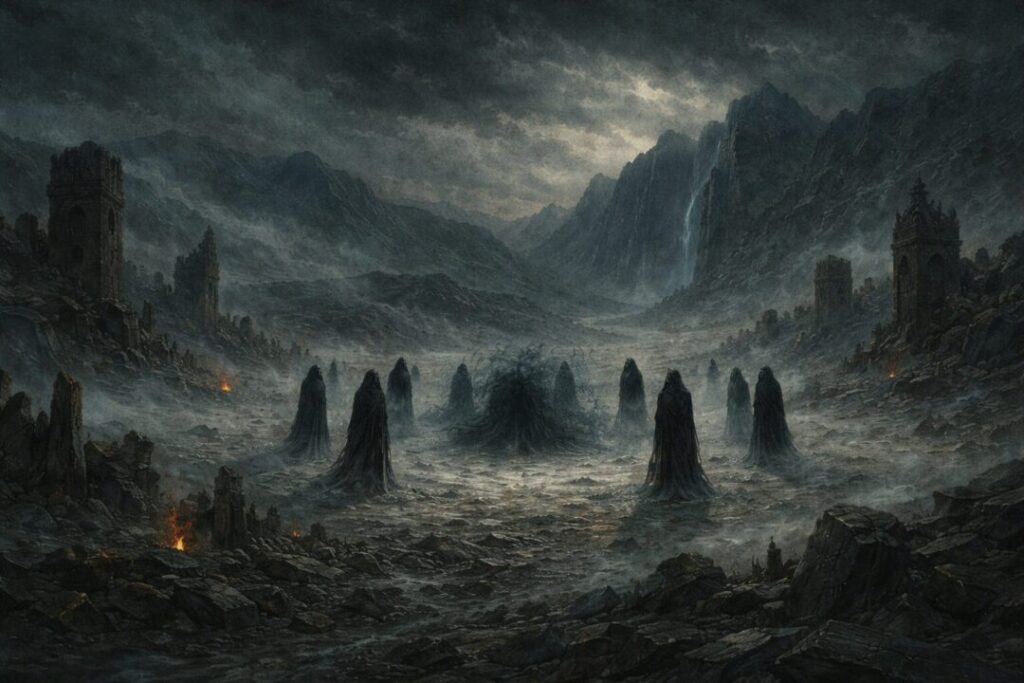
The Ringwraiths issue from Mordor and lay siege to Minas Ithil, taking it and turning it into their own place. Tolkien Gateway’s Mordor page preserves the key chronology: the first shadow in Mordor is linked to the Lord of the Nazgûl in 1980, and Minas Ithil is conquered by the Ringwraiths in T.A. 2002.
This is one of the clearest “between wars” pivots in the entire legendarium, because it creates the condition for the centuries that follow.
After Minas Ithil becomes Minas Morgul, the Nazgûl no longer need to roam to remain dangerous. They have a fixed point—a dreadful city on Gondor’s border—that serves as a permanent pressure.
From there, the West can be bled without constant conquest.
A garrison of fear is sometimes more effective than an advancing army.
The Watchful Peace: stillness as strategy
The Watchful Peace (T.A. 2063–2460) is often read as a pause where “nothing happens.”
But the tradition explicitly says the Nazgûl remain quiet in Minas Morgul during this period.
That is the point many fans forget: quiet does not mean absent.
It means contained.
Gondor watches Mordor. Mordor watches Gondor. And Minas Morgul sits like a wound that will not close. The Nazgûl do not need to raid openly for their presence to shape decisions. Their very existence changes where troops are stationed, which roads feel safe, and how much confidence Gondor can afford.
A “peace” where the enemy remains in a fortress on your border is not peace in the ordinary sense. It is a waiting posture with a blade left on the table.
And it suits the Nazgûl perfectly, because they are not builders of normal realms. They are instruments—kept ready.
Dol Guldur and the divided Nine: duty stations, not constant riding
Later, as Sauron’s shadow is forced out of Dol Guldur and he returns openly to Mordor, the Nazgûl appear again in a quieter logistical way.
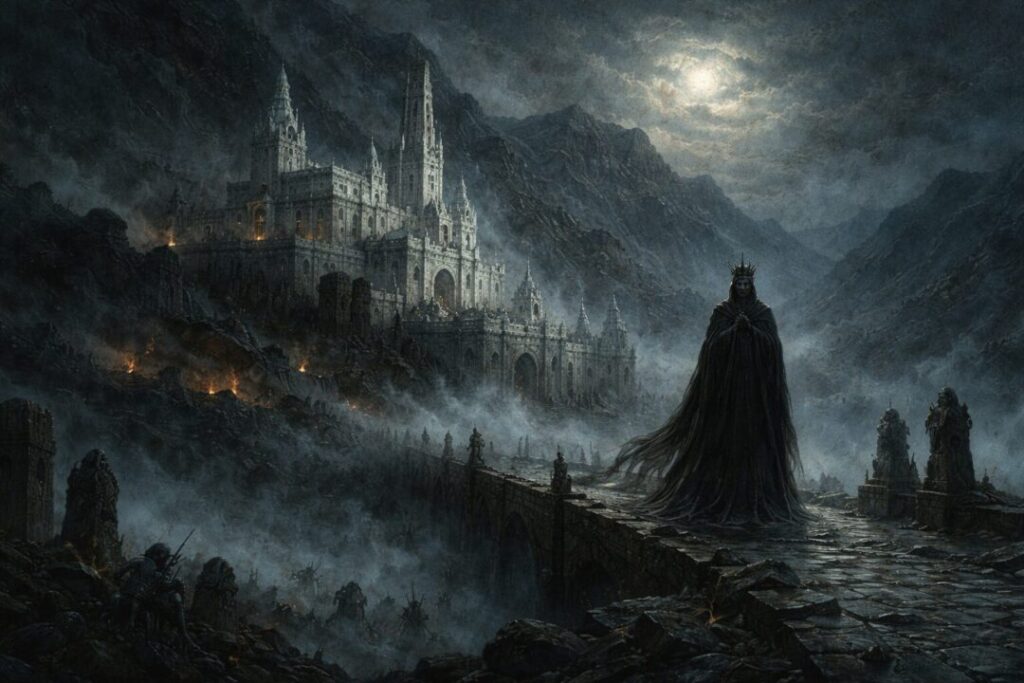
Tolkien Gateway’s Nazgûl page summarizes that in T.A. 2951, when Sauron declares himself openly, three of the Nazgûl are sent to Dol Guldur to garrison it.
This matters for “between wars” because it shows the Nine doing something unglamorous but crucial: holding territory, maintaining threat, and serving as the highest-level enforcers of Sauron’s will in key strongholds.
Seven in Minas Morgul. Two associated with Dol Guldur earlier in the Hunt material tradition.
Not nine riders always together—rather, the Nine used as pressure points.
It is the behavior of a regime that plans for centuries, not a band of roaming monsters.
3018: the “quiet” ends, and the offstage plan becomes visible
When the Nazgûl finally ride north to seek “Baggins of the Shire,” it can feel like a sudden escalation.
Unfinished Tales complicates that impression.
In “The Hunt for the Ring,” the Nazgûl are not simply unleashed as a panic move. The texts present them as part of a calculated sequence: an assault on Osgiliath, the breaking of the bridge, and then a shift—Sauron “stayed the assault,” and the Nazgûl were ordered to begin the search for the Ring.
Even the manner of their movement is described in unnerving terms: the Lord of Morgul leads them over Anduin “unclad and unmounted, and invisible to eyes,” yet still a terror to living things nearby.
That detail is important because it shows what the Nazgûl are in the “quiet centuries” as well: not always riders, not always visible figures, but a moving dread—deployed when secrecy matters.
So what did they do between wars?
As far as the primary tradition allows us to say with confidence:
- They faded and remained hidden when Sauron’s power was hidden.
- They returned as a long-term weapon in the north through the Witch-king’s realm and the destruction of Arnor.
- They gathered in Mordor as Gondor’s watch failed, then took Minas Ithil and turned it into a lasting border-fortress of fear.
- During the Watchful Peace they remained quiet in Minas Morgul—still present, still shaping the West by threat rather than action.
- As Sauron reasserted himself, they were stationed and used strategically, including a garrison at Dol Guldur.
- And when the final hunt began, they moved with secrecy and terror in ways that reveal they were never merely “black riders,” but instruments of an unseen war.
The quiet centuries are not empty.
They are the Nazgûl doing what they do best: not fighting battles every year, but ensuring that whenever battles come, the world is already tired, already divided, already afraid.
And once you see that, their appearance on the Road in 3018 stops feeling like the beginning of the threat.
It feels like the moment the threat finally steps into the light.
Sources & Notes
- J.R.R. Tolkien, The Lord of the Rings, Appendix B, “The Tale of Years”: the Nazgûl first appear in the Second Age, long before their Third Age deployments.
- J.R.R. Tolkien, The Lord of the Rings, Appendix A, “Eriador, Arnor, and the Heirs of Isildur”: the Witch-king comes to Angmar around T.A. 1300 and directs the long war against Arnor.
- J.R.R. Tolkien, The Lord of the Rings, Appendix B, “The Tale of Years”: in T.A. 1980 the Witch-king comes to Mordor and gathers the Nazgûl; in T.A. 2000–2002 they besiege and capture Minas Ithil.
- J.R.R. Tolkien, The Lord of the Rings, Appendix B, “The Tale of Years”: Sauron’s open return in T.A. 2951 includes sending three Nazgûl to reoccupy Dol Guldur.
- J.R.R. Tolkien, Unfinished Tales, “The Hunt for the Ring”: the Nazgûl’s 3018 movements are coordinated with the assault on Osgiliath and the secret search for the Shire.