Tom Bombadil creates one of the most uncomfortable moral questions in The Lord of the Rings.
Not because he is sinister.
Not because he is false.
But because he seems good—and yet leaves evil standing nearby.
That tension is easy to miss on a first reading, because Tom arrives in the story as a rescuer.
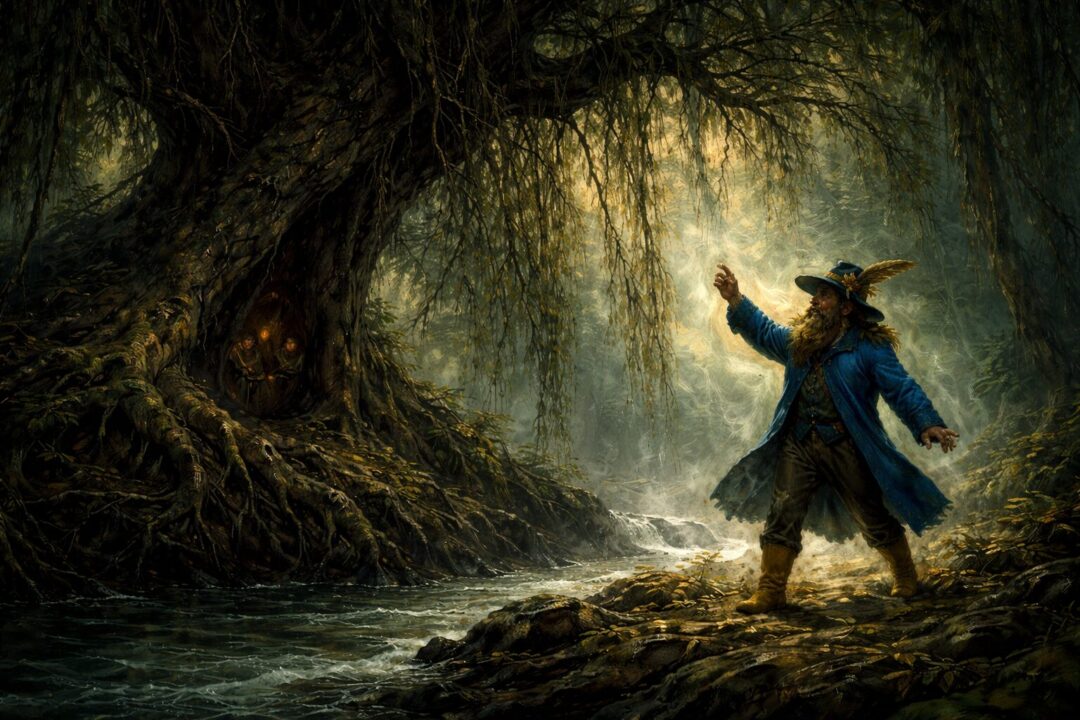
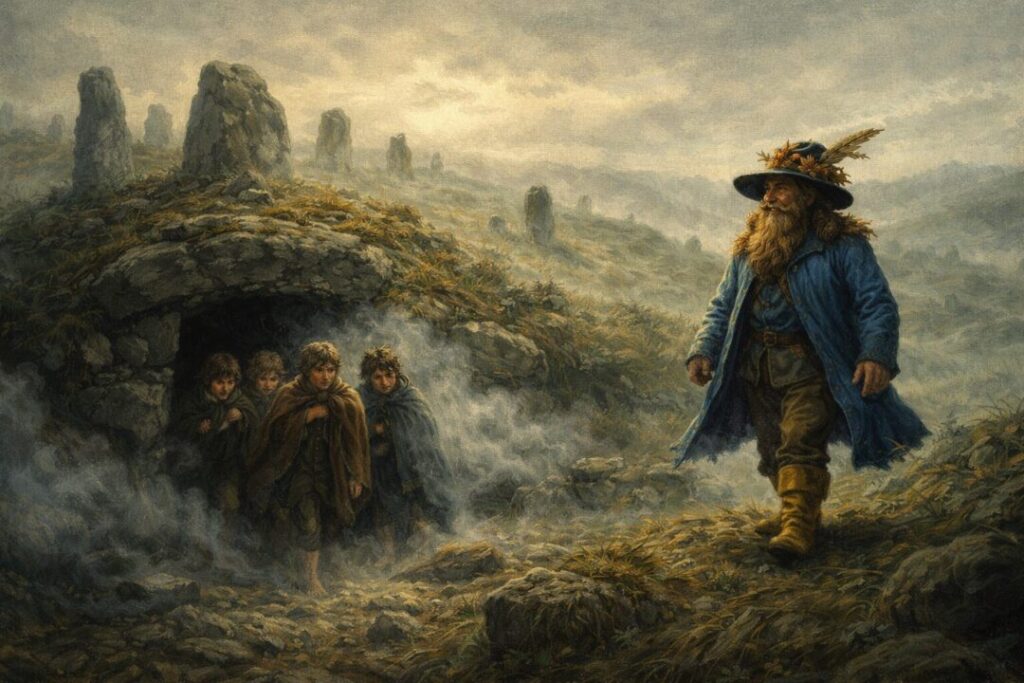
The hobbits are trapped by Old Man Willow, and Tom saves them. Soon after, they fall into the hands of a barrow-wight, and again Tom comes, breaks the danger, and brings them out. In both episodes he acts with startling ease, as if the hostile powers around him cannot finally withstand him when he is present.
So the obvious question follows almost at once.
If Tom can do this, why is the Old Forest still dangerous at all?
Why is Old Man Willow still there? Why are the Barrow-downs still haunted? Why does Tom deliver travelers from peril without removing the peril itself? Those are not modern questions imposed on the story from outside. They grow naturally from the text, because the story itself later raises a similar issue at the Council of Elrond: if Bombadil is so untouched by the Ring, why not give it to him?
The answer given there helps explain the Old Forest too.
But to see it clearly, you have to begin with Goldberry’s description of Tom.
When Frodo asks who Tom Bombadil is, Goldberry does not explain him in the ordinary way. She says simply, “He is.” Then she calls him the Master of wood, water, and hill. Yet when Frodo assumes that this means the land belongs to Tom, Goldberry corrects him immediately. No, she says: that would be a burden. The trees and grasses and living things belong each to themselves. Tom is the Master, but not because he owns them.
That is the first clue, and it matters more than it first appears.
In much of Middle-earth, power is expressed through possession, command, or ordering. Sauron is the most obvious example: his will seeks to dominate other wills. But even good rulers govern realms, hold borders, defend lands, and exercise stewardship. Tom is different. The text does not present him as lord of the Old Forest in the political sense, and Goldberry explicitly resists that reading. His mastery is real, but it is not ownership.
That difference may explain why he does not “fix” everything.
To fix the Old Forest in the total sense many readers imagine would mean imposing a final order on it—turning a living, willful, dangerous place into something permanently subdued. But Goldberry’s words point in the opposite direction. In Tom’s country, things remain themselves. Even the phrase that the living things “belong each to themselves” suggests a world that is not meant to be absorbed into one central controlling will.
This does not mean Tom approves of evil.
The text does not support that.
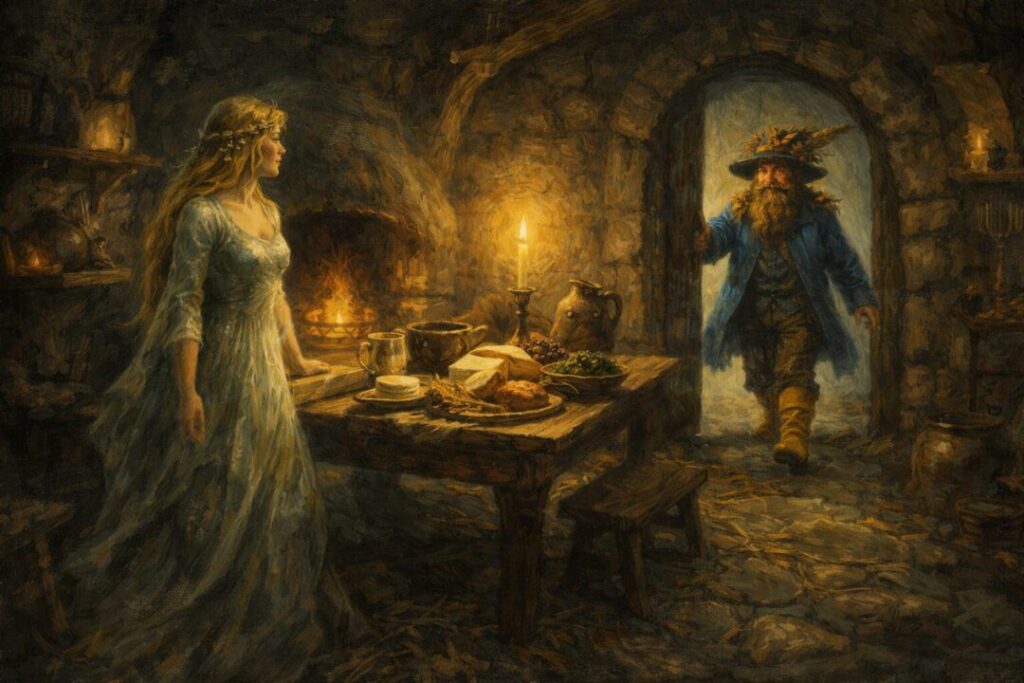
He plainly opposes the immediate threats faced by the hobbits. He commands Old Man Willow to release Merry and Pippin. He casts out the barrow-wight and frees the captives. Whatever else Bombadil is, he is not morally indifferent in the sense of being unable to distinguish peril from safety or malice from hospitality. His house is one of the story’s brief places of deep rest. The hobbits are healed there, fed there, and sent onward with counsel.
But helping is not the same thing as remaking the whole region.
That is where the Council of Elrond becomes decisive.
When Bombadil is suggested as a possible keeper of the Ring, Gandalf rejects the idea in careful terms. He does not say that Tom is weak in the ordinary sense. He says rather that the Ring has no power over him; Bombadil is his own master. Yet Gandalf adds two limits that matter enormously: Tom cannot alter the Ring itself, and he cannot break its power over others. He has withdrawn into a little land, within bounds he has set, and he will not step beyond them. If entrusted with the Ring, he would not grasp its necessity in the same way the Council does; he would soon forget it, or most likely throw it away.
That passage does several things at once.
First, it confirms that Bombadil’s goodness is not expressed through participation in the great struggle for dominion. He is outside that contest in a way almost no one else is. The Ring cannot hook into him because the kind of control it offers does not answer to his mind at all.
Second, it shows that immunity is not the same as universal competence.
Bombadil is not corrupted by the Ring, but he is also not the one who can solve the Ring’s problem. That distinction is crucial. Readers sometimes treat freedom from domination as if it automatically implied the ability to defeat domination everywhere. The text does not say that. In fact, it says the opposite. Bombadil stands outside the Ring’s logic, but that very distance is part of why he is unsuited to carry the central burden of the age.

Then Galdor sharpens the point further.
The power to defy Sauron, he says, is not in Bombadil—unless such power is in the earth itself. And yet Sauron can torture and destroy even hills. That is one of the most important lines in the discussion, because it removes a common misunderstanding. Tom’s presence may feel elemental, ancient, and rooted in the land, but the text does not present him as an all-conquering answer to the world’s evils. He is not the hidden trump card of Middle-earth.
So why is he still good?
Because in this part of the story, goodness is not defined by total intervention.
That is the real pressure point.
Modern readers often assume that if a being has power and does not eliminate every nearby evil, that failure must be moral. But The Lord of the Rings does not always measure goodness that way. There are many kinds of good in the book: the good of kingship, the good of pity, the good of endurance, the good of stewardship, the good of renunciation. Bombadil seems to embody a kind of good that refuses possession itself. He does not dominate the land, even though he is called its Master. He does not seize the Ring, even though it does not affect him. He does not turn every wild thing into a tamed extension of his own will.
That does not make him less moral than Aragorn or Gandalf.
It makes him differently placed.
Tom’s goodness is local, immediate, and non-possessive. He helps those who come within his hearing. He gives shelter. He gives warning. He gives rescue. But he does not seem to seek the conversion of the whole world into peace by force of mastery. The text even suggests that “ownership” would be the wrong category for him altogether; Goldberry calls it a burden.
And that may be why the Old Forest remains itself.
Not wholly healed.
Not wholly safe.
Not wholly claimed.
There is also a broader literary point here.
In the letters, Bombadil is described as an intentional enigma, and as something that belongs to the larger world beyond the central Ring-story. That does not solve his identity, and it should not be used to force a definitive answer about what he “really” is. But it does support the idea that Bombadil represents something the main conflict cannot absorb: a mode of being outside the usual struggle for power.
That fits the narrative surprisingly well.
Bombadil appears early, before the great councils and campaigns, almost as if the book briefly opens a window onto an older kind of existence—one not organized around possession, ambition, or even strategic necessity. Then the story moves on. The War of the Ring is still unavoidable. Sauron must still be opposed. But Bombadil remains as a quiet reminder that not all goodness takes the form of rule, and not every good thing exists to be weaponized against the main enemy.
In that light, the Old Forest being left “unfixed” is not proof that Tom fails to be good.
It may be proof that his goodness is of a kind that refuses to become domination, even for righteous ends.
He will save the lost traveler.
He will break the immediate spell.
He will open his door, set food on the table, and send frightened people onward stronger than they were before.
But he will not make the whole world into his burden.
And in Middle-earth, that may be one of the reasons he remains so strangely uncorrupted.
Because Tom Bombadil does not fail to fix everything because he is less good than the heroes.
He leaves some things unfixed because his goodness is not built on possessing the world at all.
Sources & Notes
- J.R.R. Tolkien, The Lord of the Rings, Book I, Chapter 6, “The Old Forest” — shows Old Man Willow as a real local malice that Bombadil can command and restrain without turning the Forest into a tamed realm.
- J.R.R. Tolkien, The Lord of the Rings, Book I, Chapter 7, “In the House of Tom Bombadil” — gives Goldberry’s “He is” answer and her correction that mastery is not ownership: the trees, grasses, and creatures belong each to themselves.
- J.R.R. Tolkien, The Lord of the Rings, Book I, Chapter 8, “Fog on the Barrow-downs” — has Bombadil break the barrow-wight’s power and rescue the hobbits, proving active aid without implying a permanent cleansing of the Downs.
- J.R.R. Tolkien, The Lord of the Rings, Book II, Chapter 2, “The Council of Elrond” — explains why Bombadil cannot be made the answer to the Ring: he is his own master, bounded in his land, and unable to break the Ring’s power over others.
- J.R.R. Tolkien, The Letters of J.R.R. Tolkien, Letter 153 — treats Bombadil as deliberately meaningful without reducing him to a plot-solution, especially in relation to renunciation of control and possession.