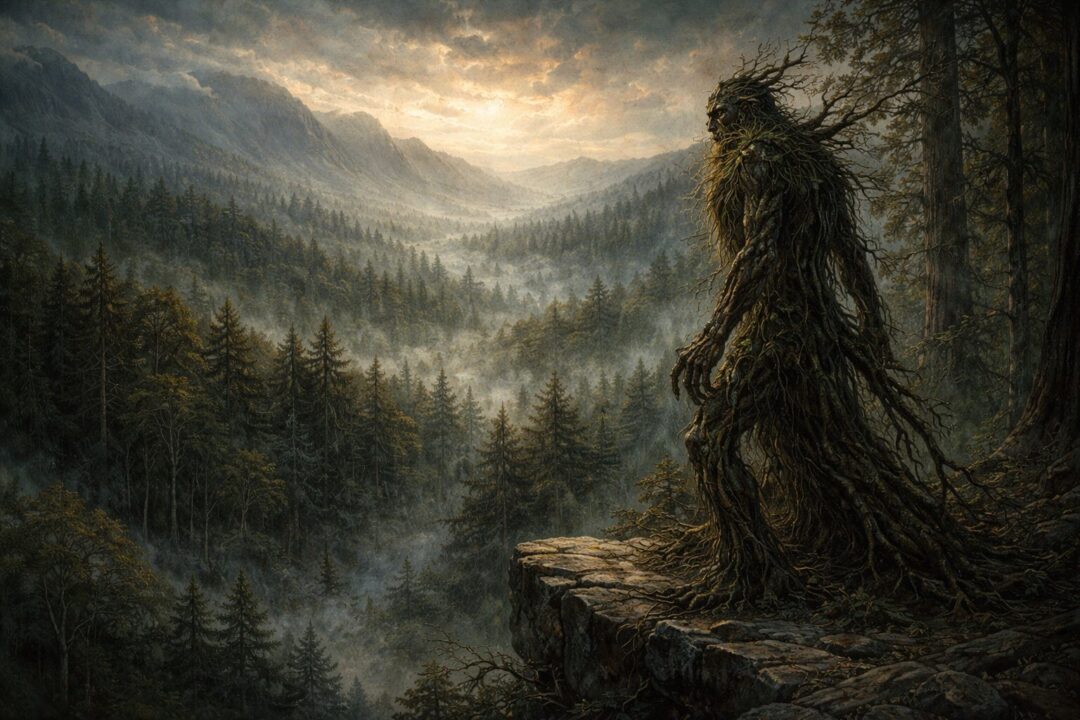
The Ents are easy to reduce.
If you only meet them in outline, they can seem like a striking but simple idea: ancient tree-giants who live in Fangorn, speak slowly, and become angry when Saruman starts cutting down the forest.
That is true as far as it goes.
But it does not go far enough.
Because once Treebeard begins to speak, the scale of the Ents’ story changes. Fangorn stops being merely a strange wood on the edge of Rohan, and starts to look like something far more important: one of the last surviving fragments of an older Middle-earth. The Ents are not simply local guardians keeping watch over their favorite trees. They are the remaining shepherds of a world that has already been diminished once, and is now being diminished again.

The Ents were made to guard living things, not to build kingdoms
The first thing to keep in view is that the Ents were not accidental beings of the forest. In the tradition behind The Lord of the Rings, they exist because Yavanna feared what would happen to growing things in a world filled with axes, fire, and hunger for mastery. The Ents were therefore set in the world as protectors: “Shepherds of the Trees,” not rulers of cities or founders of empires.
That matters, because it means their entire role is defensive and preservative from the beginning.
They are not trying to expand Fangorn. They are not trying to dominate their neighbors. They are not even especially interested in the affairs of other peoples until those affairs break into the woods. Their purpose is tied to the protection of living, growing things that cannot defend themselves against stronger, quicker, more destructive hands.
So when readers ask what the Ents were protecting, the most basic answer is obvious: trees.
But Treebeard’s own memory pushes the answer far beyond that.
Fangorn is not just a forest. It is a remnant.
The decisive detail comes when Treebeard explains that Fangorn was once only the “East End” of a vast wood. In other words, the forest in which Merry and Pippin find themselves is not a complete realm in its own right. It is what remains after immense loss. Tolkien Gateway’s summary of the tradition reflects this clearly: Fangorn is one of the small remnants of the ancient forests that once covered much more of western Middle-earth.
That changes the emotional weight of the Ents immediately.
They are not just inhabitants of an old forest.
They are survivors inside a shrinking one.
The Fellowship, for the most part, never pauses over this. Fangorn is known as perilous, ancient, and difficult to enter. That much is clear. But to outsiders, it still appears as a place—one dangerous region among many. To Treebeard, it is the remainder of something that used to stretch far beyond the boundaries anyone now takes for granted.
And once you understand that, the Ents’ slowness looks different.
They are not merely slow by temperament. They belong to an order of life that measures loss across ages.
The Ents had already watched one world disappear
The story becomes sadder when Treebeard turns to the Entwives.
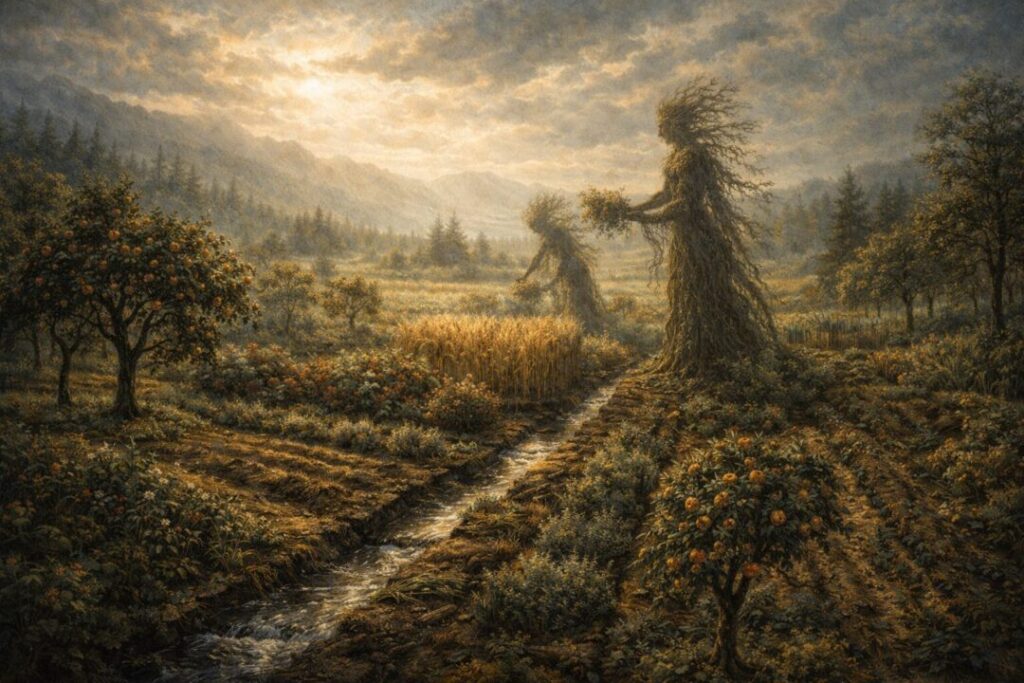
His account does not present the Ents as a people living in wholeness until Saruman arrives. Their grief is older than the War of the Ring. The Entwives had long ago moved away from the wandering forests because they preferred order, planting, and cultivated growth. They crossed the Anduin, made gardens in the lands that later became the Brown Lands, and even taught agriculture to Men. Then their gardens were ruined, and the Entwives were lost.
This is one of the most important details in the whole Ent story.
The Ents are already a broken people before Isengard falls.
There are no Entings. The old union between Ent and Entwife is gone. Treebeard still speaks in hope rather than certainty when the subject comes up, and later material suggests destruction is a likely end for the Entwives, though the narrative itself leaves the matter unresolved. That uncertainty is important. The text does not let us state their fate as absolute fact inside the main story.
What can be said with confidence is this: by the end of the Third Age, the Ents are not guarding a flourishing future.
They are guarding what has not yet vanished.
What Saruman threatens is not lumber, but continuity
This is why Saruman’s assault on the trees near Isengard matters so much.
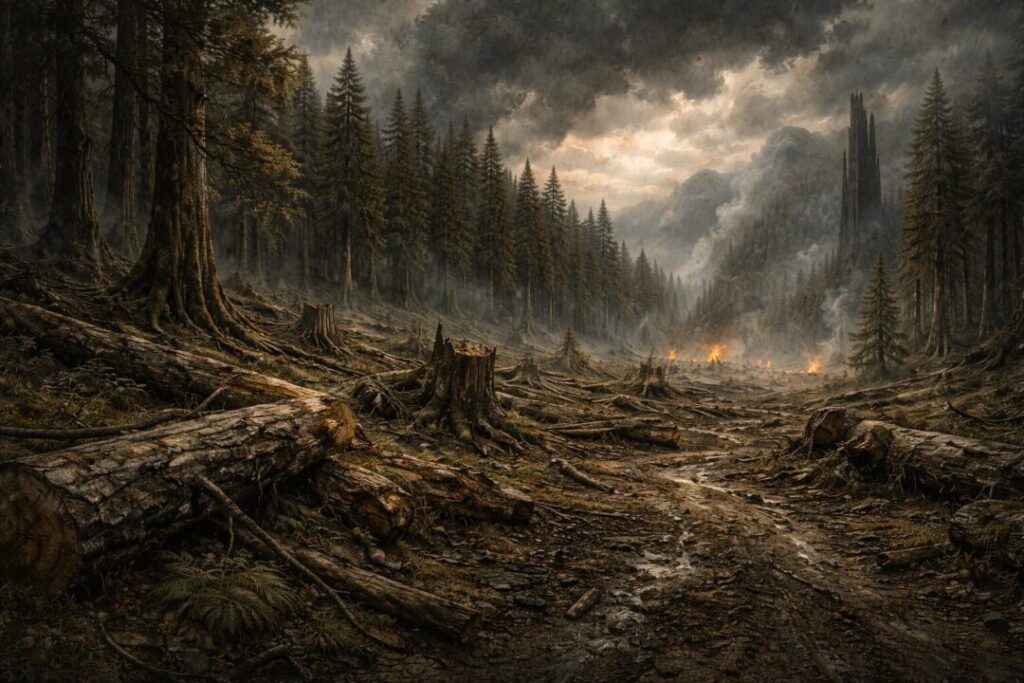
From the outside, it can look practical: fuel for furnaces, timber for war, industrial destruction on a military frontier. That is all true. But for the Ents, the cutting is worse than resource extraction. Saruman is attacking one of the last surviving continuities with the elder world. He takes what is old, living, and unmastered, and reduces it to material. Tolkien Gateway notes that Saruman had once been welcomed by Treebeard and learned much from him, which makes the betrayal even sharper.
The Ents’ response therefore is not just environmental anger in a modern sense.
It is civilizational memory answering violence.
Treebeard’s grief over the destroyed trees is personal, but it is also historical. Many of those trees were his friends; yet the deeper wound is that the same pattern is happening again. First the great forests diminish. Then the Entwives are sundered and lost. Then the surviving remnant beside Isengard is fed into fires by a mind that values power over growth.
That is why the march on Isengard feels so unlike the marches of Men.
The Ents are not campaigning for conquest.
They are intervening at the edge of annihilation.
Not everyone in the Fellowship is equally blind
The title needs one careful distinction.
Strictly speaking, “no one in the Fellowship understood” is too absolute if taken literally. Gandalf clearly knows Treebeard, calls him the guardian of the forest, and has a deeper sense than the others of what kind of being he is dealing with. So the truest version of the claim is that almost no one in the Fellowship fully understands what the Ents are preserving, and even Gandalf only grasps it from outside the Ents’ own long memory.
Merry and Pippin come closest because they actually listen.
That is a subtle but important feature of the Fangorn chapters. The hobbits do not “solve” Treebeard. They do not become masters of ancient lore. But they stay long enough to hear the sorrow underneath the slowness. Through Treebeard’s memories, they begin to see Fangorn not as a backdrop, but as an endangered inheritance.
The rest of the Fellowship never really has that experience.
Aragorn, Legolas, and Gimli know enough to respect the forest. Gandalf knows far more than they do. But the full emotional meaning of Fangorn belongs first to Treebeard, and then, in a smaller way, to the two hobbits who hear him out.
The deepest thing the Ents protect is a way of growth the world is losing
This is where the answer becomes clearest.
The Ents are protecting trees, yes. They are protecting Fangorn, yes. But beneath both of those is something larger: they are protecting the survival of unmastered, ancient, slow-growing life in a world increasingly shaped by haste, utility, and domination.
That is why the contrast with the Entwives matters so much.
The Entwives loved ordered growth, gardens, fruitfulness, and peace. The Ents loved the great wild trees and the untamed woods. The text does not condemn either side. In fact, the old song of the Ent and the Entwife makes their difference feel tragic rather than moralized. But by the end of the Third Age, the Entwives are gone, their ordered lands are gone, and Fangorn remains as one of the few places where the older forest-life still endures.
So what the Ents are preserving is not merely bark and leaf.
They are standing over the last visible proof that Middle-earth was once richer, wider, and less broken than the people now moving through it can easily imagine.
Why this makes Treebeard one of the saddest figures in Middle-earth
Treebeard is often remembered for his age, his humor, or his explosive wrath at Isengard.
But his real tragedy is quieter.
He is ancient enough to remember more living world than anyone around him. He is patient enough to go on guarding what remains. And he is lonely enough to know that even victory cannot restore what has already been lost. The Ents can break Saruman’s works. They cannot simply call back the unbroken forests of earlier ages, and they cannot undo the long sundering from the Entwives.
That is the hidden weight inside the Fangorn story.
The Ents are not just defending a forest from an enemy.
They are defending one of the last surviving fragments of an older order of life.
And almost no one passing through truly sees that until Treebeard speaks.
Sources & Notes
- J.R.R. Tolkien, The Silmarillion, “Of Aulë and Yavanna” — Yavanna’s fear for the olvar and Manwë’s answer about spirits that will walk in the forests ground the Ents as “Shepherds of the Trees.”
- J.R.R. Tolkien, The Lord of the Rings, Book III, Chapter 4, “Treebeard” — Treebeard tells Merry and Pippin that Fangorn is only the east end of a once-vast forest, turning the wood into a remnant rather than a mere local wilderness.
- J.R.R. Tolkien, The Lord of the Rings, Book III, Chapter 4, “Treebeard” — the account of the Entwives, their gardens beyond Anduin, and the lack of Entings supports the article’s sense of the Ents as already diminished before Saruman’s attack.
- J.R.R. Tolkien, The Lord of the Rings, Book III, Chapter 4, “Treebeard” — Treebeard’s grief over trees with voices, names, and long friendship explains why the Ents are protecting living memory, not just timber.
- J.R.R. Tolkien, The Lord of the Rings, Book III, Chapter 8, “The Road to Isengard” — the wrecked woods around Isengard and Saruman’s furnaces show the assault on Fangorn as industrial consumption answered by the Ents’ march.