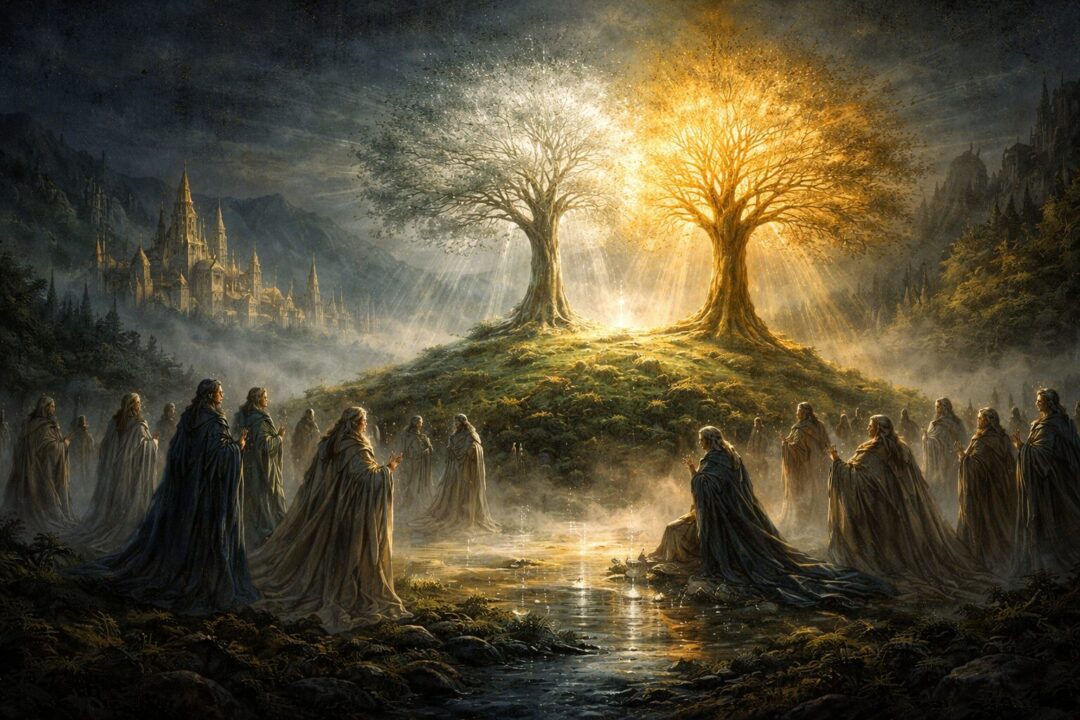
The Two Trees are often remembered as one of the great lost beauties of the Elder Days.
That is true.
But it is not enough.
Telperion and Laurelin were not only wondrous living things in Valinor. They were the source of a distinction that would shape the whole structure of Arda afterward: the difference between lands that had known the Light of Aman and lands that had not. Once that distinction existed, the world was no longer morally flat.
That does not mean every western place became good, or every eastern place became evil.
The texts do not support a simplification like that.
But they do show something more subtle and more important. The Two Trees turned geography into memory, and memory into hierarchy. They made the West not merely a direction, but a source of blessed light, authority, and loss.
The Trees Did Not Light All of Arda
This is the first point that matters.
After the destruction of the Two Lamps, Yavanna made Telperion and Laurelin in Valinor, upon Ezellohar outside Valimar. Their silver and gold light began the Years of the Trees. They waxed and waned in turn, and their mingled hours created the nearest thing Arda had to dawn and dusk before the making of the Sun and Moon.
But that light was not spread evenly through the world.
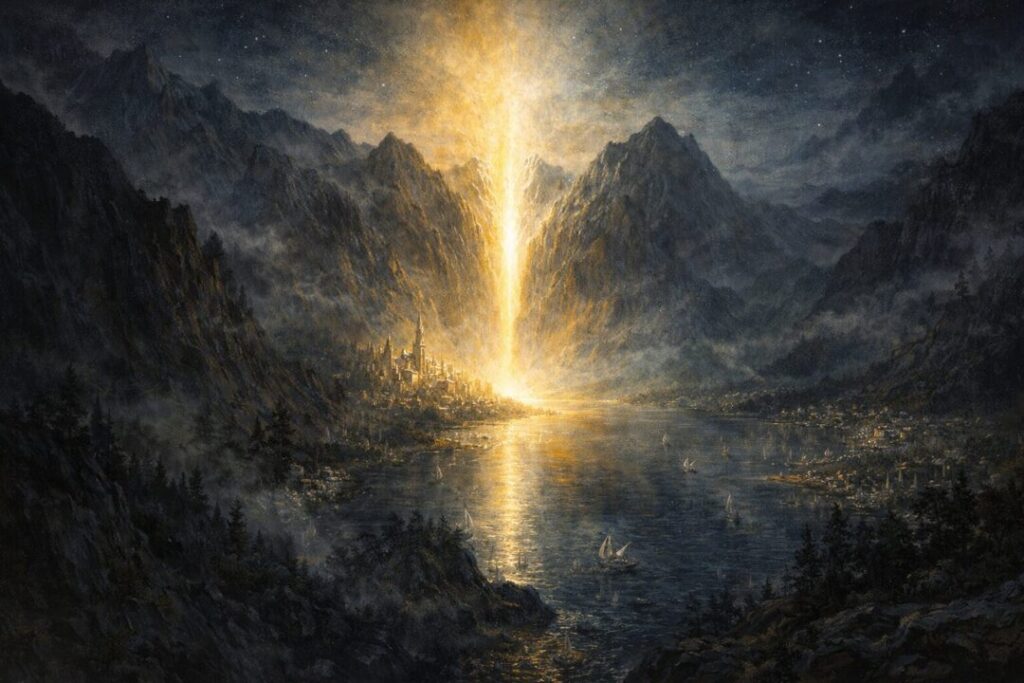
The Pelóri fenced Valinor, and only through the Calacirya did the light pass outward, touching Eldamar and Tol Eressëa. Middle-earth itself remained under starlight. That matters because the Two Trees did not create a universal condition. They created a privileged region. The blessed light of Arda had a location.
This is where the moral geography begins.
Not because the map becomes a blunt allegory, but because holiness, beauty, and proximity to the Valar are now concentrated in one visible part of the world.
The West Became More Than a Direction
Once Valinor possessed the Light of the Trees, westward orientation became charged with more than distance.
Aman was the Blessed Realm. Valinor was the dwelling of the Valar. Through the Calacirya, even the light that escaped the mountain-wall moved eastward from that source. The structure is hard to miss: fullness is in the West, and the further one is from it, the less directly one shares in that light.
This does not mean that Middle-earth is evil by nature.
It was the intended home of Elves and Men.
But in the Elder Days it is also the place outside the immediate radiance of Aman. That difference becomes spiritually and culturally significant. The world is not divided only by mountains and seas, but by nearness or remoteness from a primordial light that later peoples remember, desire, or mourn.
That is why longing for the West in this legendarium is never merely homesickness. It is often a longing for an order of being that seems fuller, clearer, and less marred.
The Elves Were Literally Divided by the Light of the Trees
The clearest textual proof of this moral geography is the division among the Elves.
Those who had seen the Light of the Trees were called the Calaquendi, the Elves of Light. Those who had not were called Moriquendi, the Elves of Darkness. The distinction is not simply geographic, and it is not merely ethnic. It depends on whether one has beheld that light before the Sun and Moon.
That is an extraordinary thing.
A physical journey to Aman becomes a permanent distinction of status and identity. Even after many of the Noldor return to Middle-earth in exile, they remain marked by having seen what other Elves never saw. The light has become part of how peoples are named and understood.
This is one reason the Two Trees matter so much. Their light does not remain a local phenomenon. It becomes a criterion of classification.
And classification, in Arda, is never morally empty.
The texts do not say that every Moriquende is lesser in virtue. But they do make clear that seeing the Light of Aman sets the Calaquendi apart in dignity, memory, and stature. That is already a kind of moral map written onto the peoples of the world.
The Trees Turned Loss Into the Central Crisis of the Elder Days
There is a famous reason the Two Trees loom so large in the First Age material: their fate drives nearly everything that follows.
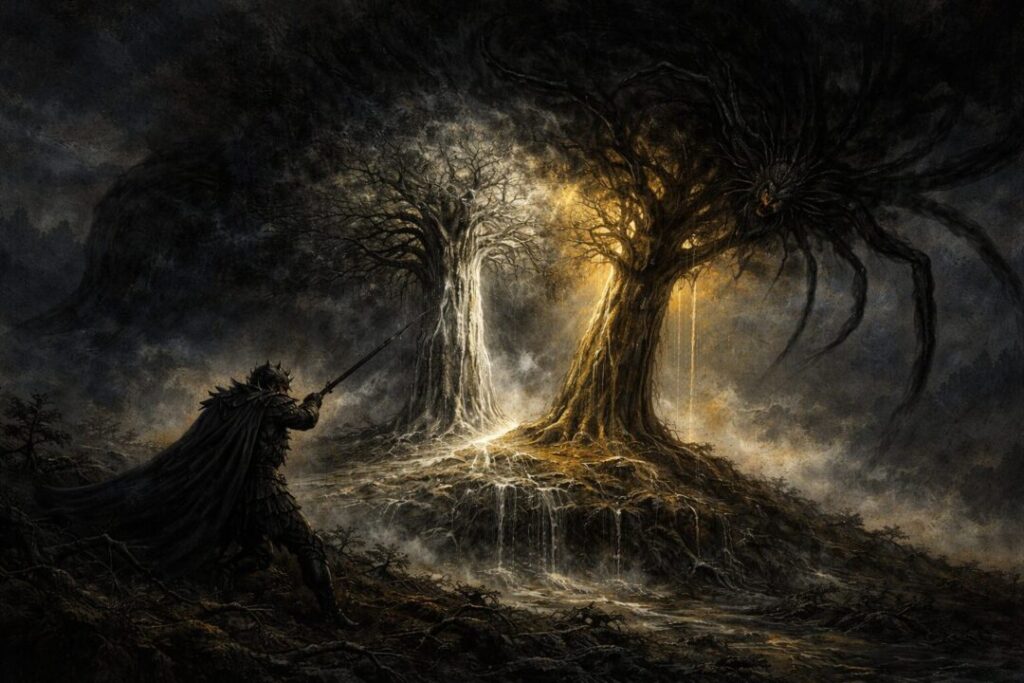
Their light is captured in the Silmarils. After Melkor and Ungoliant destroy the Trees, the Valar cannot restore them except by the light preserved in those jewels. Fëanor refuses. Then the Silmarils are stolen, and the long catastrophe of the Noldor begins.
This is why the Trees are not just scenery behind the real story.
They are the real story’s vanished center.
The Exile of the Noldor is not simply political rebellion. It is born in a world where the highest created light has been wounded, enclosed, possessed, and lost. The whole movement back into Middle-earth carries that wound with it.
In other words, the geography of Arda does not stop being shaped by the Trees when they die.
It becomes shaped by their absence.
Middle-earth is now the place to which the exiles return, carrying memory of the West and the grief of its darkening. Beleriand becomes a theater of war not in isolation, but in the shadow of what was lost at Ezellohar.
The Sun and Moon Changed the World, But Not the Hierarchy of Memory
After the Darkening of Valinor, the Valar make the Moon from the last flower of Telperion and the Sun from the last fruit of Laurelin. Light is no longer confined to Valinor alone. The whole world is illuminated.
But this does not erase the older distinction.
The Light of the Sun and Moon is not treated as identical in meaning to the Light of the Trees. The very terminology of Calaquendi and Moriquendi depends on the pre-solar light. The Elder Days continue to treat the original light as something more ancient and more blessed.
So even after light becomes universal, moral memory does not.
Arda has daylight now, but it still remembers that there was once a holier form of light in the West. The map has changed physically, yet the old hierarchy survives in language, longing, and prestige.
This is why later ages still feel haunted by a westward orientation they did not invent.
The Legacy of the Trees Survived in Kingship and Realm
One of the strongest later echoes of this pattern appears in the line of the White Tree.
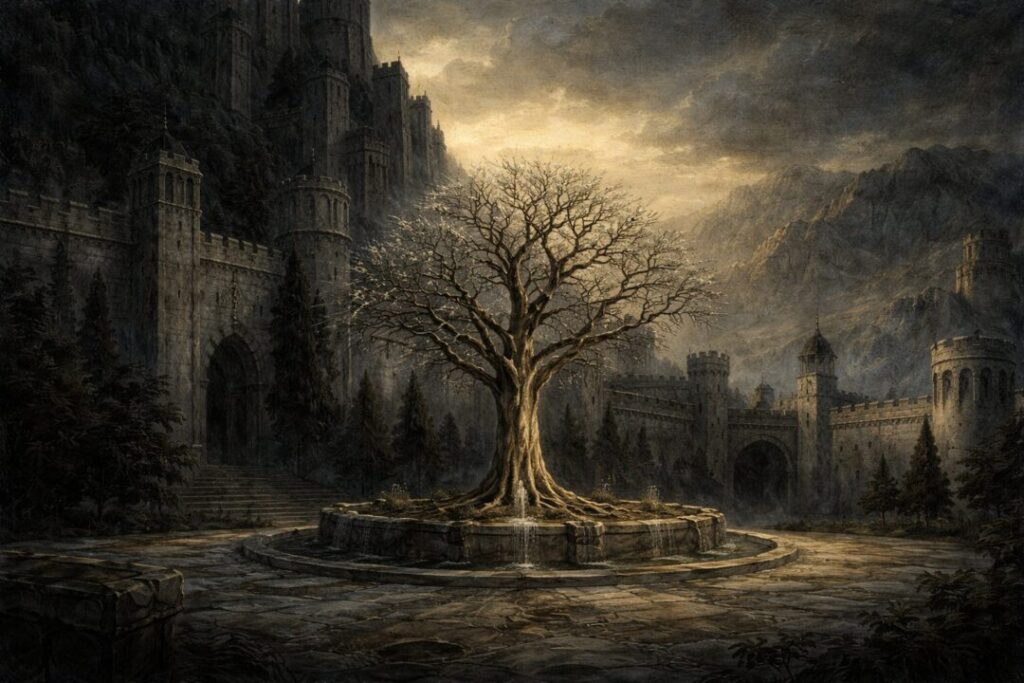
The White Tree of Gondor descends through Nimloth of Númenor from Galathilion, which was made in the image of Telperion. By the Third Age, that line stands at the heart of Gondor’s kingship and legitimacy.
That continuity matters.
It means the memory of the Trees does not remain trapped in First Age myth. It survives in the symbolic center of the greatest Númenórean realms. A kingdom of Men, in its highest emblem, still points back toward the silver tree of Valinor.
This does not prove that every king consciously thought of Telperion in theological terms.
The texts do not say that.
But they do establish the lineage, and the lineage itself is enough. It shows that rightful order in later ages is still imagined through a living inheritance from the lighted West. When the White Tree stands dead, something is out of joint. When it blooms again under Aragorn, restoration is expressed through a symbol whose deepest ancestry goes back beyond Númenor, beyond the Sun, to the Trees.
That is moral geography made visible in political form.
Why “Moral Geography” Is the Right Phrase
Used carefully, this phrase fits.
Not because Arda is a simplistic map of good west and bad east.
But because the Two Trees establish a world in which place carries moral and spiritual weight. Where one has been matters. What light one has seen matters. Proximity to Aman matters. Exile from it matters even more.
The Trees help explain why so many of the deepest motions in the legendarium are directional.
Elves journey west.
Exiles return east.
Men look westward in memory.
Even in the Third Age, the West remains the direction of healing, authority, and the Undying Lands beyond ordinary reach.
The world has rivers, mountains, kingdoms, and seas.
But after Telperion and Laurelin, it also has gradations of remembered light.
That is the difference.
The Two Trees Never Really Ended
The Trees are destroyed early.
Yet they never stop shaping the world.
Their light survives in the Silmarils, then in Sun and Moon. Their memory survives in the Calaquendi. Their loss drives the Noldorin exile. Their image survives in Númenor and Gondor. Their radiance survives as the standard by which later light is measured and later decline is felt.
So the deepest consequence of the Two Trees is not simply that they were slain.
It is that afterward, almost nothing in Arda feels spiritually neutral.
The map remembers them.
And that may be why the Elder Days never treat them as a vanished ornament of paradise, but as the lost center around which the whole world keeps turning.
Sources & Notes
- J.R.R. Tolkien, The Silmarillion, "Of the Beginning of Days" — the making of Telperion and Laurelin in Valinor after the fall of the Lamps.
- J.R.R. Tolkien, The Silmarillion, "Of Eldamar and the Princes of the Eldalië" — the Calacirya, the light of Aman, and the distinction between Calaquendi and Moriquendi.
- J.R.R. Tolkien, The Silmarillion, "Of the Darkening of Valinor" — Melkor and Ungoliant’s destruction of the Trees and the irreplaceable light preserved in the Silmarils.
- J.R.R. Tolkien, The Silmarillion, "Of the Sun and Moon and the Hiding of Valinor" — the last flower of Telperion and fruit of Laurelin becoming the Moon and Sun.
- J.R.R. Tolkien, The Lord of the Rings, Appendix A, "Annals of the Kings and Rulers" — the White Tree’s Númenórean and Gondorian line as a later echo of Telperion.