
The One Ring is often spoken of as if it does only one thing.
It corrupts.
It dominates.
It turns the good into the dangerous.
All of that is true.
But it is not the whole truth.
What the story actually shows is more precise, and therefore more disturbing. The Ring does not seem to approach every person in the same form. It does not merely pour evil into the mind in some flat, identical way. Again and again, it appears to work through desire already present, enlarging it, distorting it, and slowly turning it toward possession and control.
That matters, because once you start watching closely, a pattern emerges.
Hobbits, Men, Dwarves, and Elves are not tempted in exactly the same way.
The Ring remains one thing. Its end is always domination. But the road it takes to reach that end is different.

The Ring Does Not Need the Same Door Into Every Heart
The simplest way to say it is this:
The Ring is not creative in its goal, but it is adaptive in its approach.
Its final logic is always mastery. Sauron made it to rule the other Rings and bring their bearers under his will. The Ring is bound up with domination. Yet the way that domination first presents itself can look very different depending on who encounters it.
That is why one character dreams of saving a city, another of preserving a realm, another of hoarded wealth, and another of something as small as a garden.
The temptation is not random.
It is fitted.
How the Ring Tempts Men: Power, Victory, and the Right to Use Force
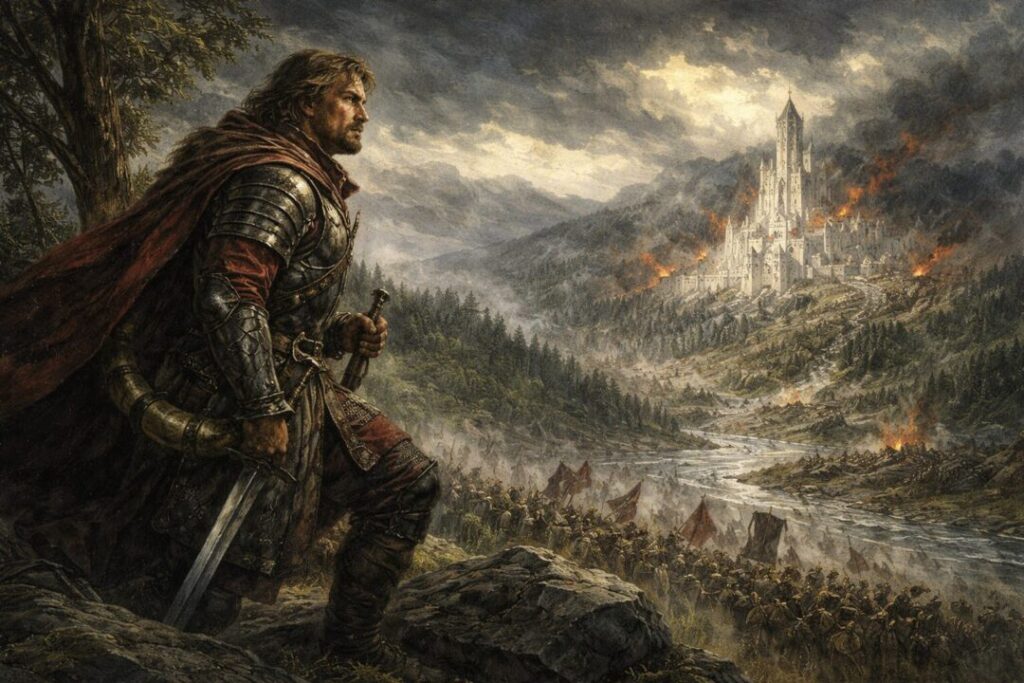
With Men, the pattern is the clearest.
The Nine Rings given to mortal Men ended in enslavement. The Nazgûl are the most complete example in the legendarium of what happens when power, mortality, and domination become permanently joined. Men prove especially vulnerable to rule-through-power.
Even outside the Nine, the same pattern appears around the One Ring.
Isildur does not describe his claim in the language of petty greed. He takes the Ring as a weregild for his father and brother, and as an heirloom for his house. That is important. The Ring does not first appear to him as naked evil. It appears in the shape of grief, lineage, and rightful possession.
Boromir reveals the next stage of the same temptation. He is not drawn by comfort. He is drawn by necessity, war, and the desperate hope of saving Gondor. The Ring offers him command. It offers the power to gather force and break Mordor by strength. That is what makes his temptation tragic rather than trivial. He is not merely selfish. He wants victory for his people, but by taking up the very instrument of domination that cannot be used cleanly.
For Men, then, the Ring often comes dressed as responsibility.
A kingdom to save.
A house to defend.
A weapon too great to ignore.
And because those desires are not always base desires, the temptation can sound reasonable before it sounds corrupt.
How the Ring Tempts Elves: Preservation, Beauty, and the Refusal to Let the World Fade
With Elves, the temptation becomes stranger.
The Three Elven Rings were used to preserve beauty, ward off decay, and postpone the weariness of the world. Rivendell and Lórien are not merely pretty realms. They are examples of resistance to time and fading through the power of the Three.
That is why the Elven form of temptation is not best understood as simple lust for conquest.
Galadriel’s test makes this unmistakable. She admits that her heart had greatly desired what Frodo offered. But what she stands to gain is not just a battlefield advantage. The deeper temptation is to preserve, order, protect, and rule a world made fair under her will. When she rejects the Ring, she also accepts diminishment and eventual departure into the West.
That is what makes the Elven temptation so unsettling.
It is not merely the desire to possess power.
It is the desire to use power against loss.
To keep memory from fading.
To keep beauty from withering.
To hold a beloved world in place.
And yet the text is clear that even this becomes domination in the end. The vision still leads toward absolute rule. It only arrives wearing a fairer face.
So if Men are tempted by victory, Elves are tempted by permanence.
Not crude empire, but the power to preserve what should not be preserved by force.
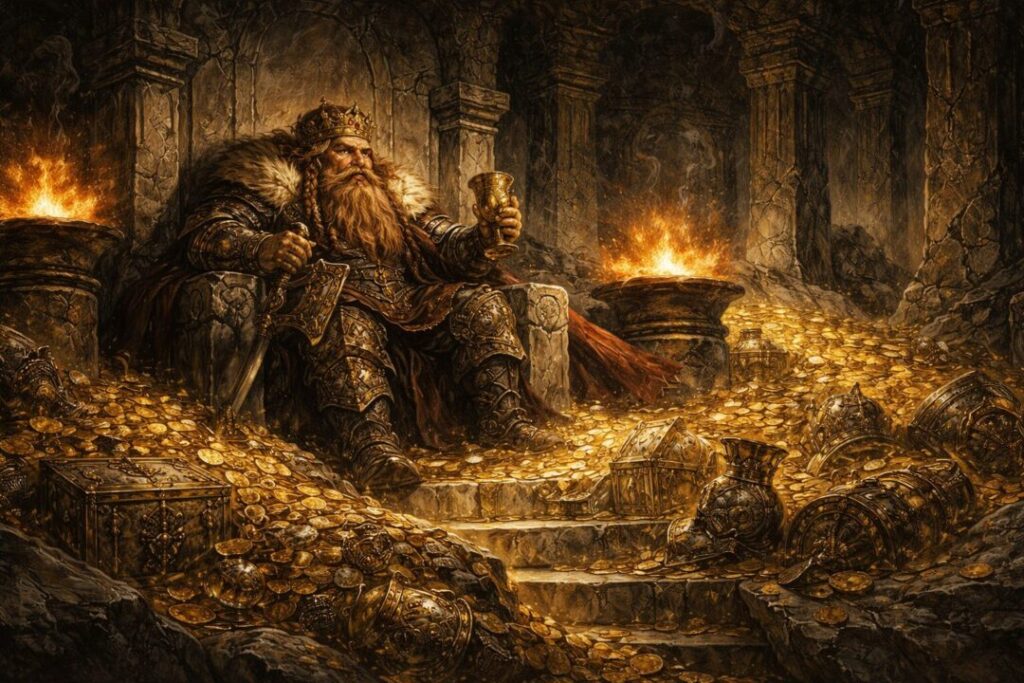
How the Ring Tempts Dwarves: Wealth, Hoards, and Inflamed Possession
The Dwarven case needs more care.
The story never gives us a full narrative of a Dwarf bearing the One Ring the way it does with Bilbo, Frodo, or Gollum. So we should not pretend the text gives a direct chapter-by-chapter Dwarven One Ring temptation. It does not.
What it does give is a consistent pattern through the Seven Rings.
The Dwarves proved hard to dominate. Their thoughts were difficult to fathom, and they were not turned into wraiths as Men were. But that did not mean the Rings failed to affect them. Instead, the Rings kindled greed and wrath, helped generate immense hoards, and inflamed the desire for wealth.
That distinction matters.
Men are bent toward subjection.
Dwarves are driven toward accumulation.
The corruption is real in both cases, but it takes a different form.
This is why it is misleading to imagine the Ring’s power as identical across all peoples. The Dwarves are not simply “Men but shorter and more stubborn.” Their resistance changes the shape of the damage. What the Rings seem to magnify in them is not fading into shadows, but possessiveness hardened into greed and wrath.
Even in the wider legendarium, Dwarven stories are often shadowed by treasure under pressure: hoards, inheritance, claims, and the danger of wealth becoming a trap rather than a good. The Rings do not invent that weakness out of nothing. They inflame it.
So the Dwarven path of temptation is not best described as obedience to Sauron.
It is better described as a magnified hunger to possess and hold.
How the Ring Tempts Hobbits: Privacy, Possession, Comfort, and Only Then Grandeur
The Hobbit pattern is the most deceptive.
Hobbits are often called unusually resistant, and the texts support that. Gandalf especially values Hobbit pity, courage, and humility, and Gollum may have avoided becoming a wraith partly because of his hardy Hobbitish nature. But resistance is not immunity. Hobbits do not escape temptation. They simply meet it in a different form.
Look at Bilbo.
Even after giving up the Ring, he remains sick with longing for it in Rivendell. His corruption is slower than Gollum’s, but it is real. Tolkien Gateway’s summary, drawing on the text tradition, notes that Bilbo was corrupted more slowly partly because his life with the Ring began in mercy, whereas Gollum’s began in murder. That contrast is revealing.
Look at Gollum.
He is of Hobbit-kind, and the Ring turns possession into identity itself. “My Precious” is not just ownership language. It is a sign that the boundary between self and possession is collapsing. He both loves and hates the Ring, and even confuses it with himself.
Look at Sam.
When he bears the Ring, he does not first imagine a throne. He imagines Samwise the Strong, yes, but even that fantasy is translated into his own Hobbit nature: the vale of Gorgoroth becoming a vast garden under his command. Then the vision breaks, because deep down he still knows that one small garden of a free gardener is enough.
And before that, Galadriel’s testing glance and the Mirror scenes both connect Sam’s inner vulnerability to home, the Shire, and a garden of his own. The text keeps returning to this. His temptation is not abstract empire. It is the enlargement of what is small, local, and beloved until it becomes a realm.
That may be the clearest clue to how the Ring works on Hobbits.
It begins privately.
With the comfort of having.
With the secrecy of keeping.
With the feeling that one little thing can remain mine.
Only later does it swell.
Bilbo hides it.
Gollum clings to it.
Frodo grows increasingly burdened by it.
Sam briefly sees the same logic expand into command.
In Hobbits, the Ring seems to begin with possession before it moves toward domination.
Why This Difference Matters
If the Ring tempted everyone in the same language, it would be far easier to recognize.
But it does not.
It speaks to Men in the voice of strength.
To Elves in the voice of preservation.
To Dwarves in the voice of wealth.
To Hobbits in the voice of private possession, comfort, and beloved small things.
That is why the Ring is more frightening than a simple symbol of power.
It is not merely offering evil.
It is offering a distorted form of each people’s good.
Victory becomes tyranny.
Preservation becomes control.
Wealth becomes greed.
Home becomes possessiveness.
And because each temptation grows out of something real, it does not always look monstrous at first glance.
The Darkest Part of the Pattern
The darkest part is that none of these paths stay separate forever.
They begin differently, but they move toward the same end.
The Ring always narrows the self.
Always turns desire inward.
Always bends love toward possession and then possession toward mastery.
That is why Galadriel’s temptation, Boromir’s temptation, Gollum’s obsession, and the Dwarven pattern around the Seven can all belong to the same moral design without being identical experiences.
The Ring does not need everyone to want the same thing.
It only needs everyone to believe that their thing can be kept, saved, enlarged, or secured if they take hold of power.
Why Hobbits Matter More Than They First Appear
This may also explain why Hobbits matter so much to the story.
Not because they are incorruptible.
They are not.
But because their desires are smaller, humbler, and less naturally imperial. Sam can still imagine command, but even in fantasy he imagines it as a garden. Bilbo can cling, but he does not seek a kingdom. Frodo bears the burden longer than almost anyone could. Their scale of desire does not remove the danger, but it alters the pace and shape of it.
That does not make Hobbits morally superior in every way.
It makes them less immediately aligned with the Ring’s final purpose.
And that difference may be the crack through which the entire quest becomes possible.
The Real Horror of the One Ring
The One Ring is terrifying not only because it corrupts.
It is terrifying because it seems to know how to begin.
It does not walk into every heart carrying the same promise.
It offers Men the power to save the world by force.
It offers Elves the power to preserve what they cannot bear to lose.
It offers Dwarves the fuel of hoards and possessive wealth.
It offers Hobbits something smaller, gentler, and more intimate—until that too begins to widen into control.
So the real question is not whether the Ring would tempt someone.
The real question is what shape the temptation would take.
And once you start reading Middle-earth that way, the Ring stops being a blunt instrument of evil.
It becomes something much more precise.
It becomes a mirror.
Sources & Notes
- J.R.R. Tolkien, The Silmarillion, “Of the Rings of Power and the Third Age” — states the One Ring was made to rule the others, while the Nine enslaved Men and the Seven inflamed Dwarven greed without making them wraiths.
- J.R.R. Tolkien, The Lord of the Rings, Book II, Chapter 2, “The Council of Elrond” — Isildur claims the Ring as weregild, and Boromir’s arguments show how the Ring can appear to Men as rightful force for defending Gondor.
- J.R.R. Tolkien, The Lord of the Rings, Book II, Chapter 7, “The Mirror of Galadriel” — Galadriel’s test connects the Ring with the Elvish temptation to preserve, order, and rule beautifully before she rejects it and accepts diminishment.
- J.R.R. Tolkien, The Lord of the Rings, Book I, Chapter 2, “The Shadow of the Past” — Gandalf’s account of Sméagol, Bilbo, pity, secrecy, and possession grounds the Hobbit pattern of slower but real corruption.
- J.R.R. Tolkien, The Lord of the Rings, Book IV, Chapter 10, “The Choices of Master Samwise” — Sam’s brief vision of himself as Samwise the Strong turns even his Hobbit love of gardens into command before humility breaks the spell.
- J.R.R. Tolkien, Letter 131 — describes Sauron’s Ring as an instrument for control and domination, supporting the article’s claim that varied temptations still move toward the same end.