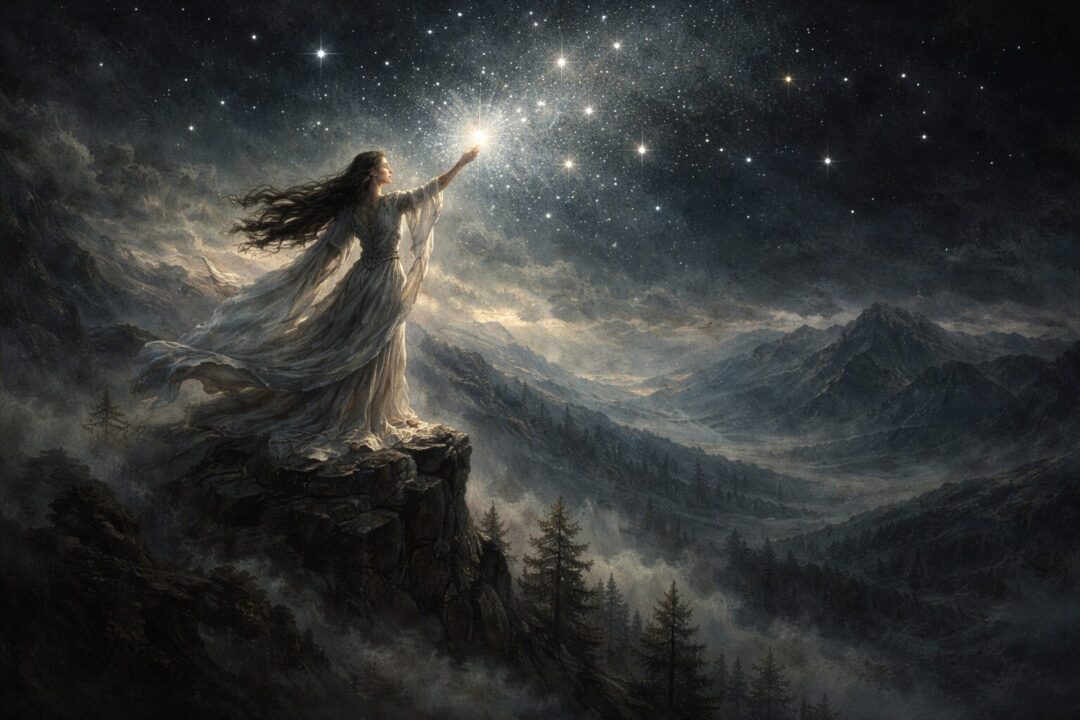
At first glance, Varda seems like one of the most distant figures in the whole legendarium.
She does not travel beside the Fellowship.
She does not rule a kingdom in Middle-earth.
She does not enter the plot in the direct, visible way that Gandalf, Galadriel, or Elrond do.
And yet her presence is everywhere.
Her names are spoken in fear and in praise.
Her stars stand over the oldest memories of the Elves.
Her light returns in some of the darkest moments of The Lord of the Rings.
That is why Varda matters more than many readers first realize.
She is not simply a remote divine figure placed in the background to make the mythology feel larger. She helps explain one of the deepest emotional structures in Middle-earth: why beauty still matters in a fallen world, and why darkness is never allowed the final claim.
Who Varda Elentári Is
Varda is one of the Valar, the great powers who entered the world at its beginning. She is the spouse of Manwë, and in the older order of Arda she is among the highest of the Queens. She is associated above all with light, and especially with the stars. In Quenya she is called Elentári, “Queen of the Stars.” In Sindarin she is known as Elbereth, and also Gilthoniel, the Star-kindler.
But titles alone do not explain her importance.
The texts give Varda a unique moral and symbolic weight. She is linked with light that Melkor hates and fears. That detail is not decorative. It places her in direct opposition to the great pattern of darkness, domination, and desecration that runs through the long history of Arda.
So when her name survives into the Third Age, it does not survive only as religious memory.
It survives as a memory of unsullied light.
Why the Elves Revere Her Above All
One of the most important details about Varda arrives very early in the mythology.
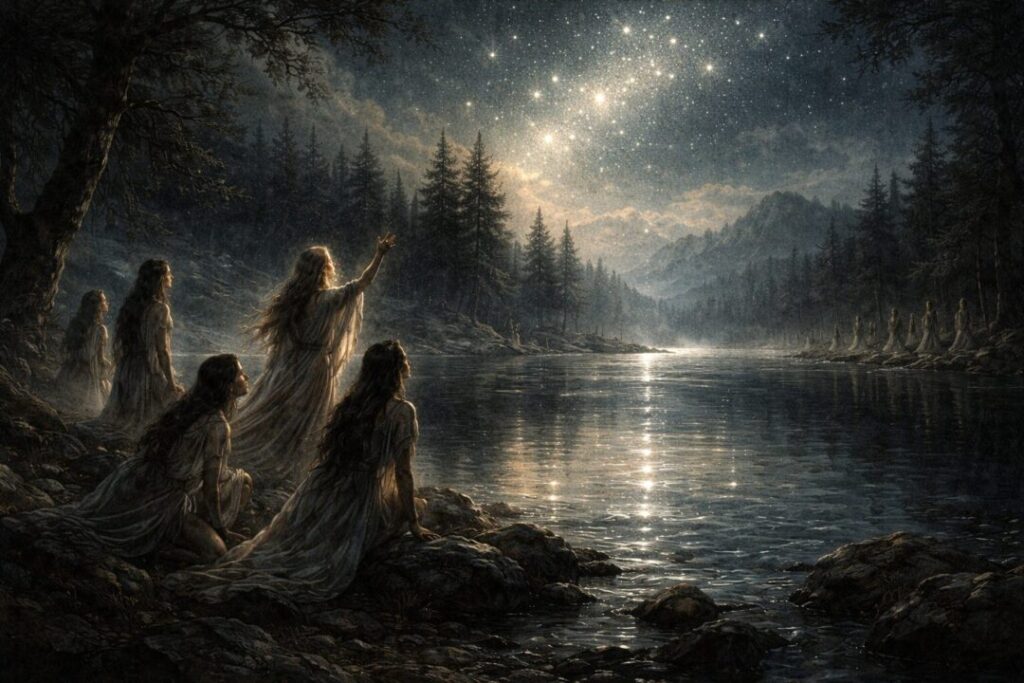
The Elves awaken at Cuiviénen under the stars, before the first rising of the Sun and Moon. Their eyes behold first of all things the stars of heaven. That first sight matters enormously. It means the first beauty they know in the world is starlight. It also explains why they become the people most closely associated with stars, and why they especially love and revere Varda.
This is one of the quiet foundations beneath a great deal of Elvish feeling.
The stars are not merely part of the scenery to them.
They are bound up with awakening, memory, identity, and reverence.
That is why hymns to Elbereth do not feel ornamental. They grow out of the oldest relationship the Elves have with the world itself. The stars are the first sign that beauty exists before kingdoms, before wars, before exile, and before sorrow has fully unfolded.
So when the Elves call upon Elbereth, they are not simply naming a distant Queen.
They are turning toward one of the oldest lights they know.
Why Starlight Matters Before the Sun
Modern readers often instinctively rank sunlight above starlight.
In Middle-earth, that is not always how feeling works.
Sunlight is later.
Moonlight is later.
For the Elves especially, starlight comes first.
That changes the symbolism.
Starlight is not the full blaze of revealed glory. It is not noon, certainty, or worldly triumph. It is smaller, colder, farther away. Yet it is precisely that kind of light that matters in many of the legendarium’s darkest places.
It is the kind of beauty that remains visible when the world is still largely shadowed.
It is distant, but not absent.
It does not remove darkness, but it denies darkness the right to define everything.
That is why starlight in Middle-earth so often feels like endurance rather than conquest.
This is interpretation, but it is strongly supported by the way the texts use stars emotionally. They are not usually signs of easy rescue. They are signs that beyond fear, ugliness, and oppression, there is still something unmastered.
Elbereth in the Living Story
Varda would remain a remote figure if her names stayed only in the ancient tales.
They do not.
That is one of the clearest signs that she matters.
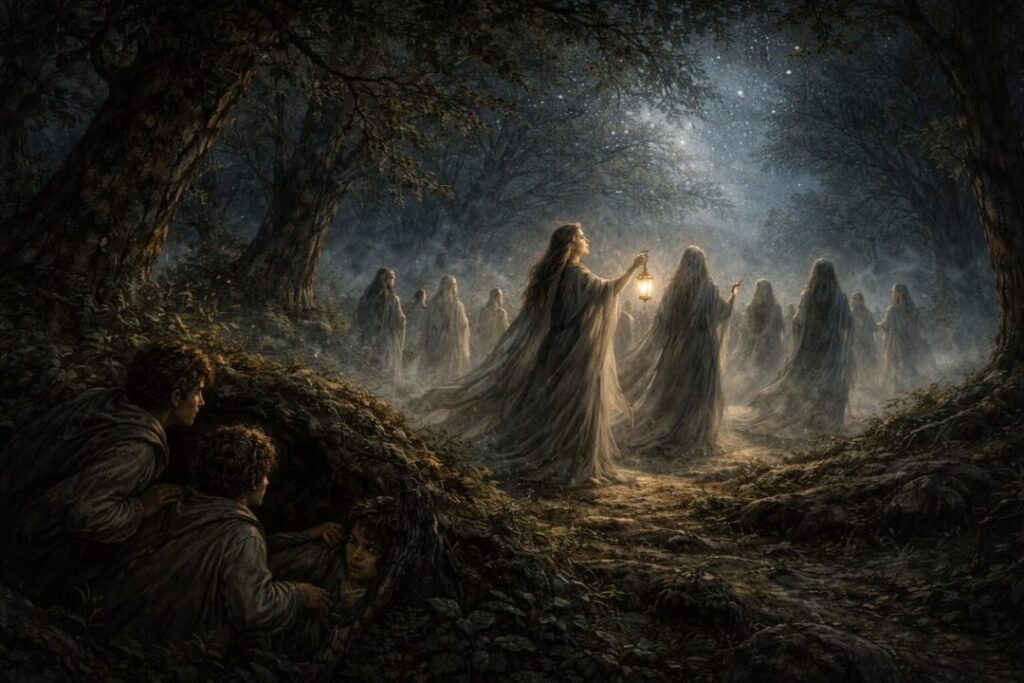
Early in The Fellowship of the Ring, the wandering Elves in the Shire sing to Elbereth. The hymn presents her not as an abstract cosmic principle, but as a living object of praise and longing. She is “O Queen beyond the Western Seas,” and “O Light to us that wander here.” That wording is important. The song does not treat light as a neutral phenomenon. It treats it as something personal, remembered, and beloved.
Later, at Weathertop, Frodo cries out “O Elbereth! Gilthoniel!” in the moment of attack. The text does not pause to explain this in doctrinal terms. It simply lets the name break into the scene. That alone tells us how deep the association runs between Elbereth and resistance to terror.
Then the pattern deepens again in the passages around Shelob and Cirith Ungol, where Elbereth and Eärendil are invoked in connection with light against a creature of ancient darkness. Here we should be careful: the texts do not reduce this to a mechanical formula, as though saying the right holy name automatically produces a spell effect. But they clearly connect these invocations with an older and purer light that darkness recoils from.
That distinction matters.
Varda is not used in the story like a fantasy power-up.
Her name enters where memory, reverence, fear, and hope converge.
The Star in Mordor
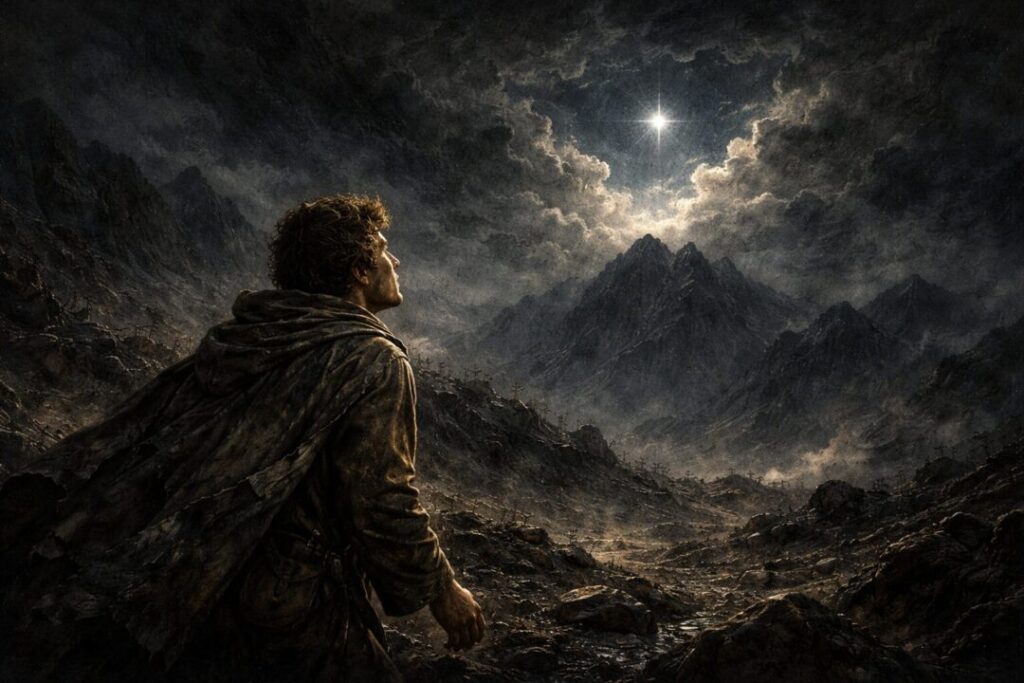
If there is one moment that reveals why starlight matters, it may be Sam’s glimpse of a star in Mordor.
The passage is brief, but unforgettable. Sam looks up through the cloud-wrack and sees a white star twinkle for a while. Its beauty strikes his heart, and the thought comes to him that in the end the Shadow is only a small and passing thing, and that there is light and high beauty beyond its reach.
This is one of the clearest statements in all of The Lord of the Rings about what beauty does.
The star does not remove Sam from danger.
It does not destroy Sauron.
It does not even change the immediate misery of the landscape around him.
What it changes is proportion.
For a moment, Mordor ceases to look ultimate.
That is the key.
The Shadow always tries to appear total.
It wants to define the whole horizon.
It wants despair to feel like realism.
But one star is enough to expose that as a lie.
And once you see that, starlight in Middle-earth stops being mere atmosphere. It becomes one of the story’s purest signs that evil, however vast it appears, is still bounded.
Varda Is Distant—but Not Absent
One reason Varda can be misunderstood is that she does not act in the obvious way many readers now expect from powerful beings in fantasy.
She does not descend into battle scenes.
She does not speak long prophecies into the plot.
She does not become a visible solution.
But Middle-earth is full of important powers that work indirectly.
The memory of Varda remains active through song, prayer, naming, reverence, and light.
That is not nothing.
In a world shaped by moral and spiritual realities, that may be more important than spectacle.
The texts never present Varda as a convenient rescuer who cancels human or hobbit courage.
Instead, her light belongs to a different order. It reminds characters what kind of world they still inhabit, even when they are trapped inside its worst ruins.
That is why her distance actually matters.
If she were constantly present in direct intervention, starlight would become mere protection.
Because she remains high and far, starlight keeps its deeper meaning: not the end of struggle, but the certainty that struggle takes place under a reality greater than the Shadow.
Why This Matters to the Whole Myth
Varda helps hold together one of the central truths of the legendarium.
Darkness is real.
Evil wounds deeply.
Fear is not an illusion.
Loss is not undone by cheerful optimism.
But neither does evil become the deepest thing.
That is what the stars keep saying.
The Elves wake beneath them.
Songs return to them.
Frodo reaches toward Elbereth in mortal fear.
Sam sees one above Mordor and remembers, suddenly, that despair has overstated its case.
So who was Varda Elentári?
Not just a remote queen in an old cosmology.
Not just a name hidden in Elvish song.
Not just the maker of beautiful lights.
She is one of the clearest reminders that in Middle-earth, the highest beauty is not conquered by darkness, even when darkness seems to fill the whole sky.
And that is why starlight matters.
Not because it makes the night disappear.
Because it proves the night is not all there is.
Sources & Notes
- J.R.R. Tolkien, The Silmarillion, “Valaquenta” — identifies Varda as Elentári, Queen of the Stars, beloved of the Elves and especially feared and hated by Melkor.
- J.R.R. Tolkien, The Silmarillion, “Of the Coming of the Elves and the Captivity of Melkor” — places the Elves’ awakening under the stars of Varda, giving starlight its ancient place in Elvish memory and reverence.
- J.R.R. Tolkien, The Lord of the Rings, Book I, Chapter 3, “Three Is Company” — the Elves’ hymn to Elbereth in the Shire preserves Varda’s light as living praise, not merely remote mythology.
- J.R.R. Tolkien, The Lord of the Rings, Book I, Chapter 11, “A Knife in the Dark” — Frodo’s cry of “O Elbereth! Gilthoniel!” at Weathertop shows her name invoked against terror and the servants of darkness.
- J.R.R. Tolkien, The Lord of the Rings, Book IV, Chapter 9, “Shelob’s Lair” — Sam’s use of the Phial and the Elvish cry to Elbereth link remembered starlight with resistance to ancient darkness.
- J.R.R. Tolkien, The Lord of the Rings, Book VI, Chapter 2, “The Land of Shadow” — Sam’s glimpse of a single star above Mordor gives the article its central image of beauty and light beyond the Shadow’s reach.