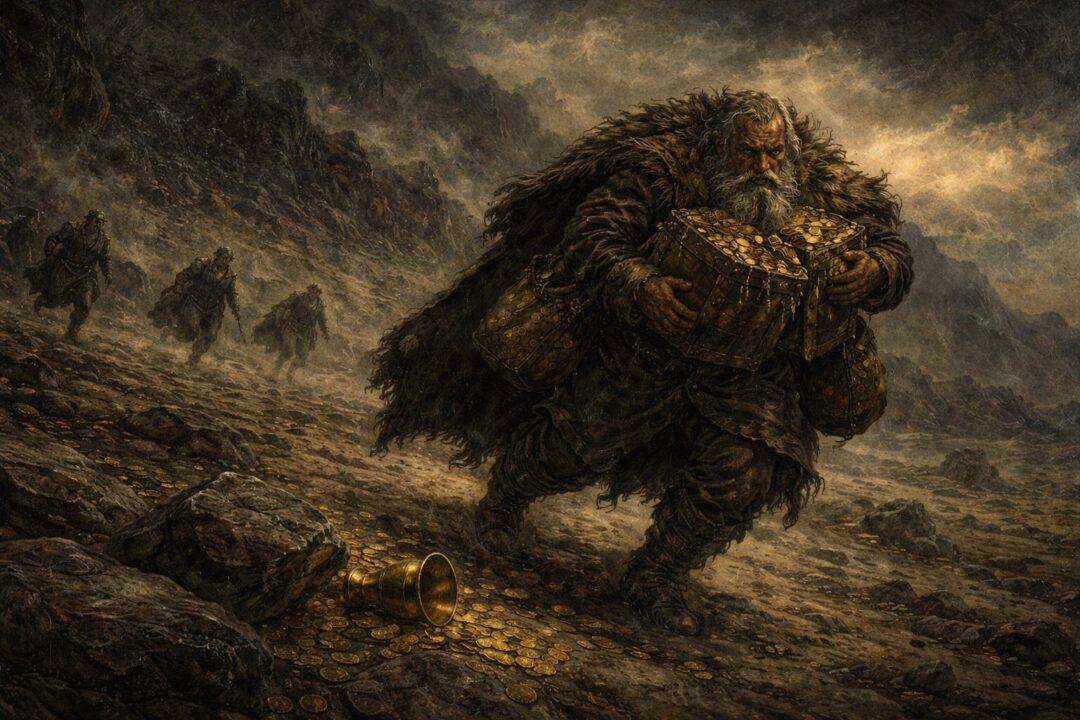
When people talk about dragon-sickness in The Hobbit, they usually flatten it into one familiar idea.
Greed.
That is not wrong. But it is smaller than what the story is actually doing.
Because the gold under the Lonely Mountain is never just gold. From the moment Erebor enters the story, treasure is bound up with ruin, memory, inheritance, exile, and the long humiliation of a people driven from their home. By the time Thorin stands again inside the kingdom of his fathers, the hoard is not simply wealth recovered. It is grief made visible.
And once that becomes clear, dragon-sickness begins to feel less like ordinary avarice and more like something knotted around old damage.
Not a clinical diagnosis. Not a modern term hiding inside the text.
But a pattern.
A wound fastening itself to treasure.
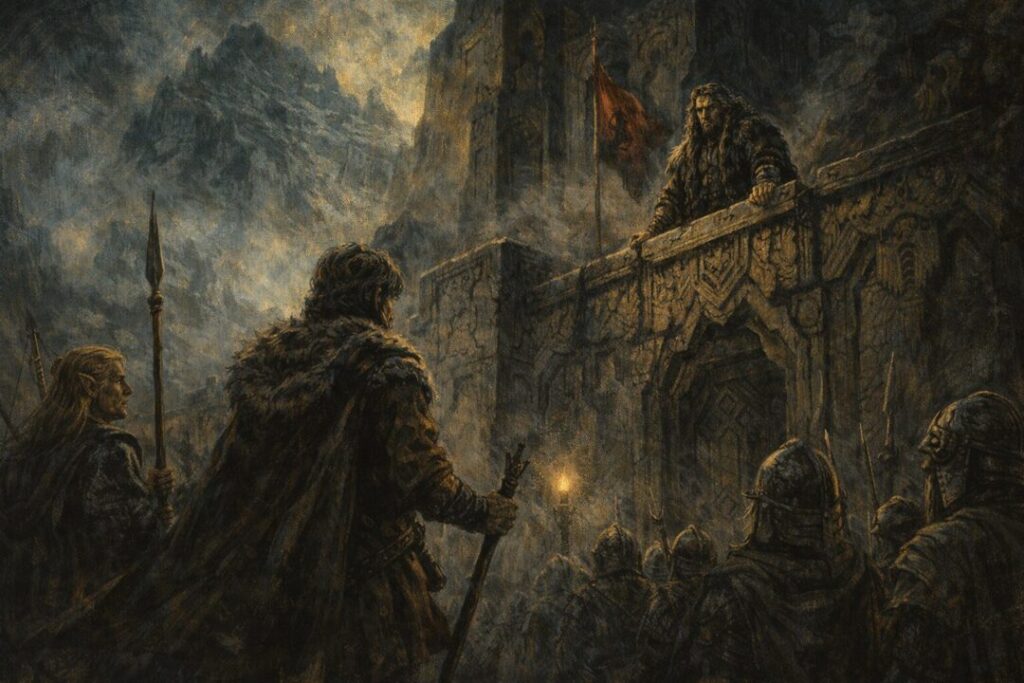
Dragon-sickness Is Real in the Book, but the Book Uses It Carefully
One thing needs to be said first.
The term “dragon-sickness” is used very sparingly in canon.
In The Hobbit, the phrase is explicitly applied to the Master of Lake-town after Bard gives him gold for the rebuilding of his people. He takes most of it, flees into the Waste, and dies there. That is the clearest direct use of the term.
With Thorin, the narration is more careful.
The text does not simply stop and declare: this is dragon-sickness. Instead, it describes the force working on him. Bilbo “did not reckon with the power that gold has upon which a dragon has long brooded.” Thorin has spent long hours in the treasury, and “the lust of it was heavy on him.” He is drawn not only to the Arkenstone, but to many other beautiful things in the hoard.
That distinction matters.
The book gives us a named case and an implied pattern. It does not reduce the entire episode to a neat magical curse with clear rules. It leaves the effect morally and emotionally dense.
That is one reason the episode remains so powerful.
The Treasure Is Bound to Loss Before Thorin Ever Touches It
If dragon-sickness were only greed, Thorin’s fall would be simpler than it is.
But Thorin’s claim to the treasure is rooted in catastrophe.
Smaug did not merely steal some wealth from strangers. He destroyed a kingdom. He drove out its people. He left the House of Durin in exile. Thorin later calls his halls in the Blue Mountains only “poor lodgings in exile,” which tells us a great deal about how incomplete that life felt to him. Erebor was not just an economic prize. It was the place where identity, lineage, kingship, memory, and belonging had once been held together.
That background changes the emotional weight of the hoard.
When Thorin resists Bard’s claim, he does so in harsh and unjust ways. But listen closely to the logic of his refusal. He says Smaug robbed Bard of life or home, yet the same dragon robbed Thorin’s people too. The treasure he is defending is not framed in his mind as random wealth. It is what remains of a violated inheritance.
That does not make him right.
It makes him complicated.
And complication is exactly what pushes this beyond simple greed.
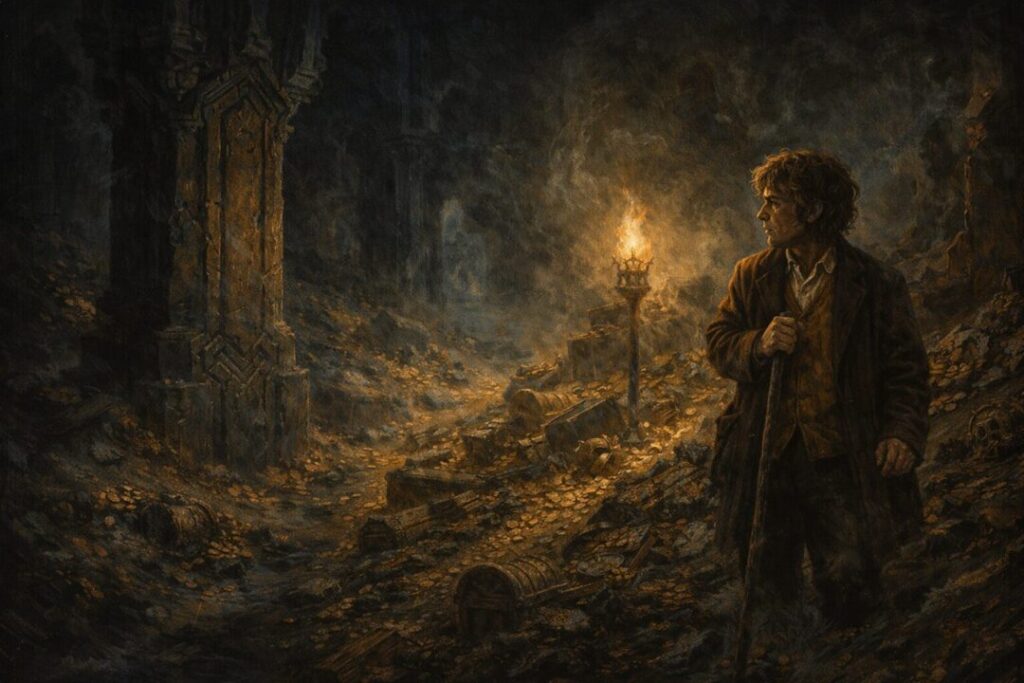
The Most Important Line Is About Memory, Not Possession
The key sentence in the entire episode may be the one readers often pass over too quickly.
The text says Thorin looked on the treasure with “old memories of the labours and the sorrows of his race” wound about it.
That is an extraordinary detail.
If the hoard were only functioning as temptation, the narration would not need that language. It could simply stress wealth, desire, or pride. Instead, the treasure is surrounded by memory and sorrow. The gold is carrying history.
That means Thorin is not merely grasping for more.
He is reacting to what the hoard represents.
The mountain is the site of ancestral work, old greatness, old pain, old dispossession. The recovered treasure is entangled with the injuries that created the quest in the first place. In that light, Thorin’s possessiveness begins to look like something more defensive and desperate than mere appetite.
He is not only hoarding.
He is guarding the material shape of what was taken.
That is why his behavior feels so intense and so closed off. He is not acting like a man who has found money. He is acting like someone who believes he is about to lose his home all over again.
The Text Links Dwarvish Gold-Desire to Wrath and Vengeance
This reading becomes stronger when placed beside the wider legendarium.
In The Lord of the Rings Appendix A and in The Silmarillion, the Dwarves are described as resistant to domination, but especially vulnerable in another way: the Rings given to Dwarf-lords inflamed in them a greed of gold and precious things, so that if they lacked them, other good things seemed profitless, and they were filled with wrath and desire for vengeance against those who deprived them.
That wording matters.
The danger is not described as greed alone. It is greed fused with deprivation, anger, and retaliatory feeling. Wealth matters because loss matters. Possession becomes absolute because dispossession burns underneath it.
That is very close to what happens around Erebor.
Thorin’s fall is not presented as the empty hunger of someone who had too much. It is the hardening of someone for whom treasure, kingship, and theft cannot be cleanly separated.
Again, that does not excuse him.
But it shows why his breakdown feels so emotionally credible.
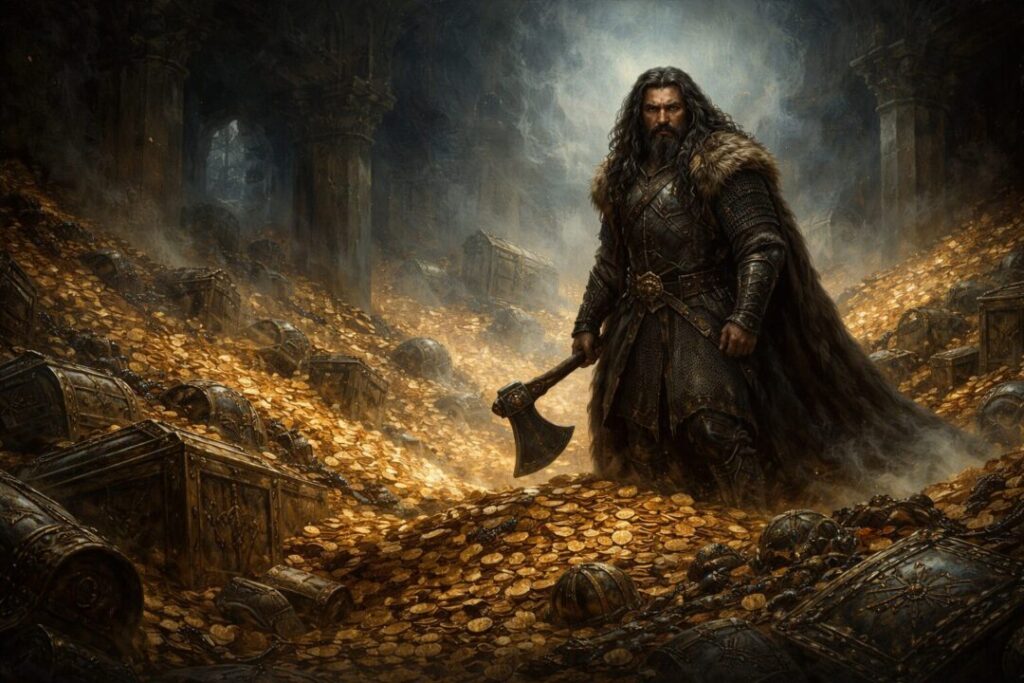
Even Bilbo Senses the Mountain as Contaminated
One of the most revealing lines does not come from Thorin at all.
Bilbo says, “The whole place still stinks of dragon, and it makes me sick.”
That line works on more than one level.
Yes, Smaug has physically occupied the place. But Bilbo’s reaction also captures the moral atmosphere of Erebor after the dragon’s death. The treasure is not neutral once the dragon is gone. The mountain still feels infected by what has happened there.
That is exactly the opposite of a simple greed story.
In a simple greed story, the gold is just gold, and characters project desire onto it. Here, the setting itself feels altered. Dragon, hoard, memory, fear, and corruption all seem to cling together. The result is less like temptation arriving from nowhere and more like a damaged place drawing damaged responses out of those who enter it.
Thorin is the clearest victim of that atmosphere, but he is not the only one who feels it.
Bilbo wants out.
The Master later collapses under it completely.
The gold does not sit quietly in the story.
Why the “Trauma” Reading Fits So Well
To say dragon-sickness feels like trauma is not to claim the book uses modern psychology.
It does not.
The point is that the emotional logic resembles trauma more than ordinary greed.
Trauma is often not just fear. It can involve fixation, defensiveness, mistrust, control, the inability to loosen one’s grip, and the sense that safety depends on never again surrendering what was once taken. That is strikingly close to the emotional weather around Thorin in Erebor.
He is suspicious.
He hardens against appeal.
He clings more tightly precisely when he should become more generous.
He treats compromise as threat.
Those are not just the reflexes of appetite. They are the reflexes of someone whose deepest losses have been tied to a physical place and a physical inheritance, and who cannot separate recovery from possession.
The treasure becomes the object through which old damage speaks.
That is why the episode still feels sharp even to modern readers. The story understands that people do not always cling because they love a thing too much. Sometimes they cling because losing it once already changed them.
But the Book Never Lets Thorin Off the Hook
This is the boundary the reading has to keep.
Seeing more depth in dragon-sickness does not remove moral responsibility.
Thorin is wrong to refuse just claims.
He is wrong to harden himself against pity.
He is wrong to value the hoard above the lives and needs around him.
The book does not soften that.
But neither does it leave him there.
His repentance matters because it proves the sickness, however understood, is not the truest thing about him. At the end he sees clearly again. He blesses Bilbo, rejects hoarded gold as the highest good, and dies with his better self restored.
That recovery is essential.
If the story were only about greed, Thorin would simply be a warning. Instead, he becomes something sadder and greater: a noble figure who falls under a burden that touches both character and wound, and who still finds his way back to truth before the end.
That is why the tragedy works.
The Real Horror of Dragon-sickness
The deepest horror of dragon-sickness may be this:
it attaches itself most easily not just to desire, but to injury.
The Master of Lake-town is “of the kind that easily catches such disease,” which suggests moral weakness. Thorin’s case is more painful. In him, the gold reaches into something already broken open by exile, inheritance, and the memory of loss. The hoard is not just tempting him. It is answering something in him.
That is what makes the whole episode feel larger than a lesson about greed.
It is about what happens when a person finally regains the visible shape of what was stolen from him, only to discover that loss has already changed the way he can hold it.
And once that is clear, the treasure under the Mountain stops looking like a prize.
It starts looking like a wound with a glittering surface.
Which may be why The Hobbit leaves readers with a question deeper than whether Thorin wanted gold too much.
The more unsettling question is what, exactly, the gold was holding for him all along.
Sources & Notes
- J.R.R. Tolkien, The Hobbit, Chapter 1, “An Unexpected Party” — Thorin’s account of Smaug’s destruction of Dale and Erebor, and the Dwarves’ exile, grounds the treasure in loss and dispossession before it becomes temptation.
- J.R.R. Tolkien, The Hobbit, Chapter 13, “Not at Home” — Bilbo underestimates the power of gold on which a dragon has long brooded, while Thorin’s gaze on the hoard is bound up with old memories of his people’s labours and sorrows.
- J.R.R. Tolkien, The Hobbit, Chapter 15, “The Gathering of the Clouds” — Thorin’s long hours in the treasury, the heavy lust of the gold, and his refusal of Bard’s claim show the sickness working through pride, inheritance, and fear of loss.
- J.R.R. Tolkien, The Hobbit, Chapter 18, “The Return Journey” — Thorin’s deathbed repentance contrasts hoarded treasure with food, cheer, and song, making his fall moral and tragic rather than merely acquisitive.
- J.R.R. Tolkien, The Hobbit, Chapter 19, “The Last Stage” — the Master of Lake-town is explicitly said to fall under dragon-sickness after taking rebuilding gold, giving the article its clearest named canon case.