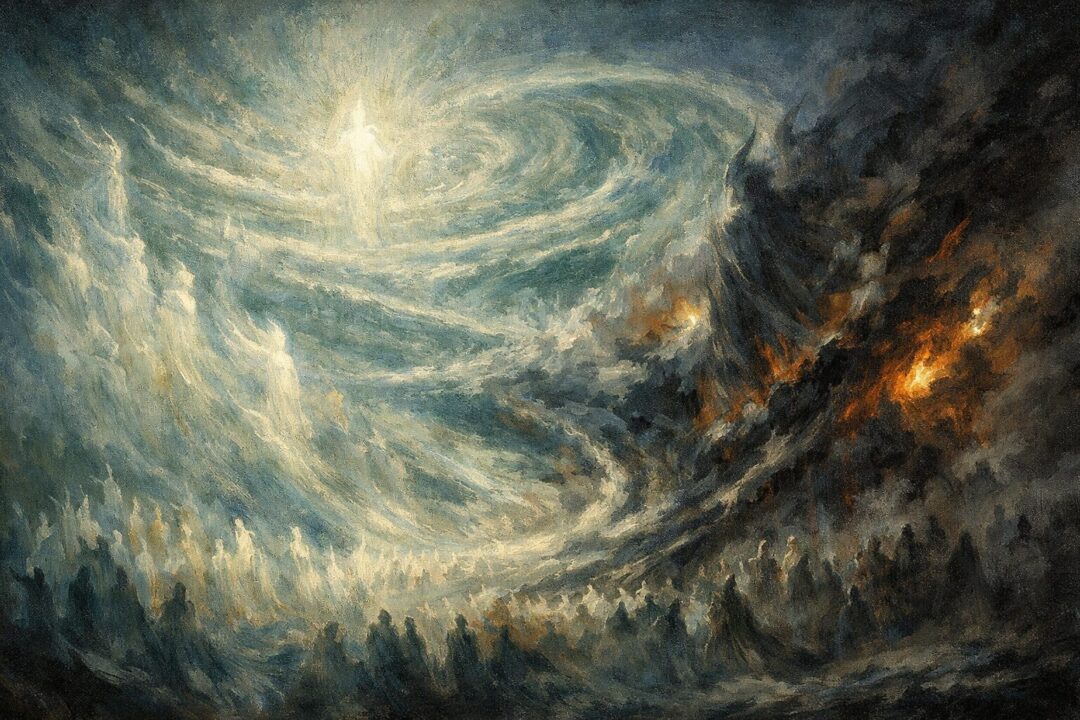
When people think of the Music of the Ainur, they usually think of creation.
They think of the beginning of the world, the first harmony, the shaping of Arda before its history fully unfolds.
That is true as far as it goes.
But the Music is not only a creation story.
It is also the first explanation for why Middle-earth is beautiful in the particular way it is beautiful: not untouched, not painless, not preserved from grief, but deepened through endurance, loss, and resistance to ruin. In Ainulindalë, Melkor introduces discord into the great Music, and Ilúvatar does not merely erase it. Instead, he raises new themes against it, until the greatest music becomes “deep and wide and beautiful,” yet “blended with an immeasurable sorrow, from which its beauty chiefly came.” That idea sits near the foundation of the whole legendarium.
The Music begins in harmony, but not for long
The Ainur begin by singing the themes of Ilúvatar.
At first, this is ordered and glorious. But Melkor, greatest of the Ainur in gifts and power, begins weaving into the music thoughts of his own. The text is careful here. His error is not described as independent creation, because the Flame Imperishable remains with Ilúvatar alone. Rather, Melkor desires to bring forth things of his own and, in that pride, turns away from the shared harmony into self-assertion. From that choice, discord enters the Music.
This matters because tragedy in Middle-earth is not presented as something built into creation from the start as a flaw in Ilúvatar’s theme.
It arises through rebellion within creation.
Melkor’s music disturbs those near him. Some grow despondent. Some falter. Some begin to attune themselves to his discord rather than to the first thought they had received. In other words, the earliest fracture in Arda’s history is not only noise. It is also misalignment.
That pattern never really disappears.
Again and again in Middle-earth, evil works not only by destroying what exists, but by bending good things away from their proper harmony.
Ilúvatar does not deny the discord
One of the most striking things in the story is what Ilúvatar does next.
He does not end the Music at the first sign of rebellion.
He responds by introducing new themes.
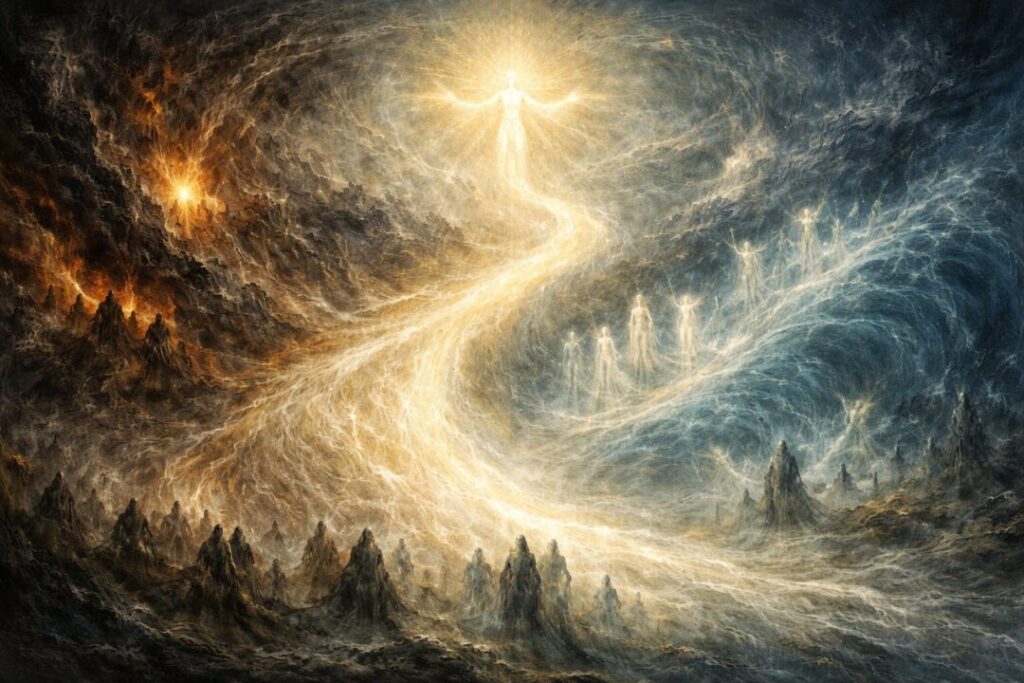
First comes a second theme, “like and yet unlike” the first, gathering power and new beauty amid the storm. Then, when Melkor’s discord rises more violently still, a third theme appears: at first soft and sweet, but impossible to quench. Eventually, two musics are heard at once, utterly at variance.
This is where the text becomes especially important for your question.
The greater of those two musics is described as “deep and wide and beautiful,” but also slow and blended with immeasurable sorrow, “from which its beauty chiefly came.” That is a direct statement, not a fan interpretation. The beauty is not merely present alongside sorrow. The text says its beauty chiefly came from that sorrow.
That does not mean sorrow is good in itself.
The discord remains discord. Melkor is rebuked, not praised. His will is still opposed to Ilúvatar’s order. But the passage does mean that once rebellion enters the history of Arda, the resulting beauty is no longer the simple beauty of untouched harmony. It becomes the beauty of depth, endurance, pity, mercy, and things that could not exist in quite the same way without the reality of loss. This is an interpretation of the text’s pattern, but it is a very conservative one, because the wording of Ainulindalë explicitly binds beauty and sorrow together at the highest level of the Music.
The Children arrive with the third theme
The next detail is easy to miss, but it changes everything.
The Children of Ilúvatar, Elves and Men, come with the third theme. They were not in the theme propounded at the beginning, and the Ainur had no part in their making. Ilúvatar alone conceived them.
That means the Children enter the story not in the untouched first harmony, but in the part of the Music already marked by contest, sorrow, and a deeper beauty that cannot be quenched.
This does not mean Elves and Men are caused by Melkor’s evil.
The text does not say that.
It does mean they appear in the stage of the Music where Ilúvatar’s answer to discord is being most fully unfolded. So when the history of Middle-earth becomes a history of exile, grief, fading, death, courage, and unexpected mercy, that history is not alien to the Music. It is already foreshadowed within it.
This is one reason so many of the greatest moments in the legendarium feel beautiful precisely because they are fragile.
Lúthien’s song in the face of loss.
Finrod’s loyalty unto death.
The long defeat of the Elves.
Sam’s pity in a ruined land.
The eucatastrophic turn at the edge of disaster.
These are not beautiful despite the world’s brokenness in some simple sense. They are beautiful in the kind of world the Music has already shown: one where sorrow cannot have the last word, but still leaves its mark on everything noble.
Even Melkor’s triumphs are taken up into a larger pattern
One of the most important lines in the entire passage says that Melkor will discover his secret thoughts are “but a part of the whole and tributary to its glory.” Ilúvatar also declares that no theme may be played that does not have its uttermost source in him, and that one who tries to alter the music in defiance will prove only an instrument in the devising of things more wonderful than he imagined.
This can be misunderstood if stated carelessly.
It does not mean Melkor’s evil is secretly good.
It means Melkor cannot escape the sovereignty of Ilúvatar.
His rebellion is real. Its damage is real. The suffering that follows is real. But it is not ultimate. Even the most triumphant notes of his discord are taken by the greater music and woven into its solemn pattern. That image is central. Evil can wound the history of Arda. It cannot seize authorship of it.
That is why the tragedies of Middle-earth are tragic without becoming meaningless.
The ruin of Beleriand is still ruin.
The Oath of Fëanor is still catastrophic.
The deaths of the innocent are still losses.
Yet none of them stand outside the possibility of redemption, memory, or a beauty deeper than untested joy.

The world itself keeps the echo of that first Music
The Music is not left behind once the vision becomes the world.
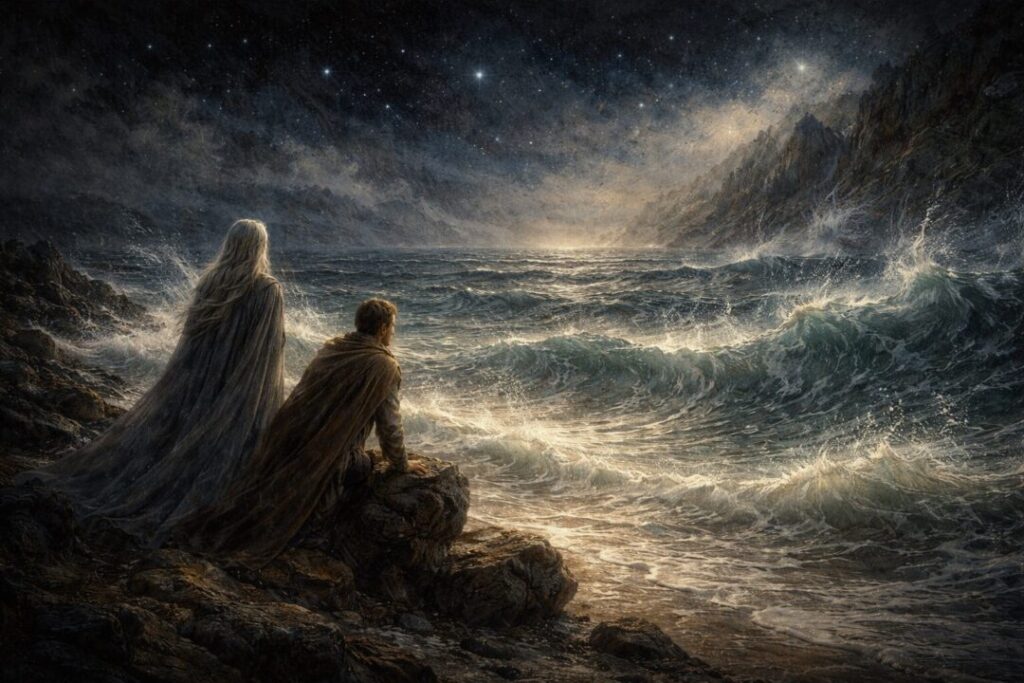
The text says that in water there lives yet the echo of the Music of the Ainur more than in any other substance on Earth, and many of the Children still listen unsated to the voices of the sea without knowing why.
That small detail says a great deal.
Middle-earth is not merely a stage built after the Music. It still carries the resonance of that first harmony, especially in the places where beauty and longing are hardest to separate. The sea, in Tolkien’s world, is often bound up with memory, homesickness, desire, and grief. This does not prove that every sorrowful beauty in Middle-earth is a conscious recollection of the Music. But it strongly fits the pattern: the world remains charged with echoes of a harmony that contains both splendor and ache.
Beauty in Middle-earth is rarely simple
This helps explain why so much beauty in the legendarium feels piercing rather than restful.
The fairest things are often the most vulnerable.
The Elder Days are glorious, but already passing.
The Elves are radiant, but their history is filled with grief.
The victory over Sauron is real, but it comes with departure, diminishment, and the end of an age.
That emotional texture is not accidental.
It is present at the world’s beginning.
The Music prepares us for a creation where beauty is not flat perfection. It is beauty under pressure. Beauty that survives fracture. Beauty that becomes more profound because it has passed through sorrow without surrendering to it. That is not stated in those exact words in the primary text, but it is the most natural reading of the line that says the music’s beauty chiefly came from immeasurable sorrow.
Why this matters
The Music of the Ainur creates both beauty and tragedy because the world of Arda is shaped by both harmony and rebellion.
Melkor’s discord introduces division, violence, and grief.
Ilúvatar’s response does not cancel history or erase freedom. Instead, it draws even wounded things into a larger design that remains beautiful, and in some sense becomes more beautiful through the depth sorrow gives it.
That is why Middle-earth never feels like a world where darkness simply interrupted a perfect song.
It feels like a world where the greatest music was always going to be the one that could endure darkness and still remain music.
And once you see that, one of the hardest truths in the legendarium comes into focus:
the deepest beauty in Arda is not the beauty that was never threatened.
It is the beauty that survives being broken.
Sources & Notes
- J.R.R. Tolkien, The Silmarillion, “Ainulindalë” — describes Melkor weaving his own thoughts into the Music, the resulting discord, and Ilúvatar answering with new themes rather than simply erasing it.
- J.R.R. Tolkien, The Silmarillion, “Ainulindalë” — gives the key image of music made “deep and wide and beautiful” yet blended with immeasurable sorrow, from which its beauty chiefly came.
- J.R.R. Tolkien, The Silmarillion, “Ainulindalë” — has Ilúvatar declare that no theme can lack its source in him, and that Melkor’s defiance will prove tributary to a greater glory.
- J.R.R. Tolkien, The Silmarillion, “Ainulindalë” — places the Children of Ilúvatar with the third theme and says the echo of the Music remains most strongly in water and the sea-longing of the Children.