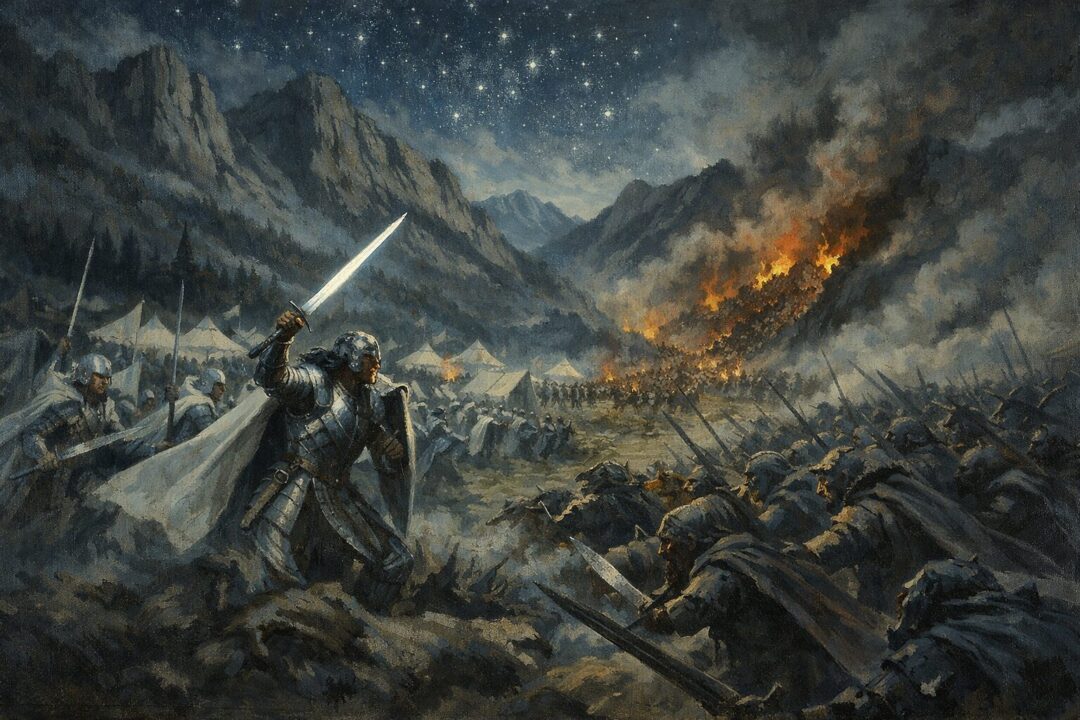
Dagor-nuin-Giliath is often remembered as one of the great early triumphs of the Noldor.
The name itself carries the wonder of the scene: the Battle-under-Stars, fought before the first rising of the Moon, in the ancient darkness of the Elder Days. It is one of those moments in the history of Beleriand that feels almost mythic even by the standards of The Silmarillion.
But if the battle is read carefully, it becomes something more than a glorious first victory.
It becomes a study in misjudgment.
Morgoth misjudges the force that has just entered Middle-earth.
Fëanor misjudges the enemy he has come to destroy.
And between those two errors, the entire future of the war is already beginning to take shape.
Morgoth Strikes First
One detail is easy to miss when people tell this story from memory: Dagor-nuin-Giliath does not begin with Fëanor launching an attack.
It begins with Morgoth responding.
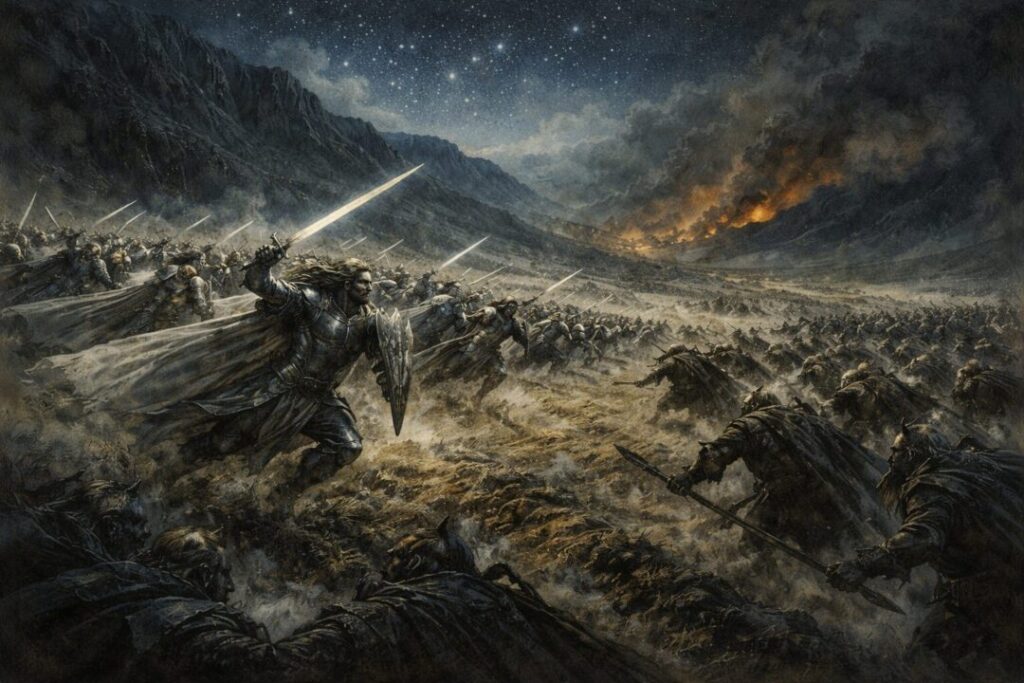
After the burning at Losgar and the tumult in Lammoth, Morgoth’s watchers become aware that a new power has entered the North. He does not yet fully understand what has come against him, but he does understand one thing clearly enough: he must move before the newcomers are settled. The text says his forces came through the passes of Ered Wethrin and assailed Fëanor suddenly, before his camp was fully made or put in defense.
That is strategy.
Morgoth’s aim appears straightforward: destroy the Noldor at the moment of disorganization. Strike before fortification. Strike before alliance. Strike before numbers can be properly gathered and ordered.
On paper, it is a strong opening move.
Fëanor has only recently landed. His people are in a strange country. They are not yet entrenched. They have just burned the ships that brought them. Even without knowing the full strength of the Noldor, an immediate attack is sensible.
And yet the plan fails.
Not because the attack itself is foolish, but because Morgoth does not yet understand what kind of enemies he is facing.
Why the Noldor Win So Fast
The text is unusually direct about why the Noldor prevail.
They are outnumbered. They are taken unawares. Yet they are “swiftly victorious,” because the light of Aman has not yet dimmed in their eyes, and they are strong, swift, and terrible in anger. This is not presented as mere poetic ornament. It is part of the explanation for the battle’s outcome.
That matters because it tells us the battle is not won through elaborate battlefield planning on Fëanor’s side.
The source does not describe a careful formation, a hidden reserve, or some masterpiece of command. The advantage lies in the quality and force of the Noldor themselves. They are still newly come from Aman. Their power has not yet faded into the long weariness that later ages will know.
In other words, Morgoth launches a rational military strike and runs into something he has not properly measured.
This is one of the first great shocks of the wars in Beleriand. Until this moment, Morgoth’s power has spread fear among the Sindar, damaged the lands of Beleriand, and pinned down places like the Havens of the Falas. But the arriving Noldor are not simply another Elvish people to be harried and worn down in the same way. They hit back with a violence and speed that overturn his expectation almost at once.
The Battle Expands Beyond Mithrim
The battle does not end with Morgoth’s first host breaking.
That is what makes Dagor-nuin-Giliath strategically interesting.
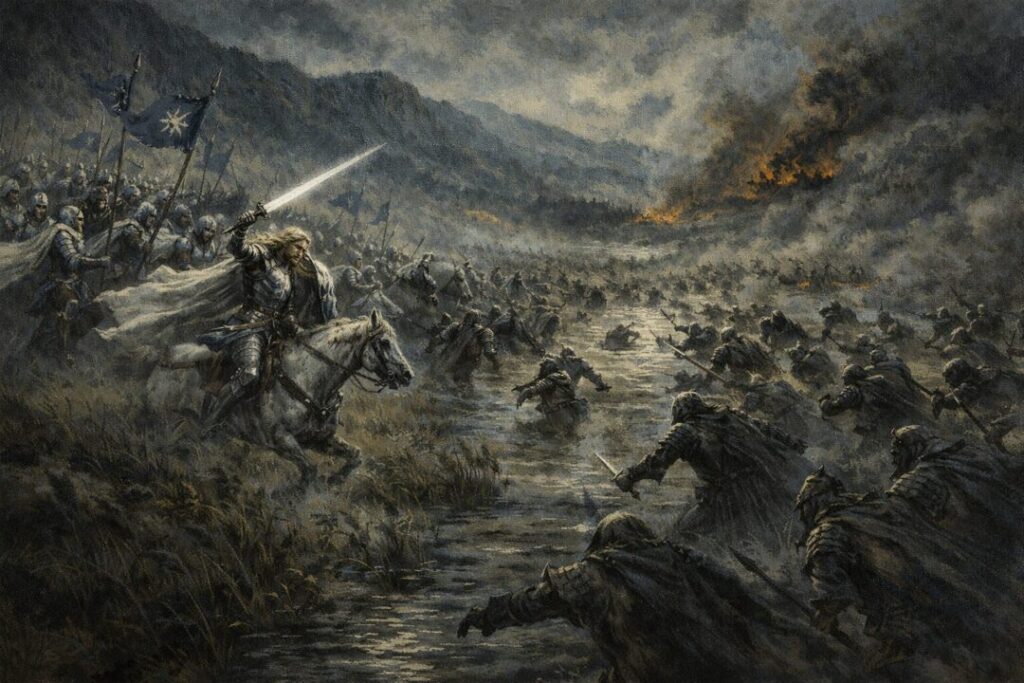
As the Orcs flee over the Mountains of Shadow and across Ard-galen, the fighting widens. Another of Morgoth’s forces, the one that had moved south and beleaguered Círdan in the Havens of the Falas, comes northward to support the retreating army. But instead of restoring the fight, this reinforcement is intercepted.
Celegorm, having learned of their movement, waylays them with part of the Elven-host near Eithel Sirion and drives them into the Fen of Serech. The result is devastating. The battle lasts ten days, and from all the hosts Morgoth had prepared for the conquest of Beleriand, only a tiny remnant returns. The text then adds that Morgoth was dismayed by the tidings that came to Angband.
This is the point where the scale of the defeat becomes clear.
Dagor-nuin-Giliath is not merely a successful defense of a camp.
It becomes the destruction of a major offensive structure Morgoth had already set in motion across Beleriand.
That does not mean Morgoth is near final defeat. The texts do not say that. But they do show that his first answer to the Noldorin return ends in a severe and surprising reverse.
Where Victory Turns Dangerous
If the story ended there, Dagor-nuin-Giliath would stand as an almost unqualified triumph.
But it does not.
Instead, the text pivots from collective victory to personal recklessness.
Fëanor, in his wrath, continues the pursuit of the broken enemy. This is the crucial strategic failure of the battle. The Orcs are beaten, but Angband is not broken. Morgoth’s outer armies are shattered, but Morgoth himself still holds his fortress, his reserves, and his strongest servants. Fëanor either does not know, or does not sufficiently reckon with, the depth of that defense. Tolkien Gateway’s summary of the relevant passage captures the point cleanly: Fëanor pressed too far ahead, and at the edge of Dor Daedeloth the battle changed when Balrogs came forth from Angband.
The deeper problem is not simply courage overrunning caution.
It is that Fëanor treats a battlefield collapse as if it were the same thing as strategic collapse.
He sees the enemy in flight and reads the moment as final.
It is not final.
It is only the first breach in a much larger war.
Fëanor’s Fatal Misreading
The text and related tradition are consistent on what follows.
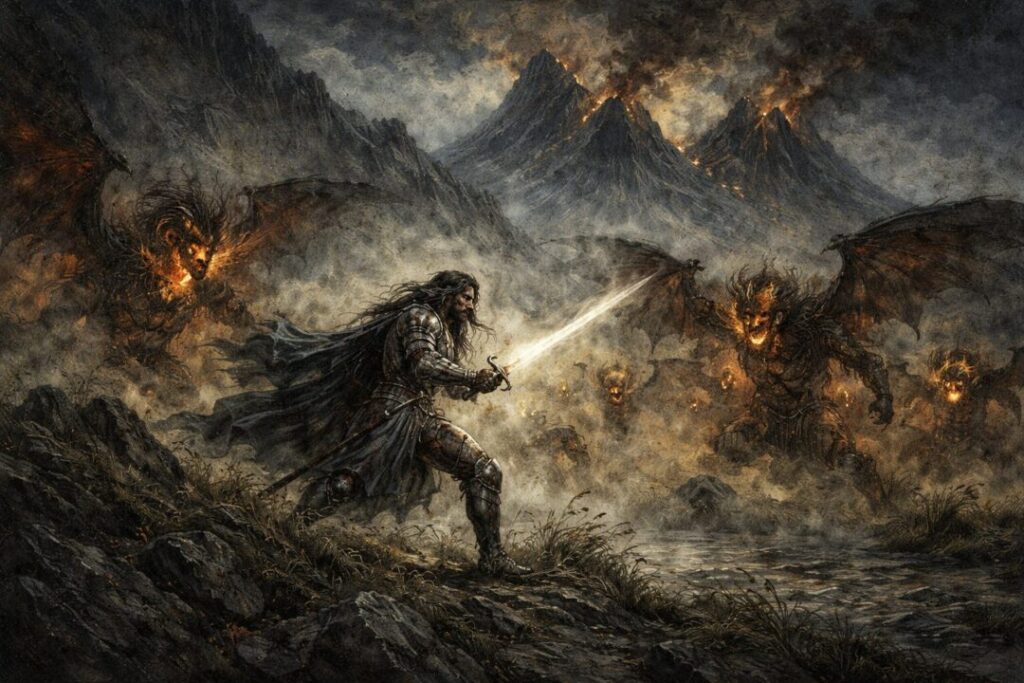
Fëanor draws far ahead of the van of his host. Seeing him isolated, Morgoth’s servants turn to bay, and Balrogs issue from Angband to aid them. Fëanor is surrounded with few friends about him. He fights long and fiercely, but Gothmog, Lord of the Balrogs, wounds him mortally before his sons arrive with greater force and drive the Balrogs back.
This is where the battle reveals its real shape.
Morgoth’s initial strategy fails because he underestimates the Noldor.
Fëanor’s final movement fails because he underestimates Angband.
Both sides misread the other.
But Morgoth survives his error.
Fëanor does not.
And then comes one of the most striking moments in the entire episode: as he is dying, Fëanor sees the far peaks of Thangorodrim and knows that the Elves, unaided, will never throw down those dark towers.
That realization matters because it confirms what the battle itself has already shown.
A brilliant tactical success is not enough.
Not against Morgoth.
Not against Angband.
Not even for the greatest of the Noldor.
What the Battle Actually Proves
So what is the real strategy behind Dagor-nuin-Giliath?
At the safest textual level, it is this:
Morgoth tries to destroy the Noldor before they are established.
The Noldor prove far stronger than he expects.
The battle widens into a catastrophic defeat for his field armies.
Then Fëanor throws away the full advantage by transforming victory into pursuit without sufficient support.
Everything beyond that should be stated carefully.
The texts imply that Morgoth’s first great miscalculation in Beleriand was not taking the returning Noldor seriously enough. They also imply that Fëanor’s greatest military error was believing that the destruction of armies in the field meant Angband itself was exposed. That is a fair reading of the sequence, but it should still be called a reading of the sequence rather than an explicit authorial thesis.
What the sources do make explicit is the pattern:
surprise,
reversal,
annihilation,
overreach,
punishment.
Why Dagor-nuin-Giliath Matters So Much
Dagor-nuin-Giliath matters because it looks simple at first glance.
It is easy to remember the stars, the fury of the Noldor, the humiliation of Morgoth’s armies, and the mighty last stand of Fëanor.
But beneath all of that is one of the clearest early lessons in the wars of Beleriand: Morgoth can be checked in the field, yet still remain overwhelmingly dangerous in depth. And the fire that makes Fëanor victorious is the same fire that makes him incapable of stopping when victory has already been won.
That is why the battle is not merely glorious.
It is revealing.
Under the stars, Morgoth learns that the Noldor are more terrible than he expected.
And Fëanor learns too late that Morgoth is more deeply entrenched than wrath can overcome.
Sources & Notes
- J.R.R. Tolkien, The Silmarillion, “Of the Return of the Noldor” — Morgoth’s sudden assault before Fëanor’s camp was set in defence, and the Noldor’s swift victory under the stars.
- J.R.R. Tolkien, The Silmarillion, “Of the Return of the Noldor” — Celegorm’s interception near Eithel Sirion, the driving of Morgoth’s forces into the Fen of Serech, and the ten-day scope of the battle.
- J.R.R. Tolkien, The Silmarillion, “Of the Return of the Noldor” — Fëanor’s overextended pursuit toward Dor Daedeloth, the coming of the Balrogs, and Gothmog’s mortal wounding of him.
- J.R.R. Tolkien, The Silmarillion, “Of the Return of the Noldor” — Fëanor’s dying sight of Thangorodrim and his realization that the Noldor alone could not overthrow it.