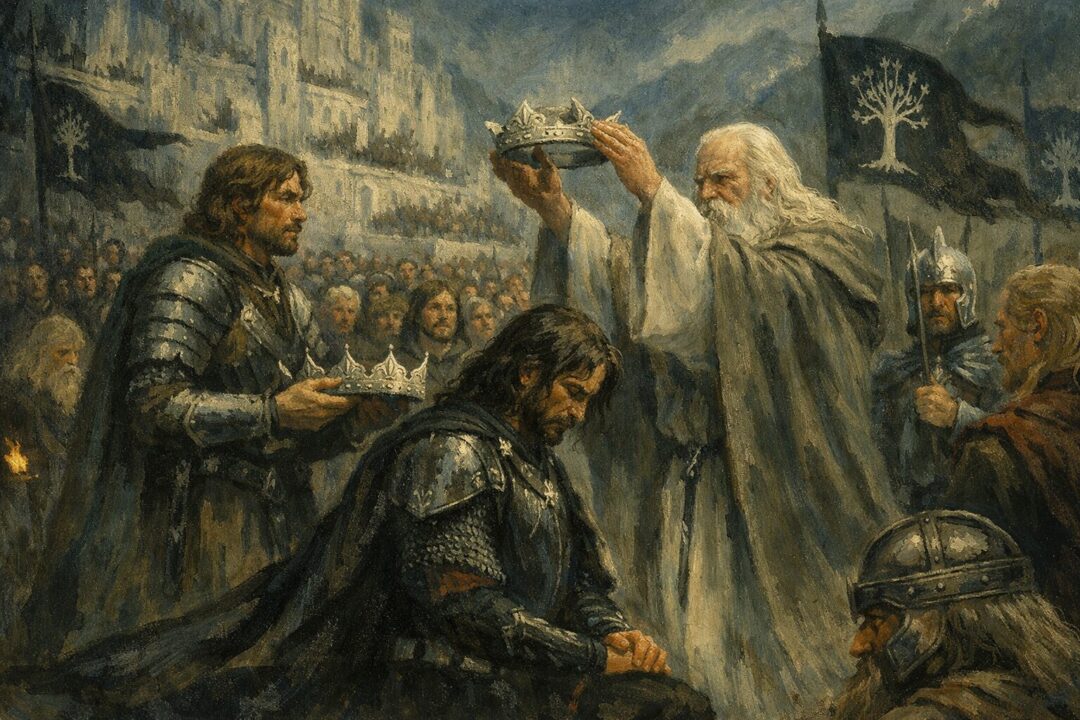
When people hear The Return of the King, they usually read the title as a straightforward promise.
The lost heir comes back.
The rightful ruler is crowned.
Order is restored.
That is true, but only at the broadest level.
Because in Middle-earth, Aragorn’s return is not just the emotional completion of a heroic arc. It is the repair of a political fracture that has shaped the West for centuries. The title points not merely to a man reclaiming a throne, but to the restoration of kingship itself — and with it, a whole pattern of legitimacy, memory, protection, and political order that had been wearing thin long before the War of the Ring began.
Gondor Did Not Lack Government
One detail matters immediately.
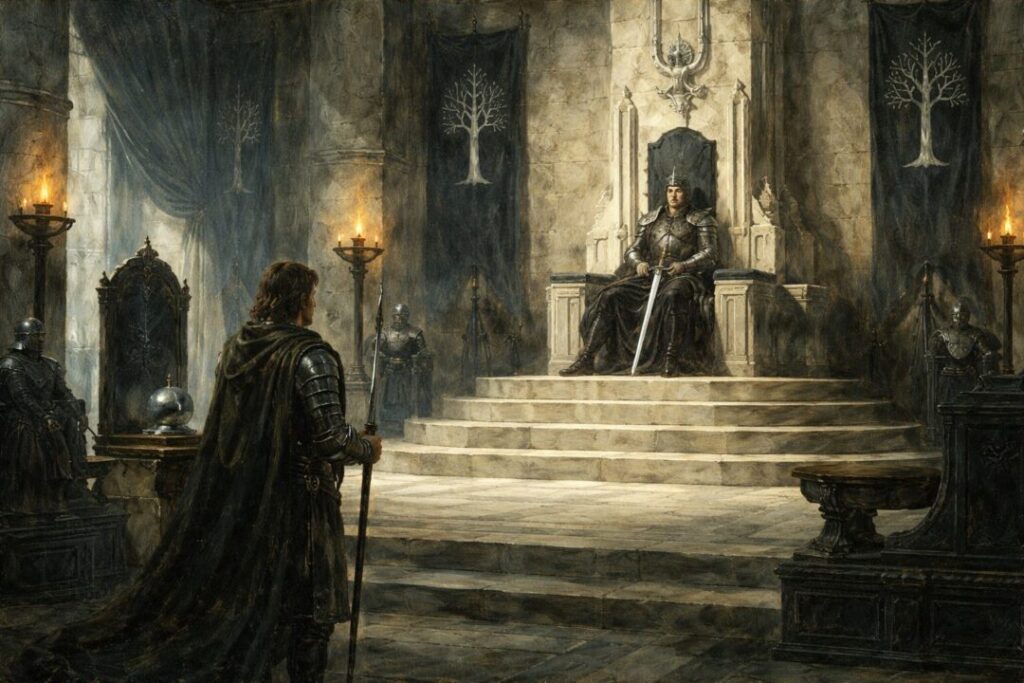
Gondor was not leaderless before Aragorn.
For generations, it had been ruled by Stewards. They were not usurpers in the simple sense. Their office was lawful, ancient, and originally understood as custodial. The Stewards governed “in the name of the king, until he shall return,” even after those words had become more ritual than expectation. In practice, they held the power of kings while the throne remained empty.
That makes Aragorn’s arrival politically sharper than it first appears.
He is not merely stepping into chaos.
He is displacing an established substitute.
And that substitute had endured so long that many in Gondor no longer expected the kingship to become real again. The office of Steward had become normal. The king had become half memory, half tradition, and partly a matter of old language that still survived after belief had weakened.
So the “return” is not the creation of government from nothing.
It is the ending of a long provisional age.
The Return Is About Legitimacy, Not Just Victory
This is why the political meaning of Aragorn’s accession is deeper than military success.
He does not become king merely because he helped defeat Sauron.
He becomes king because he stands in the line of Elendil and reunites what had once been divided: the North-kingdom of Arnor and the South-kingdom of Gondor. The text presents this as restoration, not invention. Aragorn is the heir of Isildur, and with his crowning the old Númenórean kingship in exile is made whole again in the Reunited Kingdom.
That matters politically because legitimacy in Middle-earth is not treated as mere force.
Sauron has force.
Saruman seeks force.
The Ring offers force.
Aragorn’s rule, by contrast, is framed as rightful continuity: an old line returning, a broken structure repaired, an office once held in trust finally answered by the one for whom it was intended. Even Gandalf’s words to him after the war point toward ordered beginning rather than simple triumph: the new age must now be set in order, and what can be preserved must be preserved.
So politically, the title does not mean “a strong man wins.”
It means “a rightful form of rule, long deferred, becomes real again.”
Arnor Matters More Than Many Readers Notice
A lot of readers instinctively focus on Gondor because Minas Tirith is where the coronation happens.
But politically, Aragorn’s return means more than a southern throne being filled.
It also means the North is restored.
Arnor had long since fallen, and its heirs had survived only in diminished form through the Chieftains of the Dúnedain. Aragorn is therefore not just the new king of Gondor. He is king of the Reunited Kingdom of Arnor and Gondor. That phrase matters, because it signals that the old split between the two realms of Elendil is over. The West is being gathered back together.
This makes the title The Return of the King broader than “the return of Gondor’s king.”
It is really the return of a high kingship that reconnects north and south after centuries of fracture.
That is one reason the event feels so weighty in the story. A personal claim becomes a civilizational restoration.
The New Realm Is Not Built on Simple Annexation
What Aragorn restores is not a flat empire that erases every lesser polity around it.
The texts are more careful than that.
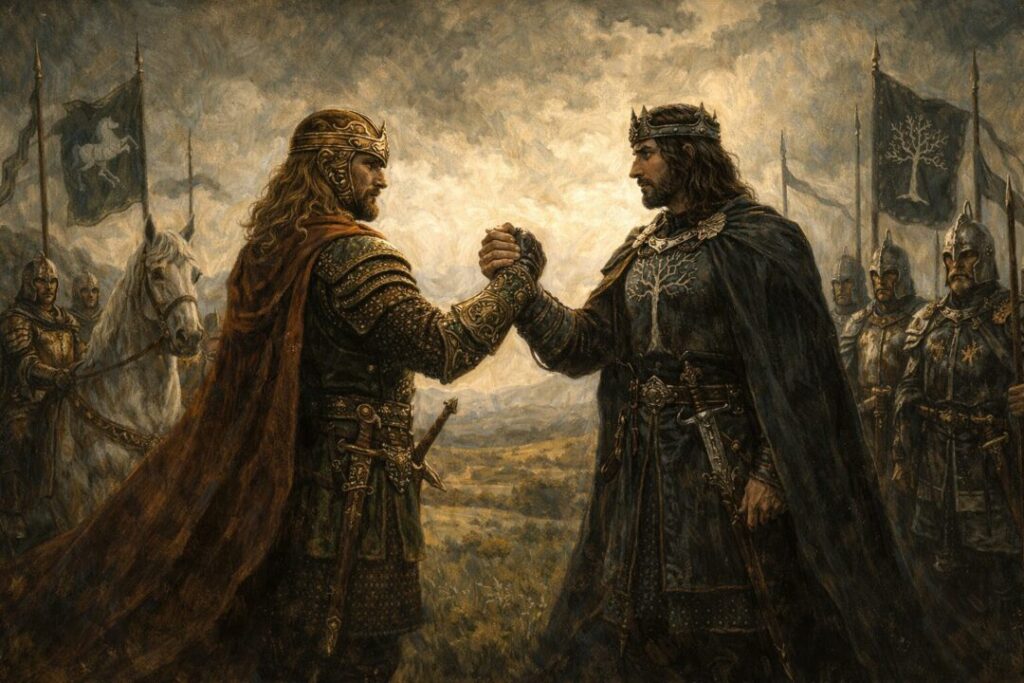
Rohan remains outside his direct kingship. In the lands of the old realms he is king, but not in Rohan; there the gift of Cirion is renewed to Éomer, and the Oath of Eorl is renewed as well. That means the alliance is reaffirmed, not swallowed up. Rohan remains a separate kingdom under its own ruler, bound in loyalty and mutual obligation, not reduced to a province.
That distinction is politically important.
It shows that restored kingship in Middle-earth is not identical with endless centralization. Aragorn’s authority has bounds. Some lands are directly his by ancient right; some remain allied and sovereign in their own structures. The return of the king therefore restores hierarchy, but not uniformity.
The Shire Is Protected, Not Absorbed in the Ordinary Way
The Shire makes this even clearer.
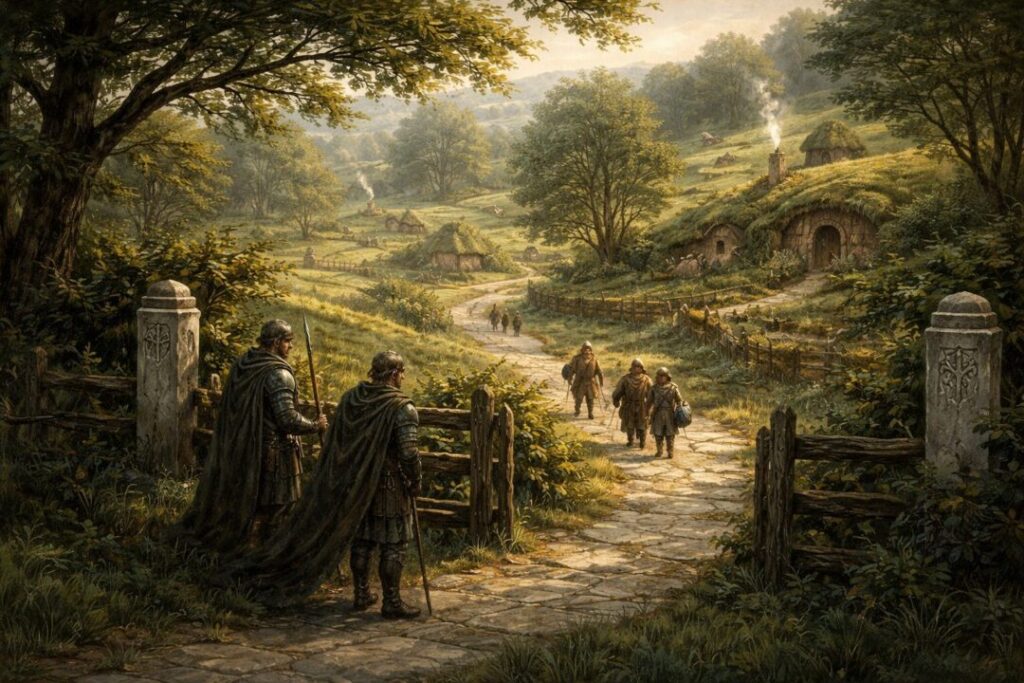
After Aragorn’s accession, the Shire becomes a Free Land under the protection of the Northern Sceptre, and Men are forbidden to enter it. Later, the Thain, the Master of Buckland, and the Mayor are made Counsellors of the North-kingdom.
This is one of the most revealing political details in the late legendarium.
The king does not abolish the Shire’s local institutions.
He does not replace its customary rulers with royal officers.
He does not “modernize” it into sameness.
Instead, he protects its separateness.
The Shire remains within the larger restored order, but its internal character is preserved. Its local offices still matter. Its boundaries are guarded. Its smallness is not treated as political insignificance, but as something worth sheltering.
That tells us a great deal about what the king’s return actually means.
Not the flattening of differences.
The guarding of them.
Faramir Shows What Restored Kingship Is Supposed to Do
Faramir’s fate after the coronation is another crucial political clue.
If Aragorn’s return were only about replacing rivals, Faramir would be diminished.
Instead, the opposite happens.
Faramir, who had become the de jure Ruling Steward after Denethor’s death, yields place lawfully at Aragorn’s crowning. But he is not disgraced. He remains Steward and is made Prince of Ithilien, with his seat in Emyn Arnen. In other words, the returning king does not destroy honorable service under the old order; he confirms it, re-places it, and gives it a fitting role inside the restored realm.
That is politically revealing.
Good kingship in Middle-earth does not consume every lesser dignity.
It gives each office its right proportion.
The Steward is no longer the substitute for an absent throne, but neither is he discarded. Ithilien itself, a borderland long shadowed by war, is entrusted to Faramir as a princedom. That is restoration through ordering, not restoration through humiliation.
The Return of the King Also Marks the Return of Meaning
There is another political layer here that is easy to miss.
For centuries, the institutions of Gondor had continued while some of their original meaning had thinned out. The Steward ruled, but the throne stood empty. Ancient formulas survived, but in diminished faith. Hope of return lingered, but often only as rumor or memory.
Aragorn’s crowning changes that.
It does not only fill an office.
It restores the meaning of the office.
The king is not now a decorative addition to a system already complete. His return reveals that the system was incomplete all along. What had been functioning politically was still waiting, in a deeper sense, for the thing it was built around.
That is why the title feels so large.
The return is military.
It is dynastic.
It is territorial.
But it is also symbolic in the strongest political sense: an invisible center becomes visible again.
Why the Title Matters
By the end of the war, Sauron is gone.
But the passing of Sauron does not automatically tell Middle-earth what kind of order should follow him.
That answer arrives with Aragorn.
The Reunited Kingdom is restored.
The line of kings is renewed.
Rohan remains an honored ally rather than an absorbed dependency.
The Shire is preserved in its own small freedom.
Faramir is confirmed rather than cast aside.
The Fourth Age begins not as formless aftermath, but as a world deliberately put back into shape.
So The Return of the King does not simply mean that Aragorn gets what was his.
It means Middle-earth gets back a form of rule that had nearly passed into legend.
Not perfect rule.
Not domination.
Not the end of all conflict.
But a restored kingship whose purpose is to set things in order, preserve what can be preserved, and let different lands remain themselves under a larger peace.
That is why the title is stronger than it first appears.
It is not only about the man who returns.
It is about the return of political wholeness after a very long age of substitutes.
Sources & Notes
- J.R.R. Tolkien, The Lord of the Rings, Appendix A, “Annals of the Kings and Rulers”: the divided realms of Arnor and Gondor, the line of Isildur, and the long rule of Gondor’s Stewards frame Aragorn’s accession as restoration.
- J.R.R. Tolkien, The Lord of the Rings, Book VI, Chapter 5, “The Steward and the King”: Faramir surrenders the Steward’s office at the coronation and Aragorn is acclaimed as King Elessar.
- J.R.R. Tolkien, The Lord of the Rings, Appendix A, “The House of Eorl”: the gift of Calenardhon and the Oath of Eorl explain why Rohan remains an allied kingdom, not a province of Gondor.
- J.R.R. Tolkien, The Lord of the Rings, Appendix B, “The Tale of Years”: Aragorn’s reign as King of the Reunited Kingdom, the Shire’s protection as a Free Land, and later northern counsellors show the restored order after the War.
- J.R.R. Tolkien, The Lord of the Rings, Book VI, Chapter 6, “Many Partings”: Aragorn’s charge to order the realm and preserve what may be preserved supports reading restored kingship as healing rather than conquest.