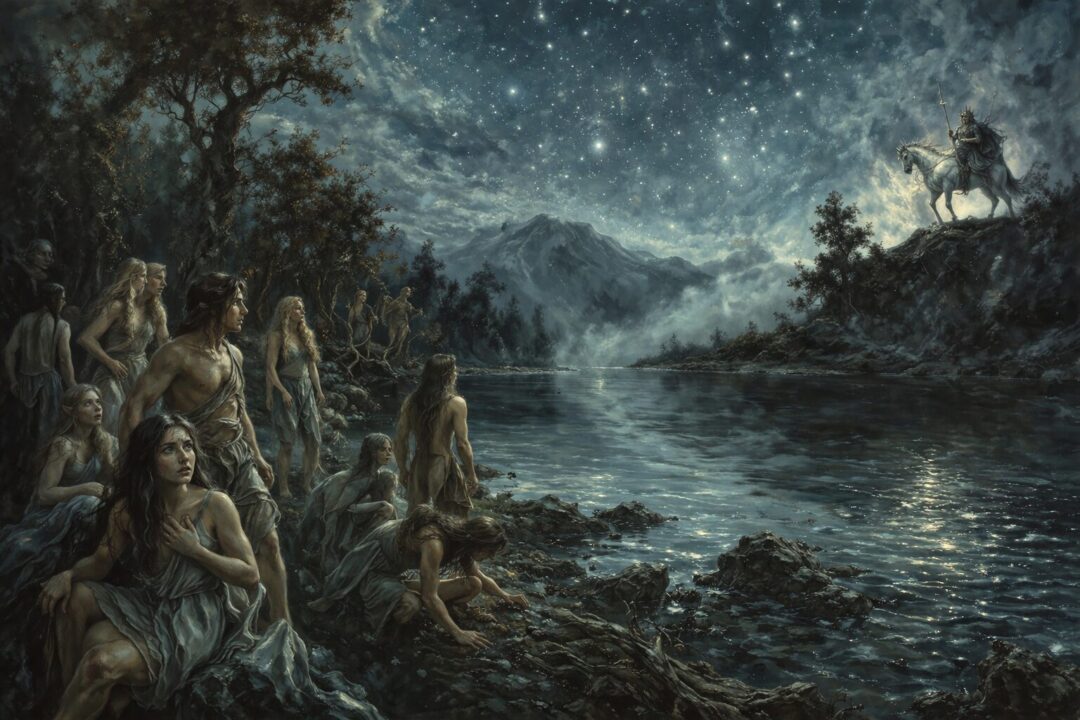
When people think about the divisions among the Elves, they usually look to the great disasters of later ages.
They think of Fëanor and the Silmarils.
They think of exile, kinslaying, and the long sorrow of Beleriand.
They think of the fading of the Elves in Middle-earth.
But the deepest separation begins earlier than all of that.
It begins with the Great Journey.
At first glance, the Journey seems simple enough: the Elves awaken in Middle-earth, Oromë discovers them, and the Valar summon them west toward Aman. Some answer that summons, and some do not. It can sound almost like the beginning of a migration story.
But the texts treat it as something much greater.
The Great Journey does not merely move the Elves across the world. It creates the first lasting fracture within Elvenkind, and every later distinction grows out of it.
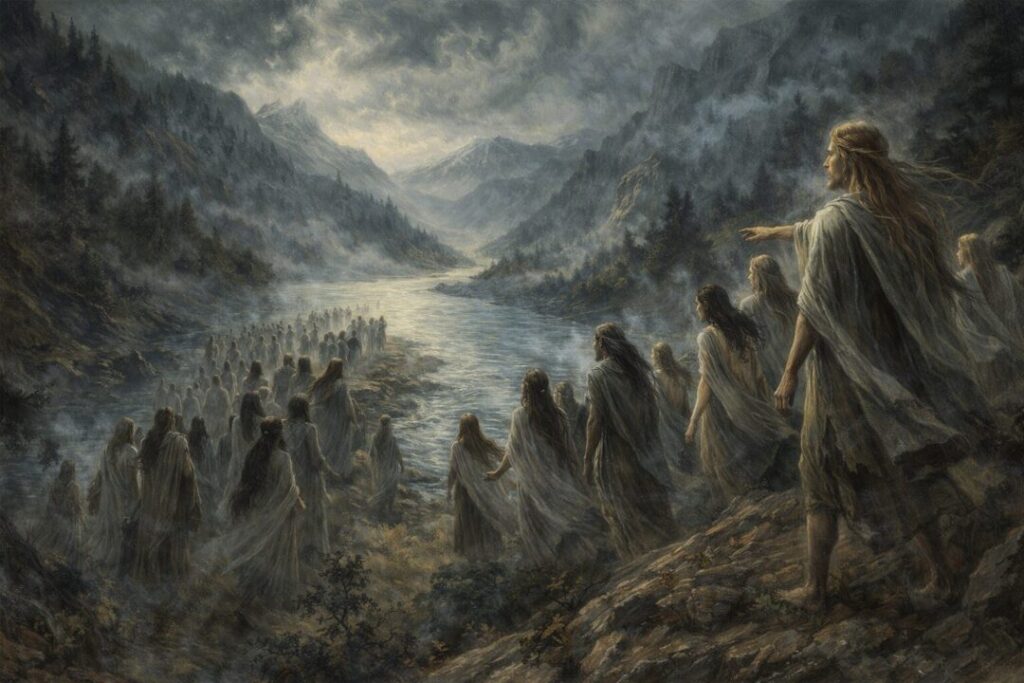
The first division is a choice that cannot be undone
The first break comes at Cuiviénen.
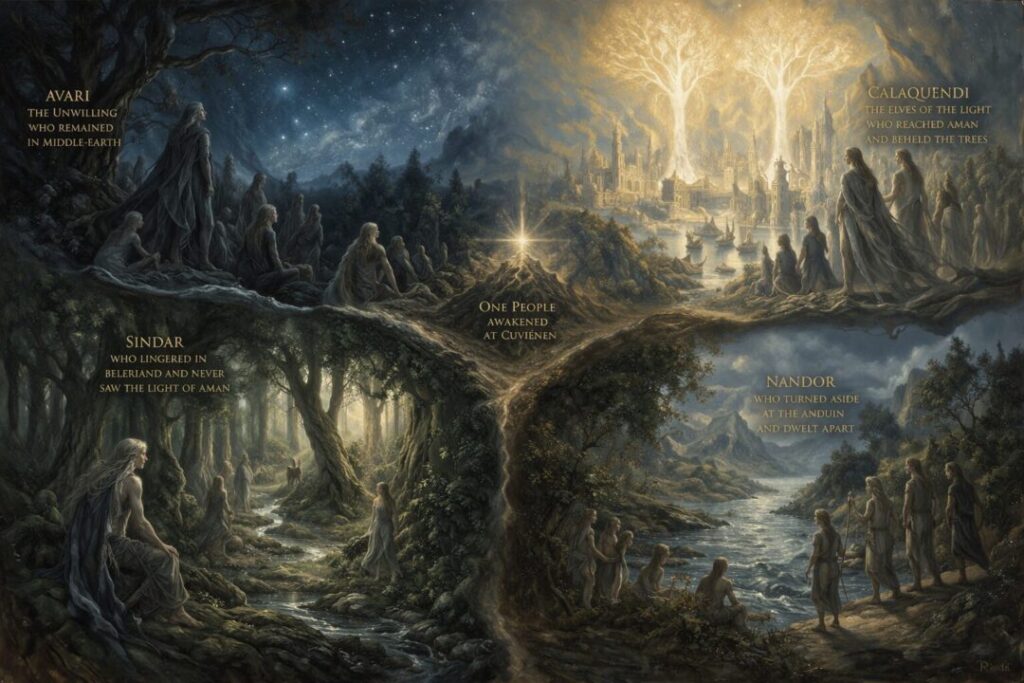
When the Elves are summoned west, not all of them are willing to go. Those who accept the summons become the Eldar. Those who refuse are the Avari, the Unwilling. From that moment, the division is already more than geographical. It is historical and cultural from the beginning. The traditions explicitly treat this as a sundering, not a temporary disagreement.
This matters because the separation happens before the Elves have spread into all the peoples most readers know by name.
In other words, the split does not arise after centuries of drift.
It happens near the source.
The Elves who remain behind do not simply miss a destination.
They become a different branch of Elven history.
That does not mean they cease to be kin. They remain Quendi, the same Firstborn race. But the legendarium never suggests that the original division is later erased. The Avari remain outside the histories that define the Eldar, and much of what later becomes “high” Elven memory belongs only to those who accepted the summons at all.
Even the Elves who leave do not remain one people
The second fracture happens on the road itself.
Not all who begin the Journey finish it.
The Vanyar and the Noldor reach Aman. But among the Teleri, the largest and slowest of the hosts, the road produces further partings. Some turn aside at the Anduin under Lenwë and become the Nandor. Others continue west but linger in Beleriand. Later, when Elwë is lost in Nan Elmoth, many remain behind and become the Sindar rather than complete the passage to Aman.
That is why the Great Journey does not produce a simple division between “those who went” and “those who stayed.”
It produces layers of sundering.
Some never begin.
Some begin and turn back.
Some come far but not far enough.
Some reach the Blessed Realm at last.
And each stage leaves a lasting mark.
The Nandor become a people apart in the texts, especially associated with woodland life and the vales of Anduin. The Sindar, though they never saw the light of the Two Trees, become the great Elven people of Beleriand under Thingol and Melian. The Teleri who do reach Aman become the Falmari of the Sea. These are not temporary camps along one road. They become enduring peoples with distinct histories.
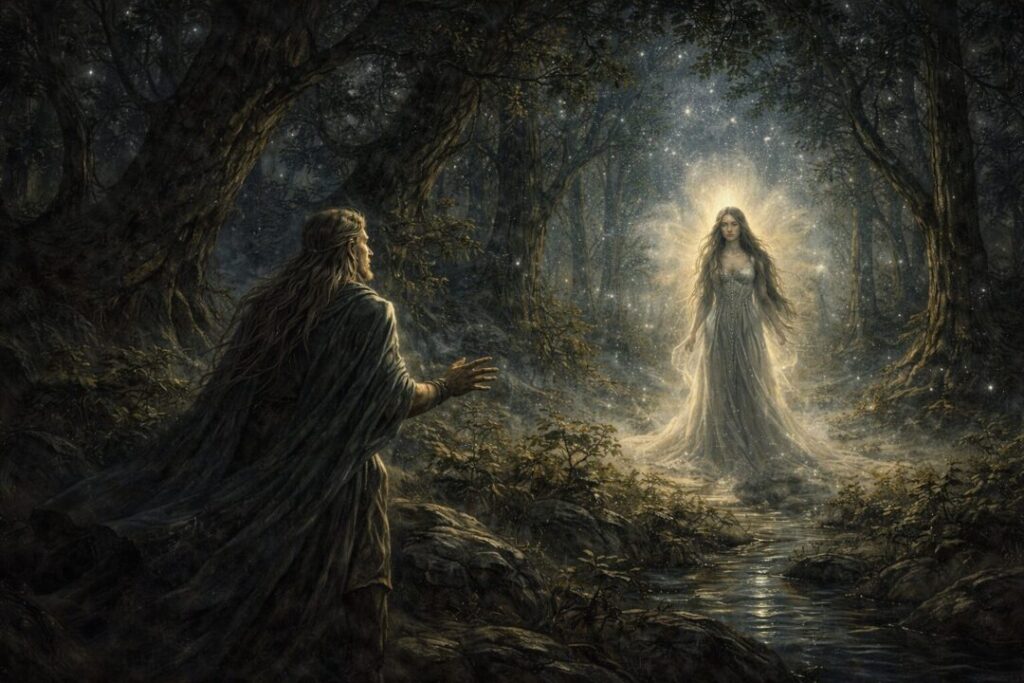
The light of Aman makes the split deeper
The deepest difference is not merely who traveled farthest.
It is who beheld the light before the Sun and Moon.
The tradition distinguishes between the Calaquendi, the Elves of the Light, and the Moriquendi, the Elves of the Darkness. In this usage, the Calaquendi are those who reached Aman and saw the light of the Two Trees. Those who did not—whether Avari who refused the summons or Eldar who never completed the journey—are counted among the Moriquendi, because they never beheld that light.
This is one of the clearest signs that the division is permanent in kind, not only in location.
The Trees are gone.
The Elder Days pass.
Exiles return to Middle-earth.
Yet the distinction remains meaningful.
Why? Because the experience cannot be replicated later. Once the Trees are destroyed, no later reunion can place the Sindar, Nandor, or Avari into the same unbroken inheritance as those who had seen that ancient light. Even if Elves of different branches dwell together afterward, they do not share the same beginning anymore.
That is the quiet force of the Journey.
It creates not just distance, but unequal memory.
Reunion does happen, but it does not reverse the sundering
This point is easy to miss because the Elves do reunite in many ways.
The Noldor return to Middle-earth.
The Sindar and Noldor dwell in overlapping realms.
Silvan peoples are ruled in later ages by lords of Sindarin descent.
Kinship remains real, and the texts never portray all Elvish divisions as hostility.
But reunion is not the same thing as restoration.
Thingol can be acknowledged as kin to the Teleri of Aman without ever becoming one of them in experience.
The Silvan Elves can be related to the Sindar and still remain more remote from Aman.
Even among the Eldar, those who lived in the Blessed Realm carry something the others do not.
The legendarium is full of returns that do not truly undo what happened before.
The Noldor can come back from exile, but the bliss of Valinor is not restored in Beleriand.
The Sindar can greet the Exiles as kin, but they have not shared the same road.
The scattered branches of the Teleri can be traced back to common ancestry, yet they remain historically separate.
So when people say the Elves are “one immortal people,” that is true in one sense and incomplete in another.
They share nature.
They do not share one uninterrupted history.
The Journey changes what each people knows the world to be
The real reason the Great Journey splits the Elves forever is that it gives different branches different first truths.
For the Avari, the world remains fundamentally a world of Middle-earth under the stars.
For the Sindar, Middle-earth is also home, but they live close to the memory of the West through rumor, kinship, and eventually through Melian.
For the Calaquendi, the world includes the Blessed Realm not as hearsay but as memory. They know the Trees not as legend but as lived reality.
This means later encounters are never taking place on equal ground.
One people remembers what another only imagines.
One people has seen what another can only be told about.
One people bears titles and authority rooted in Aman itself, while another develops entirely within Middle-earth.
That difference shapes language, prestige, culture, and the way later histories are told. It is also why terms like Eldar, Avari, Calaquendi, Moriquendi, and Úmanyar are so important. They are not decorative labels. They preserve the memory of irreversible divergence.
“Forever” should be understood carefully
It is worth being precise here.
The texts do not suggest that every Elf is permanently alien to every other Elf after the Journey. Nor do they say reconciliation is impossible. There are alliances, intermarriages among kindreds of Eldarin background, shared realms, and mutual recognition across many ages.
So “forever” should not mean that all unity is lost.
It means the original undivided state is never fully recovered in the histories we are given.
No later event makes the Avari into Eldar.
No later event makes the Sindar into Calaquendi.
No later event gives the Moriquendi the memory of the Trees.
No later event rewinds the choices, delays, losses, and turnings that happened on the road west.
The Great Journey is therefore not merely one episode in Elvish history.
It is the event that makes later Elvish history plural.
Why this matters so much in Middle-earth
Once you see this, many later patterns make more sense.
Why the Sindar can be both close kin and clearly distinct from the High Elves.
Why the Silvan realms feel ancient yet different from the traditions of Aman.
Why the memory of the West carries such prestige.
Why returning to Middle-earth does not erase what the Exiles once were.
The Journey is the reason.
It is the road that turns one people into many remembered branches.
And because Elves are immortal within the life of Arda, those branches do not simply vanish in the way mortal migrations might. Their memories endure. Their names endure. Their claims about the past endure.
That may be the strangest part of all.
Among Men, time can blur an origin until it becomes legend.
Among Elves, the ones who walked different roads may still remember that divergence as living history.
So the Great Journey splits the Elves forever not because they stop being kin.
It splits them forever because kinship survives the separation.
They remember the same awakening from different distances.
They inherit the same origin through different worlds.
And after the road west begins, no later age ever makes them wholly one people again.
That is why the Journey matters so much.
It is not just how the Elves travel into history.
It is how history enters the Elves.
Sources & Notes
- J.R.R. Tolkien, The Silmarillion, “Of the Coming of the Elves and the Captivity of Melkor” — gives the summons of the Valar, the refusal of the Avari, and the first naming of the Eldar as those who began the westward journey.
- J.R.R. Tolkien, The Silmarillion, “Of Eldamar and the Princes of the Eldalië” — follows the sundering of the hosts, including the Teleri who lingered or remained in Beleriand and those who finally reached Aman.
- J.R.R. Tolkien, The Silmarillion, “Of Thingol and Melian” — supports the article’s point that Elwë’s loss in Nan Elmoth left many Teleri in Middle-earth, becoming the Sindar under Thingol.
- J.R.R. Tolkien, The War of the Jewels, “Quendi and Eldar” — clarifies the terms Eldar, Avari, Úmanyar, Calaquendi, and Moriquendi, and why seeing the Light of Aman remained a lasting distinction.