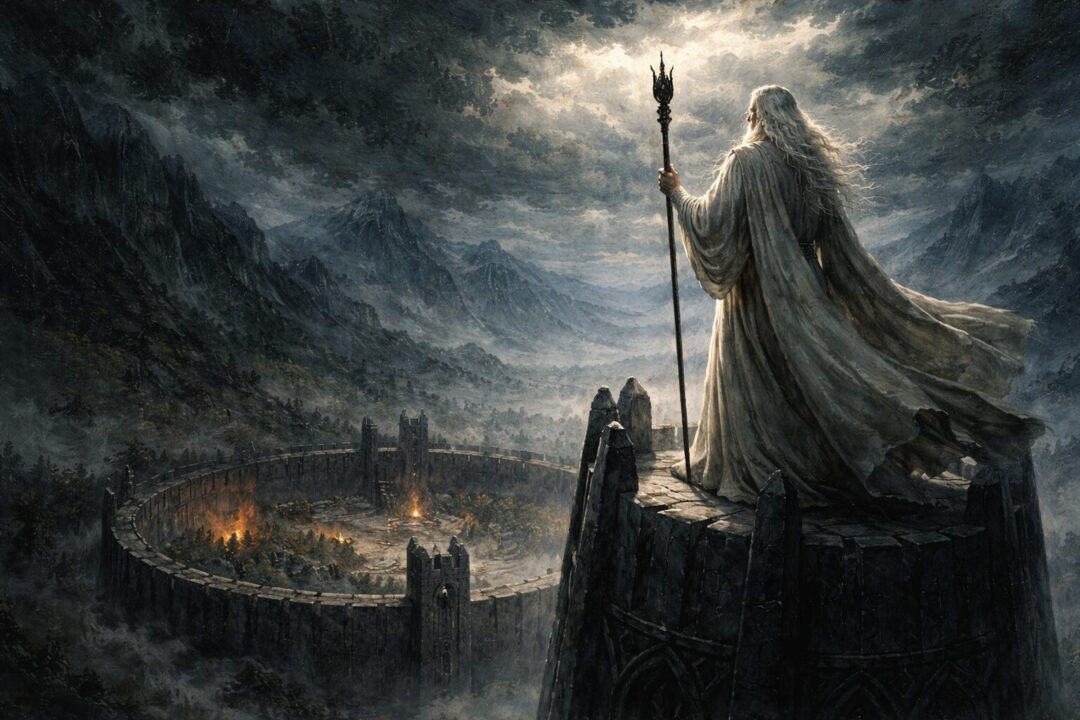
When most readers first encounter Saruman in The Lord of the Rings, his fall is already complete. He rules Isengard as a tyrant, commands great engines of war, and speaks with a voice crafted to dominate the wills of others. His betrayal feels sudden only because Tolkien introduces us at the end of the story, not the beginning.
But Tolkien is clear—Saruman did not fall in a moment of rage or desperation. His corruption did not begin with alliance to Sauron, nor with the breeding of armies or the felling of Fangorn’s trees.
It began quietly.
It began with withdrawal.
Saruman’s retreat from the White Council and his decision to rule from Isengard was not exile, punishment, or accident. It was a calculated choice—one that Tolkien presents as a familiar and deeply moral pattern: evil often begins not with rebellion, but with isolation.
Saruman’s Original Role Among the Wise
Saruman was not merely one wizard among many. When the Istari were sent from the West to oppose Sauron, Saruman was appointed their chief. Unfinished Tales explains that this role was given to him because of his unmatched knowledge of the Enemy and his mastery of lore, especially the arts of craft and ring-making.
From the beginning, Saruman was trusted.
When the White Council was later formed—bringing together the greatest powers opposing Sauron—it was Saruman who became its head. This position was not seized or enforced. It was granted through reputation. He was the one others deferred to, the one whose voice carried authority in matters of strategy and history.
At this stage, Tolkien leaves no doubt: Saruman genuinely opposed Sauron. He was not feigning loyalty. His early work against the Shadow was sincere, diligent, and effective.
But Tolkien repeatedly warns that wisdom, when paired with pride, becomes dangerous. Saruman’s knowledge was vast, but it was also inward-facing. Where others sought counsel and balance, Saruman began to trust his own judgment above all others.

The Seeds of Withdrawal
The turning point is the One Ring.
Saruman’s study of ring-lore goes beyond academic interest. He becomes convinced that the power of the Rings—particularly the Ruling Ring—holds the key to defeating Sauron. Not through destruction, but through mastery.
This belief quietly separates him from the rest of the Council.
When the White Council debates whether to act openly against Sauron at Dol Guldur, Saruman urges delay. He argues that the One Ring has long been lost, swept down the Anduin into the Sea. On the surface, this sounds reasonable. Beneath it lies something far more dangerous.
This is not ignorance.
It is strategy.
Saruman knows the Ring may yet be found. By misleading the Council, he buys himself time—time to search in secret, time to study, time to prepare for a future where power, not restraint, decides the fate of Middle-earth.
Tolkien presents this moment as critical: Saruman does not yet serve evil, but he has begun to lie in service of his own designs. The line between opposition and ambition has been crossed.
Why Isengard, Not Rivendell or the Council Chambers?
Saruman’s withdrawal is not merely political. It is geographical.
He chooses Isengard.
Isengard was no ordinary stronghold. At its heart stood Orthanc, an ancient tower of Númenórean craft—indestructible, filled with hidden chambers and devices beyond the understanding of later ages. It was strategically positioned at the southern end of the Misty Mountains, commanding key routes between north and south.
From Isengard, Saruman could watch the world.
More importantly, from Orthanc he could work unseen.
Unlike Rivendell or Lórien, Isengard was not a place of counsel or memory. It was a place of control. Saruman could command land, build industry, and shape events without explanation or debate.
Crucially, Tolkien is explicit: no one forced Saruman there. He was not exiled. He was not removed from leadership. He chose Isengard and gradually ceased attending the White Council.
This mirrors a recurring Tolkien theme: evil rarely announces itself. It withdraws first, convincing itself that secrecy is wisdom and independence is strength.
The Palantír and the Illusion of Mastery
Saruman’s possession of a palantír accelerates his fall.
Through the Seeing-stone of Orthanc, Saruman believes he can match Sauron mind to mind. Tolkien later clarifies the tragic irony: Saruman thinks he is using the palantír freely, when in truth he is being shown only what Sauron wishes him to see.
Yet even here, Saruman is not coerced.
He looks into the stone because he believes he is strong enough to do so safely. Pride convinces him that knowledge alone grants control. The palantír becomes both his greatest tool and his deepest chain—binding him psychologically long before any alliance is declared.
By the time Saruman openly reveals his ambition, he has already lost the freedom to choose differently.
Saruman vs. Gandalf: Two Paths of Wisdom
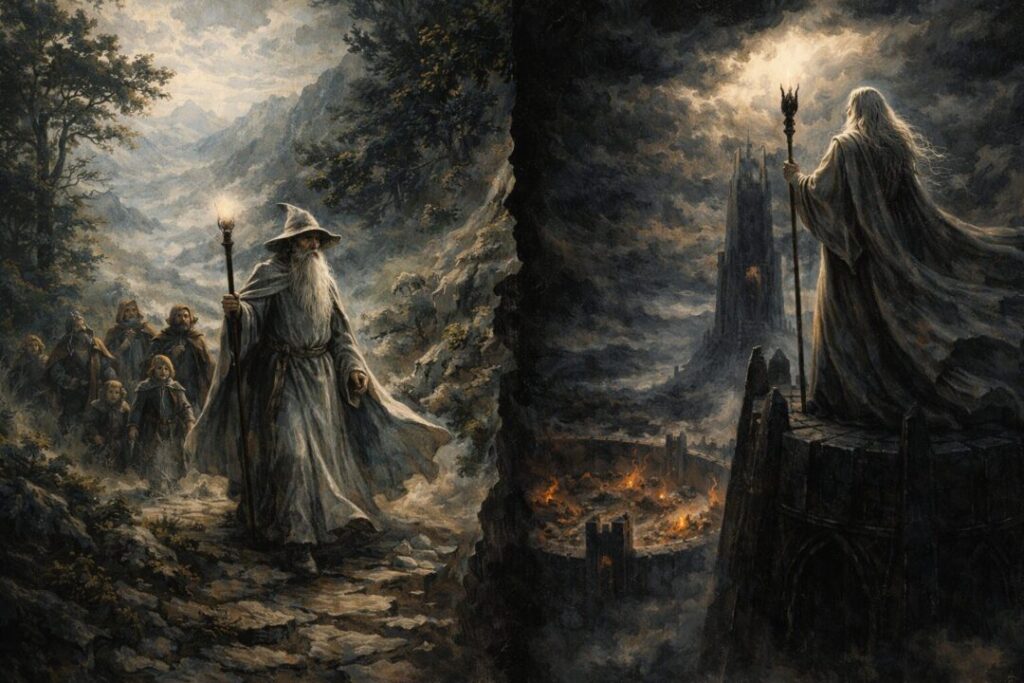
Tolkien deliberately contrasts Saruman with Gandalf.
Gandalf travels. He listens. He places trust in the weak and the overlooked. He refuses domination, even when offered power that could end the war quickly.
Saruman does the opposite.
He isolates himself. He centralizes power. He believes wisdom must command obedience to be effective. Where Gandalf values humility, Saruman sees inefficiency.
This difference is everything.
Both seek to oppose Sauron. Only one understands that victory cannot come through imitation.
By the time Saruman declares himself openly—claiming that the old world has ended—the fall has already happened. His words are not a beginning, but a confession.
Isengard Was Never a Prison
It is tempting to see Orthanc as Saruman’s cage. Tolkien makes clear this is not true.
Orthanc was his laboratory.
From there, Saruman studied, planned, and industrialized. He bred armies, cut down forests, and reshaped the land according to his will. He believed he was preparing Middle-earth for survival in a harsher age.
But Tolkien’s moral framework does not judge Saruman by intention alone. The means matter. And Saruman’s methods—control, secrecy, domination—align him ever more closely with the Enemy he claims to oppose.
The tragedy is that Saruman never recognizes this similarity until it is too late.

The Tragedy of Saruman
Saruman did not fail because he was weak. He failed because he tried to defeat Sauron by becoming like him.
Tolkien describes this as one of the great ironies of the Third Age. Saruman studies the Enemy so closely that he adopts the Enemy’s values without realizing it. Order replaces mercy. Power replaces wisdom. Control replaces trust.
He withdraws to Isengard believing he is preparing to save Middle-earth.
In truth, he is preparing to rule it.
And by the time Saruman understands the cost of that choice, Orthanc has become what he never intended—a tower of isolation, stripped of allies, stripped of purpose, and stripped of grace.
Could Saruman Have Returned?
So the real question is not why did Saruman leave the White Council?
The question Tolkien quietly asks is this:
Was there ever a moment when he could have returned?
Tolkien suggests that there was—early, quietly, before the lies hardened into certainty. But once Saruman chose secrecy over counsel and mastery over humility, the path narrowed rapidly.
His fall was not sudden.
It was chosen—step by step.
And that, more than his armies or his treachery, is what makes Saruman one of Tolkien’s most tragic figures.
Sources & Notes
- J.R.R. Tolkien, Unfinished Tales, “The Istari” — Saruman is named chief of the Wizards and especially learned in Sauron’s devices, matching the article’s starting point for his authority and danger.
- J.R.R. Tolkien, Unfinished Tales, “The Hunt for the Ring” — Saruman’s counsel about the Ring and his secret search near the Gladden Fields support the article’s claim that delay became self-serving strategy.
- J.R.R. Tolkien, The Lord of the Rings, Book II, Chapter 2, “The Council of Elrond” — Gandalf’s account of Saruman in Orthanc gives the core evidence for his withdrawal, ring-lore obsession, and desire for power.
- J.R.R. Tolkien, Unfinished Tales, “The Palantíri” — the Orthanc-stone and Sauron’s domination through the palantír ground the article’s treatment of Saruman’s illusion of mastery.
- J.R.R. Tolkien, The Lord of the Rings, Book III, Chapter 10, “The Voice of Saruman” — Saruman’s persuasive voice and refusal of mercy show the moral end point of the isolation and domination described here.