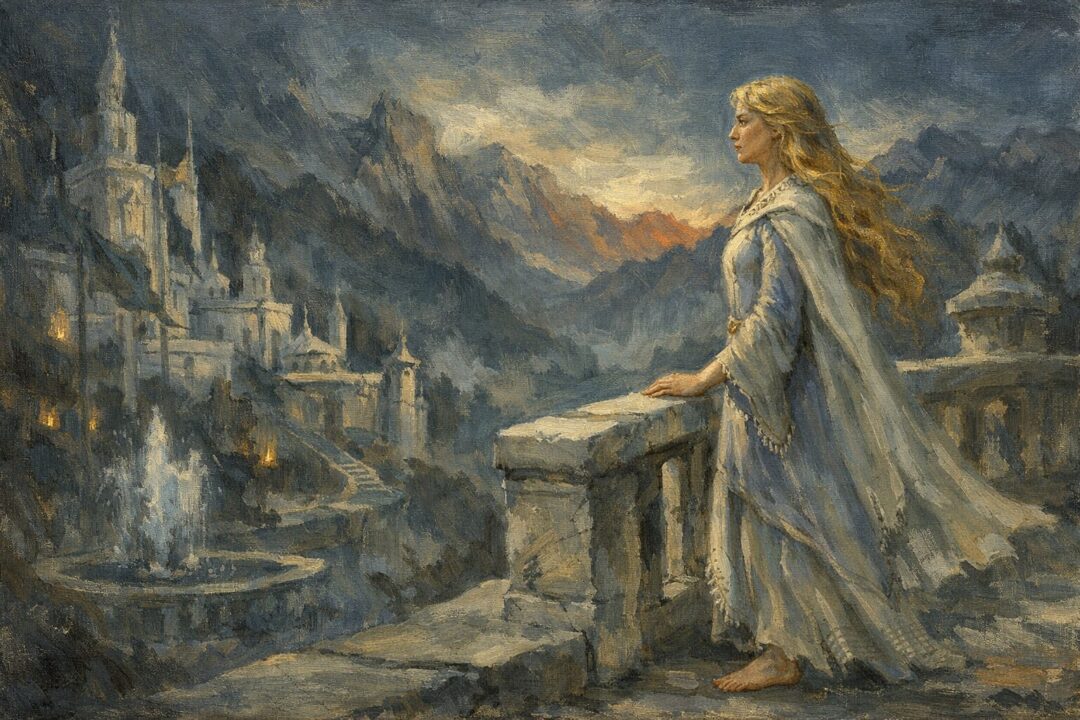
When people think about Idril Celebrindal, they often begin in the wrong place.
They begin with beauty.
That is understandable. The text describes her in luminous terms. She is Turgon’s daughter, golden-haired, set among the brilliance of Gondolin itself. In a city built almost as a last masterpiece against loss, Idril can seem at first like part of that radiance: noble, distant, admired.
But that first impression does not last if you follow what the story actually does with her.
Because Idril is not simply someone the narrative displays.
She is someone it trusts.
Again and again, in the material surrounding Gondolin’s fall, the text attaches to Idril not passivity, but judgment. Not ornament, but perception. Not helplessness, but preparation.
And the more carefully you read, the clearer it becomes that she is one of the very few people in Gondolin whom the story never allows us to treat lightly.
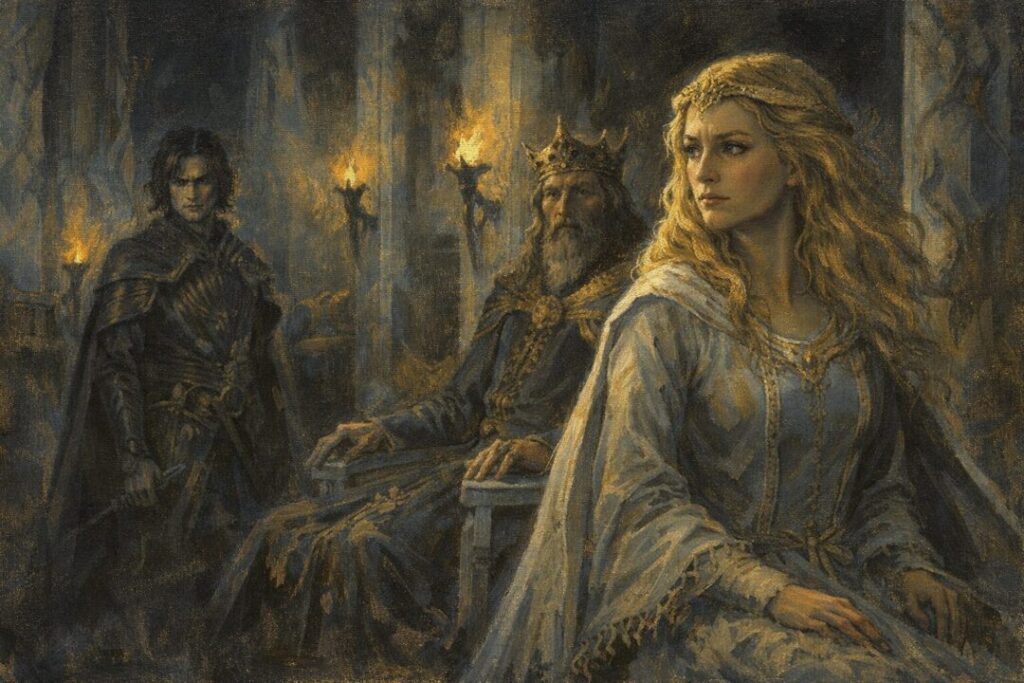
Idril Is Introduced in Splendor, but Not Left There
Idril’s setting encourages a certain kind of misreading.
She belongs to Gondolin, perhaps the most visually dazzling city in the Elder Days. She is the daughter of its king. She is associated with brightness, grace, and high lineage. Maeglin is captivated by her. Tuor falls in love with her. She later becomes the mother of Eärendil, whose destiny reaches far beyond the ruin of the hidden city.
In many stories, that combination would push a character into a symbolic role.
She would become the beautiful princess, the dynastic bride, the mother of a greater hero, or the noble figure whose value is mostly measured by what others feel about her.
Idril is never quite written that way.
The text does not deny her beauty, but it refuses to let beauty explain her importance. That is the crucial distinction. The moment you look beyond how other characters see Idril and start paying attention to what she sees, the whole balance shifts.
The Story Gives Idril Sight Before It Gives Her Action
One of the most important details about Idril is not military, political, or magical.
It is inward.
The text says she is “wise and farseeing.” That matters because it is not ornamental praise. It becomes the key to what follows. Her heart misgives her. Foreboding grows upon her before Gondolin’s destruction arrives in full. She perceives danger while the city is still outwardly strong.
That pattern is easy to overlook because Gondolin itself is built on confidence.
Its secrecy has held for years.
Its walls seem unassailable.
Its king has faith in what has already endured.
But stories of doomed strongholds often turn on exactly this point: the danger is real before the city admits it is real.
Idril understands that.
And the text does not frame her unease as irrational fear. It frames it as true perception.
That is a major difference. The narrative is not saying that Idril is merely anxious while wiser heads remain calm. It is saying that she sees clearly before others do.
She Is Also One of the Few Who Is Never Wrong About Maeglin
Idril’s clarity is not limited to the general fate of Gondolin.
It also appears in her response to Maeglin.
Maeglin’s desire for her is one of the darkest tensions within the city. He is drawn to her intensely, and the text makes clear that Idril perceives his thought and recoils from it. She loves him “the less,” not because of some misunderstanding, but because she recognizes in him something morally twisted.
That detail matters.
Maeglin is not simply a rejected admirer who later turns bitter. The story presents his desire as part of a deeper crookedness in him. And Idril is not naive about it. She does not misread him. She does not soften toward him. She does not stand in need of explanation from others before recognizing the danger.
In a tale where betrayal comes from within Gondolin’s own walls, that is not a small character note.
It is another sign that Idril is written as a reader of peril.
She sees corruption before it announces itself openly.
The Secret Way Changes Everything
Then comes the detail that makes it impossible to treat Idril as secondary.
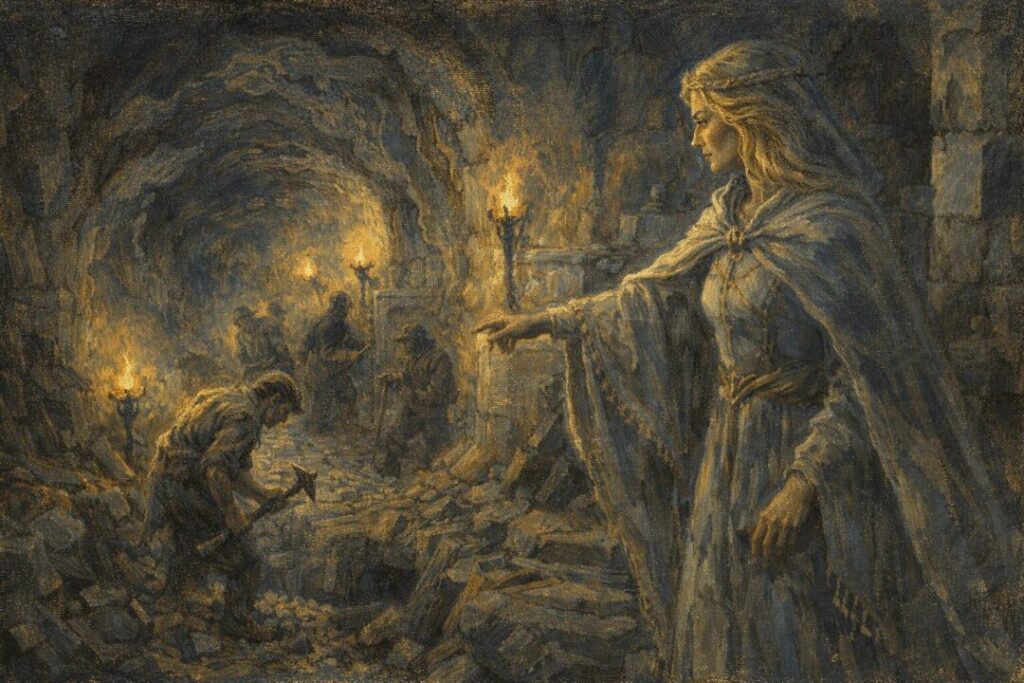
Foreseeing evil, Idril has a secret way prepared out of Gondolin. More than that, she makes sure the work is concealed from Maeglin. This is one of the most practical and consequential acts taken by anyone in the entire Gondolin story.
It is also deeply revealing.
Idril does not answer foreboding with beautiful sorrow.
She does not answer danger with a lament.
She does not wait for permission from events.
She plans.
That is what makes her so easy to underestimate at first and so difficult to underestimate afterward. Her wisdom is not abstract. It hardens into action before the crisis arrives.
And when Gondolin finally falls, that hidden preparation becomes one of the reasons a remnant survives at all.
Without that choice, the city’s splendor would end in near-total annihilation.
With it, there is still loss beyond measure, but not absolute ending.
That difference runs straight through Idril.
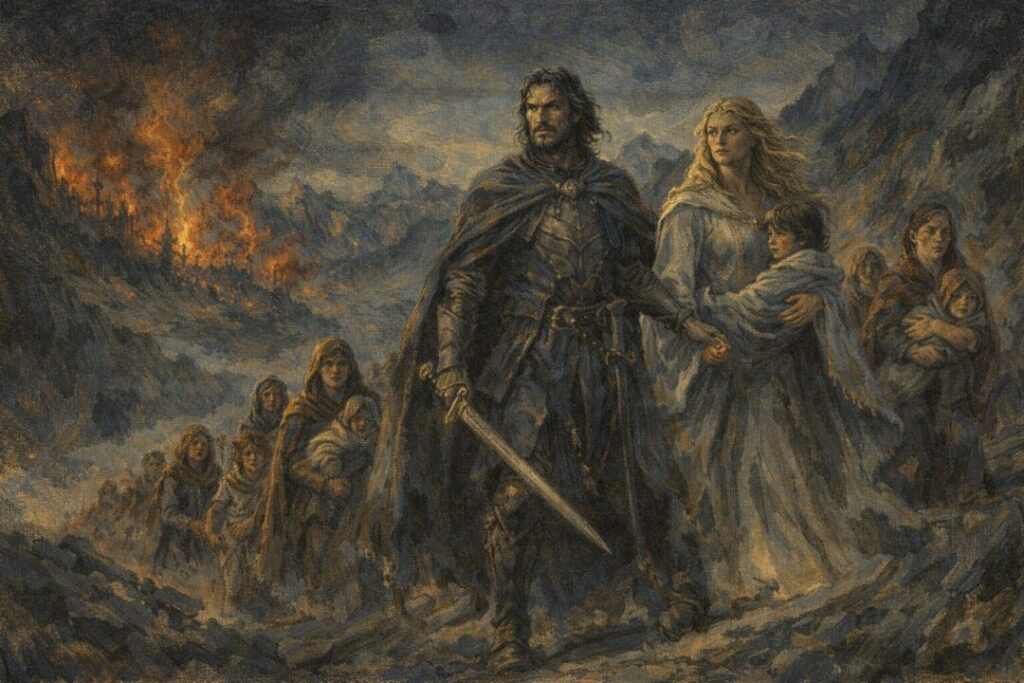
Gondolin’s Fall Looks Different Once You Center Her
Many readers remember the fall of Gondolin through its spectacle.
The assault.
The betrayal.
The burning city.
The deaths of great lords.
The sheer scale of collapse.
But if you look at the structure beneath the spectacle, another pattern appears.
Gondolin falls because it mistakes concealment for safety.
It falls because Turgon will not abandon the city in time.
It falls because Maeglin’s inner corruption becomes political disaster.
And it does not end in complete extinction because Idril had already prepared for the moment everyone else hoped would never come.
That does not make her the sole savior of Gondolin. The texts do not say that, and it would be too large a claim.
But they do show that her foresight materially shapes who lives.
That is enough to change how the whole story is read.
Idril is not simply present at the hinge of events.
She helps create the hinge.
She Is Not Important Only Because of Eärendil
Another common way Idril gets flattened is by being treated mainly as Eärendil’s mother.
Of course that lineage matters. Through Idril and Tuor, one of the great lines of hope in Middle-earth continues. Her union with Tuor is one of the central crossings of Elves and Men in the Elder Days, and its consequences echo far beyond Gondolin.
But even here, the story does not reduce her to genealogy.
Before Eärendil becomes the mariner of hope, Idril is already a character of judgment, independence, and practical foresight. Her significance does not begin only when she gives birth to someone more famous.
That is exactly why she remains so striking.
The text gives her inherited dignity, but it also gives her earned authority.
Why the Story Refuses to Let Her Stay Decorative
There is a broader narrative reason Idril matters so much.
Gondolin is a city of surfaces in the best and worst sense. It is beautiful, ordered, hidden, elevated. Yet beneath that magnificence lie fatal weaknesses: pride, delay, false confidence, and an enemy already too near.
A lesser treatment of Idril would make her part of Gondolin’s surface beauty only.
Instead, she becomes one of the few people in the city aligned with reality.
That contrast is powerful.
The city shines, but she sees.
The king hopes, but she prepares.
Maeglin conceals, but she perceives.
Disaster delays, but she acts before it arrives.
This is why Idril feels stronger the more you think about her. The narrative does not need to give her long speeches about strategy or pages of explanation about her intelligence. It builds trust in her by attaching truth to her instincts and consequences to her decisions.
That is a far more effective kind of authority.
Idril’s Greatness Is Quiet, and That Is the Point
Idril does not dominate the story in the way Galadriel does.
She does not overturn kingdoms by direct power in the way Lúthien does.
She is not a war-leader in the mold readers sometimes expect from heroic fantasy.
Her greatness is quieter than that.
She sees danger early.
She judges character accurately.
She acts before certainty becomes universal.
And when the catastrophe comes, she is already the reason hope still has a road to follow.
That last point may be the most important of all.
Middle-earth often honors dramatic heroism, but it also repeatedly honors another kind of strength: the strength to perceive truly before others do, and to prepare faithfully while others still trust appearances.
Idril belongs to that second pattern.
And once you see it, she becomes very hard to minimize.
Why Idril Still Feels Underrated
Idril remains easy to underrate because so much around her is larger, louder, and more immediately famous.
There is the beauty of Gondolin.
There is the tragedy of Maeglin.
There is the heroism of Tuor.
There is the future greatness of Eärendil.
There is the ruin of an entire hidden kingdom.
But Idril is not lost among those things.
She is one of the characters who makes their meaning clearer.
She shows that Gondolin was not destroyed only by force from outside, but by blindness within.
She shows that wisdom in Middle-earth is often proven before the world admits it was needed.
And she shows that a character can stand near the center of a legendary fall without ever being reduced to someone else’s emotional backdrop.
So perhaps the most revealing thing about Idril Celebrindal is this:
The story never asks us to admire her only from a distance.
It asks us to notice that she was right.
And in Gondolin, that may be the most important distinction of all.
Sources & Notes
- J.R.R. Tolkien, The Silmarillion, “Of Maeglin” — identifies Idril Celebrindal as Turgon’s daughter and describes Maeglin’s forbidden desire for her.
- J.R.R. Tolkien, The Silmarillion, “Of Tuor and the Fall of Gondolin” — presents Idril as “wise and farseeing,” wary of Maeglin, and moved by foreboding before the city’s fall.
- J.R.R. Tolkien, The Silmarillion, “Of Tuor and the Fall of Gondolin” — recounts Idril’s secret way from Gondolin and its role in preserving survivors from the ruin.
- J.R.R. Tolkien, Unfinished Tales, “Of Tuor and His Coming to Gondolin” — gives fuller context for Tuor’s arrival, Gondolin’s splendor, and Idril’s place in Turgon’s house.
- J.R.R. Tolkien, The Silmarillion, “Of the Voyage of Eärendil and the War of Wrath” — grounds Idril and Tuor’s importance in the line and destiny of Eärendil.