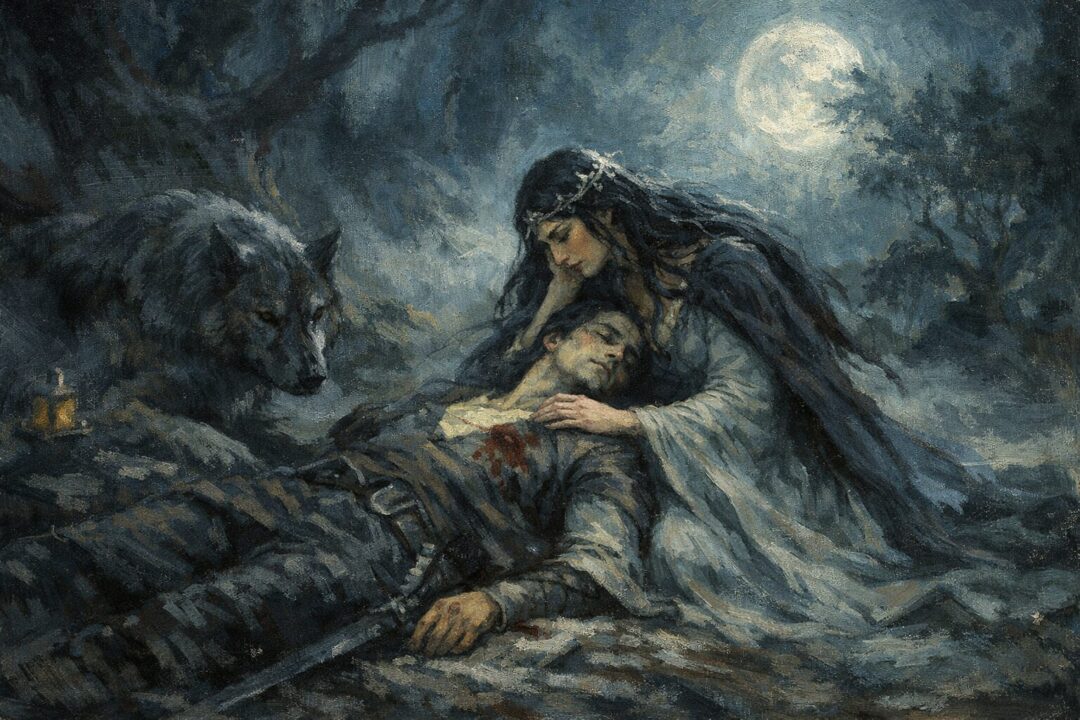
At first glance, Elvish immortality in Middle-earth looks like freedom from the ordinary human condition. Men age, weaken, and die. Elves do not die of age or disease. They can live through kingdoms rising and falling, through wars, exiles, and the changing of the world. So it is tempting to assume that grief must touch them less deeply too.
But the texts point in almost the opposite direction.
The Elves are not detached immortals floating above pain. They are incarnate beings, with spirit and body, meant to remain united for the life of Arda. Their death is not their proper end in the way the death of Men is bound up with the Gift of Ilúvatar. For Elves, the sundering of body and spirit is a wound in the nature of the world as it now exists under marring. That alone helps explain why grief among them is not shallow, brief, or merely decorative. It cuts against what they were made to be.
Elvish immortality is not escape from the world
One of the most important points in Tolkien’s legendarium is that Elves are immortal only in a very specific sense. They are deathless within the life of the world. Their fëar are bound to Arda until its ending. Men, by contrast, leave the circles of the world in death. The fate of Men is mysterious and fearful to many within Middle-earth, but it is also release. The fate of Elves is endurance.
That difference matters.
A mortal life is brief, but it moves toward departure. Elvish life does not. An Elf remains amid the places where joy once was, amid the lands altered by time, amid the memories of those who are gone. Loss is not softened because life goes on for centuries. In many cases, loss becomes sharper because life goes on for centuries.
This is why Elvish immortality can feel tragic rather than enviable. The Elves are tied to history. They do not merely remember the ancient world; they survive into its diminishing.
The grief of the Elves is woven into memory
The lore surrounding Elvish life emphasizes that over long ages the Eldar become more weary of the world and more burdened by its sorrows. That is a crucial idea. Their longevity does not make them emotionally numb. It makes them accumulative. Memory deepens. Sorrow layers. The past does not recede as quickly for them as it does for mortals.
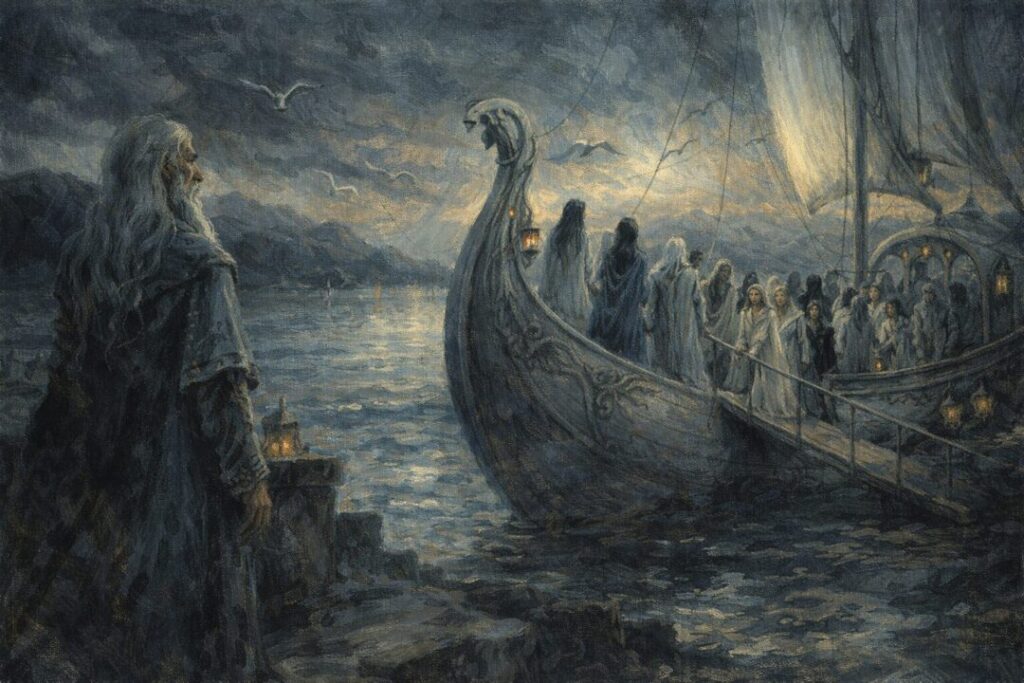
That helps explain why the Elves in The Lord of the Rings often feel as though they are standing in the middle of beauty and mourning at the same time. Rivendell is still fair, Lórien is still golden, and yet both are marked by an awareness that their time in Middle-earth is ending. Even without open tragedy in every scene, there is often a feeling that the Elder Days are being carried as a living burden.
This is not because Elves are melodramatic. It is because they remember too well and remain too long.
Death is unnatural for Elves, which makes loss harder, not easier
Another reason Elves can grieve so intensely is that death itself is alien to their intended nature. The separation of fëa and hröa is not the normal completion of Elvish life. They can be slain, and the texts also allow that they may die of grief, but this is presented as part of the brokenness of Arda, not as their proper design.
This means an Elvish bereavement is not just emotionally painful. It is metaphysically disordered. Something has happened that should not have happened in an unmarred world.
That is why the stories do not treat Elvish loss as light simply because re-embodiment in Aman is possible in some cases. Rehousing is not a casual reset button. Separation is still terrible. The Halls of Mandos are still associated with waiting, judgment, and loss. And for those who remain in Middle-earth, reunion is not immediate and may be impossible within the circles of their ordinary life.
So immortality does not cancel grief. In practice, it can intensify it.
Finwë and Míriel show how serious Elvish grief can be
One of the clearest examples appears before the great tragedies of Beleriand even begin.
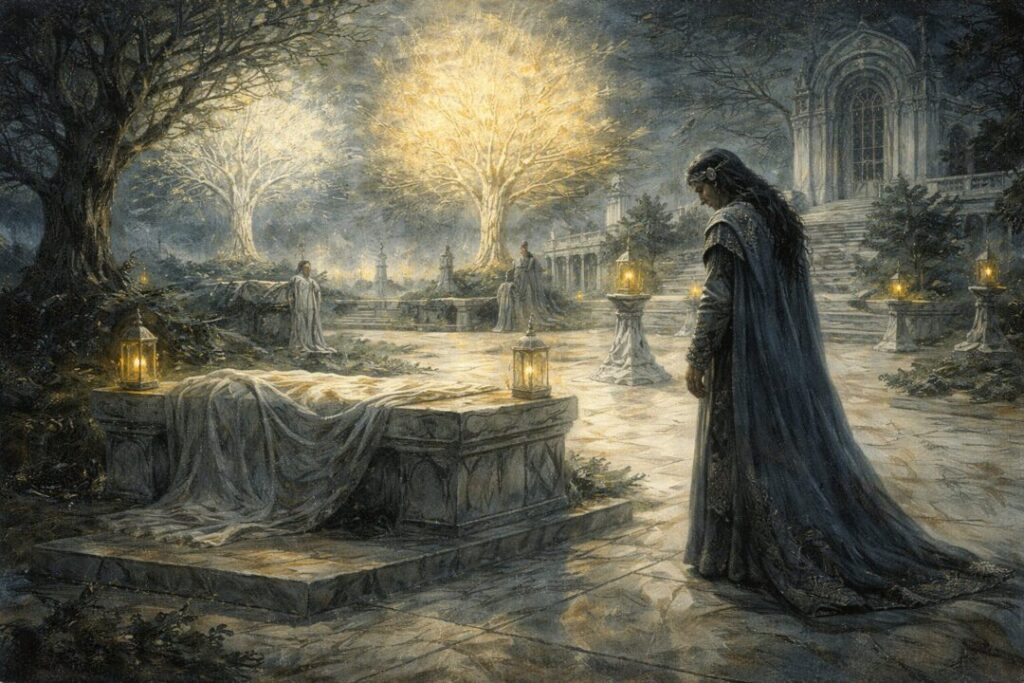
After the birth of Fëanor, Míriel declines in spirit and passes to Mandos, refusing return. This is not treated as a small domestic sorrow. It becomes a grave matter that troubles the Valar and leads to the long debate and judgment known as the Statute of Finwë and Míriel. Finwë’s grief is not fleeting, and the whole episode reveals how profound and consequential loss is among the Eldar.
That alone answers a great deal. If immortality made grief trivial, this story would not carry such theological and historical weight. Instead, the loss of one Elf-wife and the sorrow of one Elf-husband echo into the history of the Noldor.
It also shows something else: among the Elves, love is not lesser because life is longer. It is in some ways more absolute.
Lúthien and Thingol reveal that grief can break even the greatest
The most famous example is Lúthien.
After Beren is mortally wounded, the tradition summarized in Tolkien Gateway from The Silmarillion states that Lúthien soon wasted of grief. That language is important. It is not the language of a being who merely observes death from a serene immortal distance. It is the language of total sorrow.
And the grief does not stop with her.
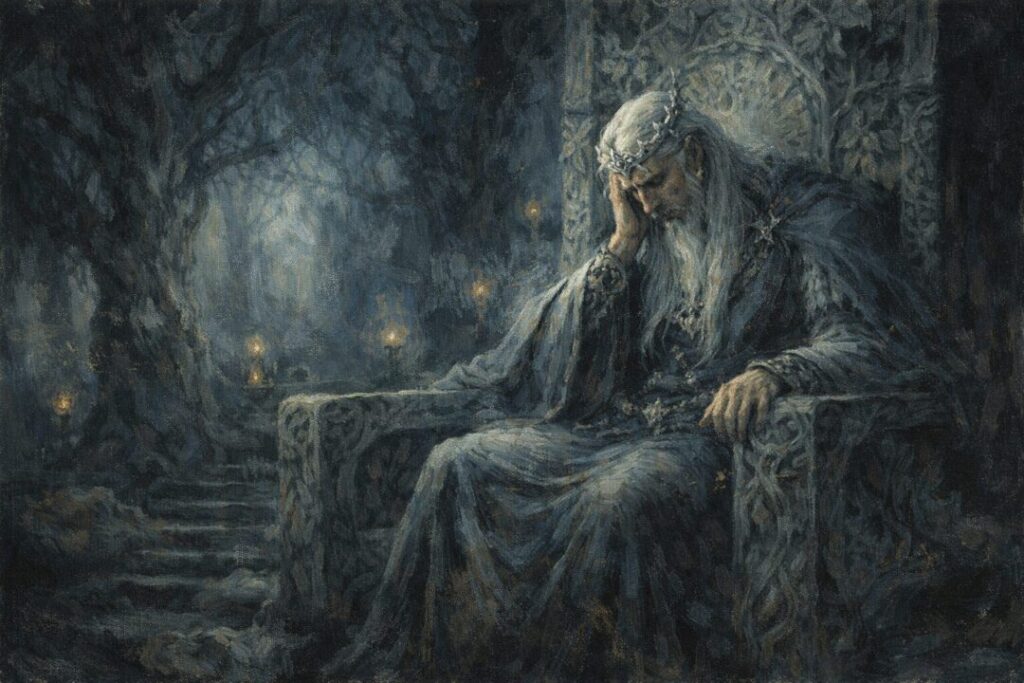
When Lúthien is lost, Thingol is described as falling into something like the winter of mortal old age. That comparison is one of the most striking in the legendarium. It does not mean Thingol literally becomes a mortal Man. It means the text reaches for mortal imagery to describe how deeply grief has entered him.
So here the answer becomes unmistakable: an immortal Elf can grieve “like a mortal” precisely because immortality in Middle-earth does not erase emotional reality. In fact, the texts sometimes use mortal decline as the nearest image for the depth of Elvish sorrow.
Elves do not fear grief less because they have longer horizons
There is another subtle point here. Readers sometimes imagine that because Elves can, in some cases, be restored, death must seem less final to them. But this is too simple.
The stories repeatedly show that separation still matters desperately. Place matters. Presence matters. Shared life in Middle-earth matters. An Elf in Mandos is not simply standing in the next room. And not every sundering is easily healed inside the history we follow.
This is part of the ache in tales involving the Half-elven too. Tolkien’s Letter 154, as summarized by Tolkien Gateway, notes the grief bound up with the parting of Elrond and Arwen because the Half-elven choose once between different fates. The pain there comes not from ignorance, but from knowing exactly what the separation means.
Knowledge does not protect the Elves from grief. Often it deepens it.
Why immortal sorrow is one of the defining notes of Middle-earth
Once you see this, many things in Middle-earth come into focus.
The sadness of the departing Elves. The long memory of ancient wrongs. The repeated sense that beauty in Arda is always under pressure from loss. The phrase “the long defeat,” often associated with Galadriel’s perspective, makes more sense in a world where the people who remember the old beauty are the same people forced to watch it diminish age after age.
Their immortality is therefore not a shield against grief. It is one reason grief endures so powerfully in their stories.
Mortals suffer and pass beyond the world. Elves suffer and remain within it. They walk the same woods after joy has gone from them. They hear the same songs after the voices that first sang them are silent. They carry memory not for a lifetime, but for ages.
That is why Elvish sorrow feels so different from ordinary fantasy immortality. It is not the sadness of beings too distant to care. It is the sadness of beings made to love the world deeply and stay in it long enough to watch it break.
The real tragedy of Elvish immortality
So why can Elves be immortal and still grieve like mortals?
Because in Middle-earth, immortality is not emotional exemption. It is prolonged participation in a marred world.
The Elves are deathless, but not untouched. They are enduring, but not invulnerable. They are bound to Arda, and that means they are bound not only to its beauty, but also to its wounds. Their memory is long, their loves are deep, and their losses are not quickly buried under time.
In some ways, Men are the ones who escape.
The Elves remain.
And that may be the saddest part of all.
Sources & Notes
- J.R.R. Tolkien, The Silmarillion, “Of the Beginning of Days” — describes the Elves as bound to Arda while it lasts, unlike Men, whose death is a different fate.
- J.R.R. Tolkien, Morgoth’s Ring, “Laws and Customs among the Eldar” — explains Elvish fëa and hröa, death by violence or grief, and the seriousness of disembodiment and return from Mandos.
- J.R.R. Tolkien, Morgoth’s Ring, “The Later Quenta Silmarillion: Of Finwë and Míriel” — gives the Míriel, Finwë, and Mandos material behind the article’s example of Elvish grief becoming a grave theological matter.
- J.R.R. Tolkien, The Silmarillion, “Of Beren and Lúthien” — supplies the central examples of Lúthien’s grief over Beren and the devastating effect of loss on Thingol.
- J.R.R. Tolkien, The Lord of the Rings, Book II, Chapter 7, “The Mirror of Galadriel” — Galadriel’s language of fighting the “long defeat” supports the article’s reading of immortal memory, loss, and endurance in Middle-earth.