In The Lord of the Rings, weather does more than set a mood. It presses on the characters, narrows their choices, drains hope, and at times seems to behave almost like an opponent. Readers remember the freezing assault on Caradhras, the suffocating darkness from Mordor, and the uncanny hostility of places like the Old Forest because those moments do not feel like neutral background. They feel targeted.
That feeling is not accidental. But the important point is this: the books do not say that every storm in Middle-earth is a conscious attack. The effect is stronger and more interesting than that. The text presents several different kinds of hostility at once—ordinary natural danger, places with a will or corruption of their own, and the direct pressure of dark power. Tolkien keeps some of these deliberately ambiguous, which is exactly why they feel so real and so unsettling.
Middle-earth is not an unfallen world
A major reason weather feels threatening is that Middle-earth is not a pristine or fully healed creation. In the wider legendarium, Arda is “Marred”: the world has been wounded by Melkor’s rebellion and corruption from the beginning. That does not mean every windstorm is demonic. It does mean the world of the story is not perfectly ordered, transparent, or harmless. Suffering, decay, fear, and disorder are woven into its history.
This matters because it changes the emotional baseline. When the Fellowship enters wild country, the land does not feel like scenic backdrop waiting to be admired. It feels ancient, damaged, and unpredictable. Readers sense that the world itself carries memory and strain. So when snow blocks a pass or darkness spreads unnaturally from the East, those moments fit the deeper condition of Middle-earth rather than feeling like random fantasy weather effects.
Caradhras is the clearest example
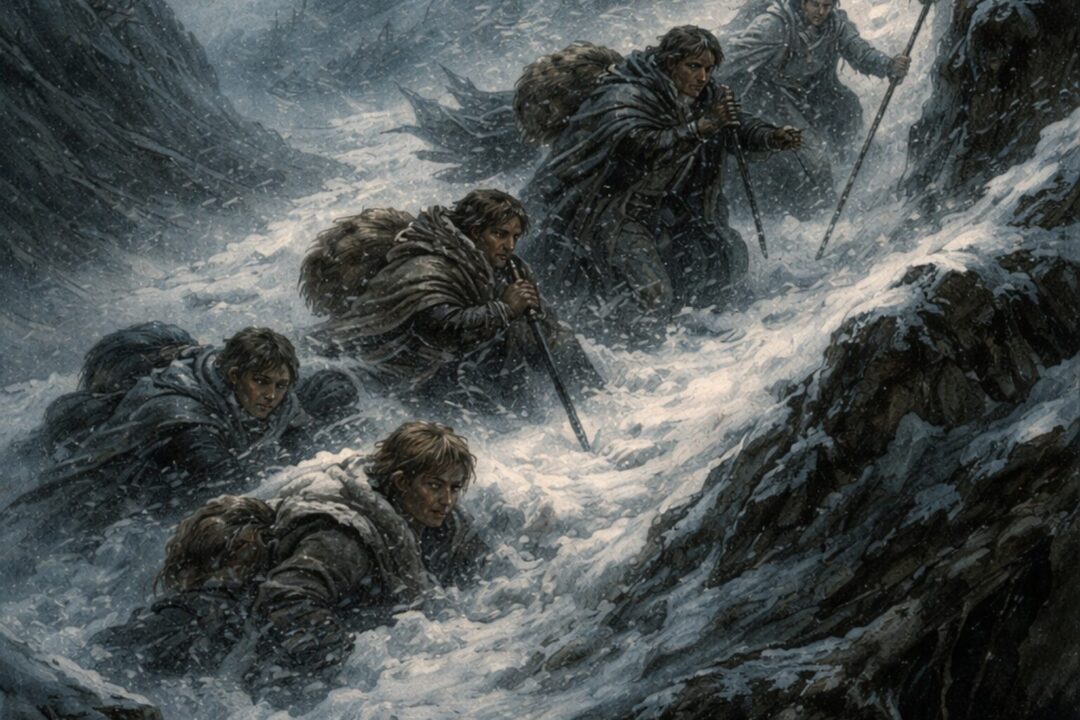
No episode captures this better than the attempt to cross the Redhorn Gate. Caradhras is already known as “the Cruel,” and Gimli explicitly says that the mountain had an ill name long before Sauron’s power was heard of in those lands. That detail is important because it prevents a neat, single explanation. The danger on Caradhras cannot simply be dismissed as a new trick from Mordor. Something about the place was feared in its own right.
But the text also does not fully settle what the Fellowship is facing. Gimli speaks of the ill will of Caradhras itself. Gandalf, characteristically, does not flatten the mystery. He allows for powers in the world greater than himself and does not reduce the storm to mere chance. The result is deliberate ambiguity: perhaps it is harsh mountain weather; perhaps the malice of the mountain; perhaps the Enemy’s reach working through an already dangerous place. The book leaves that tension alive.
That ambiguity is exactly why the scene feels so hostile. If the storm were explained too clearly, it would become manageable in the mind. Instead, the Fellowship faces something more frightening: a landscape that may or may not be acting with intention. Snow becomes a trap. The path disappears. Retreat feels like defeat, not inconvenience. The narration itself reinforces that impression when it effectively treats Caradhras as the victor.
The Old Forest shows that nature can be morally bent
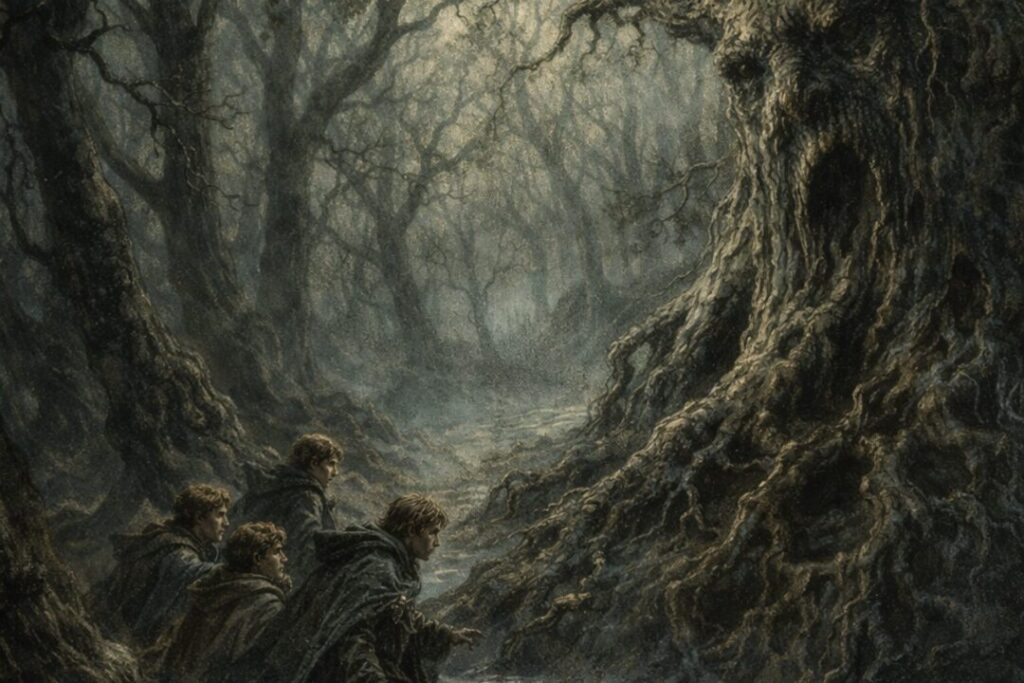
Caradhras is not an isolated case. Early in the journey, the Hobbits pass through the Old Forest and meet a different kind of hostility. This is not weather, but it helps explain why natural forces in Middle-earth often feel like enemies. Tom Bombadil describes the trees as having dark hearts, and Old Man Willow is singled out as especially malicious, spreading hatred of walking things through much of the forest.
That is a crucial pattern. The natural world in Tolkien is not always inert. Trees, rivers, mountains, darkness, and wind can carry history, temper, resistance, and sometimes corruption. Not all woods are like the Old Forest; not all mountains are like Caradhras. But once the reader sees one part of nature behaving with intent, later scenes of hostile weather feel more plausible within the story’s logic. The world is alive enough that danger can feel personal even when the mechanism is left unclear.
Sauron does turn atmosphere into a weapon
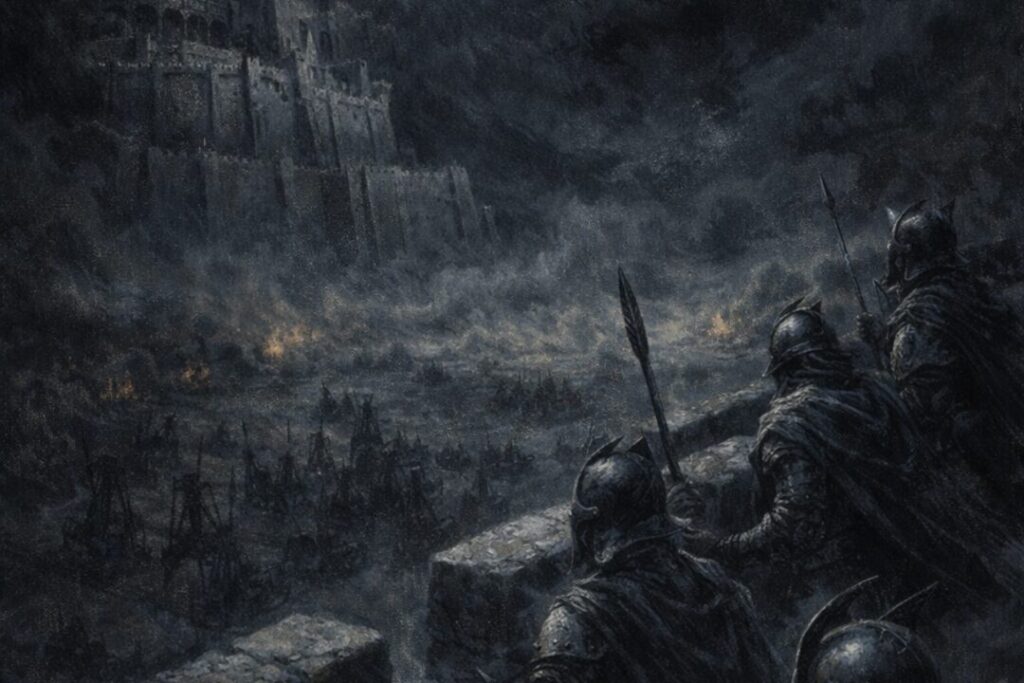
If Caradhras is ambiguous, the darkness from Mordor is much less so. During the War of the Ring, Sauron’s Darkness spreads out of Mordor and covers the lands of the West. This is not just poetic language for bad morale. In the text tradition summarized by Tolkien Gateway, it becomes an actual force used by the Dark Lord to breed fear and despair. On the Pelennor, it helps make the world feel closed, breathless, and doomed before the battle fully begins.
This is where weather and warfare nearly merge. The defenders of Gondor are not only outnumbered; they are psychologically crushed by an environment that seems conquered before the armies even arrive. Light fails. Air feels heavy. Distance shrinks. Hope contracts. Sauron does not merely command Orcs and siege engines. He alters the felt atmosphere of the battlefield. That is one reason the war chapters feel so oppressive even before the first great collisions of arms.
But the books also show weather breaking against evil
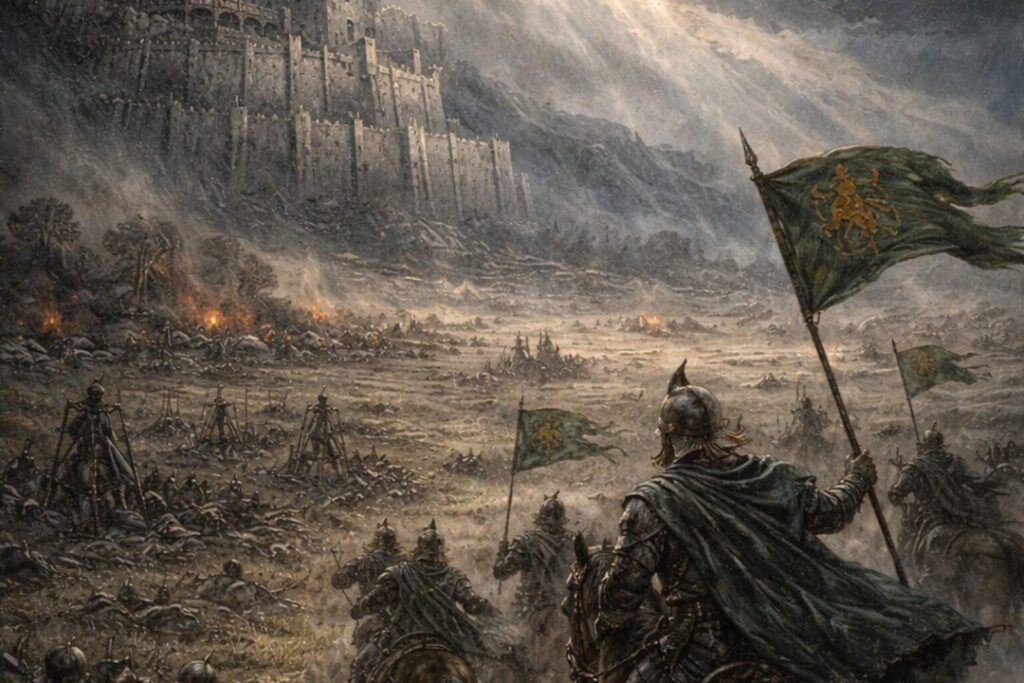
There is another side to this pattern, and it is just as important. In The Lord of the Rings, weather does not only menace the heroes. Sometimes wind and light break the pressure of darkness. The best example is the change that comes at the Pelennor, when Sauron’s Darkness is driven away by a wind from the south-west. The text records the change; it does notexplicitly say, in so many words, that a Vala personally sends that wind. Readers often interpret it within a larger pattern of providential aid, but that step should be labeled interpretation rather than certainty.
That restraint matters. If we over-explain every helpful wind as direct divine intervention, we flatten the subtlety. The books are stronger when we admit what they actually do: they repeatedly associate darkness, choking air, and oppressive sky with evil power, and they repeatedly let wind, sea-air, and returning light feel like relief, clarity, and renewed courage. The pattern is real even where the mechanism is not fully spelled out.
Why it works so powerfully on readers
So why does weather feel like an enemy in these books more than in many other fantasies?
Because it attacks on several levels at once.
It is physical: cold, snow, exhaustion, bad roads, darkness, and exposure are real survival threats. It is emotional: hostile weather isolates characters and makes hope feel irrational. And it is metaphysical: in Middle-earth, the state of the world is never entirely separate from the moral struggle moving through it. The land has old memory. Some places are bent. Some powers can darken the air itself. Even when the story refuses to explain exactly what is happening, it makes sure we feel that the world is not neutral.
That is why the Fellowship’s hardest moments often feel larger than logistics. Caradhras is not memorable only because the climb failed. It is memorable because failure seemed to come from more than altitude and snow. The Pelennor is not terrifying only because of armies. It is terrifying because the sky itself appears enlisted. The Old Forest is not frightening merely because the Hobbits are inexperienced. It is frightening because the place resents them.
The deeper answer
Weather feels like an enemy in The Lord of the Rings because the story’s world is morally charged without always being mechanically explained. Sometimes the danger is simple natural hardship. Sometimes it is the malice of a place. Sometimes it is the pressure of Sauron reaching outward. And beneath all of it lies the deeper truth that Middle-earth is a marred world, where beauty remains real but is never untouched by the long history of shadow.
That combination is what gives Tolkien’s landscapes their unique force. They are beautiful, but never merely decorative. They can shelter, test, mislead, oppress, or hearten. And when the weather turns against the characters, it feels frightening precisely because the books allow us to wonder whether the world is only dangerous… or whether, for a moment, it has become an adversary.
Sources & Notes
- J.R.R. Tolkien, The Lord of the Rings, Book II, Chapter 3, “The Ring Goes South” — the Fellowship’s failed passage over Caradhras, including the mountain’s evil name and the ambiguity around its hostile storm.
- J.R.R. Tolkien, The Lord of the Rings, Book I, Chapter 6, “The Old Forest” — the Old Forest and Old Man Willow establish that parts of the natural world can bear memory, resentment, and malice.
- J.R.R. Tolkien, The Lord of the Rings, Book V, Chapter 4, “The Siege of Gondor” — Sauron’s Darkness spreads from Mordor over Gondor, making the atmosphere itself part of the war’s pressure.
- J.R.R. Tolkien, The Lord of the Rings, Book V, Chapter 6, “The Battle of the Pelennor Fields” — the change of wind and returning light break the Darkness during the battle without requiring an over-specific explanation.
- J.R.R. Tolkien, The Silmarillion, “Ainulindalë” — Melkor’s discord and the marring of Arda provide the wider mythic background for a world where nature is beautiful but not unfallen.