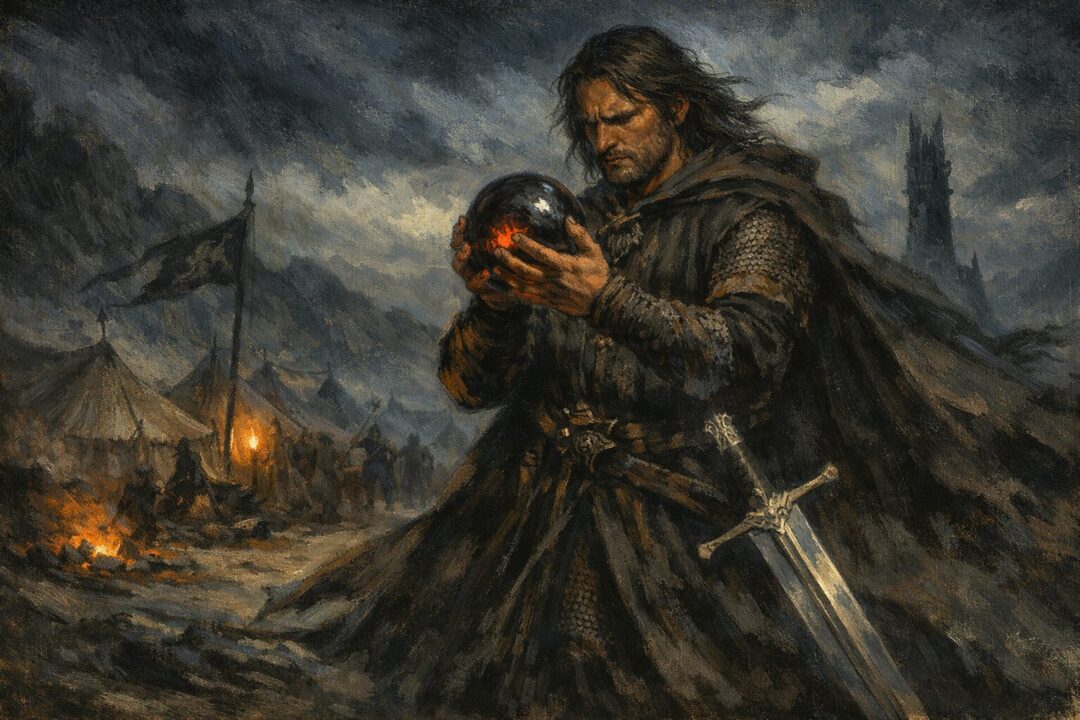
In adaptations, the palantíri are often remembered as eerie seeing-stones: dark globes, burning eyes, sudden visions. But in Tolkien’s legendarium, their importance in the War of the Ring is much more strategic than decorative. They are not just ominous magical objects. They are part of the war’s information system. They affect command, morale, timing, and political judgment.
That matters because the War of the Ring is not decided only by armies in the field. It is also decided by what rulers believe, what they fear, what they misread, and when they choose to act. The palantíri help shape all of that.
What the palantíri actually were
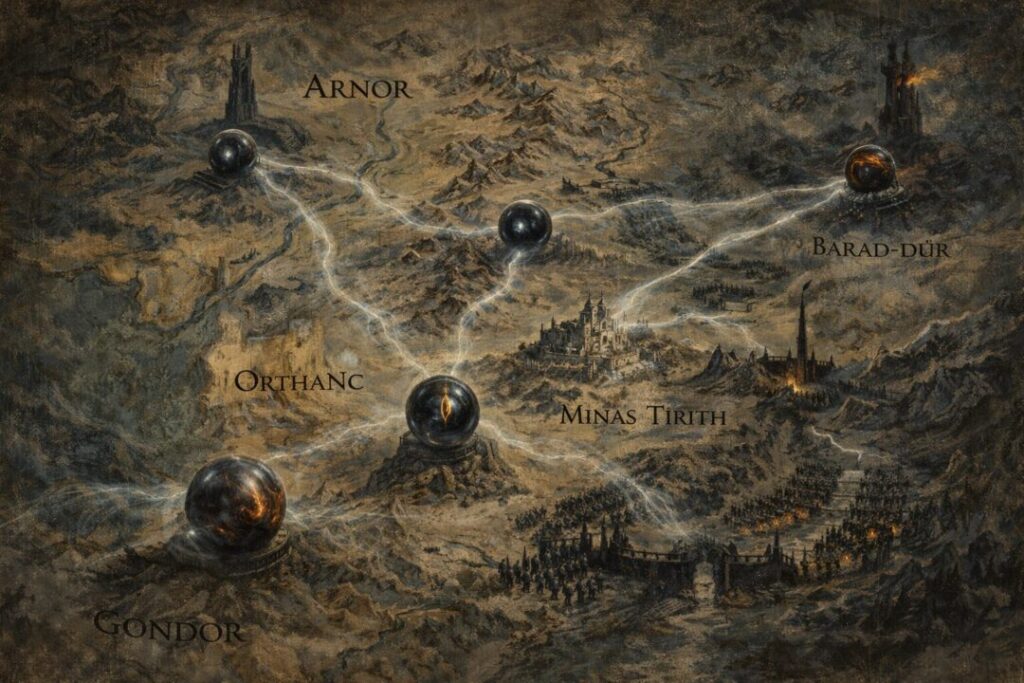
The palantíri were ancient Númenórean heirlooms, likely made in the Uttermost West, probably by Fëanor according to later tradition. Elendil brought seven stones to Middle-earth after the Downfall of Númenor, and they were distributed across Arnor and Gondor. Their main purposes were communication and far-seeing. Users of sufficient strength could commune with other stones and direct their sight over great distances.
This is the first thing worth stressing: the stones were not primarily weapons in the ordinary sense. They did not hurl force across the battlefield. Their military value was informational. A ruler who possessed a working palantír had a powerful advantage in communication and surveillance. That could strengthen a realm — but it could also become disastrous if an enemy controlled one of the linked stones, or if the user lacked the strength or wisdom to interpret what was seen.
So when we ask how the palantíri changed strategy in the War of the Ring, the answer is simple in principle: they changed the war by changing who knew what, who thought they knew enough, and who made fatal decisions on incomplete truth.
Saruman: the first strategic casualty of the stones
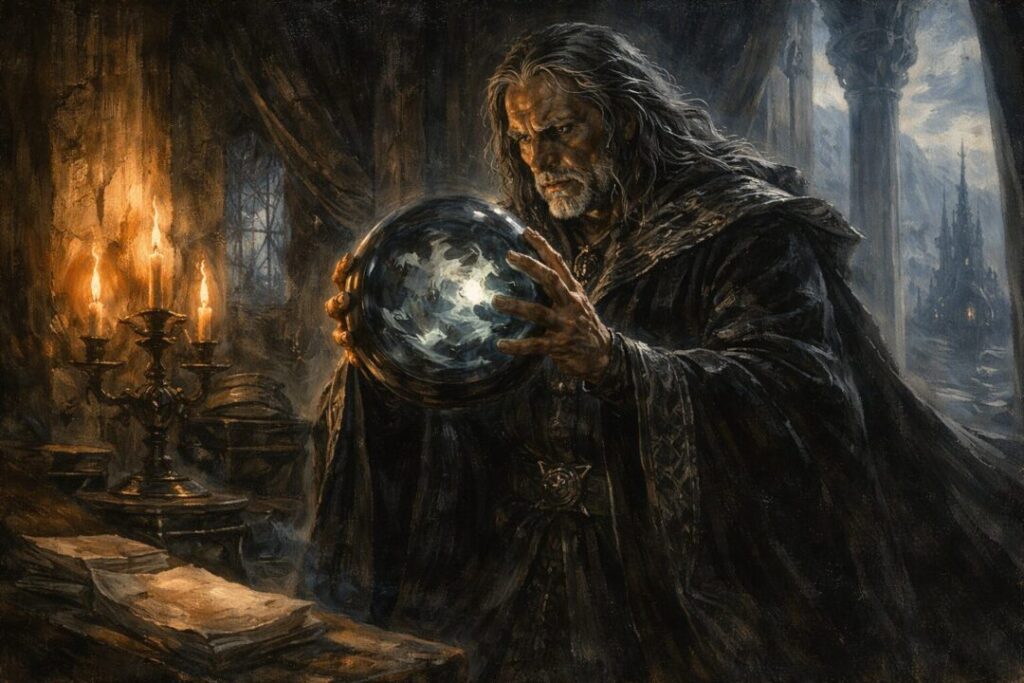
One of the earliest major strategic effects of the palantíri is the corruption of Saruman. Tolkien’s lore makes clear that Sauron established contact with him through the captured Ithil-stone, the stone of Minas Ithil, after that city fell and became Minas Morgul. Saruman, already proud and increasingly jealous of Gandalf, was ensnared through this contact.
This matters far beyond Saruman’s personal fall. Once Saruman is compromised, the war is no longer a straightforward contest between Sauron and the Free Peoples. It becomes a three-cornered crisis: Sauron in Mordor, Saruman in Isengard, and the weakened resistance of the West. Saruman’s betrayals divide attention, threaten Rohan from within and without, and force Gandalf and Aragorn to spend precious energy containing a rival power that, in theory, should never have existed on that scale.
In other words, one strategic effect of the palantíri comes before the main battles most readers think of. The stones help create the political and military map of the war itself. Without Saruman’s palantír-assisted ensnaring, the West faces a different war, with fewer internal fractures and less immediate danger to Rohan. That is not speculation in the loose fan-fiction sense; it is a direct consequence of Tolkien’s account that Sauron used the stones to bend Saruman into his orbit.
Denethor: intelligence without hope
Denethor is a more complex case. Tolkien does not present him as a fool who simply gets tricked by fake visions. In fact, Denethor is formidable. He is strong-willed enough that Sauron does not simply dominate him. But that does not mean he is safe. The danger lies in the frame. Denethor sees true things, yet Sauron can still control what is shown and thereby steer Denethor toward despair.
Strategically, that is devastating. A ruler who sees only the enemy’s overwhelming strength, while losing sight of any larger purpose, becomes less capable of rational long-term command. Denethor continues to defend Gondor, and he is not stripped of all competence. But by the time of the siege, the pressure of loss, Boromir’s death, fear for Faramir, and the burden of the stone have helped drive him into hopelessness.
This changes the war because Gondor is fighting under a steward whose judgment is being narrowed by despair at the exact moment flexibility and endurance are most needed. The issue is not that Denethor suddenly becomes ignorant. The issue is that information without hope can be as dangerous as ignorance. Tolkien turns the palantír here into a study of command failure: knowing much, seeing truly in part, and still being unable to interpret events in a way that preserves action.
Pippin’s accidental glimpse and Sauron’s first bad conclusion
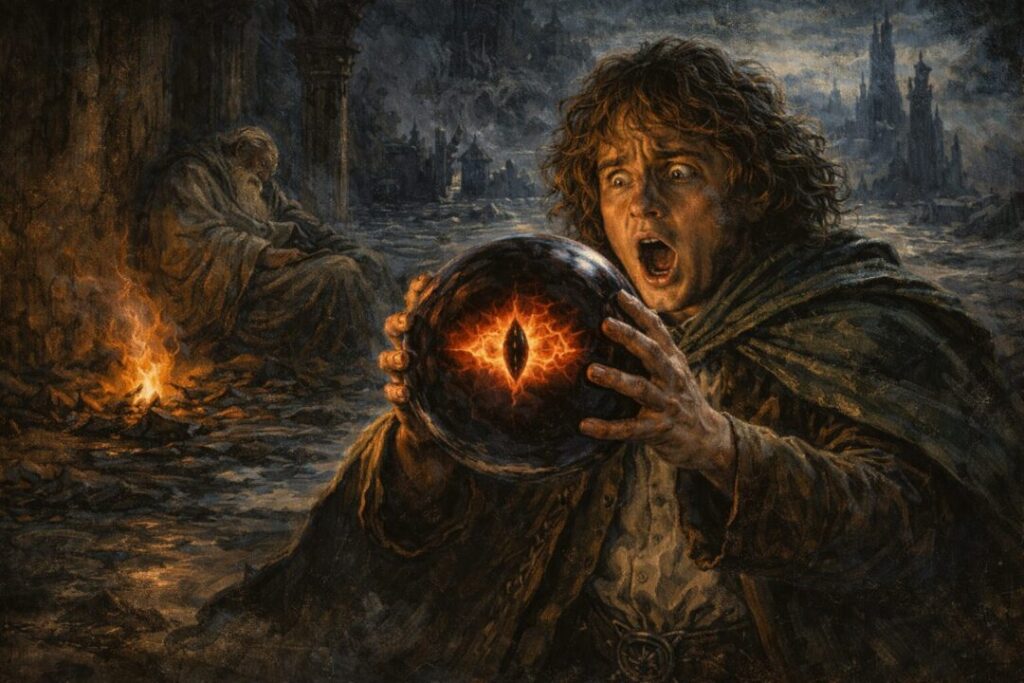
The next major shift comes almost absurdly: through Pippin’s curiosity. When Pippin looks into the Orthanc-stone after Saruman’s fall, Sauron sees him. Gandalf quickly realizes the danger, but also the opportunity. Sauron appears to assume that the hobbit he sees is in Saruman’s hands at Isengard and that the Ring is somehow involved in that situation.
This is a crucial strategic turning point because Sauron now has a fragment of truth and a false narrative built around it. He really has seen a hobbit. A hobbit really is central to the war. But he mislocates the problem and misreads the situation. Gandalf judges that this confusion buys time and immediately alters his own movements, taking Pippin away to Minas Tirith both for safety and because the war is now moving faster.
The palantír is not acting like a neutral camera here. It is producing consequences because Sauron interprets what he sees through his own assumptions about power, possession, and the Ring. He cannot yet imagine the real plan. That limitation becomes one of the great strategic weaknesses on which the West survives.
Aragorn uses the stone as a weapon of timing
If Pippin’s use of the stone is accidental, Aragorn’s is deliberate. After taking the Orthanc-stone, Aragorn reveals himself to Sauron as the Heir of Isildur and shows him the sword reforged. Tolkien’s narrative and reference tradition both connect this directly to Sauron’s decision to hasten his assault on Gondor.
This is one of the clearest examples of a palantír changing strategy in the war. Aragorn is not merely gathering information. He is feeding Sauron a controlled impression. He wants Sauron to see a claimant of royal authority rising suddenly in the West. He wants him unsettled, pressured, and pushed toward early action.
Why does this work? Because Sauron thinks in terms of power politics. If Aragorn has emerged, then perhaps he has also seized the Ring or means to use it soon. Sauron therefore attacks before he is fully ready, hoping to crush his enemies before any rival can challenge him with the Ring’s power. Tolkien Gateway’s summary of the relevant sequence reflects this logic directly: Sauron launches the assault immediately rather than waiting for all preparations to be completed.
That is not a small adjustment. It changes timing, and timing in war can matter as much as raw strength. The West does not become stronger than Mordor. Instead, Mordor is pressured into moving on a schedule that serves Aragorn and Gandalf better than it serves Sauron.
The final deception: why the Black Gate plan works at all
After the victory on the Pelennor, the Captains of the West choose what looks like a hopeless course: march on the Black Gate with a force too small to defeat Sauron militarily. This only makes sense because they are relying on Sauron’s false reading of the situation. He now believes one of his open enemies may possess the Ring and may soon attempt to use it. That makes the Host of the West the kind of threat he understands.
So the final strategy of the Free Peoples depends heavily on the chain of misconceptions shaped through the palantíri. Sauron watches the obvious army. He pours attention toward the challenge at the Morannon. Even when signs emerge elsewhere, his central assumption remains fixed: the decisive struggle must be happening in the realm of visible power.
That is exactly why Frodo and Sam can reach Mount Doom at all. The stones do not single-handedly win the war, and Tolkien never says they do. But they help create the mental battlefield on which Sauron loses.
What Tolkien is really doing with the palantíri
In the end, the palantíri matter because they reveal one of Tolkien’s deepest ideas about evil and power: seeing more is not the same as understanding more. Saruman sees and falls. Denethor sees and despairs. Sauron sees much, but he cannot imagine voluntary renunciation or self-sacrifice on the terms his enemies choose. Aragorn, by contrast, uses the stone not for domination but for calculated misdirection in service of a larger hope.
So yes, the palantíri changed strategy in the War of the Ring. They changed alliance structures, weakened judgment, accelerated the assault on Gondor, and helped make the Black Gate feint believable. But their greatest strategic effect was this: they helped turn the war into a contest not just of armies, but of interpretation. And in Tolkien, that is often where victory or ruin truly begins.
Sources & Notes
- J.R.R. Tolkien, Unfinished Tales, “The Palantíri” — explains the stones’ origin, distribution in Arnor and Gondor, rules of use, and the danger created when Sauron held the Ithil-stone.
- J.R.R. Tolkien, The Lord of the Rings, Book III, Chapter 11, “The Palantír” — covers Pippin’s look into the Orthanc-stone, Gandalf’s explanation, and Sauron’s mistaken reading of what he has seen.
- J.R.R. Tolkien, The Lord of the Rings, Book V, Chapter 7, “The Pyre of Denethor” — shows Denethor’s use of the Anor-stone and how true but selective visions feed despair.
- J.R.R. Tolkien, The Lord of the Rings, Book V, Chapter 2, “The Passing of the Grey Company” — has Aragorn deliberately confront Sauron through the stone and reveal the reforged sword.
- J.R.R. Tolkien, The Lord of the Rings, Book V, Chapter 9, “The Last Debate” — explains the Captains’ march on the Black Gate as a feint exploiting Sauron’s assumptions about the Ring.