When people talk about what drives The Lord of the Rings, they usually name the obvious forces first.
The Ring.
Providence.
Courage.
Mercy.
Despair.
Pride.
All of those matter.
But Tolkien repeatedly builds his plot on something far less dramatic on the surface:
how quickly people can move through the world.
Not in a modern, mechanical sense. Middle-earth does not run on timetables and railways. Its movement is human, animal, seasonal, exhausting, and uncertain. Riders tire. armies scatter. rough ground steals hours. a river crossing changes everything. A delay of one day can become the difference between rescue and ruin.
And once you start tracing the story that way, a striking pattern emerges.
Again and again, the great moral choices of the story only matter because someone reaches a place at exactly the right time — or fails to.
Tolkien’s world is built on distance
Middle-earth is vast, and Tolkien wants you to feel that.
The world of the War of the Ring is not one where help appears instantly. News travels slowly. Reinforcements must be summoned long before they are needed. Even the strongest characters remain bound by roads, weather, terrain, and endurance. Appendix B makes this unusually clear: the crisis of late February and March 3019 is not just a sequence of battles, but a race of movements happening almost at once across Rohan, Gondor, Isengard, and Mordor.
That matters because it means the plot cannot simply bend around intention.
Wanting to save someone is not enough.
Knowing danger is coming is not enough.
Even choosing correctly is not enough.
You must still get there.
The chase of the Uruk-hai changes far more than it seems
One of the clearest examples comes immediately after the breaking of the Fellowship.
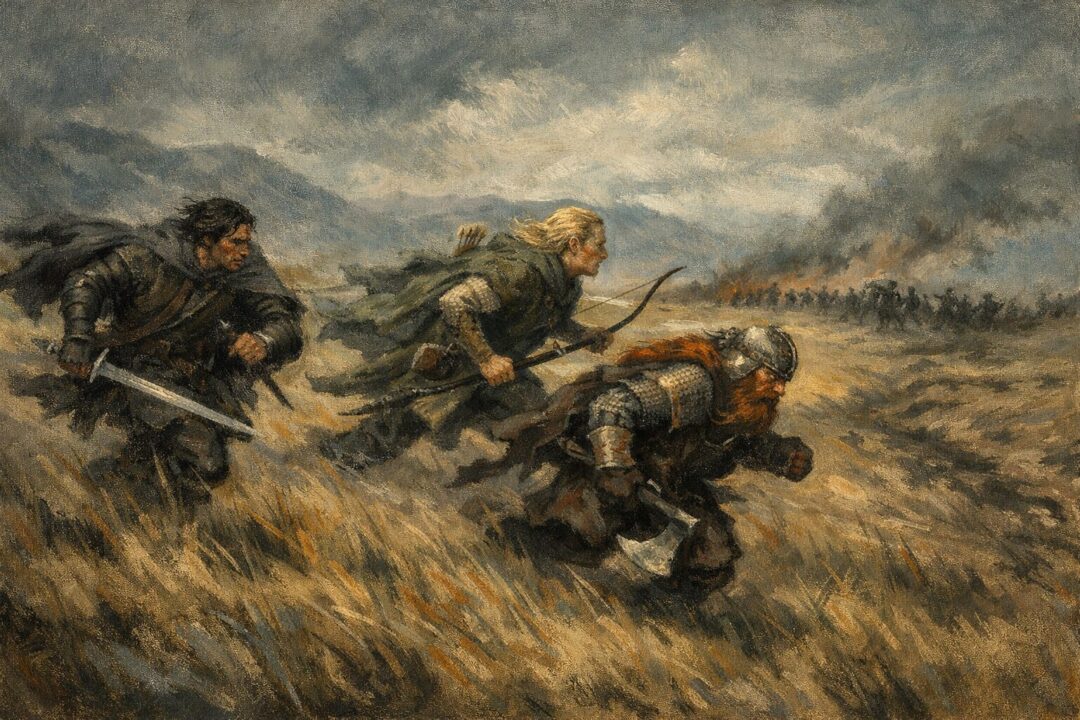
Merry and Pippin are carried off by the Uruk-hai, and Aragorn, Legolas, and Gimli begin their pursuit. On the surface, this looks like a straightforward rescue attempt. But the deeper function of the episode is temporal. The speed of both groups determines where multiple storylines will intersect. The Uruk-hai’s forced run across Rohan is what brings them near Fangorn. The Three Hunters’ relentless pursuit is what brings them into contact with Éomer and, soon after, into the orbit of Gandalf returned.
If the Uruks moved more slowly, the Rohirrim might catch them elsewhere.
If Aragorn’s company moved more slowly, they might miss the aftermath entirely.
If Merry and Pippin were not driven to the edge of Fangorn, they do not meet Treebeard when they do.
And if that does not happen, the destruction of Isengard does not unfold in the same way.
In other words, what looks like a pursuit sequence is actually one of Tolkien’s key engines of convergence. Speed is not just background realism here. It is plot architecture.
Rohan does not merely choose to ride — it must ride in time
The same pattern appears on a much larger scale with Théoden and the Rohirrim.
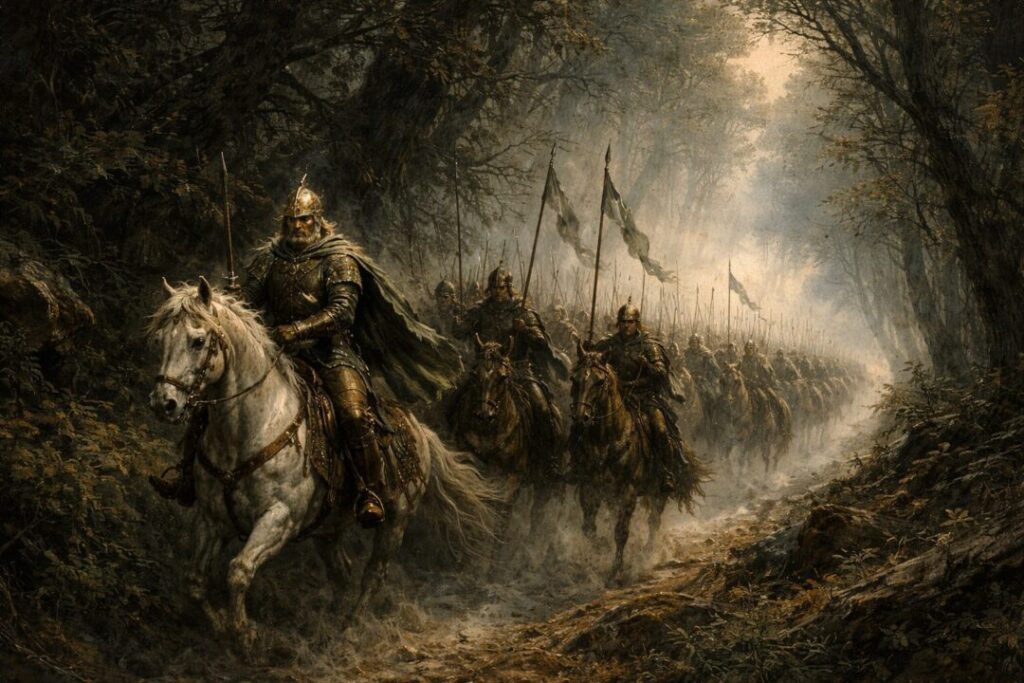
It is tempting to summarize this thread as simple loyalty: Gondor calls, and Rohan answers. But Tolkien makes the timing painfully important. The beacons are seen on 7 March while Gandalf and Pippin ride east. Théoden’s forces gather and then set out from Harrowdale on 10 March. They do not arrive at Minas Tirith immediately; the road itself becomes a problem to solve, and the hidden route through the Drúadan Forest becomes decisive. They finally reach the Pelennor in time to strike on 15 March.
That is the crucial point.
The Rohirrim are not important merely because they come.
They are important because they come before the city is fully lost.
A slower muster, a worse road, or a longer delay, and their courage would remain admirable but cease to be history-changing. Minas Tirith might already have fallen in fact, not only in fear.
Tolkien does not present this as an accident of logistics separated from heroism. He fuses them. Théoden’s greatness lies not only in willingness, but in answering fast enough for willingness to retain meaning.
Gandalf repeatedly wins by moving before others can react
Gandalf’s role in the late war shows the same quiet law.
After Isengard, he leaves with Pippin for Minas Tirith on 5 March. By the night of 7 March, they see the beacons lit. He reaches Gondor before the siege reaches its worst point, and his presence becomes essential in the city’s defense and in the preservation of order under Denethor’s collapse.
This is easy to flatten into “Gandalf helps where he is needed.”
But the texts show something sharper. He helps where he is needed because he is always in motion at the critical moment. His wisdom matters, but so does his speed. Shadowfax is not a decorative marvel in the story. He is one of the ways Tolkien makes timing physically possible. Without that pace, Gandalf’s counsel would arrive too late to steady Minas Tirith when it begins to break.
Aragorn turns speed into strategy
Aragorn’s southern journey is perhaps the strongest example of all.
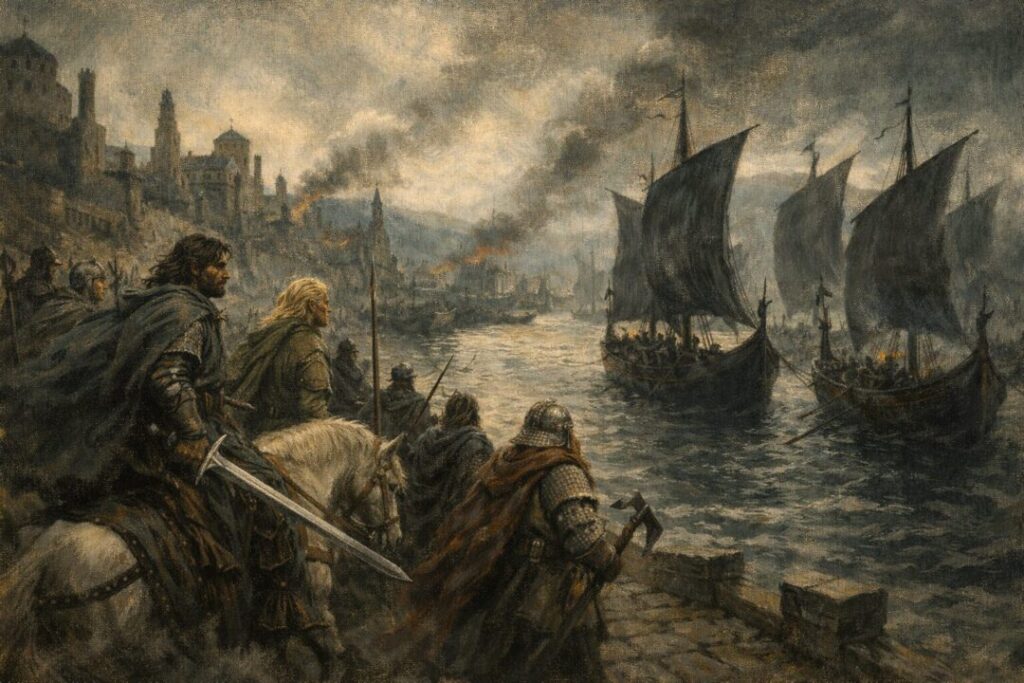
After using the Orthanc-stone, he chooses the Paths of the Dead and sets out on 8 March. He reaches the Stone of Erech that same day, drives south, reaches Pelargir on 13 March, captures the Corsair fleet, and then sails north to arrive at the Battle of the Pelennor on 15 March.
This is not merely dramatic entrance.
It is an operation built on beating the clock.
Sauron’s war plan depends in part on pressure from the south, including the Corsair threat. Aragorn does not simply defeat that threat in battle. He outruns its usefulness. He reaches Pelargir before the southern assault can close properly around Gondor, then uses the captured ships to reverse the expected movement up the Anduin.
So Aragorn’s kingship is revealed not only in open combat or prophecy fulfilled, but in mastery of movement. He understands that in war, where you are on the right day may matter more than how strong you are when you arrive.
Frodo’s final road is a race no one can openly name
The same principle governs the Ring-quest itself.
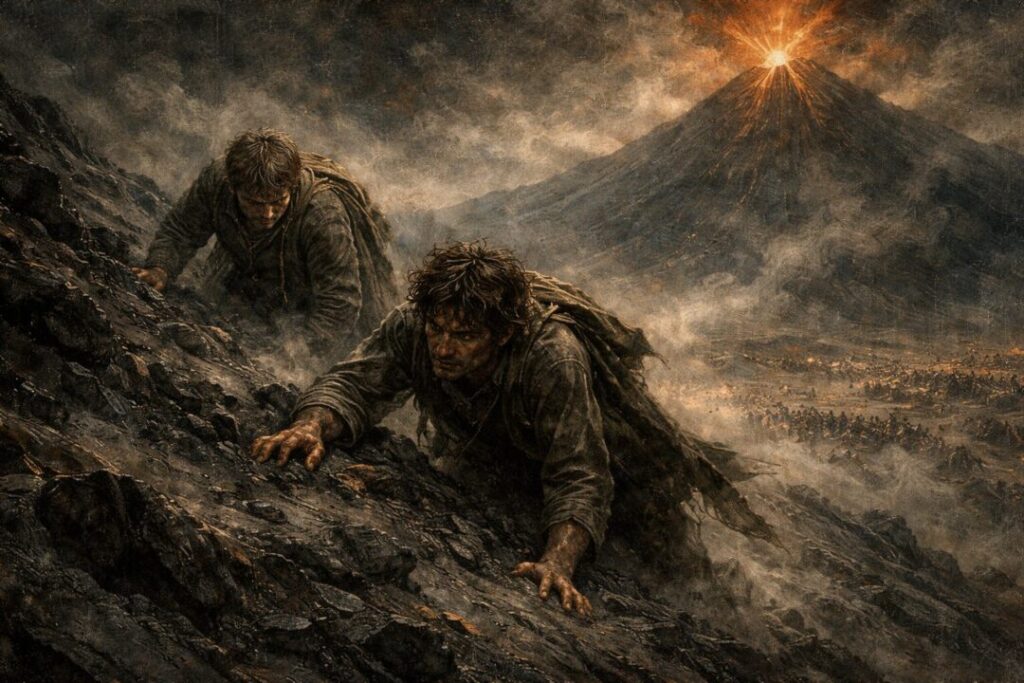
By mid-March, the war before Minas Tirith and the march to the Black Gate are functioning, in part, as a desperate effort to occupy Sauron’s gaze. Frodo and Sam reach the foot of Mount Doom on 24 March and the Cracks of Doom on 25 March, the very day the Host of the West stands before the Morannon. When Frodo claims the Ring, Sauron at last understands where the true danger lies.
That timing is everything.
Too early, and Sauron’s military focus is not yet fixed in the same way.
Too late, and the distraction at the Black Gate may fail before Frodo reaches the mountain.
Too slow, and exhaustion, thirst, or pursuit break the quest before the final ascent.
Tolkien never reduces this to mechanics. The moral and spiritual burden remains central. But he also never treats the road as symbolic only. Frodo and Sam must physically cover the last miles before the outer war collapses. The climax of the book is not just a contest of wills. It is also a race conducted under absolute concealment.
The Hobbit quietly works the same way
This is not only a Lord of the Rings pattern.
In The Hobbit, Thorin’s company does not merely arrive at Erebor eventually. They reach the Lonely Mountain at the edge of a narrow calendrical moment: the hidden door can be opened with the last light of Durin’s Day. Tolkien Gateway’s summaries of the relevant chapters and character pages reflect that the company arrives at Erebor in late autumn and finds the secret side-door with the last light of that day.
That means pace matters there as well.
The quest is not just “go to the mountain.” It is “reach the mountain in time for the world to line up with the clue.”
That is a deeply Tolkienian pattern: hidden things become possible not merely through cleverness or bravery, but through exact arrival at the appointed hour.
Why this matters so much
Once you notice this structure, many of Tolkien’s greatest moments begin to look different.
The story is not less grand for being tied to movement.
It is more convincing.
Courage is still courage.
Mercy is still mercy.
Providence is still providence.
But all of them must work through bodies on roads, horses under strain, armies on long marches, and travelers who do not know how much time remains.
That gives the legendarium one of its quiet strengths.
It never lets destiny float free of the physical world.
In Middle-earth, the fate of kingdoms can turn on whether a company pressed on through the night, whether a rider changed roads, whether a host reached the field by dawn, or whether two exhausted hobbits found the strength for one more climb.
So yes, Tolkien’s plot is shaped by kingship and pity and temptation and hope.
But very often, those deeper things only become visible because someone got there in time.
And in Middle-earth, that is never a small detail.
Sources & Notes
- J.R.R. Tolkien, The Lord of the Rings, Book III, Chapters 1–3, for the Uruk-hai’s forced march, the Three Hunters’ pursuit, and the timing that brings Rohan and Fangorn into the story.
- J.R.R. Tolkien, The Lord of the Rings, Appendix B, ‘The Tale of Years’, for the compressed February–March 3019 chronology behind the War of the Ring’s converging movements.
- J.R.R. Tolkien, The Lord of the Rings, Book V, Chapters 3 and 5, for Rohan’s muster, the Drúadan Forest route, and the Rohirrim reaching the Pelennor at dawn.
- J.R.R. Tolkien, The Lord of the Rings, Book V, Chapters 2 and 6, for Aragorn’s ride through the Paths of the Dead, the southern threat, and the captured ships arriving at Minas Tirith.
- J.R.R. Tolkien, The Lord of the Rings, Book V, Chapter 10, and Book VI, Chapter 3, for the Black Gate diversion and Frodo and Sam reaching Mount Doom at the decisive moment.
- J.R.R. Tolkien, The Hobbit, Chapter 11, ‘On the Doorstep’, for the hidden door opening only with the last light of Durin’s Day.