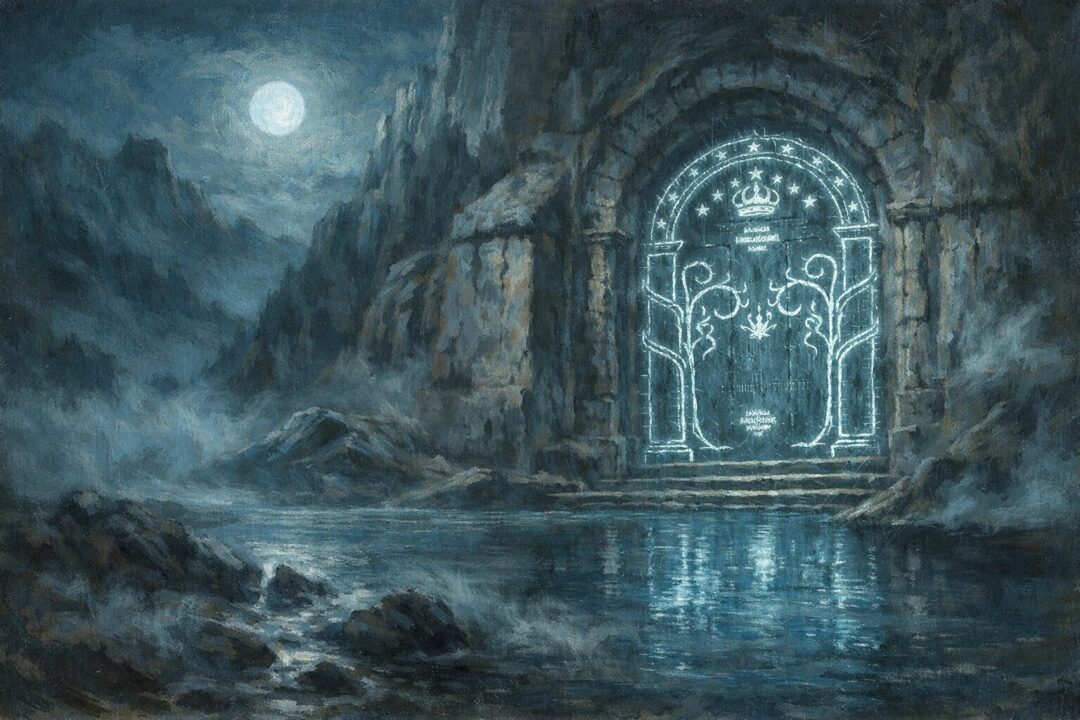
When the Fellowship reaches the West-gate of Moria in The Fellowship of the Ring, Tolkien gives us a moment that feels, at first glance, almost like a magical malfunction.
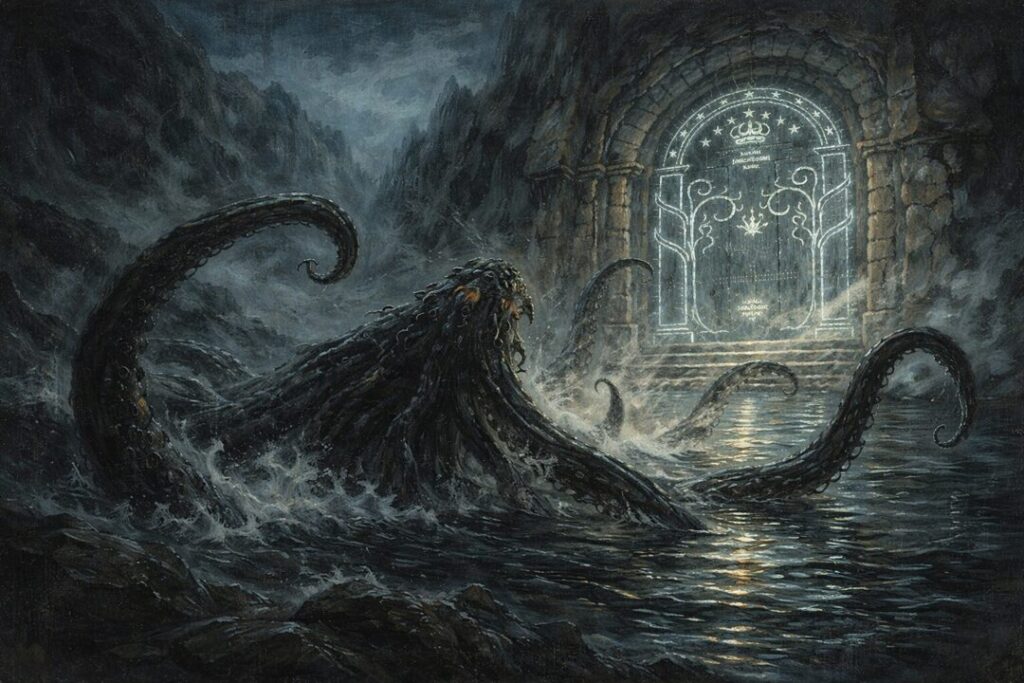
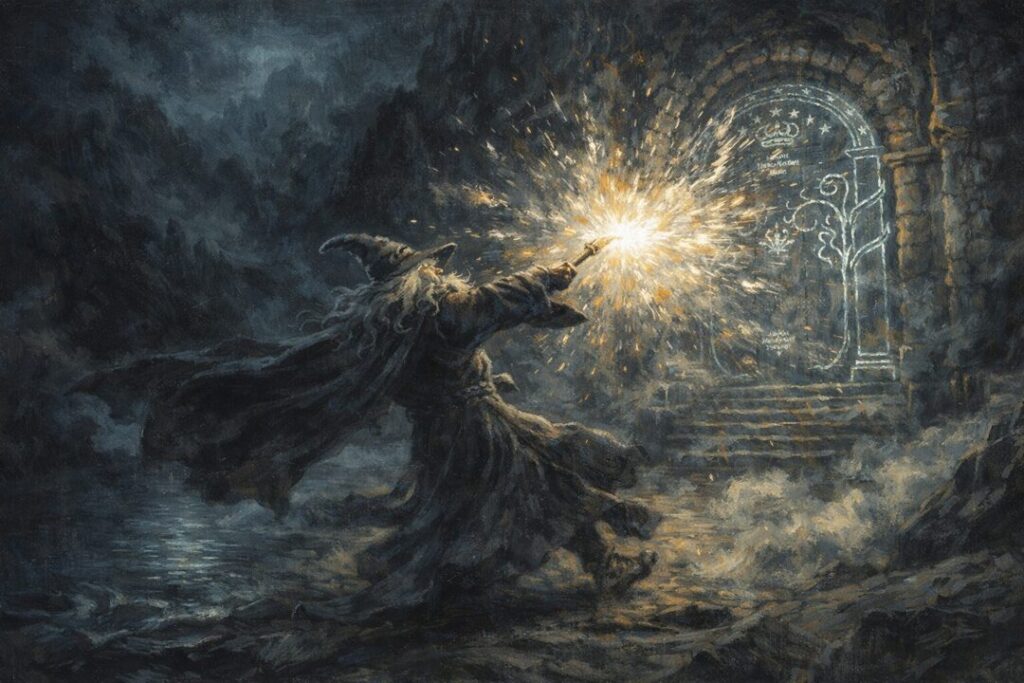
Gandalf—bearer of Narya, servant of the Secret Fire—attempts to seal the Doors of Durin against the Watcher in the Water. Fire flashes. Words of command are spoken. Power is clearly exerted.
And instead of obeying, the gate resists him.
Gandalf is thrown backward.
It is a brief moment in the text, but a striking one. Wizards in Tolkien do not often fail in such a direct, physical way. When they are resisted, it is usually through long struggle, counter-will, or moral limitation—not sudden recoil. So why here? Why does Gandalf’s magic not merely fail, but bounce back?
To understand this moment, we need to understand what the Doors of Durin actually are—and, just as importantly, what they are not.
The West-gate Was Not Ordinary Stone
The Doors of Durin were made in the Second Age by the Dwarves of Khazad-dûm in cooperation with the Elves of Eregion, at the height of friendship between the two peoples. Tolkien is explicit about this. These were not crude barriers or hastily raised fortifications. They were works of high craft, created in an age when both Dwarves and Elves were at their peak.
The doors were wrought with ithildin, a substance that only becomes visible under starlight or moonlight. In daylight, the doors appear plain and unadorned; only under the proper conditions do the runes and images emerge.
That detail alone tells us something vital: this was not passive decoration. Ithildin is reactive. It responds to light, to time, to circumstance. It is not simply painted or engraved—it is integrated into the substance of the door.
In Tolkien’s world, craftsmanship and enchantment are rarely separate things. An object does not need to glow or hum to be enchanted. The enchantment is in its making, its purpose, and its endurance. Dwarven works, especially from this era, are described again and again as resistant to wear, to time, and—crucially—to domination.
These doors were designed to close a mountain kingdom.
They were meant to last.
Gandalf’s Own Words Matter
After the failed attempt, Gandalf says something crucial—something that often passes by too quickly when reading:
“I once spoke words of opening. But the spell was broken.”
This line deserves close attention.
He does not say he forgot the spell.
He does not say he spoke the wrong words.
He does not say his power was insufficient.
He says the spell was broken.
That phrasing implies history. It implies continuity. The doors once responded to a certain magical understanding—an understanding that no longer applies. Something has changed, not in Gandalf, but in the relationship between spell, speaker, and stone.
This is not Gandalf failing to remember an incantation. This is Gandalf encountering a work that no longer recognizes the conditions under which it was made.
Dwarven Spell-Craft Was Defensive by Nature
To grasp why the spell rebounds, we must understand how Dwarven enchantment differs from other forms of magic in Middle-earth.
Dwarves do not practice domination magic in the manner of Sauron. They do not seek to bend wills, command minds, or exert control from afar. Instead, their magic—when Tolkien even chooses to call it magic—is bound into objects. It is expressed through permanence, resistance, and endurance.
Dwarven works are stubborn.
Their enchantments are not active spells waiting to be triggered. They are wards, bindings, and resistances woven into the very being of an object. A Dwarven door does not “listen” for commands. It remembers what it was made to do.
The Doors of Durin were meant to:
- Seal a mountain city
- Withstand siege
- Endure pressure, time, and force
- Resist intrusion—physical and otherwise
Including magical force.
A door that could be easily overridden by outside magic would be a catastrophic flaw. In a world where hostile powers exist—where sorcerers, ring-lords, and corrupted Maiar walk the earth—defensive resistance is not optional.
So when Gandalf attempts to force the door shut with fire and command, the magic does not “sink in.”
It glances off.
The Role of Will in Tolkien’s Magic
One of the most important things to understand about Tolkien’s magic is that it is not mechanical. It is not energy projected like a beam or discharged like a weapon. Tolkien consistently portrays magic as will exerted through substance.
Words matter because they are expressions of intent. Fire matters because it carries meaning. Authority matters because it is rooted in rightful purpose.
But will alone is not enough.
When will meets resistance—true resistance, built into the nature of a thing—something must give.
In this case, the door does not yield. The spell cannot take hold. There is no place for the magic to enter. The result is discharge rather than penetration.
The energy flashes outward. Sparks fly. Gandalf is thrown back.
Not because Gandalf is weak.
But because the door is too well made.
Why the Rebound Happens Physically
Tolkien is careful with physical consequences. When something recoils, it is because opposing forces are truly meeting.
The Doors of Durin are not inert stone. They are the product of Dwarven resistance and Elvish subtlety, designed to endure not only pressure from outside, but change itself. When Gandalf pushes against them with magic meant to compel and seal, the doors respond by not responding at all.
The magic has nowhere to go.
So it escapes.
The rebound is not an attack by the door. It is the natural result of power encountering a surface that refuses to accept it.
What This Tells Us About Moria
This moment is one of Tolkien’s quiet reminders of several deep truths in his world:
- Ancient craftsmanship can rival raw power
- Not everything can be forced, even by the wise
- Even Maiar must respect the limits imposed by the Children of Ilúvatar
Moria does not fall because it is poorly defended. On the contrary, it is too well defended. Its works endure long after its people are gone. Its doors still function. Its stone still resists.
Moria falls because something awakens inside it—not because its outer defenses fail.
And the Doors of Durin, standing silent under moonlight, still remember what they were made to do.
A Door That Remembers
When Gandalf’s spell rebounds, Tolkien is not telling us that Gandalf has reached the limits of his power.
He is showing us the enduring strength of Dwarven craft.
The doors do not break. They do not bend. They do not argue.
They simply refuse.
Final Thought
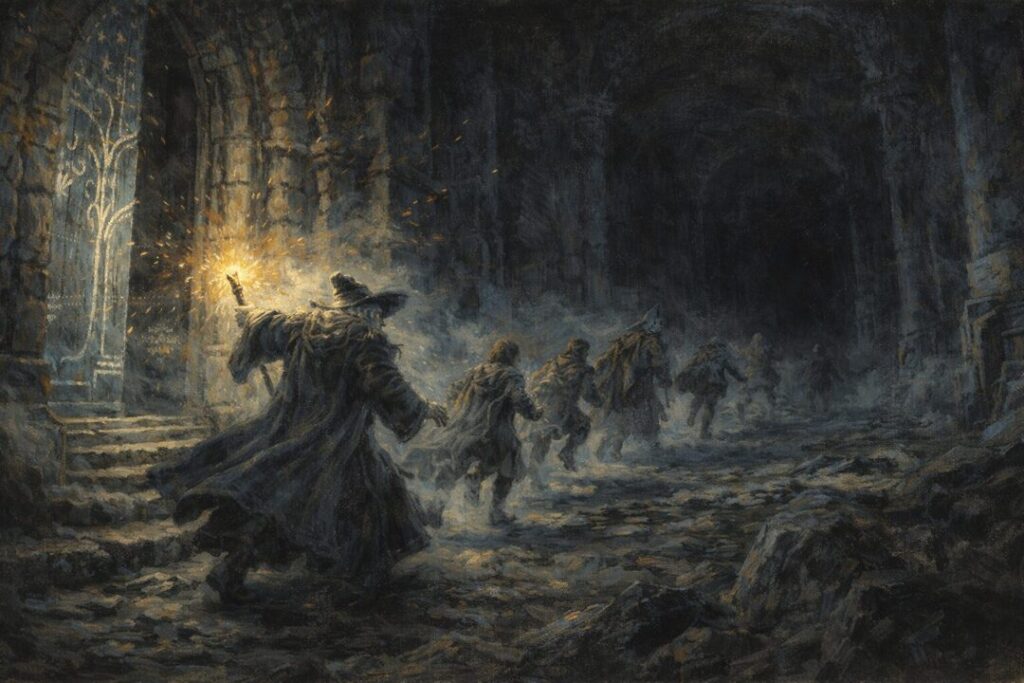
The rebound at the West-gate is not a failure of magic.
It is a success of design.
And once you see it that way, the entire scene changes.
Sources & Notes
- J.R.R. Tolkien, The Lord of the Rings, Book II, Chapter 4, “A Journey in the Dark” — the West-gate inscription names Narvi and Celebrimbor, and Gandalf explains the ithildin letters that appear only under starlight and moonlight.
- J.R.R. Tolkien, The Lord of the Rings, Book II, Chapter 4, “A Journey in the Dark” — the opening of the Doors of Durin by the password mellon, followed by the Watcher’s attack, grounds the article’s focus on the gate as a crafted and perilous threshold.
- J.R.R. Tolkien, The Lord of the Rings, Book II, Chapter 5, “The Bridge of Khazad-dûm” — Gandalf’s later shutting-spell in Moria meets a terrible counter-spell and a word of Command, the clearest textual basis for magic rebounding under opposed will.
- J.R.R. Tolkien, The Silmarillion, “Of the Rings of Power and the Third Age” — the friendship of Eregion and Khazad-dûm and the high craft of Celebrimbor’s people give the Doors of Durin their Second Age context.
- J.R.R. Tolkien, The Letters of J.R.R. Tolkien, Letter 155 — Tolkien’s distinction between enchantment/art and domination helps frame the article’s reading of Middle-earth magic as craft, will, and purpose rather than simple force.