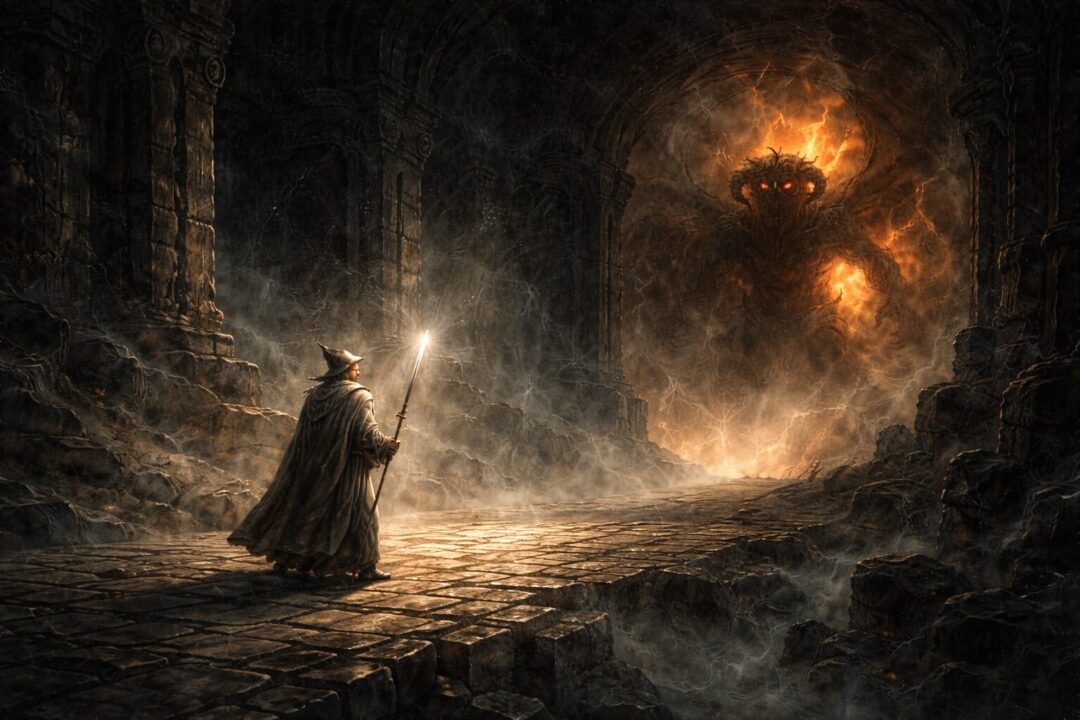
When the Fellowship flees through the endless halls of Moria, the moment everyone remembers is not the drums, not the pursuit, not even the Balrog’s first appearance.
It is the bridge.
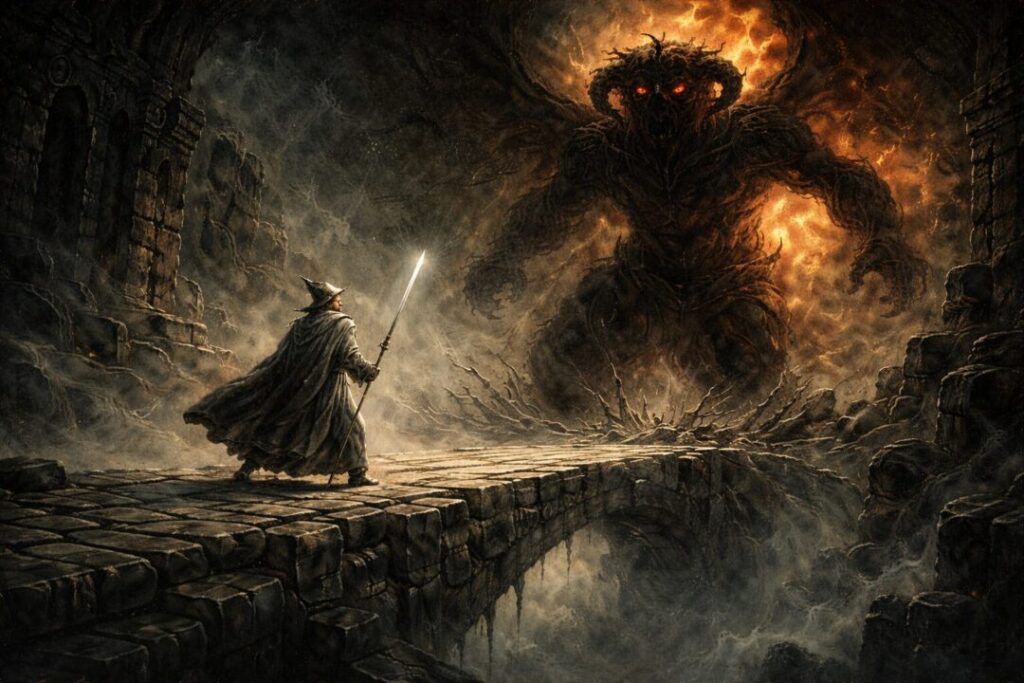
A narrow span of stone, arched over an abyss so deep its bottom is never seen.
Fire behind.
Darkness ahead.
And Gandalf, standing alone.
He raises his staff and declares a single sentence:
“You cannot pass.”
The Balrog advances anyway.
Then the bridge collapses.
At first glance, this moment feels like a classic display of magical force—a wizard unleashing power at the last possible second. But when you slow down and look closely at Tolkien’s actual words, something strange emerges. There is no description of a violent explosion. No shockwave blasting outward. No flash of blinding light.
Instead, the bridge simply breaks.
It is as if its right to exist in that moment has been revoked.
So what is really happening on the Bridge of Khazad-dûm?
Sound in Middle-earth Is Not Just Sound
One of the biggest mistakes modern readers make is assuming that Middle-earth operates according to real-world physics with a thin layer of fantasy painted on top. It doesn’t.
Tolkien’s world runs on sub-creation—the idea that the created world is shaped not only by matter, but by intention, meaning, and authority. Thought and speech are not secondary to reality; they are woven into it.
This idea is present from the very beginning of existence. In The Silmarillion, the universe is not forged with tools or summoned through raw power. It is sung into being during the Music of the Ainur. The themes of that music become mountains, seas, fire, and living creatures.
Sound, in Tolkien’s legendarium, is not decorative flavor.
It is foundational.
Which means silence matters just as much.
Before Gandalf brings down the bridge, Tolkien carefully stretches the moment. The Balrog halts. Gandalf stands firm. Time seems to tighten around them. There is a pause—a held breath—before action resumes.
This is not accidental. Again and again, Tolkien shows that power gathers in stillness before it is released. Silence is not emptiness. It is pressure.
Gandalf Is Not Casting a “Spell”
It is tempting to describe this moment as Gandalf casting a powerful spell, but Tolkien almost never frames his magic that way. Gandalf does not shout incantations or fling raw energy unless absolutely necessary—and even then, the effects are restrained.
That restraint exists for a reason.
Gandalf is a Maia, a being of the same order as Sauron and the Balrogs themselves. In sheer metaphysical weight, he is their equal. But unlike them, he is bound.
The Istari—of whom Gandalf is one—are forbidden from dominating the peoples of Middle-earth through force. They are sent to guide, advise, and inspire resistance to evil, not to replace it with their own rule.
So when Gandalf confronts the Balrog, brute force is not an option.
Instead, he uses the one thing he is fully allowed to wield:
Authority.

“You Cannot Pass” Is Not a Threat
When Gandalf speaks on the bridge, he is not issuing a warning or daring the Balrog to test him. He is making a declaration.
In Tolkien’s world, to speak with true authority is to name reality.
Gandalf invokes his role as a servant of the Secret Fire, acting in accordance with the will of the Valar. He is not saying, “I will stop you.”
He is saying, “This is not permitted.”
That distinction matters.
The Balrog is an ancient being of fire and shadow, but it is also a rebel—one who fell long ago into service of Morgoth. Gandalf’s words carry the weight of judgment against that rebellion.
The bridge breaks not because Gandalf overwhelms it with power, but because the structure cannot remain intact in a moment where Gandalf’s authority directly contradicts the Balrog’s advance.
Something has to give.
Why the Bridge Fails the Way It Does
Notice how the bridge collapses.
It does not explode outward in all directions.
It does not shatter violently into a storm of debris.
It simply fails.
The stone gives way beneath the Balrog’s feet, almost as if the bridge itself refuses to support what stands upon it.
This fits perfectly with Tolkien’s view of the world as morally responsive. Objects in Middle-earth are not morally neutral in the modern sense. Swords break when they are unworthy. Gates open to rightful heirs. Paths reveal themselves to those who are meant to walk them.
The Bridge of Khazad-dûm does not act randomly.
For one instant, the authority behind Gandalf’s command outweighs the claim of the Balrog to continue forward—and the stone obeys.
The Importance of the Pause
The silence before the bridge falls is crucial.
Tolkien understood something that modern storytelling often forgets: anticipation creates gravity. When all motion stops, attention sharpens. Meaning condenses.
That pause allows the reader to feel the weight of the decision being made—not just by Gandalf, but by the world itself.
When the action finally comes, it feels inevitable rather than explosive. The bridge does not die screaming. It simply ceases to function as a bridge.
This is why the moment feels so solemn instead of flashy. It is not spectacle. It is judgment.
A Pattern Repeated Across Tolkien’s Legendarium
Gandalf on the bridge is not an isolated incident. It fits into a much larger pattern that Tolkien returns to again and again.
- Lúthien does not defeat Morgoth with weapons. She sings him into sleep, bending the will of the mightiest being in the world through song and sorrow.
- Finrod battles Sauron not with blades, but through a contest of songs—each verse reshaping the world they stand in.
- Aragorn commands the Dead not by overpowering them, but by invoking rightful authority. They follow because they must.
In every case, power is not about volume or violence.
It is about recognition.
Why the Balrog Still Pulls Gandalf Down
If Gandalf’s authority is so absolute in that moment, why does the Balrog manage to drag him into the abyss?
Because authority is not the same as invulnerability.
Gandalf succeeds in his purpose: the Balrog does not pass. The Fellowship escapes. The judgment stands.
But Gandalf pays the cost of enforcing it. Authority does not shield him from consequence—it demands sacrifice.
This is a deeply Tolkienian idea. Victory is rarely free. The world may agree with Gandalf, but it does not spare him.
Conclusion: Middle-earth Listens
The Bridge of Khazad-dûm does not break because Gandalf is stronger than the Balrog in a simple, physical sense.
It breaks because, for one critical moment, the world agrees with him.
Stone, silence, and authority align. The Balrog’s advance is denied. Reality itself enforces the judgment spoken aloud.
And that raises a final, unsettling question:
If words can shape stone…
If silence can carry weight…
If authority can cause the world to choose sides…
What else in Middle-earth is held together only because no one has spoken against it yet?
Sources & Notes
- J.R.R. Tolkien, The Lord of the Rings, Book II, Chapter 5, “The Bridge of Khazad-dûm” — Gandalf’s command, the stroke of his staff, the bridge breaking, and the Balrog dragging him down.
- J.R.R. Tolkien, The Silmarillion, “Ainulindalë” — the world’s making through the Music of the Ainur supports the article’s theme that sound, will, and created reality are closely linked.
- J.R.R. Tolkien, Unfinished Tales, “The Istari” — Gandalf/Olórin is one of the Maiar sent to counsel and inspire resistance rather than dominate Middle-earth by force.
- J.R.R. Tolkien, The Silmarillion, “Valaquenta” — Balrogs are spirits of the same angelic order corrupted into servants of Melkor, giving weight to Gandalf’s confrontation with one.
- J.R.R. Tolkien, The Silmarillion, “Of Beren and Lúthien” — Finrod’s song-contest with Sauron and Lúthien’s song before Morgoth provide wider examples of song, authority, and will acting as real power.