When people in Middle-earth speak of Dwarven things, they do not usually speak as if they mean ordinary wealth.
They speak as if they mean something harder to replace.
A coat of mail.
A sword with a name.
A gate that holds beauty and skill together.
A jewel or treasure so bound to a people’s memory that its value cannot be reduced to coin.
This matters.
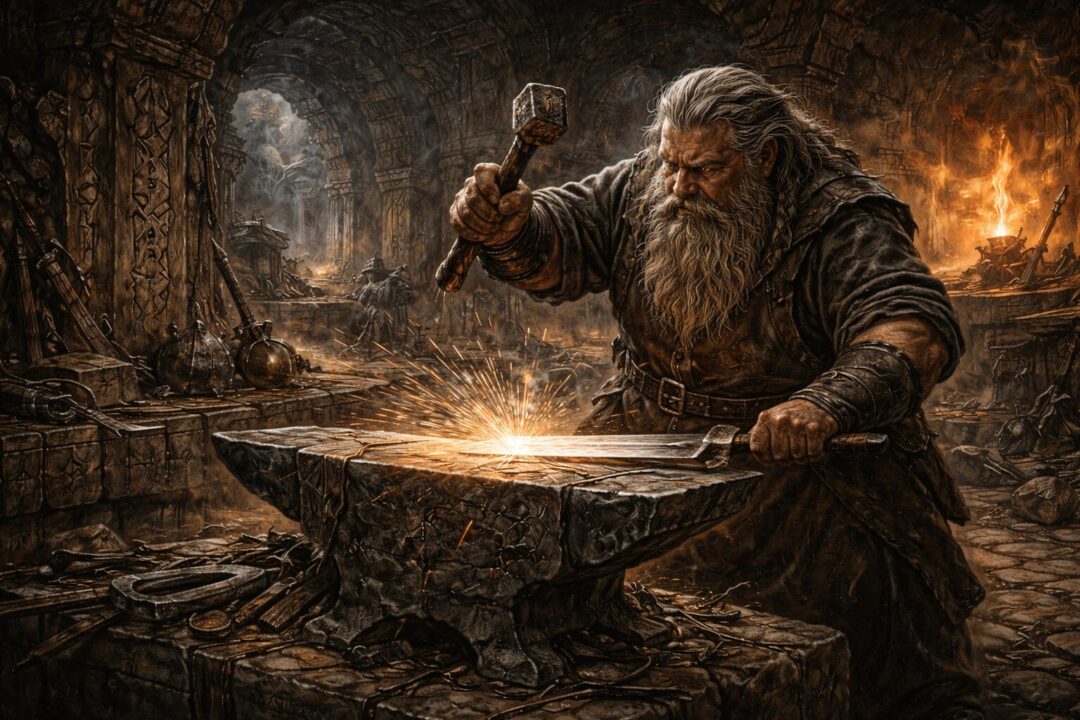
Because Dwarven goods are not expensive in the simple sense. They are not treated as fashionable luxuries or passing signs of status. Again and again, the texts present them as objects of exceptional workmanship, rare materials, and long endurance. The Dwarves are repeatedly described as masters of smithcraft, stonework, and mining, with those talents explicitly linked to Aulë, who made them.
So the question is not only why Dwarven goods cost much.
It is why Middle-earth treats them as if they belong to a category of value all their own.
Dwarven Craft Begins with What the Dwarves Are
The first answer is the simplest.
Dwarven goods are worth so much because the Dwarves themselves are made for this kind of work.
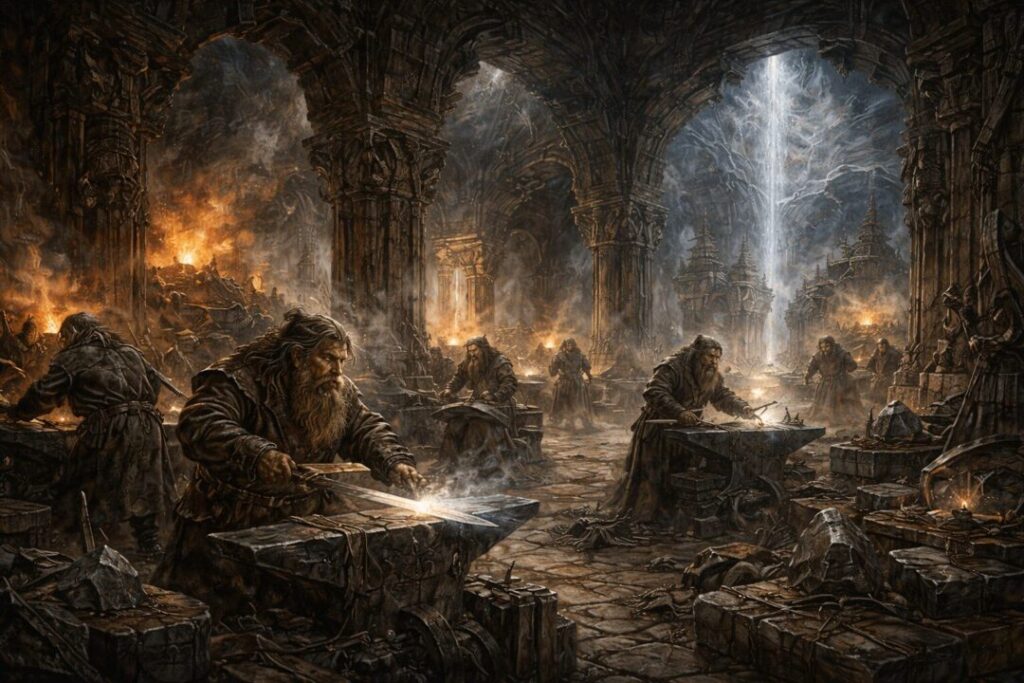
The tradition of the legendarium connects them directly to Aulë the Smith. Because of that origin, the Dwarves are especially associated with delight in making, shaping, mining, and working the substances of the earth. Reputable lore summaries are careful on this point: their skill in metal and stone is not just cultural habit, but part of how the texts characterize them from the beginning.
That does not mean every Dwarven object is magical.
The texts do not say that.
What they do suggest is something more grounded: Dwarven work tends to be unusually well made because the people producing it are unusually suited to that labor. A culture built around deep knowledge of ore, stone, tools, and endurance will not produce ordinary goods in the same way as a people less devoted to those arts.
This is why even when the story is not dwelling on treasure, Dwarven craftsmanship carries weight.
Their value begins in competence.
Khazad-dûm Made Dwarven Wealth Legendary
If Dwarven skill explains part of the value, Khazad-dûm explains the scale of it.
Khazad-dûm was not merely a rich kingdom. It was the greatest and most famous Dwarven realm, and much of its power and wealth became bound to mithril. Lore references drawing from The Lord of the Rings and the Appendices consistently describe Khazad-dûm as enriched by people, craft, and lore, but especially by the rare metal found in its mines.
This is crucial.
Gold is precious in many places.
Jewels can be gathered by kings, dragons, and thieves.
But mithril is different.
In Middle-earth, it was found nowhere but Khazad-dûm. It was stronger than steel, yet light and supple, and it shone like untarnished silver. That combination alone would have made it extraordinary. Scarcity made it greater still.
And scarcity in Tolkien’s world is never just economic.
A thing becomes more valuable when it cannot easily be replaced, when access to it depends on a specific people, a specific place, and a specific skill. Mithril meets all three conditions. It requires the mines of Khazad-dûm, the knowledge to extract it, and the craft to work it well. Once Khazad-dûm falls, the metal does not become merely expensive.
It becomes almost unreachable.
That helps explain why Dwarven goods are not just admired.
They are scarce products of a vanished height.
A Single Mithril Coat Explains the Entire Problem
The clearest example appears in one object.
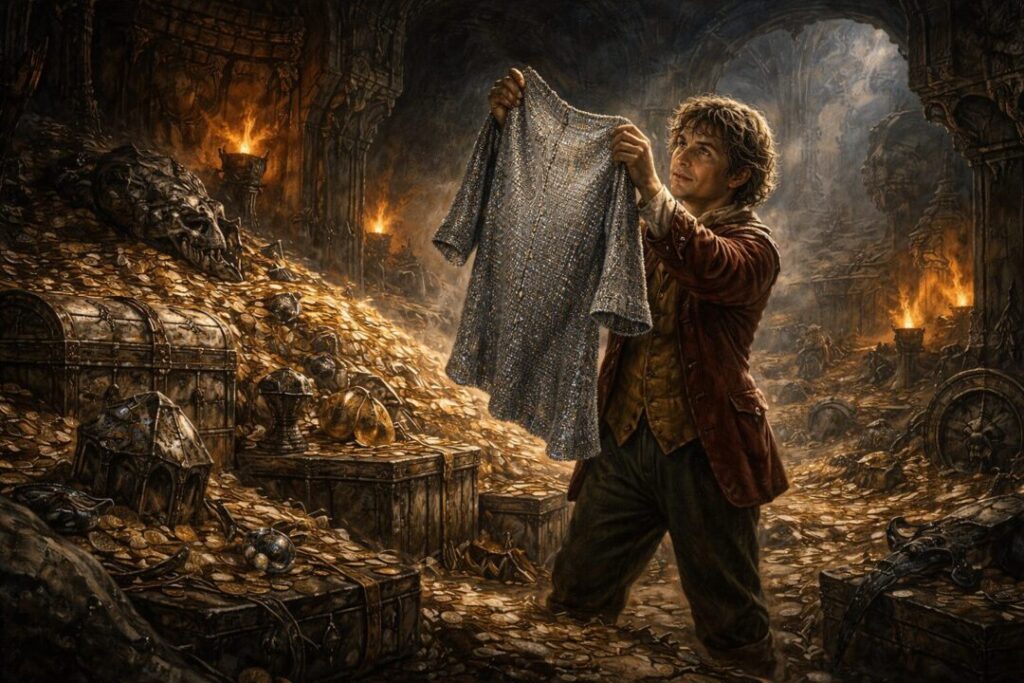
Bilbo’s mithril-coat is not treated as a fine possession among many. It is treated as something astonishing. Gimli calls it a kingly gift, and the received valuation attached to it is immense: it is said to be worth more than the value of the whole Shire.
That line matters not because it gives a precise market price.
It matters because it shows how the world of the story thinks.
A small coat, made for an Elven-princeling and later given to Bilbo, can outweigh the wealth of an entire country in perceived worth. That is not because everyone in Middle-earth is irrational. It is because the object combines nearly everything that drives Dwarven value upward at once: mithril, high workmanship, durability, and rarity beyond ordinary experience.
In other words, the mithril-coat is not an exception.
It is the clearest proof.
Dwarven Goods Are Valuable Because They Endure
Another reason Dwarven work commands such value is that it lasts.
This is easy to miss because the stories often mention the result more than the process. But when Dwarven-made things appear, they tend to survive ages, journeys, inheritances, and wars. Telchar’s name still matters because objects he made continue to shape events far beyond his own lifetime. Among the works attributed to him are Angrist, Narsil, and the Dragon-helm of Dor-lómin.
That list is striking.
Angrist is not remembered because it was decorative.
It is remembered because it could cut iron from Morgoth’s crown.
Narsil is not remembered because it looked rich.
It is remembered because it became one of the great swords of the legendarium.
The Dragon-helm is not remembered as trinketry.
It is remembered as heirloom, war-gear, and symbol.
This suggests a broader pattern.
Dwarven goods are worth much because they are not consumable luxuries. They are built to remain useful, memorable, and inheritable. In that sense, their value is closer to the value of a great fortress or a royal lineage than to the value of jewelry for display.
The Best Dwarven Work Is Not Isolated from the Rest of Middle-earth
There is also a social reason these goods are worth so much.
The greatest Dwarven craftsmanship does not stay hidden underground. It becomes part of larger networks of trade, alliance, and history.
Dale is one of the clearest examples. The town prospered by trading food for Dwarven skills and crafted goods from Erebor. It even became famed for wonderful toys, and the tradition says fathers in Dale paid handsomely to place their sons with the Dwarves as apprentices.
That passage is revealing.
It shows that Dwarven goods were not prized only by Dwarves. Men recognized their worth strongly enough to build trade around it and, at least in Dale’s case, to seek training through Dwarven hands. This is not the response of a world humoring eccentric craftsmen.
It is the response of a world that knows the work is better.
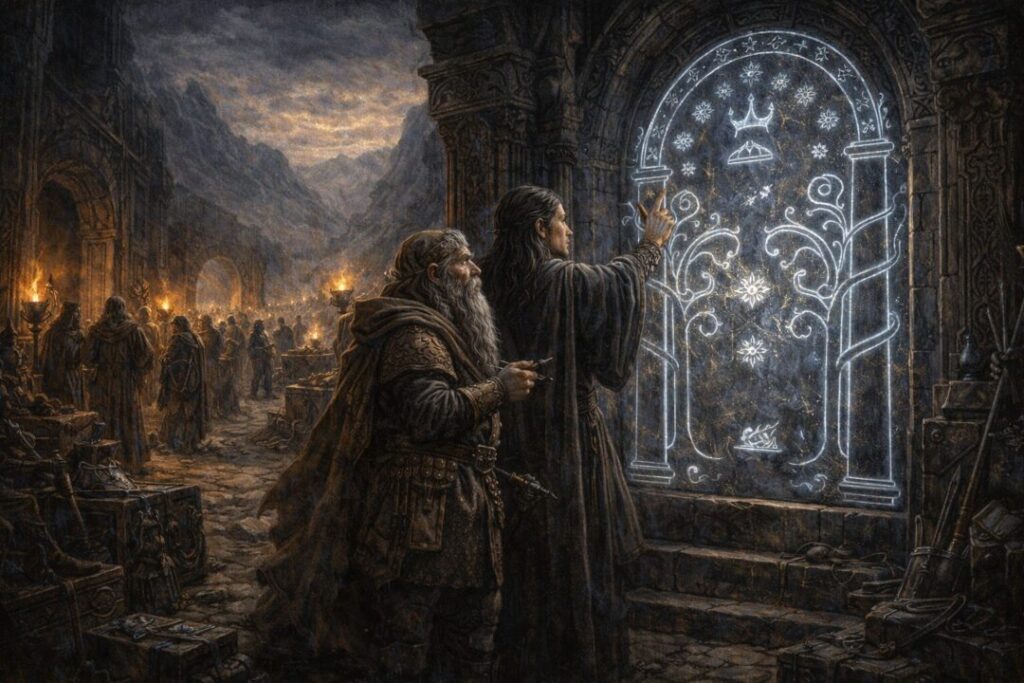
Something similar appears in the friendship between Khazad-dûm and Eregion. Narvi and Celebrimbor together made the Doors of Durin, a work remembered precisely because it joined Dwarven and Elven excellence. Those doors stand as evidence that Dwarven craft could be esteemed at the highest level even by the most gifted Elven artificers.
That does not mean Dwarves surpass Elves in every art.
The texts would not support such a flat claim.
But they do support this: in stone, metal, construction, and durable making, Dwarven work belongs among the great achievements of Middle-earth.
Value in Middle-earth Is Never Only About Money
This is where the deeper answer begins.
Dwarven goods are worth so much because the legendarium does not treat value as a purely commercial matter.
A Dwarven object often carries at least four kinds of worth at once.
First, material worth: metals, gems, and especially mithril are genuinely rare.
Second, labor worth: the skill required to produce these things is unusual, sometimes exceptional.
Third, durability: Dwarven goods are often built to outlast the age that made them.
Fourth, historical worth: many Dwarven objects become heirlooms, symbols, or instruments at major turning points in the history of Middle-earth.
Once those layers are seen together, their high value stops seeming mysterious.
Of course Dwarven goods are worth so much.
They are made from rare things by a people uniquely suited to making them, shaped with skills that other peoples often respect, and preserved long enough to gather history around themselves.
Why This Matters
There is one more reason the subject matters.
People sometimes reduce Dwarven wealth to hoarding.
But the texts are more interesting than that.
The greatest Dwarven riches do not begin with greed. They begin with making. Khazad-dûm becomes great because of craft and discovery. Dale prospers because Dwarven skill creates things others want and cannot easily imitate. The famous works of Dwarven smiths matter because they are good enough to survive into legend.
This does not mean the Dwarves are free from possessiveness or pride.
The stories plainly show otherwise.
But that is a different question.
The reason Dwarven goods are worth so much is not that Dwarves desire them fiercely.
It is that Middle-earth keeps proving they deserve to be desired.
Sources & Notes
- J.R.R. Tolkien, The Silmarillion, "Of Aulë and Yavanna" — gives the Dwarves their origin with Aulë and links them from the beginning with craft, stone, metal, and making.
- J.R.R. Tolkien, The Lord of the Rings, Book II, Chapter 4, "A Journey in the Dark" — describes mithril as the great wealth of Moria and treats Bilbo’s mithril-coat as worth more than the Shire.
- J.R.R. Tolkien, The Hobbit, Chapter 1, "An Unexpected Party" — recalls Dale’s prosperity through trade with the Dwarves of the Mountain, including crafted goods and apprenticeships.
- J.R.R. Tolkien, The Lord of the Rings, Book II, Chapter 4, "A Journey in the Dark" — the Doors of Durin name Narvi and Celebrimbor, showing Dwarven craft honoured alongside Elven artistry.
- J.R.R. Tolkien, The Silmarillion, "Of Beren and Lúthien" and "Of Túrin Turambar"; Appendix A to The Lord of the Rings — preserve Telchar’s works such as Angrist, the Dragon-helm, and Narsil as enduring heirlooms of legend.