Most readers remember Middle-earth through its highest moments.
They remember kings returning, dark towers falling, ancient swords drawn, horns sounding at dawn, and small hands carrying impossible burdens into the heart of shadow.
Those things matter. They are the moments the great stories turn upon.
But Middle-earth is not only built from turning points.
It is also built from everything that prevents collapse between those points.
That quieter structure is easy to miss because the narrative rarely lingers on it. The great tales move toward councils, journeys, battles, and reckonings. Yet again and again, the text lets us glimpse the kinds of work that make any realm survivable at all. Not glorious work. Not usually central work. But necessary work.
That pattern reveals something important about how this world actually functions.
Middle-earth is not sustained by heroism alone.
It is sustained by maintenance.
The health of a realm is not measured only by its rulers
The clearest example is Gondor.
By the end of the Third Age, Gondor has been without a king for generations beyond counting. And yet it still stands. That alone tells us something crucial. A kingdom in Middle-earth does not continue by memory or symbolism alone. It continues because someone governs, preserves, organizes, judges, commands, and holds the structure together in the absence of the thing it was originally built around.
That is what stewardship means in practice.
The Stewards are often remembered mainly because Denethor is one of them, and because Aragorn eventually replaces the long vacancy of the throne. But the deeper reality is that Gondor survived because stewardship was not ornamental. It was a living labor of preservation. The line of kings failed, but the realm itself did not simply fall into dust.
Someone kept it functioning.
That matters because Tolkien’s world is full of inheritance, ancestry, and rightful rule. Yet even there, legitimacy alone is not enough. A claim may matter, but a city also needs administration. A people need continuity. Borders must be held. Alliances must be maintained. Food, law, defense, and memory all require human hands.
The romance of kingship is visible.
The work of not letting a kingdom die is quieter.
And the texts repeatedly honor that quiet labor, even when they also show its spiritual danger in a man like Denethor. Stewardship can become pride, but before that it is burden.
Distance is one of the great enemies in Middle-earth
Another pattern appears wherever realms are separated by great stretches of land.
Middle-earth is huge. News travels slowly. Help can arrive too late. A kingdom that cannot communicate is only half a kingdom already.
That is why messengers matter far more in these stories than many readers first notice.
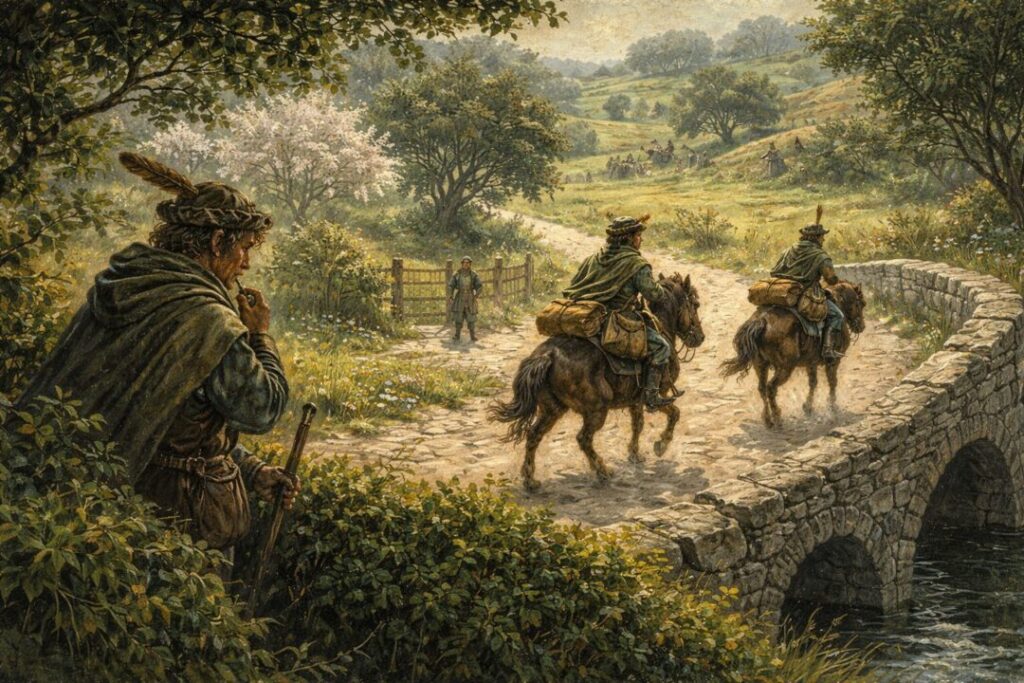
In the Shire, one of the only real official functions attached to the mayoralty is the Messenger Service. That detail can sound charming at first, almost comic, as if the office belongs to a peaceful little world too small for serious politics. But the implication is the opposite. The Shire works because communication is treated as one of the few public necessities worth organizing at all.
Messages are infrastructure.
So are roads and bridges.
The old rules remembered in the Shire include the duty to speed messengers and maintain bridges and roads. That is not decorative background. It tells us what stable life requires. A realm does not remain itself merely because its people are good-hearted. It remains itself because it keeps open the lines by which warning, trade, aid, and ordinary order can move.
Gondor shows the same truth on a larger and harsher scale.
The beacon system is not just dramatic imagery on a mountaintop. It is a standing network of readiness, with signal fires prepared and fresh horses waiting for couriers. In other words, warning itself is organized labor. Readiness is not spontaneous. Someone maintains it before the crisis comes.
That is one of the recurring truths of Middle-earth.
When the great moment arrives, it is already too late to begin building the systems that make response possible.
Healing is treated as political as well as personal
One of the most revealing places in the whole legendarium is the Houses of Healing.
At first glance, they may seem secondary to the battle outside the walls. But the text quietly refuses that hierarchy. The battle may decide who holds the field. Healing decides whether victory can actually be lived through.
This is why the famous saying about the hands of the king being the hands of a healer matters so much. It does not merely reveal Aragorn’s identity. It reveals what rightful rule is supposed to look like. Kingship is not proved by domination alone. It is proved by restoration.
But Aragorn is not the only figure who makes that scene possible.
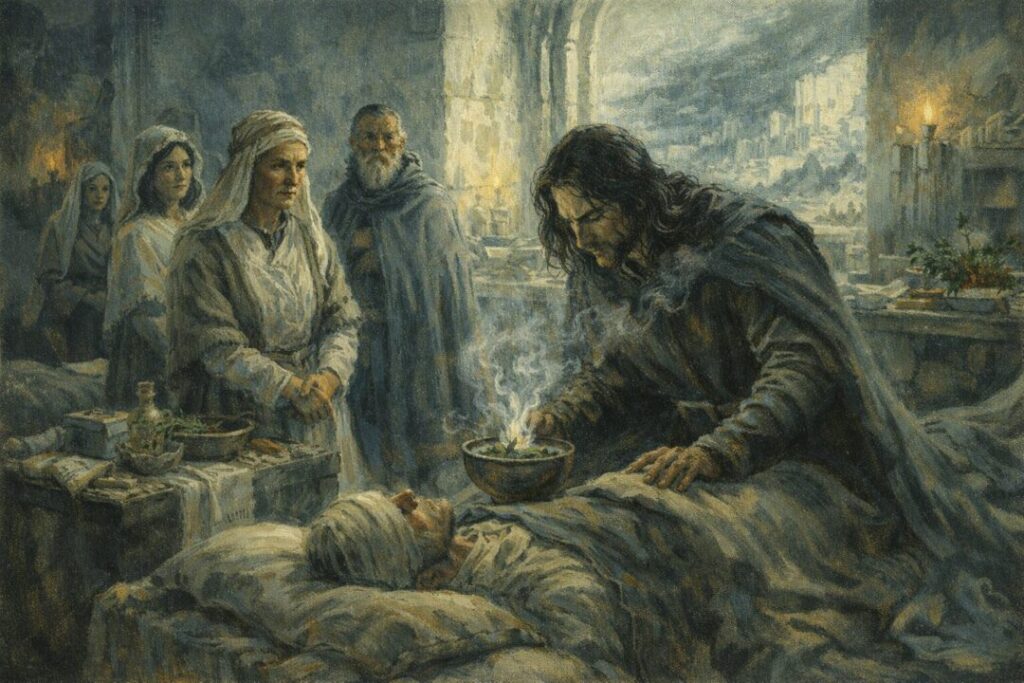
There is a warden of the Houses of Healing. There are women who serve there. There is herb-lore, memory, procedure, and practical care. There is even the slightly comic but deeply important talk surrounding kingsfoil, because knowledge survives in scattered forms: in old sayings, in common speech, in remembered uses half-dismissed by more formal learning.
That scene is filled with overlooked workers.
And that is the point.
If war is one of the great public acts of Middle-earth, then healing is one of its great hidden counterweights. The stories never suggest that survival ends when the enemy is driven back. Someone must still tend what violence leaves behind.
Without that, no victory is whole.
Borders hold because someone keeps watch before the breach
The Shire offers another instructive case.
Readers often think of it as nearly ungoverned, almost naturally peaceful. In one sense that is true. It has little formal power compared with kingdoms of Men. But it is not a void. It has its own small mechanisms of order: shirriffs for inside work, bounders for the borders, and habits of maintenance so old that many Hobbits scarcely think about them.
That is exactly why those roles matter.
The safest societies are often the ones that make watchfulness look unimportant.
A bounder is not a heroic office. A shirriff sounds almost absurd beside captains, lords, and marshals. Yet the logic is precise. Trouble is easiest to manage at the edge, when it is still small. A wandering beast, an unwanted intruder, a breach of customary order—these are not yet apocalyptic threats. But neglect enough of them, and the conditions of peace begin to rot.
The Scouring of the Shire makes this brutally clear.
Once its ordinary protections are distorted, expanded, or turned toward domination, the Shire stops feeling like itself almost at once. That is one of the sharpest political observations in the book. Even a gentle land depends on systems of order. The difference between peace and petty tyranny is not the absence of such systems, but whether they exist to preserve a common life or to control it.
Middle-earth repeatedly understands this.
The unseen work of keeping watch is morally fragile, but indispensable.
Craft is not background detail but civilizational labor
There is also the work of making and remaking the world itself.
This is especially visible in Dwarven craft, though not only there.
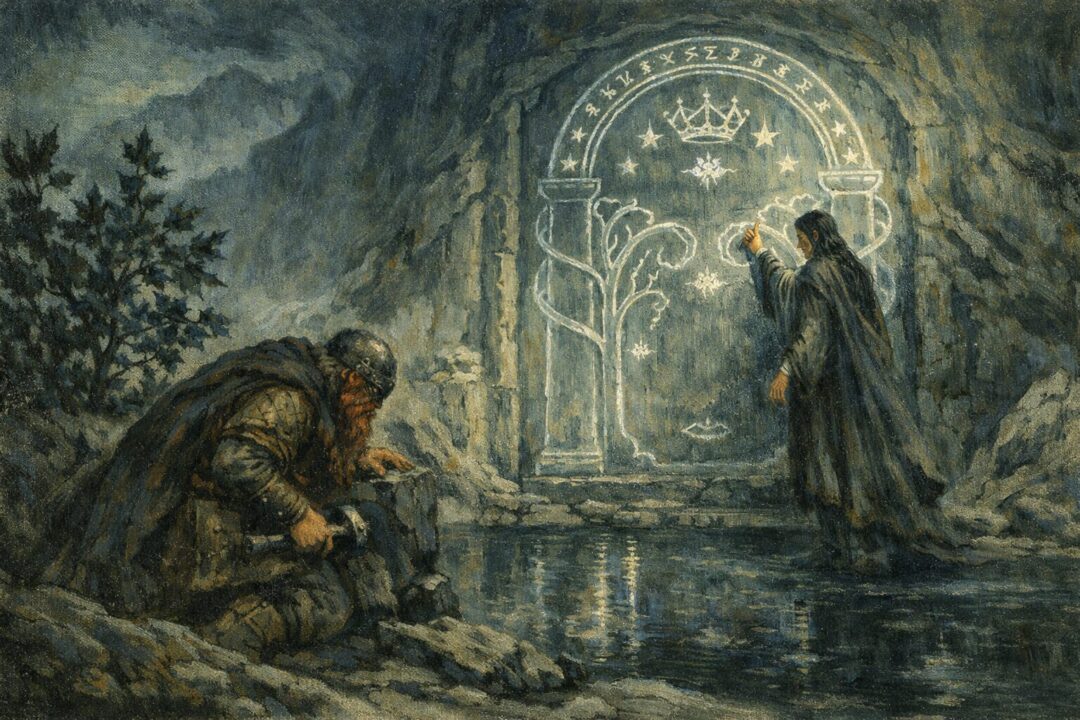
Narvi is remembered because his name is literally written into the Doors of Durin. But that single detail opens onto a larger truth. Great realms endure not only because warriors defend them, but because craftsmen shape the things that allow those realms to function, endure, welcome, protect, and be remembered. Doors, gates, halls, lamps, stonework, tools—these are not ornamental afterthoughts. They are civilization made visible.
Minas Tirith offers a striking example.
The city contains places like Lampwrights’ Street, which tells us at once that even one of the great cities of the West depends on ordinary specialist labor. Light does not simply appear because a city is noble. Someone makes the lamps.
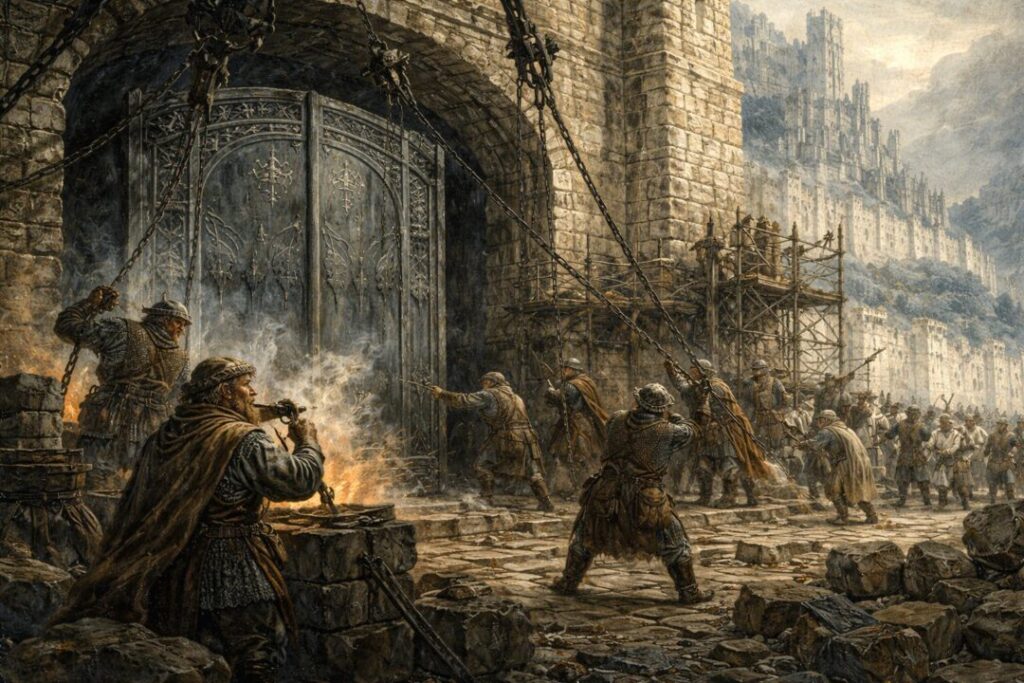
After the War, the same pattern returns in restoration. Gimli and his people do not merely admire Gondor and Rohan from afar. They perform great works there. The broken gate of Minas Tirith is remade. Stonework is tended. Beauty is restored by hands that know how to build.
That matters because restoration in Middle-earth is never only symbolic.
It is manual.
The world after catastrophe is not healed by speeches. It is healed by people who can repair what was broken.
Why these roles remain partly hidden
So why does the narrative keep these jobs near the edge of the frame?
Partly because the stories are shaped around crisis. We follow ring-bearers, captains, kings, and exiles because those are the lines along which the age itself changes.
But the text never lets us believe that those are the only lines that matter.
Again and again, it opens a side door into the supporting life of a realm. A messenger appears. A warden speaks. A healer remembers old lore. A gate is kept. A road is maintained. A lamp is made. A border is watched. A steward bears a burden for generations so that something older than himself does not vanish.
These glimpses do something powerful.
They make Middle-earth feel inhabited.
Not just mythic. Not just heroic. Habitable.
A world becomes real when it contains the work no epic can fully stop to praise.
The deeper truth behind the great stories
This is why the “unseen jobs” of Middle-earth matter so much.
They reveal that the legendarium is not only interested in who wins power, claims inheritance, or defeats darkness in open confrontation. It is also interested in the less dramatic forms of fidelity that keep a people alive long enough to have a future.
Someone must keep order while the king is absent.
Someone must ride before help arrives.
Someone must know what herb to fetch, which gate to open, which border to watch, which road to mend, which light to keep burning.
That does not make such people less important than the heroes.
In many cases, it explains how the heroes still have a world left to save.
And once you begin seeing Middle-earth that way, the great realms of the story stop looking like places sustained only by destiny.
They begin to look like places sustained, every day, by duty that almost no one sings about.
That may be one of the most truthful things in them.
Sources & Notes
- J.R.R. Tolkien, The Lord of the Rings, Appendix A, “The Stewards” — gives the long rule of Gondor’s Ruling Stewards, showing the realm preserved by inherited office and daily governance while the kingship is vacant.
- J.R.R. Tolkien, The Fellowship of the Ring, Prologue, “Concerning Hobbits” — names the Shire’s Mayor, Post, Messenger Service, Shirriffs, Bounders, and the old duties of keeping roads, bridges, and messengers moving.
- J.R.R. Tolkien, The Return of the King, Book V, Chapter 1, “Minas Tirith” — shows Gondor’s warning and response systems in motion, with beacons, errand-riders, city streets, and ordinary urban offices behind the war effort.
- J.R.R. Tolkien, The Return of the King, Book V, Chapter 8, “The Houses of Healing” — makes healing a public necessity, with wardens, attendants, herb-lore, and Aragorn’s restorative kingship all sharing the scene.
- J.R.R. Tolkien, The Fellowship of the Ring, Book II, Chapter 4, “A Journey in the Dark” — preserves Narvi’s craft on the Doors of Durin, a reminder that Dwarven making is part of how realms endure and are remembered.
- J.R.R. Tolkien, The Lord of the Rings, Appendix A, “Durin’s Folk” — records Gimli’s people repairing and beautifying the world after the War, including the remaking of Minas Tirith’s gates in mithril and steel.