
The Nazgûl, also known as the Ringwraiths, are among the most feared figures in all of Middle-earth. Clad in black, riding in silence, armed with Morgul blades, and bound utterly to the will of the Dark Lord, they seem to embody unstoppable terror. To many readers, they appear as beings of immense power—deathless servants of shadow who command fear wherever they go.
Yet Tolkien’s writings reveal a far darker truth.
The Nazgûl were not victorious servants of evil. They were its greatest victims. Their existence was not one of strength or dominion, but of endless loss, erosion of identity, and spiritual imprisonment. To become one of the Nine was not to transcend mortality, but to be stripped of everything that made life meaningful—without even the mercy of death.
Once Kings, Now Shadows
Tolkien tells us that the Nazgûl were once Men: kings, warriors, and sorcerers of great stature. They were not weak or insignificant figures. Many scholars infer that several were Númenórean lords, men accustomed to power, leadership, and long life. When nine Rings of Power were offered to Men, they accepted them not out of foolishness, but ambition.
These men desired strength, glory, influence, and endurance. The Rings granted exactly that—at first.
Their lives were unnaturally prolonged. Their authority grew. Their perception expanded beyond the limits of ordinary mortals. But this gift carried a hidden cost. The Rings did not merely enhance their abilities; they reoriented their existence.
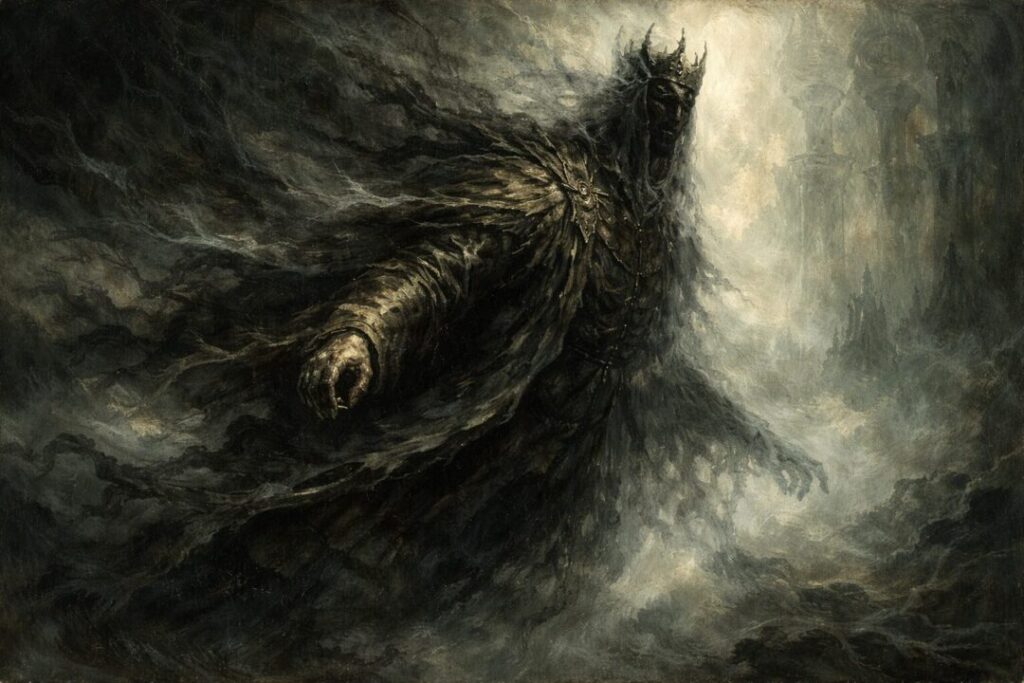
Slowly, imperceptibly, their connection to the physical world weakened. They began to fade from the Seen World and slip into the Unseen. Their bodies thinned, lost substance, and eventually vanished altogether. They did not die—but neither did they truly live.
This is Tolkien’s first and cruelest irony: immortality without presence.
The Nazgûl still existed, but no longer as whole beings. They were shadows wearing the memory of flesh.
Slavery to the One Will
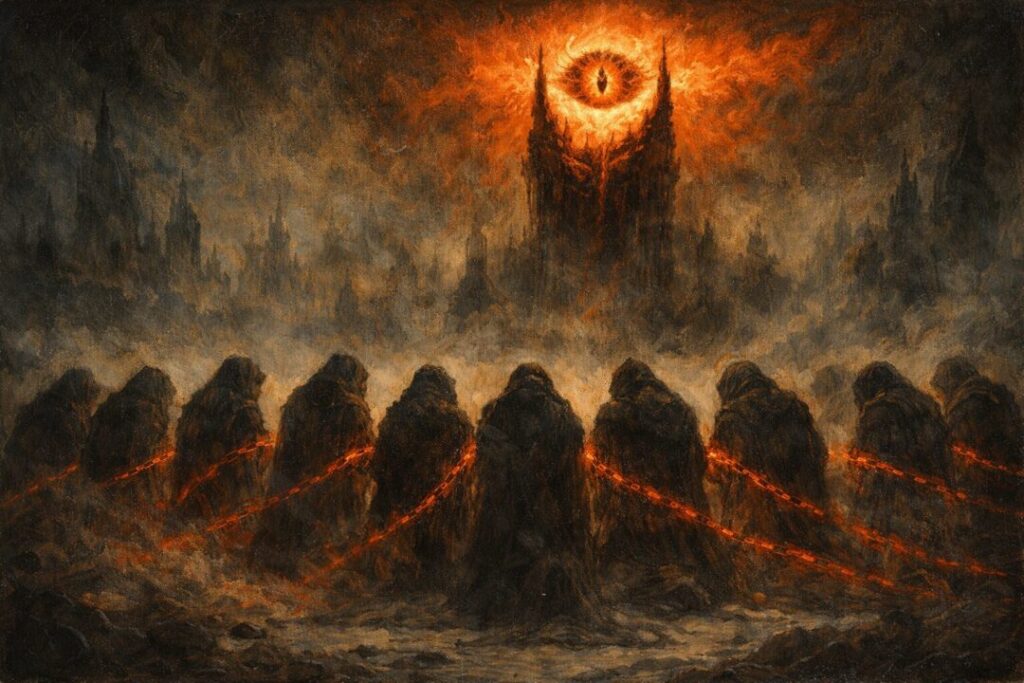
Unlike Orcs—who could scatter, rebel, or flee—the Nazgûl had no autonomy whatsoever. Their Rings bound them directly to the One Ring, and through it, to Sauron himself.
Tolkien is explicit on this point: when Sauron’s power grew, the Nazgûl grew stronger. When it diminished, they weakened. Their existence rose and fell entirely with his.
They were not allies. They were not partners. They were extensions of his will.
This is why they act with such singular purpose. They do not debate, hesitate, or interpret orders creatively. They pursue, hunt, and dominate exactly as they are directed. Even their fear—especially of fire and light—is not merely instinct, but a reflection of Sauron’s own vulnerabilities.
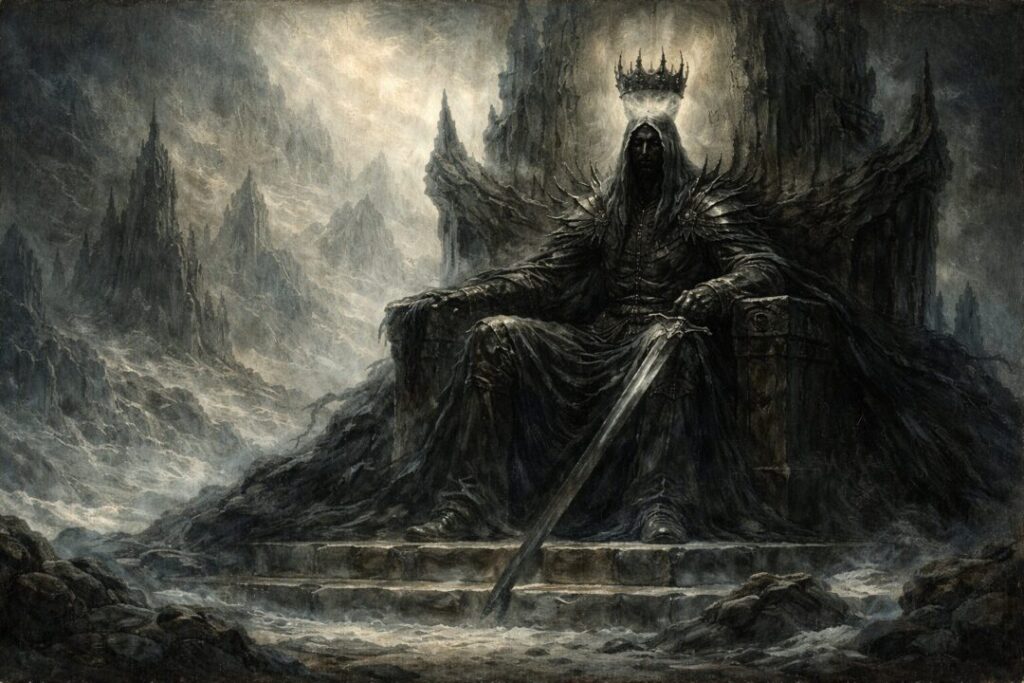
The most feared among them, the Witch-king of Angmar, is often mistaken for an independent ruler. Yet even at the height of his power, when he destroyed Arnor and ruled Angmar for centuries, he did so not as a sovereign, but as a lieutenant.
Every victory tightened his chains. Every conquest deepened his enslavement.
Power That Hollowed Them Out
From the outside, the Nazgûl appear terrifyingly powerful. Their presence inspires dread. Their cries freeze hearts. Their weapons wound beyond healing. But Tolkien makes clear that this power is not their own.
They do not create. They do not build. They do not govern wisely. They cannot even maintain realms once Sauron withdraws his attention. Angmar collapses. Dol Guldur empties. Wherever the Nazgûl rule, nothing endures.
Why? Because domination does not nourish life. It consumes it.
The Nazgûl are powerful only insofar as fear exists around them. Fear sustains them—and imprisons them. They are strongest among the weak, the despairing, the hopeless. Against courage, humility, and light, they falter.
Fear Sustains, Fear Destroys
One of Tolkien’s most unsettling insights is that the Nazgûl, who embody terror, experience terror more keenly than mortals.
They dread fire. They recoil from sunlight. They are diminished by the presence of Elves and by names of power spoken with authority. These are not tactical weaknesses; they are spiritual wounds.
The Nazgûl exist in a constant state of anxiety. Their existence is not confident or assured. It is brittle, dependent, and reactive.
This truth is revealed most clearly during the Battle of the Pelennor Fields. The Witch-king, who believes himself invincible, is undone not by superior force, but by defiance. When confronted by Éowyn, who stands without fear or desire for domination, his power collapses.
In that moment, Tolkien exposes the lie at the heart of the Nazgûl: fear is not strength. It is weakness weaponized.
No Rest, No Redemption
In Tolkien’s legendarium, death is not a curse for Men—it is a gift. It allows the soul to leave the world, to rest, and to move beyond its wounds. The Nazgûl were denied this mercy.
Bound to their Rings, they could not leave the world even when their bodies failed. They lingered in a state Tolkien describes as worse than death: eternal unbeing.
They could not heal. They could not forget. They could not grow. If memories remained, they were only echoes—enough to sustain torment, but not enough to reclaim identity.
Tolkien never offers the Nazgûl redemption, not because redemption is impossible, but because they no longer possess the will required to seek it. They surrendered that will long ago.
This is perhaps the most tragic aspect of their fate: not damnation, but erasure.
A Warning, Not a Fantasy
The Nazgûl are not merely villains designed to thrill or terrify. They are Tolkien’s most chilling moral lesson.
They represent what happens when power is sought without restraint, when control replaces wisdom, and when ambition overrides humility. They show that domination does not elevate—it empties.
To become a Ringwraith was not to rule forever.
It was to disappear forever—while still walking the world.
And in Tolkien’s universe, there is no fate more terrible than that.
Sources & Notes
- J.R.R. Tolkien, The Silmarillion, “Of the Rings of Power and the Third Age” — the Nine Rings make mortal Men powerful kings, sorcerers, and warriors, but in the end enslave them as Ringwraiths under Sauron’s domination.
- J.R.R. Tolkien, The Lord of the Rings, Book I, Chapter 2, “The Shadow of the Past” — Gandalf explains that a Ring of Power can unnaturally extend a mortal life while the bearer fades into the wraith-world.
- J.R.R. Tolkien, The Lord of the Rings, Book I, Chapter 11, “A Knife in the Dark” — the Morgul-knife wound shows what the Nazgûl inflict: a living victim drawn toward wraithhood rather than ordinary death.
- J.R.R. Tolkien, The Lord of the Rings, Book II, Chapter 1, “Many Meetings” — Gandalf says Frodo nearly became a wraith under the command of the Dark Lord, clarifying the horror of the Nazgûl’s condition.
- J.R.R. Tolkien, Unfinished Tales, “The Hunt for the Ring” — Tolkien notes the Ringwraiths’ chief weapon as terror and shows their dependence on Sauron’s will, supporting the article’s reading of them as enslaved instruments rather than free rulers.