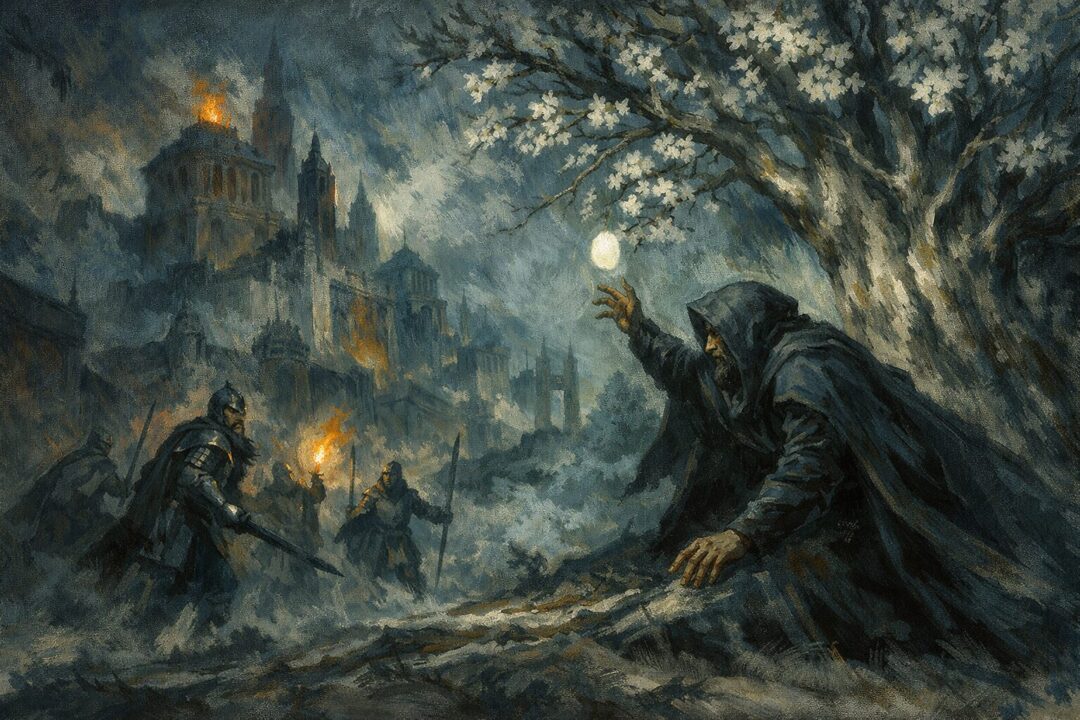
Most people remember one object when they think about Isildur and the fall of Númenor.
The fruit of Nimloth.
The White Tree of Númenor stood in the King’s court, and the tradition around it ran deep. When Sauron turned Ar-Pharazôn further against the old ways, Nimloth was condemned. Isildur learned of it, went in disguise, and took a fruit from the tree before it was cut down and burned. The line of the White Tree survived because of that act.
That is the famous part.
It is also the part that can make the larger story disappear.
Because if we ask what Isildur saved besides the White Tree seedling, the answer is not simply another single object hidden in his cloak. The deeper answer is that the fall of Númenor did not erase everything. Through Elendil and his sons, a whole inheritance crossed the Sea into Middle-earth: not only the young tree, but the heirlooms, symbols, and continuity of the Faithful. The texts are careful here. They do not say Isildur alone personally seized every treasure. But they do show that he was one of the central bearers through whom Númenor’s memory survived.
That distinction matters.
Because it changes Isildur from a man associated mainly with one fatal failure into something else as well:
a preserver.
The White Tree Was Only the Most Visible Sign
The rescue of Nimloth’s line is dramatic because it is personal.
Isildur risks death to save a living thing that carries the memory of kingship. Later, that line continues in Middle-earth. A sapling is planted at Minas Ithil, and after that tree is destroyed in Sauron’s assault, another descendant is planted in Minas Anor in memory of Anárion. The White Tree endures as a visible emblem of Gondor’s legitimacy and continuity.
But the tree is visible in a way other survivals are not.
Readers remember a tree more easily than they remember the quieter things that also came out of Númenor: the records, the heirlooms, the royal signs, the instruments of rule, and the objects that kept alive an older identity after the island was gone. In that sense, the White Tree is almost symbolic of the larger truth. It is not the whole inheritance. It is the living emblem of it.
That is why stopping at the tree gives too small a picture.
The fruit matters because it shows what kind of man Isildur was before the Ring enters his story in full. He is willing to suffer wounds for the sake of preservation. He acts not to conquer, but to save what should not be lost. The text does not frame Nimloth as a sentimental relic. It is bound up with lineage, legitimacy, and the endurance of the Faithful under mounting corruption.
What Else Came Out of Númenor
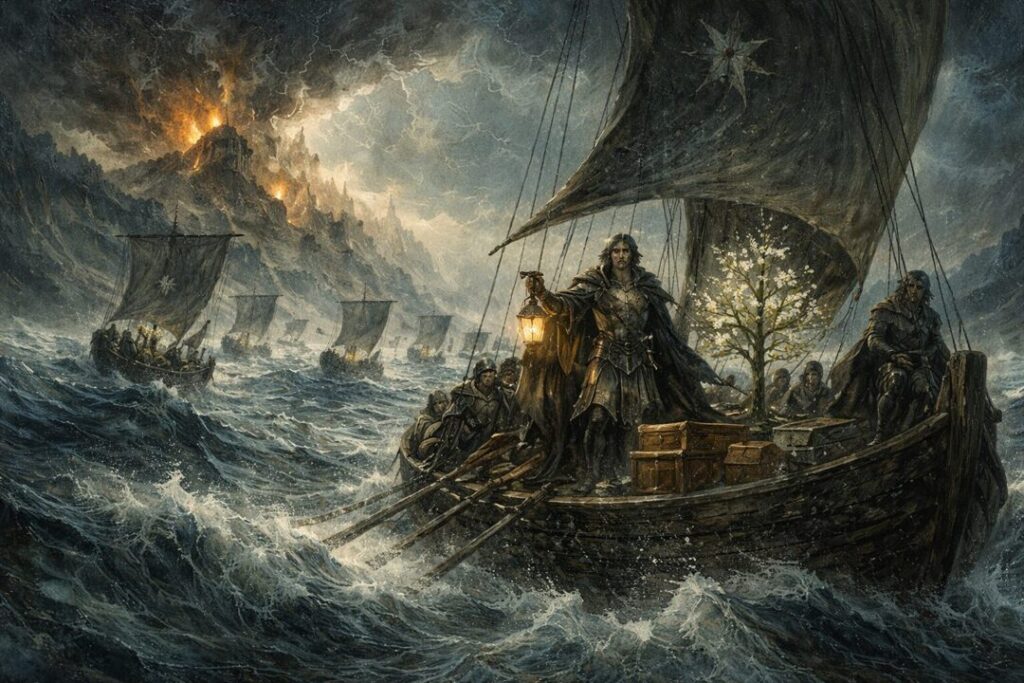
When the Downfall comes, the sources describe the exiles bringing out many beautiful and powerful things from Númenor, including the Seven Stones and the young tree. Later summaries of the tradition also identify the great heirlooms that survived with Elendil’s house: the palantíri, Narsil, the Ring of Barahir, and the sceptre traditions that passed into the northern line.
This is where careful wording matters.
It is true that these things survived the Downfall.
It is true that they survived through Elendil and his sons.
It is not always textually safe to say that Isildur alone personally rescued each one with his own hands.
The palantíri, for example, are associated with the house of Amandil and then with Elendil and his sons as the exiles flee. Later tradition divides them between north and south: three with Elendil in Arnor, and four with Isildur and Anárion in Gondor. That means Isildur is absolutely part of their preservation, but the texts present them as heirlooms carried out by the exile leadership as a whole, not as one secret theft parallel to Nimloth.
The same is true of Narsil.
Narsil survives the Downfall with Elendil, is broken beneath him in the war against Sauron, and passes on in shards until it is reforged as Andúril. Isildur does not save Narsil from Númenor in the same individualized way he saves Nimloth’s fruit, but he stands within the chain by which that sword survives the island’s destruction and enters the later history of Middle-earth.
The Ring of Barahir also remains in the inheritance of Elendil’s house and later appears among the heirlooms of the northern line. Again, not a personal rescue scene belonging to Isildur alone, but part of the same preserved inheritance that escapes the drowning of Númenor.
So the honest answer is larger than a list and narrower than a myth.
Isildur saves the fruit of Nimloth personally and explicitly.
He also helps carry forward the surviving inheritance of Númenor as one of the exiled heirs through whom its treasures, authority, and memory endure.

He Also Preserved the Line of the Realms in Exile
There is another answer, and in some ways it may be the most important one.
Isildur helps save not just objects, but continuity.
When Númenor falls, the island kingdom is gone forever. But the Faithful do not vanish. Elendil and his sons arrive in Middle-earth and establish the Realms in Exile: Arnor in the north and Gondor in the south. That political and dynastic continuation is not a minor aftermath. It is the survival of Númenor’s lawful tradition in altered form.
This is easy to underrate because kingdoms are less tangible than heirlooms.
A tree can be planted.
A sword can be held.
A stone can be set in a tower.
But the larger rescue is that the line is not broken.
The house of Elendil survives.
Its symbols survive.
Its claims survive.
Its memory survives long enough that centuries later Aragorn can still be understood as heir to something real rather than as a romantic invention from a dead past.
In that sense, Isildur is not only preserving the past.
He is preserving the possibility of return.
Without that survival, there is no White Tree in Gondor, no shards of Narsil in the north, no inherited tokens of kingship waiting through the long decline of the Third Age. The restoration at the end of The Lord of the Rings depends on the fact that something authentic endured all the way back to the cataclysm.
Why the Text Does Not Reduce This to One Object
Part of the reason people miss this is that the story gives Isildur two very different narrative shapes.
In the fall of Númenor, he is a rescuer.
At the end of the Second Age, he becomes the man who keeps the Ring.
The second image overwhelms the first.
He cuts the Ring from Sauron’s hand after Elendil and Gil-galad overthrow him. Later, he writes the account of the Ring in Minas Tirith. Then he dies in the Disaster of the Gladden Fields, and the Ring is lost in the river. That later failure is so consequential that it tends to swallow the earlier pattern of preservation.
But the two halves belong together.
Isildur is one of the more tragic figures in the legendarium precisely because the texts do not make him simple. He is not a villain wearing the mask of a hero. Nor is he an untarnished hero ruined by one random mistake. He is a man capable of genuine courage, loyalty, and preservation, who later fails at a moment of terrible moral testing.
That earlier courage should not be erased by the later failure.
And the later failure should not make us romanticize him beyond what the texts support.
The balance is what matters.
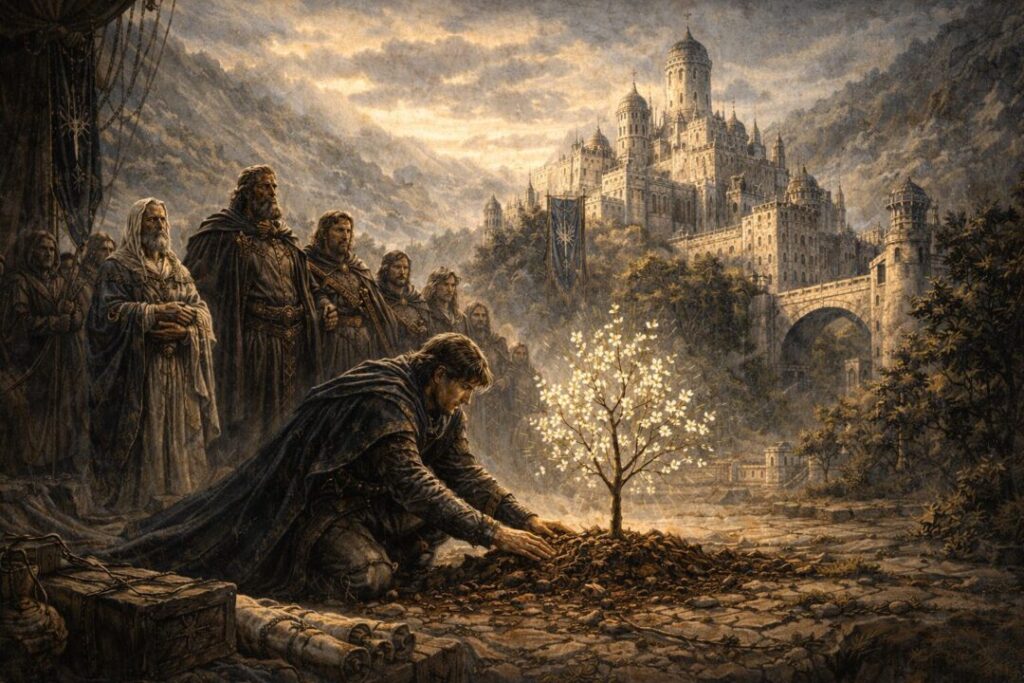
The Seedling Was a Sign of Something Larger
So what did Isildur save besides the White Tree seedling?
Not one neat relic hidden behind the better-known answer.
He helped save the surviving inheritance of Númenor.
He stands among those through whom the heirlooms of the Faithful crossed into Middle-earth.
He helped preserve the dynastic and political continuity that became Arnor and Gondor.
He carried forward the memory of a drowned civilization so that it did not end in the sea.
The White Tree matters because it lets us see that inheritance in living form.
A tree can die and rise again through its line.
A kingdom can fall and still remain through memory, symbols, law, and blood.
A world can drown and still leave behind enough for renewal.
That is why the fruit of Nimloth is not merely a beautiful anecdote.
It is the clearest sign that when Númenor died, not everything was lost.
And once that becomes visible, Isildur begins to look less like the man remembered only for refusing to cast one thing away and more like one of the last guardians of everything that still endured after the sea closed over the West.
Sources & Notes
- J.R.R. Tolkien, The Silmarillion, "Akallabêth" — Isildur’s perilous rescue of a fruit of Nimloth before the White Tree is destroyed.
- J.R.R. Tolkien, The Silmarillion, "Akallabêth" — Elendil and his sons escape the Downfall with the Faithful and carry Númenórean continuity into Middle-earth.
- J.R.R. Tolkien, The Lord of the Rings, Appendix A, "The Númenórean Kings" — the Realms in Exile, Arnor and Gondor, preserve the royal line and authority of Elendil’s house.
- J.R.R. Tolkien, Unfinished Tales, "The Palantíri" — the Seven Stones are brought from Númenor and later divided among the northern and southern realms.
- J.R.R. Tolkien, The Lord of the Rings, Appendix A and Book II, Chapter 2, "The Council of Elrond" — Narsil’s shards, Isildur’s record of the Ring, and the heirlooms of Elendil’s line frame his later legacy.