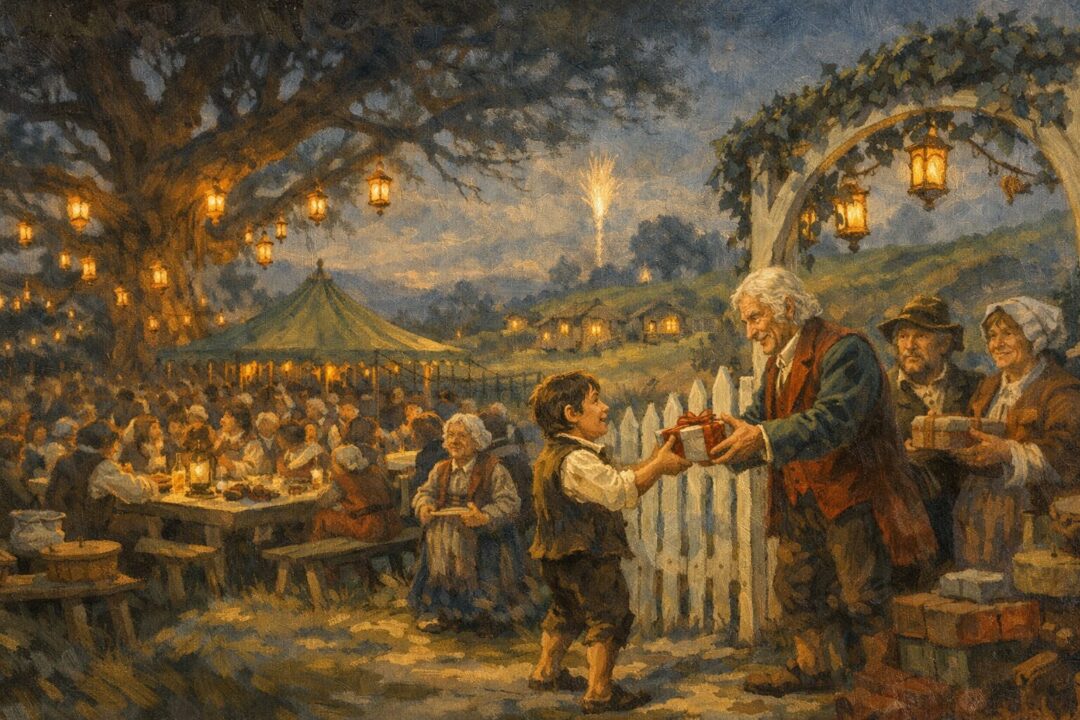
When The Fellowship of the Ring opens, the Shire looks almost absurdly gentle.
There is food everywhere.
There are fireworks over Hobbiton.
There is gossip, family politics, and a field full of guests who mostly want to eat, talk, and collect presents.
It is easy to treat all of this as scene-setting.
A charming pause before the real story begins.
But the opening chapter is doing something far more precise than that.
Because birthdays in the Shire are not presented as minor personal occasions.
They carry social force.
Bilbo’s party is not only a celebration.
It is also a handover.
And once that becomes visible, the whole chapter changes shape.
A Birthday in the Shire Is Never Just a Birthday
The first clue is plain, but easy to rush past.
Bilbo and Frodo share the same birthday: September 22.
That is convenient in a practical sense, and Bilbo even jokes about celebrating together.
But the text gives the date more weight than convenience alone.
On that day, Frodo turns thirty-three.
For hobbits, that is the age of coming of age.
So Frodo is not merely one year older.
He is crossing into recognized adulthood.
Bilbo says so openly in his speech.
Frodo comes of age and into his inheritance on that day.
That matters.
The chapter frames the birthday as a moment in which family position, legal transition, and public recognition all meet in one place.
In other words, the party is festive on the surface, but structurally it is also ceremonial.
Not in a solemn or royal way.
In a Hobbit way.
Which may be even more revealing.
The Gift Custom Is Stranger Than It Looks
Most readers remember the detail that hobbits give presents to other people on their own birthdays.
It sounds funny.
Almost backwards.
The narrator even says it was “not a bad system,” and immediately makes it feel ordinary within Hobbiton and Bywater, where birthdays were frequent enough that presents circulated constantly.
At first, that seems like one more cozy local custom.
But it has deeper implications.
A society that expects the birthday-person to give does not treat a birthday mainly as a day of receiving attention.
It treats the day as an occasion for renewing ties.
The celebrant becomes a center of distribution.
That does not mean every gift is emotionally profound.
The text is too amused, and too realistic, for that.
Some of the gifts are excellent.
Some are jokes.
Some are cutting.
Some are probably half-regifted clutter.
But the important point is that the custom moves goods outward from the birthday-person into the community.
That alone tells us birthdays in the Shire are socially active events, not passive ones.
The Later Explanation Makes the Pattern Clearer
A later explanation of Hobbit birthday customs fills in what the chapter itself leaves implicit.
It says birthdays in the Shire had considerable social importance.
The birthday celebrant had a specific name.
The customs were regulated by fairly strict etiquette.
And on birthdays, the celebrant both gave and received presents.
That is important because it prevents a shallow reading.
The custom is not just “Hobbits are quirky and like giving presents.”
It belongs to a social structure.
The explanation links the receiving of gifts to kinship and family recognition, and the giving of gifts to friendship, service, and personal ties.
So a birthday, at least in the Shire, appears to sit at the intersection of family membership and social obligation.
That makes Bilbo’s enormous party feel less random.
He is not merely being generous because he is rich.
He is acting inside a custom that already connects birthdays with belonging, exchange, and acknowledged relationships.
Bilbo simply does it on an extravagant scale.
Bilbo’s Party Is a Public Transfer Disguised as Festivity
This is where the chapter becomes much more interesting.
Bilbo’s party is obviously a farewell.
That much is impossible to miss.
But it is also a carefully staged transfer.
Frodo comes of age that day.
Frodo enters his inheritance that day.
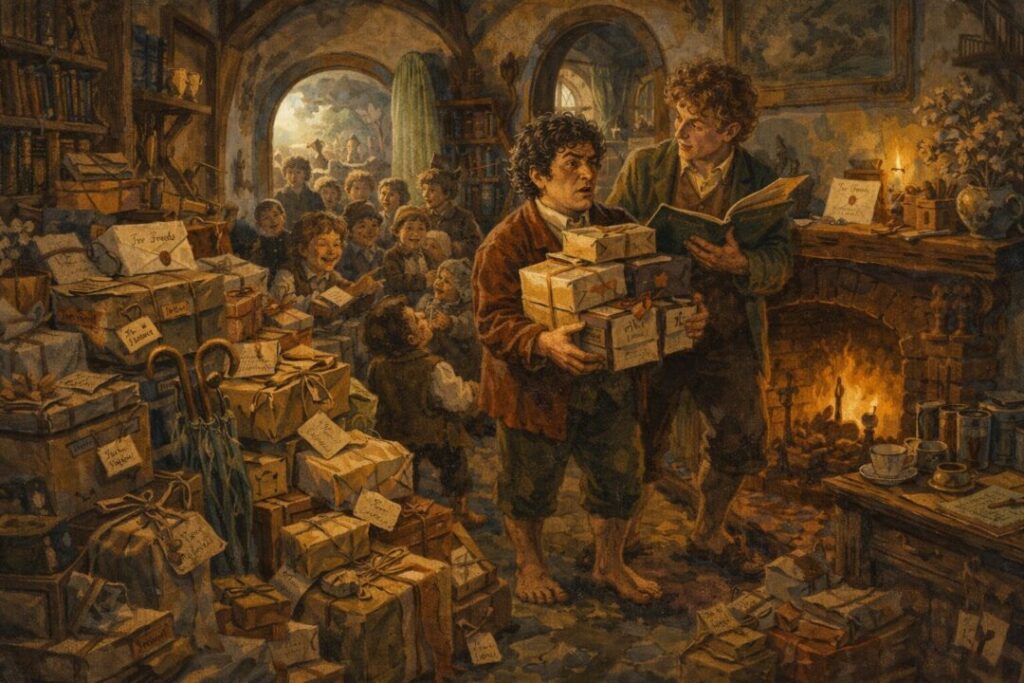
Bilbo has prepared labels, parcels, instructions, and legal papers.
He leaves Bag End to Frodo.
And he tries to leave the Ring to him as well.
None of that is accidental.
The party gathers the right people.
It sets a social frame everyone understands.
It makes giving normal.
It makes distribution expected.
It even gives Bilbo a reason to scatter goods everywhere without seeming suspicious.
Then Bilbo says something astonishing.
He admits that the party business was really about giving away lots of birthday-presents, and somehow making it easier to give it away at the same time.
That line changes the whole chapter.
Because now the Hobbit custom is not only background.
It becomes cover.
Bilbo is using a familiar Shire ritual of outward giving to help himself surrender the one thing he most does not want to part with.
The Ring enters the logic of birthday exchange.
Not because it belongs there.
But because Bilbo needs it to.
That Makes the Chapter Darker Than It First Appears
The opening of The Fellowship is often remembered as warm, funny, and slow.
And it is.
But the birthday material also introduces a sharp contrast that runs through the entire legendarium: ordinary good customs can be bent toward carrying terrible burdens.
Bilbo is not corrupting the custom.
He is leaning on it.
That distinction matters.
The birthday system itself is generous, communal, and in some ways anti-hoarding. Presents move. Objects pass from hand to hand. Even mathoms circulate through it.
The Ring is the exact opposite.
It clings.
It isolates.
It resists transfer.
It turns possession inward and obsessive.
So the birthday chapter quietly stages a collision between two moral worlds.
On one side is Hobbit custom, which normalizes giving things away.
On the other is the Ring, which makes Bilbo recoil from surrender.
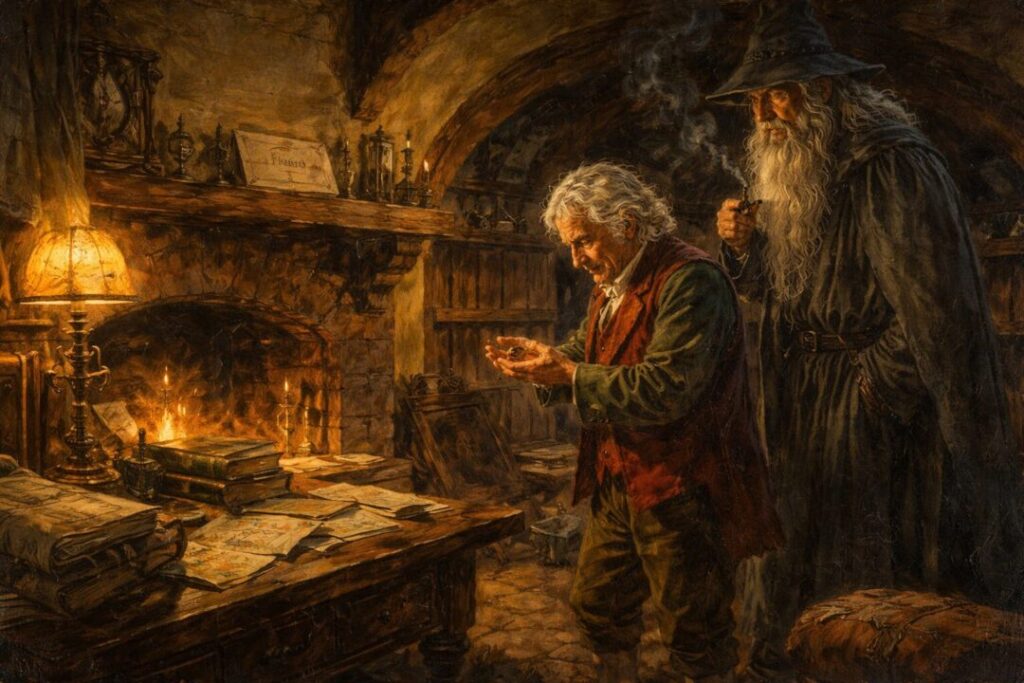
That is why Gandalf’s exchange with Bilbo matters so much.
Bilbo wants the social machinery of the party to carry the burden for him.
But in the end, even that is not enough.
He still hesitates.
His hand jerks back.
He still has to be pressed into letting the Ring go.
The custom helps.
It does not solve the problem.
Even the Mathoms Matter
The chapter goes out of its way to mention clutter.
Hobbit-holes tend to fill up with mathoms, and the text explicitly says the custom of giving so many birthday-presents was largely responsible.
Some presents were old mathoms that had been circulating around the district for ages.
That detail is comic.
But it also matters.
A mathom is a sign of a culture where objects are not always valued for pure utility.
They carry memory, connection, habit, and local history.
Things are kept.
Things are passed on.
Things mean more because they have belonged.
That makes Bilbo’s final distribution even more pointed.
He is not only emptying a house.
He is unwinding a life in material form.
And he does it through the very custom that has, over time, helped clutter the Shire with the physical traces of relationship.
Frodo’s Birthday Is Also His Threshold
It is easy to focus so much on Bilbo that Frodo’s position gets flattened.
But the chapter does not flatten it.
Frodo’s birthday is not ornamental.
He is coming of age.
He is becoming master of Bag End.
He is inheriting goods, standing, and eventually the most dangerous item in Middle-earth, though neither he nor most of the guests yet understand that fully.
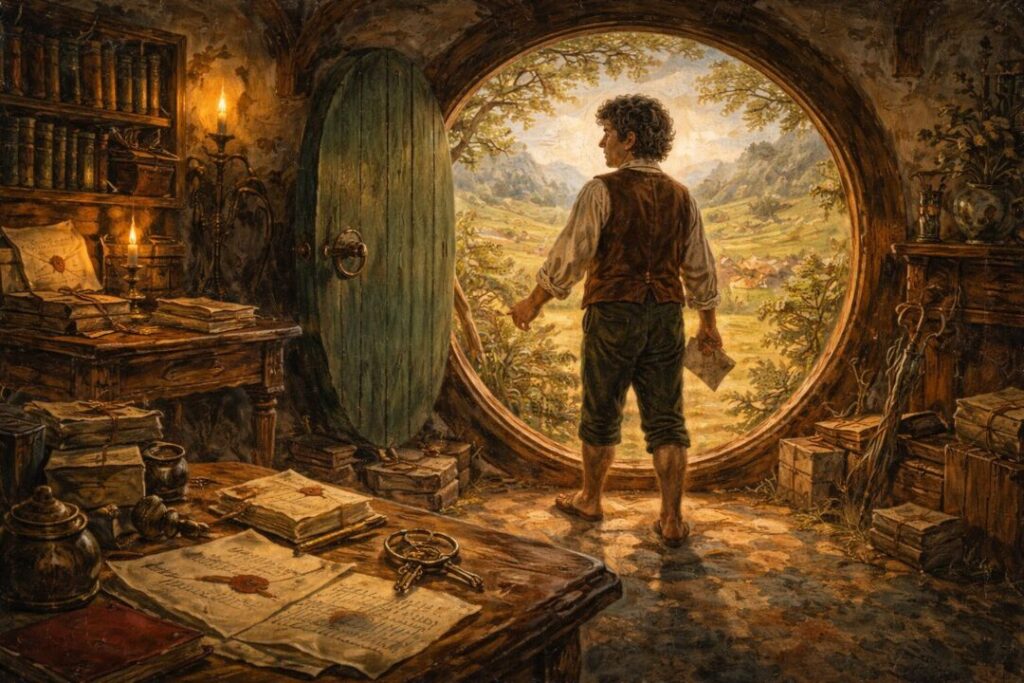
So the birthday is a threshold in a very literal way.
It marks the end of one Hobbit life in the Shire and the formal beginning of another.
That transition is partly legal.
Partly familial.
Partly social.
And because of the Ring, it is also the opening move of the entire War of the Ring story.
Without the birthday framework, the handover would feel abrupt.
Within it, the handover feels almost natural.
That is precisely what makes it so effective.
The Shire Is More Structured Than It Looks
One of the quiet achievements of the opening chapters is that they make the Shire feel warm without making it shapeless.
Hobbit life is not random comfort.
It has rules.
Expectations.
Inherited forms.
Legal habits.
Family memory.
Ceremonies that do not look like ceremonies until you look twice.
Birthdays belong to that structure.
They are playful, yes.
But they also reveal how the Shire holds itself together.
A child grows.
A cousin inherits.
A host gives.
A family recognizes.
A neighborhood receives.
A public feast turns private bonds into visible action.
That is why the opening chapter can afford to look so easy.
Underneath the jokes and the fireworks, it is laying down the social grammar of the Shire.
Why This Matters More Than It First Seems
The deeper point is not simply that Hobbits have unusual birthdays.
It is that the story uses those birthdays to show what kind of people Hobbits are before the larger powers of the world close around them.
They are people of custom.
Of kinship.
Of exchange.
Of small rituals that keep life ordered and humane.
That is exactly why Bilbo’s party matters so much.
He is not only leaving.
He is passing from one place in that order to another, and drawing Frodo across the same threshold.
And he does so in the most Hobbit way possible:
through a birthday.
Which means the first major transfer of the Ring in The Lord of the Rings does not happen in a council chamber, on a battlefield, or in a hidden rite.
It happens under lanterns, over food, among relatives, inside a custom built for gifts.
That is not a decorative detail.
It is the point.
The Shire’s birthdays matter because they reveal that what looks small in Middle-earth is often carrying far more than it seems.
Sources & Notes
- J.R.R. Tolkien, The Lord of the Rings, Book I, Chapter 1, “A Long-expected Party” — Bilbo and Frodo’s shared birthday, Frodo’s coming of age, the party gifts, and Bilbo’s handover of Bag End and the Ring.
- J.R.R. Tolkien, The Lord of the Rings, Prologue, “Concerning Hobbits” — the Shire background on mathoms, gift-giving, and the everyday customs that make birthday exchange feel socially normal.
- J.R.R. Tolkien, The Letters of J.R.R. Tolkien, Letter 214 — Tolkien’s fuller explanation of Hobbit birthday etiquette, including the birthday-person’s giving and receiving of presents.
- J.R.R. Tolkien, The Lord of the Rings, Book I, Chapter 2, “The Shadow of the Past” — Gandalf’s explanation of the Ring’s hold on its bearers and why Bilbo’s attempted surrender matters beyond ordinary gift-giving.