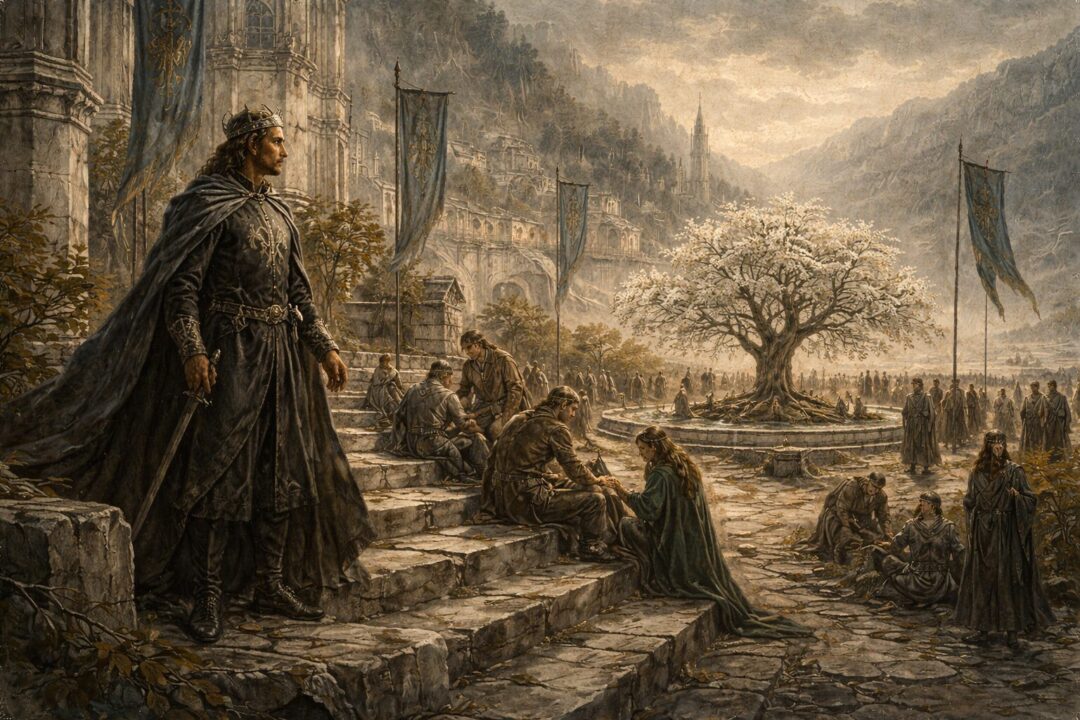
When people think about the end of the War of the Ring, they usually remember the visible signs of triumph.
The Ring is destroyed. Barad-dûr falls. Aragorn is crowned. Peace returns to Gondor. The Shadow is lifted from Middle-earth, and at last the long struggle against Sauron is over.
All of that is true.
But the ending of The Lord of the Rings is not written as if victory erases damage. In fact, the closer the story gets to its conclusion, the more careful it becomes about showing the opposite.
The war is won.
And yet the people and places that bore its weight do not emerge untouched.
That is one of the deepest things the ending reveals. The price of victory in Middle-earth is not only paid on the battlefield. It is paid afterward, in weariness, departure, fading, and the quiet knowledge that even a just triumph does not restore the world exactly as it was before.
Frodo Is the Clearest Measure of the Cost
No character shows this more plainly than Frodo.
On the surface, he survives. He reaches Mount Doom. The Ring is destroyed. He is honored at Cormallen and welcomed home. In the simplest possible telling, that sounds like a completed heroic arc.
But the text does not leave him there.
Instead, it quietly makes clear that survival is not the same thing as restoration.
After the journey, Frodo continues to suffer from the old wound he received at Weathertop. He also falls ill on the date linked to Shelob’s attack. Appendix B is very precise about this pattern, and later summaries of Frodo’s life note that these hurts continue to trouble him long after the Ring is gone.
That matters because the story is not treating his suffering as temporary.
It is showing that some wounds in Middle-earth are not fully healed by winning. The destruction of the Ring saves the world from domination, but it does not simply undo what the burden of carrying it has done to the one who bore it. Letter 131 is especially direct on this point: Frodo “cannot be healed” in Middle-earth because of what he has spent in saving the Shire.
This is why the ending at the Grey Havens is not a decorative epilogue.
It is the final statement of the cost.
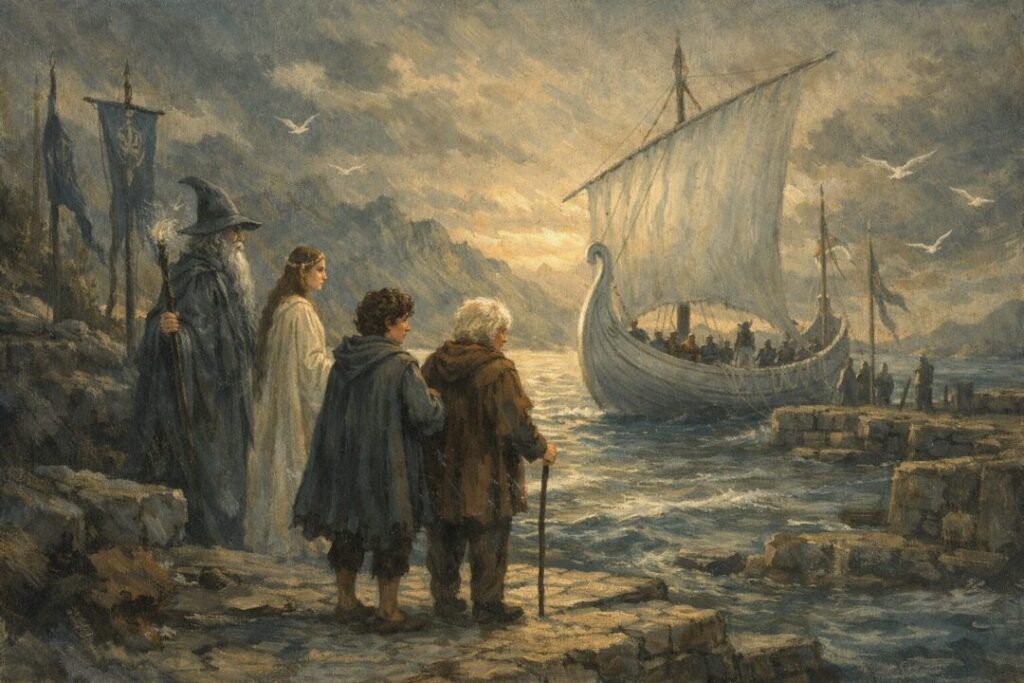
Frodo’s departure is not a reward in the ordinary sense. It is an act of mercy toward someone who has carried more than he can continue carrying within the ordinary life of the Fourth Age. Later letters explain that for mortals such a passage west does not grant immortality. It offers a limited sojourn of peace and healing.
So the war ends with the world saved.
But its chief bearer cannot simply stay and enjoy the peace he purchased.
That is not a side note to the ending.
It is one of the ending’s central truths.
The Shire Is Saved, but Not Spared
A second cost appears in the return home.
Many readers remember the great battles of Rohan and Gondor as the true war, and treat the Shire as the untouched homeland waiting at the end. But the story refuses that comfort.
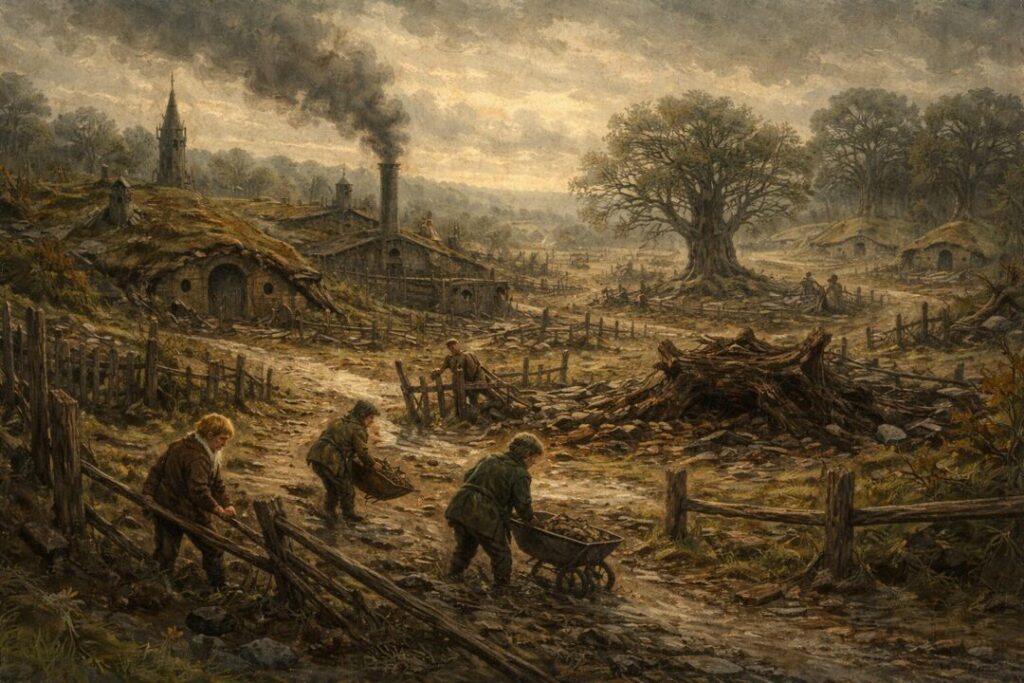
When the hobbits come back, the Shire has not been preserved in perfect innocence. It has been occupied, degraded, and reshaped by petty tyranny. The Party Tree is destroyed. Ugly mills and needless damage mark places that once stood for peace and continuity. Even Bag End has been seized.
This is one of the most important choices in the whole book.
The war does not stay far away.
It reaches home.
And that means victory cannot simply mean “returning to things as they were.” The hobbits must fight again, this time not for distant kingdoms or the fate of the world, but for their own fields, roads, homes, and trees. The Battle of Bywater makes that explicit: the Shire is capable of defense, but only after it has already been wounded.
Even the healing that follows confirms the same pattern.
Sam helps restore what has been broken, and the renewed beauty of the Shire is real. But restoration is not the same as untouched innocence. The old Party Tree is gone. What comes after it is beautiful, but it belongs to a world that has passed through loss.
That is the point.
The Shire survives.
But it survives as something tested, scarred, and changed.
The Elves Win, and Then Begin to Leave
The cost of victory is not only personal and local. It is civilizational.
The defeat of Sauron does not preserve the elder world of Middle-earth. In an important sense, it brings that world to its end.
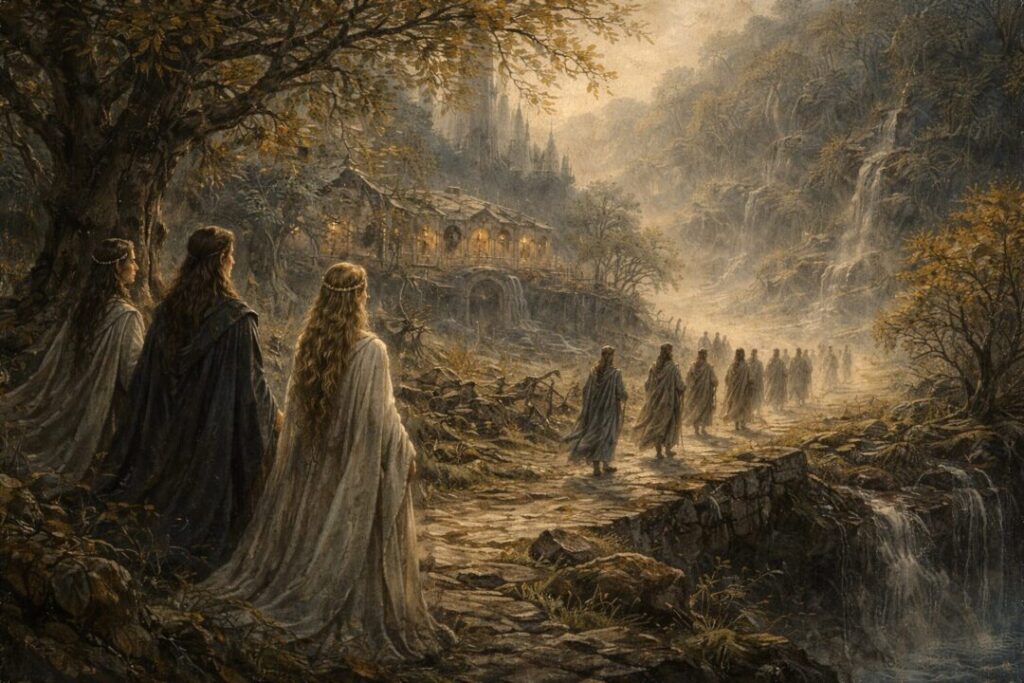
The destruction of the One Ring also causes the power of the Three Rings to fail. Tolkien Gateway’s summaries of the canonical material are consistent here: once the One is destroyed, the preserving work done through the Three cannot continue in the same way. The places sustained by Elven power are no longer held against time as before.
That means victory over Sauron comes with a quiet surrender.
Rivendell, Lórien, and the kind of preserved Elvish beauty they represented do not remain as permanent features of Middle-earth after the war. The Keepers of the Three depart, and the Third Age closes with them. The Fourth Age begins as the Dominion of Men.
This is sometimes flattened into a simple slogan that “magic leaves the world.” That phrasing is broader than the texts themselves, so it is better to be careful. What the canon clearly supports is that the age shaped by the Eldar and maintained in part through the Three Rings is ending, and many of the Elves who remain eventually pass over Sea.
So the victory is real.
But it is also a farewell.
Middle-earth is freed from Sauron, yet it loses much of the older beauty that made it what it had been. The world after the war is not false or lesser in a moral sense. Aragorn’s reign is a true renewal. But it is narrower, more mortal, and more historical. It belongs to Men.
Even the Restoration of Men Comes Through Loss
Aragorn’s kingship is one of the great triumphs of the ending.
The line of the kings is restored. Gondor and Arnor are reunited. Peace is made with former enemies. Lands are reordered. Even regions long broken or neglected begin to revive under the Reunited Kingdom.
But even here the story does not present renewal as costless.
Aragorn’s age begins not in innocence but in aftermath. The kingdoms of Men are restored only after terrible losses: Théoden is dead, Denethor is dead, Boromir is dead, and countless unnamed lives have already been spent. Faramir and Éowyn survive, but both pass through grievous hurt before healing comes.
That is worth noticing because the story consistently refuses cheap triumph.
The return of the king does not mean the story pretends no one paid for it. Rather, the restored kingdom is founded in part on endurance, burial, grief, and mercy shown after war. Aragorn pardons surrendered enemies and orders the world toward peace, but he does so as someone inheriting a wounded age, not an untouched one.
The new era is good.
It is also purchased.
Bilbo’s Ending Quietly Confirms the Same Pattern
Bilbo’s presence at the Grey Havens often passes too quickly in discussion, but it strengthens the same idea.
He, too, is a Ring-bearer. He, too, is allowed to pass West by special grace. And later explanations make clear that this grace does not undo mortality. It is not elevation into immortality. It is peace granted to one who has carried a burden that marked him.
Bilbo does not leave Middle-earth in triumphal splendor.
He leaves as someone old, tired, and near the end of his natural life.
That matters because it keeps the moral center of the ending exactly where it belongs. The Ring-bearers are not repaid with domination, glory, or escape from creaturely limits. They are shown mercy. That is a very different thing.
Why the Ending Feels So Much Sadder Than a Simple Victory
This is why the ending of The Lord of the Rings lingers the way it does.
It is not built like a clean fairy-tale restoration where evil is defeated and everything returns to its earlier happiness. The story gives victory, but it gives it in a morally serious way.
The Shire is saved, but not for Frodo in the same way it might have been before. Middle-earth is saved, but not with all its older beauty still intact. The king returns, but into a world already marked by death and fading. The Ring-bearers are honored, but honor is not the same as wholeness.
That is not a contradiction in the ending.
It is the ending.
The story insists that evil can be defeated without pretending that the struggle against it leaves no wounds behind. That is exactly why the conclusion feels so deep. It understands that the highest victories are often the ones that cost the most, not in spectacle, but in what the victors cannot keep afterward.
What Victory Actually Costs
So what does victory actually cost after the War of the Ring ends?
It costs Frodo his full place in the world he saved.
It costs the Shire its innocence.
It costs Middle-earth much of the lingering Elvish beauty that had held back time and loss.
And it costs the end of an age.
That may be the most important thing to understand about the ending. The victory is not lesser because it hurts. In Middle-earth, the pain after triumph is part of what proves the triumph was real.
Sauron is overthrown.
But the world that survives him is not the same world that began the tale.
And that is precisely why the ending feels true.
Sources & Notes
- J.R.R. Tolkien, The Lord of the Rings, Book VI, Chapter 4, “The Field of Cormallen” — the Ring’s destruction, Sauron’s fall, and Frodo and Sam’s honour after the war.
- J.R.R. Tolkien, The Lord of the Rings, Book VI, Chapter 8, “The Scouring of the Shire” — the Shire’s occupation, the Battle of Bywater, and the damage that victory does not prevent.
- J.R.R. Tolkien, The Lord of the Rings, Book VI, Chapter 9, “The Grey Havens” — Frodo’s lingering wounds, the Ring-bearers’ departure, and the bittersweet close of the Third Age.
- J.R.R. Tolkien, The Lord of the Rings, Appendix B, “The Tale of Years” — Frodo’s recurring illnesses after Weathertop and Shelob, and the chronology of the Ring-bearers’ sailing.
- J.R.R. Tolkien, The Silmarillion, “Of the Rings of Power and the Third Age” — the passing of the Three Rings’ power and the fading of the Eldar’s preserved realms after the One Ring is destroyed.
- J.R.R. Tolkien, The Letters of J.R.R. Tolkien, Letter 131 — Tolkien’s own account of Frodo’s sacrifice, his inability to be fully healed in Middle-earth, and the cost of saving the Shire.