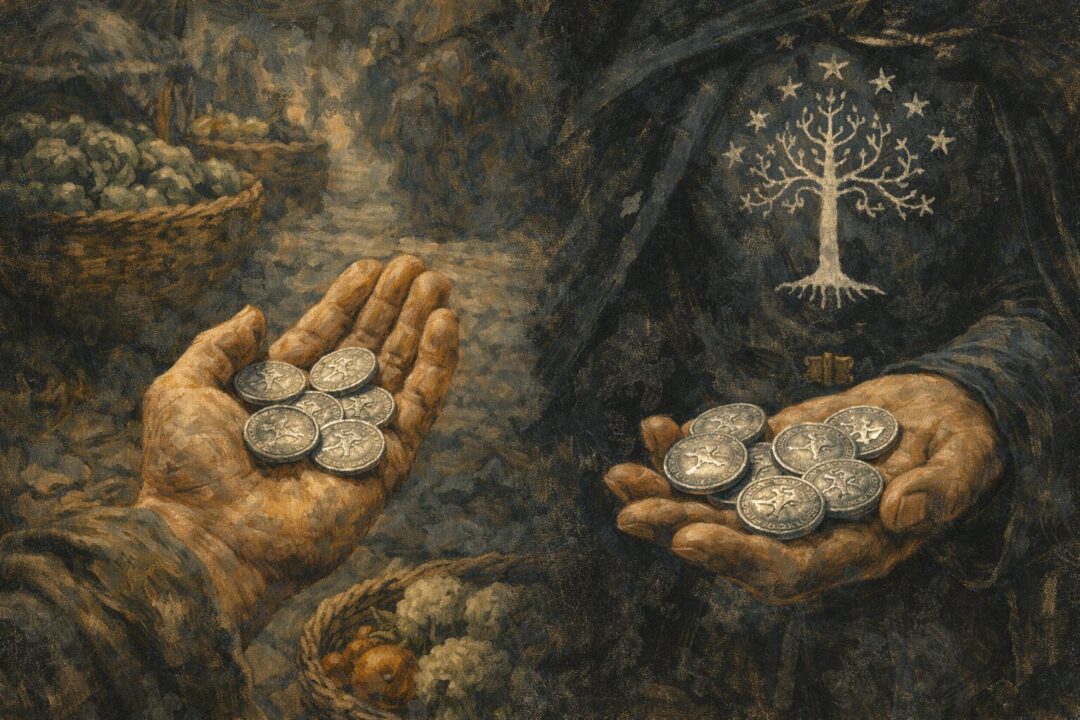
Most people imagine money in Middle-earth as treasure.
A dragon’s hoard.
A king’s ransom.
A chest of silver hidden in a hall of stone.
But that is not how most people would have known it.
Most people would have known money as something smaller. Something handled every week, not once in an age. A coin on a counter. A payment at an inn. A price argued over in a market. A practical object, worn by use, and shaped by the place that made it.
That matters, because the texts do give us just enough to say something careful here.
Not enough to reconstruct a full economy.
Not enough to catalogue complete mint systems.
But enough to see that the Shire and Gondor almost certainly did not imagine money in the same way.
And once that becomes clear, the question changes.
It is no longer only, “Did they use coins?”
It becomes: what would those coins have felt like in the hand, and what would they have quietly said about the world that minted them?
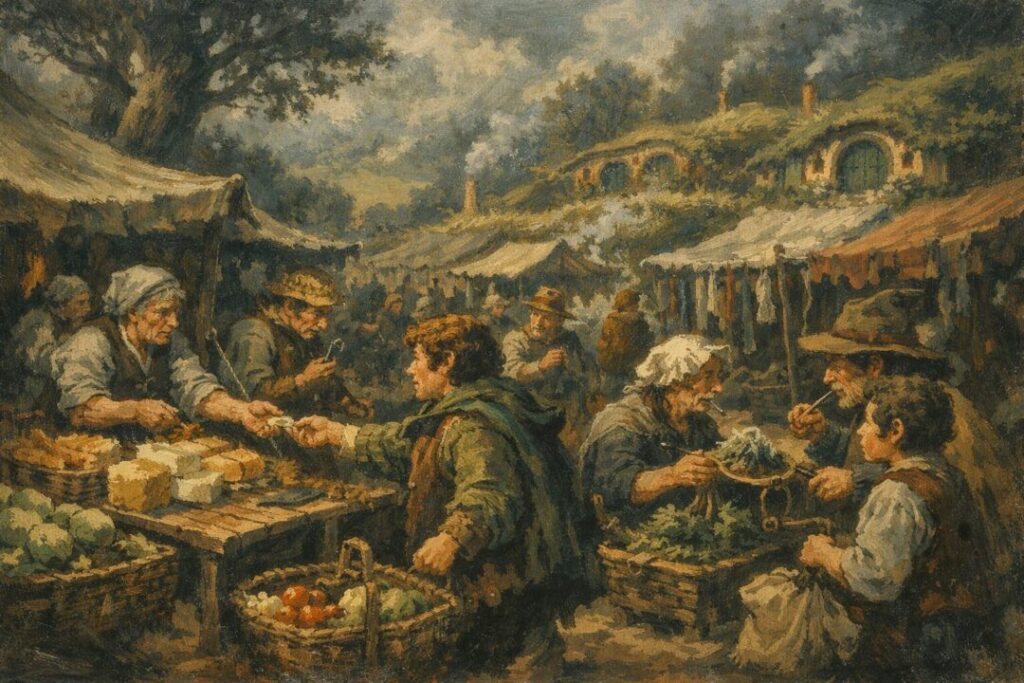
The Shire Clearly Lived in an Everyday Money Economy
The Shire is often mistaken for a place that barely needed money.
That is understandable at first glance. Hobbits are rooted in land, kinship, inheritance, meals, gardens, and local custom. Their world does not feel dominated by commerce in the modern sense. It feels stable, familiar, and slow to change.
But that is not the same thing as saying money was absent.
The Shire has small trades, workshops, fairs, inns nearby in its wider region, and a functioning messenger system. Its people buy, sell, gift, inherit, and store goods. In other words, it has exactly the sort of local life in which coin would be ordinary rather than dramatic.
That is important.
Because when readers think “money in Middle-earth,” they often jump straight to treasure. The Shire reminds us that most wealth is not treasure at all. Most wealth is practical. It moves through households, fields, brewing, milling, pipe-weed, cloth, tools, livestock, and all the small exchanges that hold a society together.
So while the texts never give us a formal Shire mint described in detail, they do make a money-using society hard to deny.
The Shire was not a realm beyond coin.
It was a realm where coin was probably too ordinary to attract much notice.
The Quiet Clue of the Silver Penny
The strongest practical clue comes not in a grand hall, but on the road.
In Bree, Bill Ferny’s miserable pony is bought for twelve silver pennies, and the text makes clear that this was an inflated and unfair price. That small detail does more work than it first appears to.
It tells us several things at once.
First, silver pennies are intelligible currency in the northwestern world through which the hobbits are moving. Second, prices can be judged against ordinary value, which means there is some shared sense of what things usually cost. Third, even fairly modest sums matter. When Barliman Butterbur later loses thirty silver pennies in the affair, it is treated as a real financial blow, even for a man considered well-off.
That is not the language of a world where coin barely exists.
It is the language of a lived economy.
And once silver pennies appear in that way, it becomes difficult to imagine the Shire as purely barter-based. Hobbits may have preferred familiarity over abstraction, but their world still touched measured value. A society with fairs, regular movement of goods, and nearby inns is not likely to function on goodwill alone.
So if we ask what money probably looked like in the Shire, the first honest answer is this:
Probably not exotic.
Probably not rare.
Probably silver at least in some common transactions.
And probably familiar enough that nobody bothered to explain it.
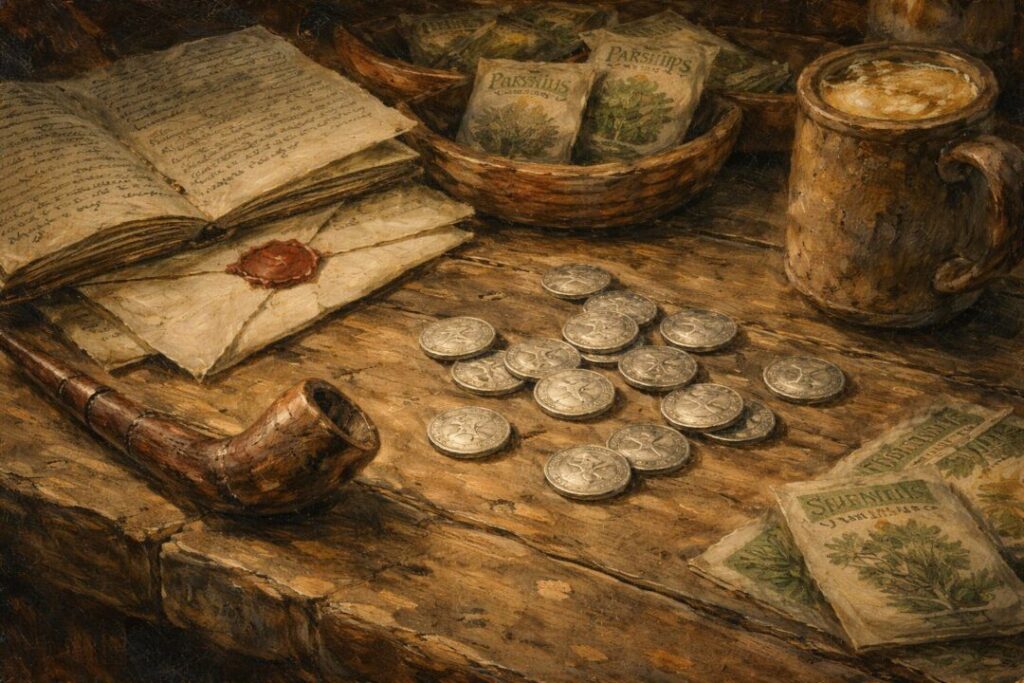
What the Shire’s Money Probably Looked Like
This is where hard canon becomes thinner, and reconstruction begins.
The texts do not give a direct description of a Shire coin’s imagery. No passage tells us what was stamped on a hobbit penny. No canonical scene lays one on a table and lingers over its design.
So anything beyond denomination and usage must be phrased carefully.
Still, the Shire’s character gives the strongest hints.
Hobbit society is local, practical, lightly governed, and not very ceremonial. Its only real official is the Mayor of Michel Delving, whose role is tied to the post and the Shirriffs more than to royal majesty. The tone of the place is domestic rather than imperial. Even the famous “Farthings” of the Shire are administrative quarters, not evidence of a coin series, though the word naturally echoes older coin-language in English.
That suggests something important.
If the Shire had locally familiar coinage, it was probably plain rather than grand. Not covered in royal portraiture. Not made to proclaim conquest. Not loaded with the visual grammar of empire.
A careful reconstruction would therefore point toward small silver pieces with simple marks: perhaps lettering, perhaps a local emblem, perhaps geometric or agricultural imagery, perhaps nothing elaborate at all.
That is still only interpretation.
But it fits the social texture of the Shire far better than a severe royal profile or a coin meant to project distant authority. Hobbits are not impressed by that sort of thing. Their world is built around usage, not display.
So the most likely Shire coin is not dazzling.
It is modest.
A coin that belongs in a market basket, a waistcoat pocket, or the till of a local trader. A coin that seems designed to work, not to awe.
Gondor Gives Us Something Firmer
With Gondor, the ground becomes more solid.
Late textual notes preserve named coinage for Gondor: the castar, also called mírian in Sindarin, as the chief currency, and the tharni or canath as a quarter of it.
That is not a vague hint.
That is actual coinage.
Immediately Gondor feels different from the Shire. More formal. More centralized. More state-shaped.
And that makes sense. Gondor is not a loose rural country of custom and small local offices. It is the greatest surviving Númenórean realm in Middle-earth, with cities, archives, heraldry, stewards, lineages, military administration, and a long memory of kingship. Even in decline, it remains a place where order is preserved through institutions.
A realm like that does not merely use money.
It mints authority into it.
That does not mean we know the exact appearance of a castar. The texts do not hand us a full visual catalogue. But Gondor’s symbolic world is much clearer than the Shire’s. The White Tree is a central emblem of the realm. The crown and stars belong to its royal tradition. Its visual language is old, noble, and public.
So when we ask what Gondorian money probably looked like, the answer can be more confident in shape, if not in exact design.
It was likely more formal than Shire coinage.
More visibly official.
More likely to bear the signs of state legitimacy and inherited rule.
Not because the text explicitly says, “the castar bore the White Tree.”
It does not.
But because Gondor’s surviving symbolic world is so coherent that state coinage would very naturally belong to it.
That remains reconstruction, not stated fact.
But it is a grounded one.
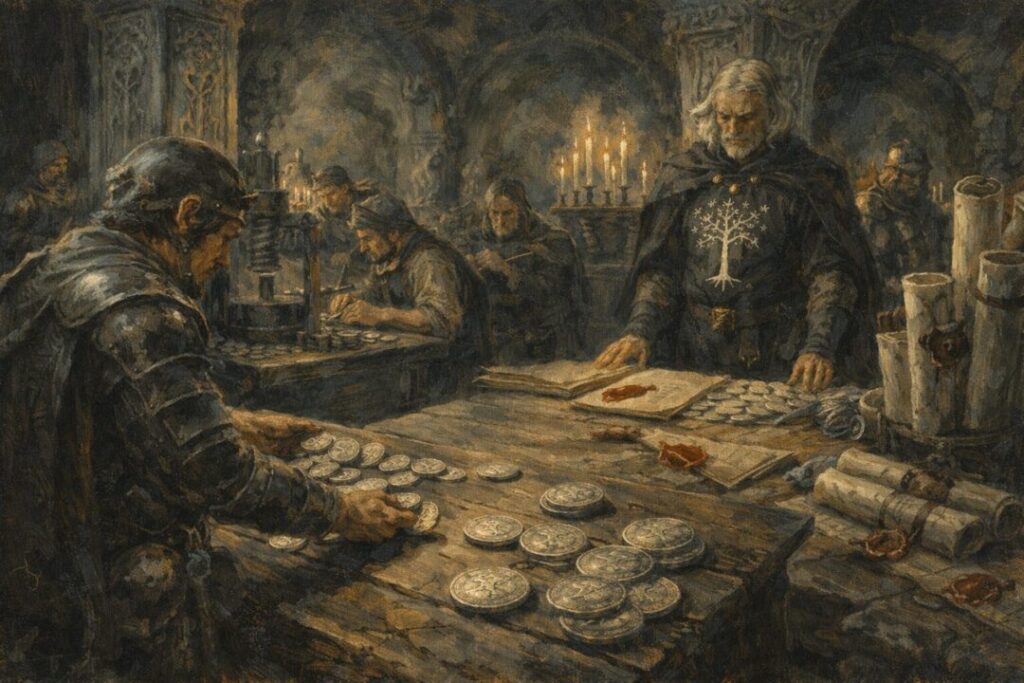
Why Gondor’s Coins Were Probably More Impressive
The difference is not only artistic.
It is political.
A Shire coin, if locally struck or locally circulated in familiar forms, would belong to a society where government was minimal and prestige was modest. Gondor’s money would belong to a realm where symbols mattered because continuity mattered. In Gondor, the image on a coin would not merely help trade. It could quietly declare that the realm still stood, the line still endured, and order had not fully failed.
That is especially important in a kingdom defined by memory.
Gondor lives amid inherited forms. Banners, lineages, towers, seals, ceremonies, and old names all carry weight there. Coinage, in such a realm, would not be culturally invisible. Even if handled every day, it would still be part of the realm’s public face.
So Gondorian money probably felt more official the moment it was seen.
Sharper edges.
Clearer marks.
A more deliberate stamp.
Less local familiarity, more state identity.
Again, the texts do not directly describe these visual details.
But they do give us the kind of kingdom in which such coinage makes sense.
The Shire and Gondor Did Not Carry Value the Same Way
This is the deeper point.
The likely visual contrast between Shire money and Gondorian money is really a contrast between two societies.
The Shire values continuity without grandeur. It preserves life through habit, kinship, appetite, and local order. Its ideal coin would fit that world by being useful, unpretentious, and unheroic.
Gondor values continuity through memory, lineage, and visible forms of legitimacy. Its ideal coin would fit that world by looking official, inherited, and unmistakably connected to the realm.
In both places, coin measures value.
But it does not symbolize value in the same way.
A Shire coin would probably say: this is enough for ordinary life.
A Gondorian coin would probably say: this belongs to an ancient order still holding.
That distinction matters because Middle-earth is never only about objects.
It is about the worlds behind them.
A sword is never just a sword.
A banner is never just a banner.
And money, where it appears, is never just payment.
It is a small piece of culture made durable.
Why the Text Leaves So Much Unsaid
There is a reason readers are left reconstructing this at all.
The great stories of Middle-earth are not economic treatises. They care far more about moral weight than fiscal systems. Coin appears when it helps root a world in reality, not because the narrative wants to inventory every mint and denomination.
But those brief details are enough.
A silver penny here.
A named Gondorian currency there.
A fair, a post, a market world in the background.
An old kingdom whose symbols survive in public life.
That is all it takes for the imagination to lock into place.
The Shire was never a realm of abstract fantasy abundance where food and goods simply appeared. Gondor was never just a backdrop of towers and trumpets with no practical exchange beneath it. Both lived in material worlds. Both had ordinary transactions beneath the epic surface.
And once that is seen, Middle-earth becomes richer.
Not because we finally know every coin.
But because we begin to feel that these places could really be lived in.
So What Did Money Probably Look Like?
In the Shire, probably small, practical silver coinage or familiar local pieces used without ceremony, ordinary enough that the text barely notices them.
In Gondor, probably more formal coinage with named denominations, tied to a realm whose identity was old enough and stable enough to stamp itself into metal.
The exact designs are not given.
That limit should be respected.
No honest reading should pretend otherwise.
But the broad contrast is there.
The Shire’s money was probably intimate.
Gondor’s money was probably official.
And that difference tells us something beautiful about Middle-earth.
Even value has a homeland.
In one place, it passes quietly between neighbors.
In another, it carries the memory of kings.
Sources & Notes
- J.R.R. Tolkien, The Lord of the Rings, Book I, Chapter 11, “A Knife in the Dark” — gives the clearest everyday coin evidence: Bill Ferny’s pony is bought for twelve silver pennies, treated as an excessive but intelligible price in the Bree-land economy.
- J.R.R. Tolkien, The Lord of the Rings, Prologue, “Concerning Hobbits” — describes the Shire’s settled local life, its Mayor, Post, and Shirriffs, supporting the article’s picture of a practical society where ordinary exchange would be unsurprising.
- J.R.R. Tolkien, The Peoples of Middle-earth, “The Rivers and Beacon-hills of Gondor” — preserves Tolkien’s late notes on Gondorian money, including the castar or mírian and the tharni/canath as a quarter denomination.
- J.R.R. Tolkien, The Lord of the Rings, Book V, Chapter 1, “Minas Tirith” — presents Gondor’s public symbols, especially the White Tree, stars, crown, and formal heraldic identity that shape the article’s cautious reconstruction of official-looking coinage.
- J.R.R. Tolkien, The Lord of the Rings, Appendix A, “Gondor and the Heirs of Anárion” — gives the historical and dynastic framework behind Gondor’s long institutional memory, useful context for why its currency would plausibly carry state authority.