
Middle-earth often feels more connected than it really is.
A warning reaches a king.
A summons crosses mountains.
News of war spreads from one realm to another.
Letters move through the Shire quickly enough for Bilbo’s birthday preparations to clog local post-offices.
Because of moments like these, it is easy to imagine that Middle-earth must have had something like a broad, functioning postal system.
But the texts suggest something much narrower.
There is no sign of one unified network serving all the Free Peoples. There is no evidence of a regular, continent-spanning institution that collects, sorts, carries, and delivers ordinary correspondence across Middle-earth as a matter of routine. What the legendarium actually shows is something more fragmented, and in some ways more interesting: local systems, state couriers, special messengers, and rare non-human carriers, all working in very different conditions.
That distinction matters.
Because if we ask what a true postal system in Middle-earth would actually require, the answer reveals something deeper about the world itself. It reveals where order exists, where it has failed, and why most of Middle-earth is far harder to connect than readers sometimes assume.
The Shire Comes Closest to a Real Mail Service
If any place in Middle-earth resembles a working civilian postal system, it is the Shire.
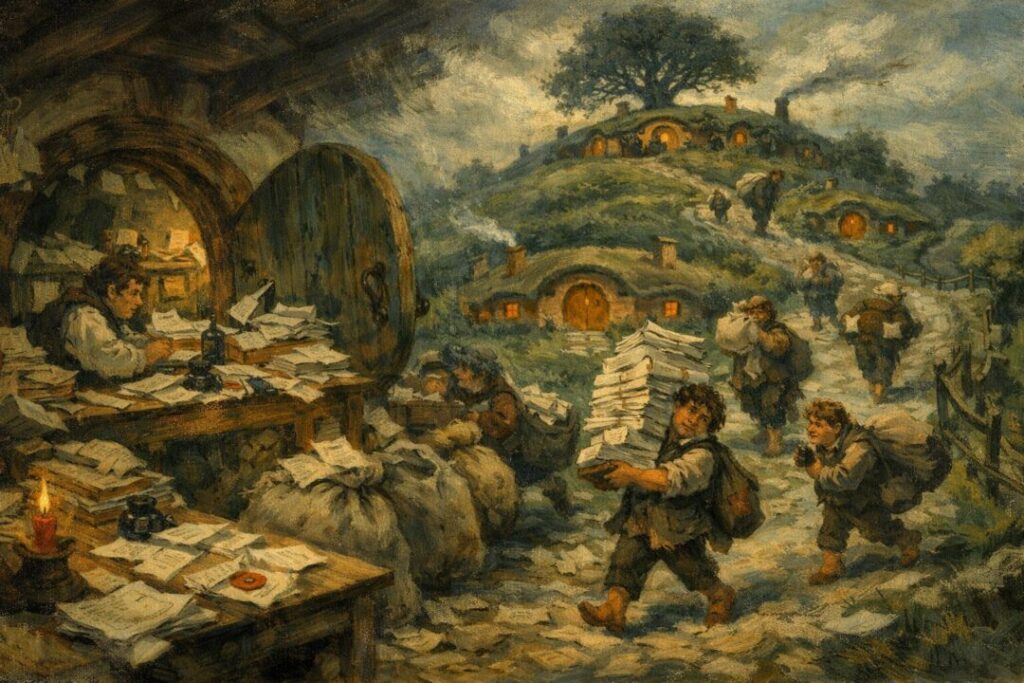
The Prologue to The Lord of the Rings makes this unusually clear. The Mayor of Michel Delving is also Postmaster, and the Messenger Service is described as one of the only real public services in the Shire. The messengers are numerous, and hobbits who are lettered are said to write constantly to friends and relations who live beyond an afternoon’s walk.
That is not a vague hint. It is a genuine institutional detail.
The Shire also has the conditions that make such a service possible. It is small by the standards of Middle-earth. It is densely settled in places. It has internal roads, local post-offices, and a population living in relative peace. Hobbiton and Bywater both have post-offices, and Bilbo’s farewell preparations produce such a flood of invitations and replies that the local system is overwhelmed.
That image tells us a great deal.
A postal service does not exist because people occasionally send messages. It exists because enough people can read, write, travel, and expect regular delivery that a system becomes worth maintaining. In the Shire, those conditions exist at least on a local scale. The texts do not give us timetables, routes, or rate tables, so anything more detailed would be speculation. But the underlying reality is solid: the Shire has organized civilian message-carrying, and it is busy.
Gondor Has Communication Infrastructure, but Not Ordinary Mail as We Know It
The next strongest evidence comes from Gondor.
But Gondor’s system is not presented in the same way as the Shire’s. Where the Shire’s Messenger Service feels civic and domestic, Gondor’s communication appears administrative, military, and strategic.
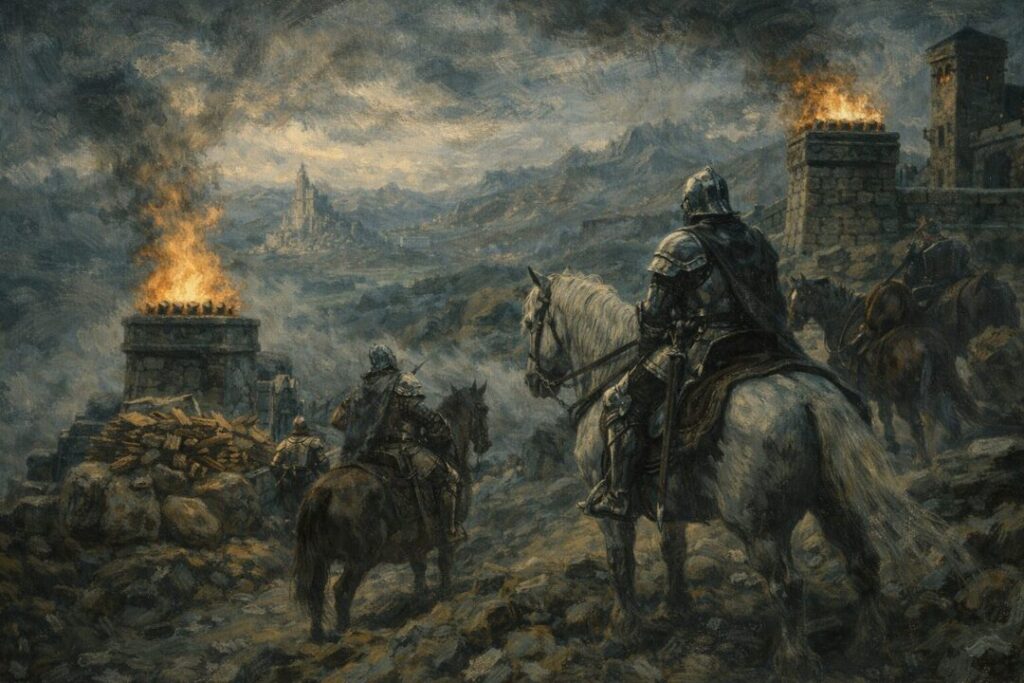
The clearest examples are the errand-riders and the warning beacons. In The Return of the King, mounted couriers carry urgent messages under the authority of the Steward. Hirgon rides to Théoden with the Red Arrow, a formal summons for aid. The beacons of Gondor are maintained warning stations with signal fires kept ready, and fresh horses are associated with the chain for couriers moving onward.
This matters because it shows what a larger realm can do when it has stable authority.
A true communications network needs more than messengers. It needs roads, relay points, political control, and enough resources to maintain stations even when nothing dramatic is happening. Tolkien’s own remarks about Gondor point in that direction: Gondor had road communications and water communications, along with the structures of a developed realm.
Even so, the texts stop short of showing a general postal service for private citizens across Gondor. We see urgent state communication. We see military signaling. We see organized movement of information. But we do not see something like ordinary household mail circulating broadly through the kingdom as a narrated feature of daily life. That could have existed in some form, but the texts do not plainly confirm it. So the safer conclusion is narrower: Gondor has substantial communication infrastructure, especially for rule and war, but not an explicitly described public postal system on the Shire’s model.

Most of Middle-earth Lacks the Conditions a Postal Network Would Need
This is where the larger question turns.
For a postal system to work across Middle-earth, it would need to cross territories that are not merely distant, but politically and physically broken.
Roads exist. The East Road passes through the Shire and Bree, and older great roads once linked the North and South Kingdoms. But the existence of a road is not the same thing as the existence of a safe route under reliable management. By the late Third Age, much of Eriador is thinly peopled wilderness. The Rangers protect the Shire and Bree in ways their inhabitants barely understand, which itself suggests how fragile security really is beyond settled borders. Gandalf later speaks of the Greenway being opened again and of empty lands becoming inhabited once more, implying that much had long fallen out of ordinary use.
A postal route needs predictability.
It needs inns, depots, local officials, and some assurance that the rider with a satchel will arrive more often than not. In much of Middle-earth, the story world offers the opposite picture: ruined kingdoms, dangerous wilds, isolated peoples, and long distances broken by mountains, forests, marshes, and hostile lands. That is why so many important messages in the narrative are not routine letters at all. They are carried by specific individuals on dangerous errands.
This is especially important in the north.
The Shire can maintain internal mail partly because it is sheltered. But that shelter is not self-generated. It depends in part on a wider protective order, including the hidden labor of the Rangers. Remove that protection, and even the Shire’s local system becomes more vulnerable than it appears.
Language and Literacy Would Matter More Than Readers Sometimes Notice
A postal system also assumes something cultural: people must be able to compose messages and expect them to be understood.
Middle-earth has shared languages, but not perfect uniformity. Westron functions as the Common Speech across much of the west, which helps any imagined message network enormously. But the texts also show a multilingual world, with Sindarin, Khuzdul, various Mannish tongues, and specialized scripts. Literate cultures certainly exist, and writing is common enough among elites, lore-masters, and many hobbits. Yet literacy is not presented as universal. The Shire passage itself says that not all hobbits were lettered.
That means scale matters again.
Local delivery among literate hobbits is one thing. Carrying ordinary correspondence across multiple peoples with different habits, scripts, and political boundaries is another. A postal system big enough to cross Middle-earth would require either a strong shared administrative language or a network of trained intermediaries. The texts do not show such a system operating broadly.
So even before danger enters the picture, communication is already uneven.
Middle-earth Often Uses Special Messengers Instead of Systems
One reason readers may overestimate the presence of postal structure is that messages in Middle-earth do travel.
They simply do not always travel through institutions.
In The Hobbit, ravens can bear messages for the Dwarves of Erebor, and thrushes are associated with carrying word toward the Men of the Lake. These are striking cases, but they are clearly exceptional and local, not components of a general public network. They belong to a specific northern context with unusual relationships between Dwarves, birds, and nearby Men.
The Eagles function even more dramatically.
They can bear tidings and intervene at decisive moments, but they are not courier animals available on demand. Treating them as a normal communication service would distort the texts. Their appearances are rare, purposeful, and never democratized into ordinary logistics.
The palantíri offer another kind of communication entirely: long-distance contact of extraordinary power, but restricted to rulers and the very few capable of using them. They solve the problem of distance only for a tiny governing elite. They do not create anything resembling postal access for ordinary people.
This is the pattern again and again.
Middle-earth does not lack communication.
It lacks universal communication.
What a Real Postal System Would Actually Require
Once the evidence is gathered, the answer becomes clearer.
A true postal system in Middle-earth would require at least five things.
First, it would require security. Roads cannot function as message routes if riders disappear into wilderness, marsh, mountain, or enemy land.
Second, it would require political continuity. Someone must pay messengers, maintain stations, repair bridges, and enforce delivery routes. That exists locally in the Shire and more grandly in Gondor, but not across most of the map at the end of the Third Age.
Third, it would require density of settlement. A postal network becomes practical when enough communities exchange enough written communication to justify regular carriage. The Shire qualifies far more than the scattered wilds of Eriador.
Fourth, it would require literacy and shared linguistic habits. The texts support this in some places, but not as a universal condition across all peoples.
Fifth, it would require time and peace. War compresses communication into warning systems and urgent riders. Peace allows correspondence to become ordinary. The Middle-earth of the War of the Ring is not a world in stable enough condition for continent-wide ordinary mail.
The Closest Answer Is Also the Most Telling
So what would a postal system in Middle-earth actually require?
In one sense, the answer is simple: it would require Middle-earth to be more unified, more governed, and less wounded than it usually is in the stories we read.
That is why the best examples are so revealing.
The Shire can sustain post because it is sheltered, local, and orderly. Gondor can sustain couriers and signal chains because it still preserves the habits of a great realm. Elsewhere, communication becomes personal, improvised, elite, or extraordinary.
In other words, Middle-earth does not present a missing postal system that we simply have not noticed.
It presents a world where communication itself reveals the map of civilization.
Where post exists, order exists.
Where only riders, ravens, or desperate summons remain, the world is thinner.
And that may be the real answer hidden inside the question.
A postal system in Middle-earth would not just move letters.
It would prove that the age of scattered refuges had begun to give way to something steadier.
Which is why, by the end of the Third Age, the most believable place for such a system is not the whole world.
It is the few places that still remember how to hold one together.
Sources & Notes
- J.R.R. Tolkien, The Lord of the Rings, Prologue, “Concerning Hobbits” — identifies the Mayor of Michel Delving as Postmaster and describes the Shire’s Messenger Service and letter-writing habits.
- J.R.R. Tolkien, The Lord of the Rings, Book I, Chapter 1, “A Long-expected Party” — Bilbo’s invitations, replies, and the Hobbiton and Bywater post-offices show local Shire mail in ordinary use.
- J.R.R. Tolkien, The Lord of the Rings, Book V, Chapter 1, “Minas Tirith,” and Chapter 3, “The Muster of Rohan” — Gondor’s beacons, errand-riders, and the Red Arrow support the article’s distinction between state communication and civilian post.
- J.R.R. Tolkien, The Lord of the Rings, Prologue, “Concerning Hobbits,” and Book VI, Chapter 7, “Homeward Bound” — useful for Westron as the Common Speech and for the late-Third-Age sense that northern roads had to be made safe again.
- J.R.R. Tolkien, The Hobbit, Chapter 15, “The Gathering of the Clouds” — Roäc and the ravens of Ravenhill show message-bearing birds as a local, exceptional arrangement rather than a general postal network.
- J.R.R. Tolkien, Unfinished Tales, “The Palantíri” — provides the clearest source for long-distance communication restricted to rulers and trained or powerful users, not ordinary public access.