Most people think the empty spaces in Middle-earth are all the same.
They are not.
That may be one of the quietest but most revealing distinctions in the legendarium.
When readers imagine Middle-earth, they often think in terms of contrast: bright havens and dark fortresses, cultivated kingdoms and dangerous wilderness, roads and trackless places. It is easy to let all land outside the settled world blur together into one category. Empty is empty. Wild is wild.
But the texts are much more precise than that.
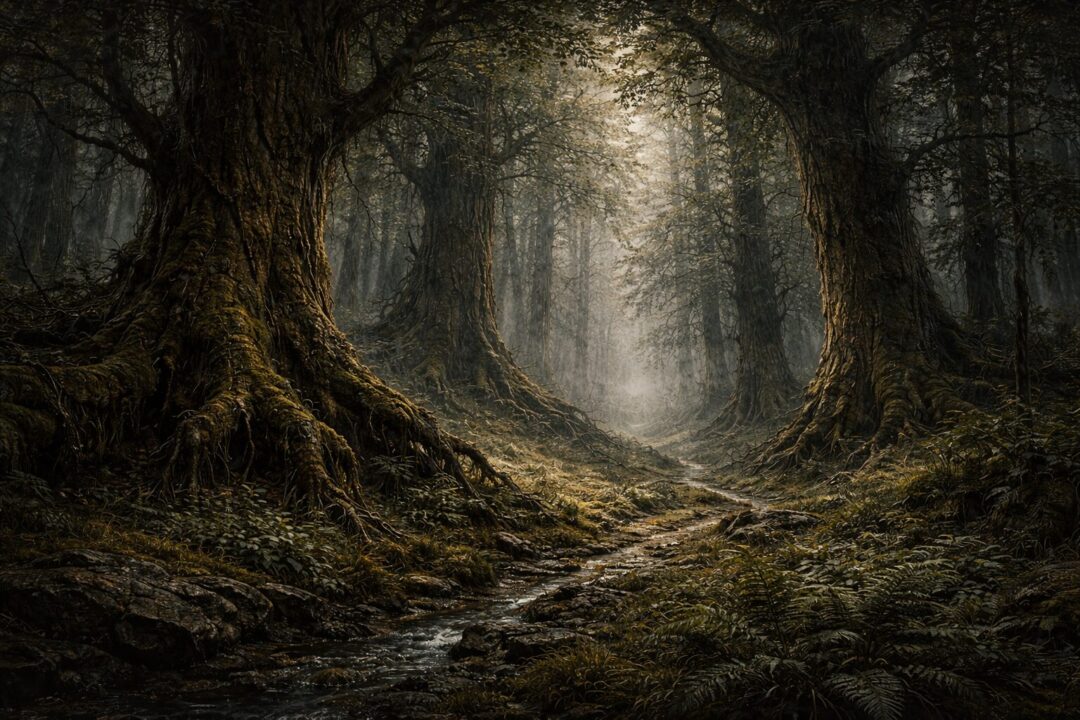
Some lands are wild because they are ancient survivors. They were never fully brought into the order of later kingdoms, or they endured from an older world with their own character still intact. Fangorn is like this. The Old Forest is like this as well: not “unused” land, but a remnant of something far older. Treebeard even recalls a time when there was “all one wood once upon a time,” stretching westward to the Mountains of Lune, with Fangorn only the “East End” of that greater forest.
Other lands are empty for a very different reason.
They were not simply left alone.
They were reduced.
Burned.
Cut down.
Depopulated.
Abandoned after catastrophe.
And Middle-earth remembers that difference.
Wild land is not the same as vacant land
One of the easiest mistakes to make in reading Middle-earth is to assume that wildness means absence.
But wild places in these texts are rarely empty in that sense.
Fangorn is not a blank on the map. It is alive, old, resistant, and full of memory. The same is true in a different register of the Old Forest, which survives in Eriador as another remnant of the ancient woodlands that once covered much more of western Middle-earth. These forests are not presented as failed civilization. They are older than the shrinking political world around them.
That matters because Middle-earth does not frame every non-urban landscape as something incomplete.
The wild can be intact.
It can be dangerous without being ruined.
It can be untamed without being damaged.
It can be morally ambiguous without being the product of recent destruction.
Treebeard’s memories are crucial here. When he speaks of the old forest-world, the tone is not one of desolation. It is loss, yes, but not the loss of a civilization replacing wilderness. It is the loss of a living natural order that once had immense scope and continuity. What remains in Fangorn is diminished in size, but not emptied of identity.
That is the first side of the distinction.
Wild land in Middle-earth is often a survivor.
The Brown Lands are not wilderness
The clearest contrast appears in the Brown Lands.
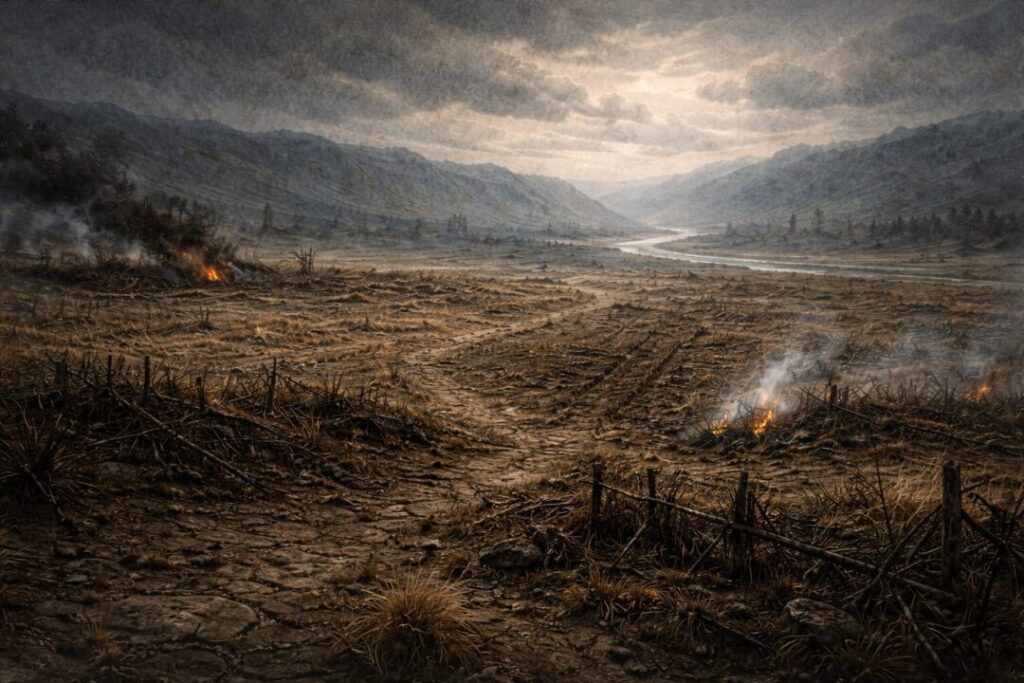
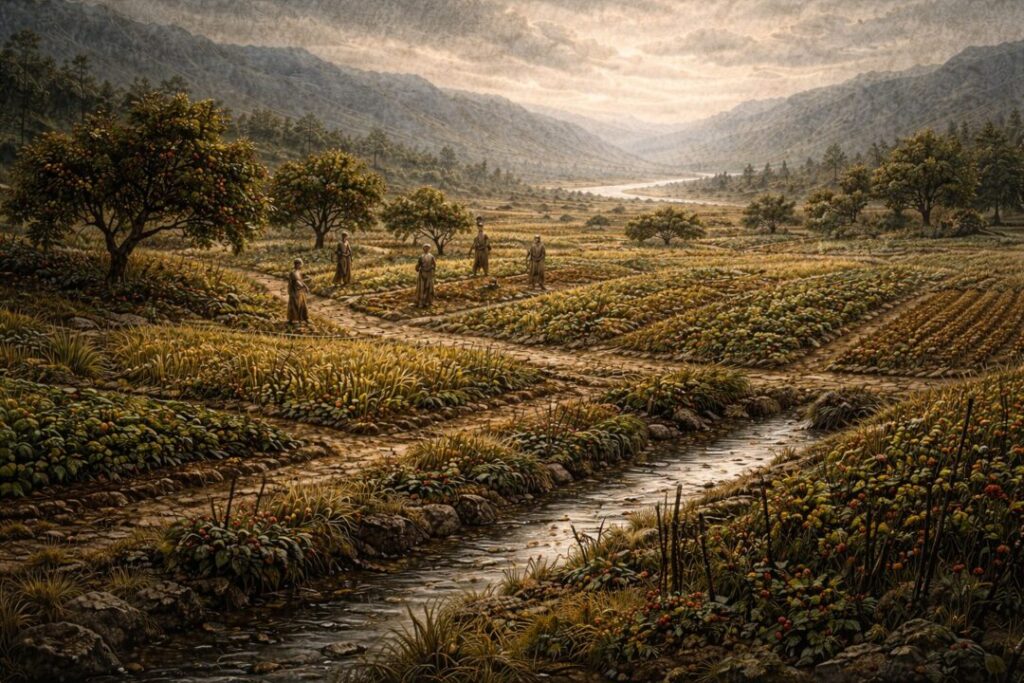
At a glance, the Brown Lands might seem like one more barren region of Middle-earth: open, lifeless, and empty. But the text gives them a specific history. Treebeard links them to the lands of the Entwives, who crossed the Anduin and made gardens, tilled fields, and created ordered growing spaces of their own. Later, those gardens were wasted, and Men called the region the Brown Lands.
That detail changes everything.
The Brown Lands are not simply a place where nothing grows because no one ever lived there. They are a place where something did live there, and where that ordered fertility was destroyed. Tolkien Gateway’s summary, drawing on The Lord of the Rings and the later letter tradition, describes Sauron as pursuing a scorched-earth policy during the War of the Last Alliance, with the Entwives’ land burned and uprooted.
So the Brown Lands do not feel like Fangorn.
They are not old wilderness persisting into the late age.
They are aftermath.
That is why their barrenness feels so different in the imagination. Wild forests carry depth. The Brown Lands carry damage. One suggests endurance. The other suggests violation.
Even their remembered past is different. The Entwives’ land was not forest in the Fangorn sense. It was cultivated. Deliberate. Fruitful in a patterned way. Its destruction therefore reads not merely as ecological loss, but as the erasure of a way of living.
Some empty lands were cut down before they were abandoned
That same pattern appears in Eriador, especially in Minhiriath and Enedwaith.
In Unfinished Tales, as reflected in Tolkien Gateway’s summary of Lond Daer and Eriador, Aldarion’s shipbuilding hunger drove large-scale deforestation in those regions. What had once been vast, nearly continuous forests was cut at an increasingly destructive rate. The local populations were angered and displaced, and later warfare compounded the damage by burning much of what remained.
This is not the same as saying that every later empty stretch of Eriador is directly caused by one event. The history is longer than that, and several losses overlap. But the texts do preserve an important memory here: there are places in Middle-earth that became emptier because they were exploited first.
That is a very different narrative from simple wilderness.
A forest that remains because it has endured is one thing.
A forest that no longer remains because it was consumed for fleets, war, or expansion is another.
This distinction is especially important because readers sometimes romanticize emptiness in Middle-earth as if it were all part of one timeless, noble landscape. But some of that emptiness is historical in the grimmest sense. It is not timeless. It is the residue of appetite, conflict, and overuse.
Eriador feels empty because history passed over it
The northern lands provide another version of deliberate emptying, though less through fire and more through attrition.
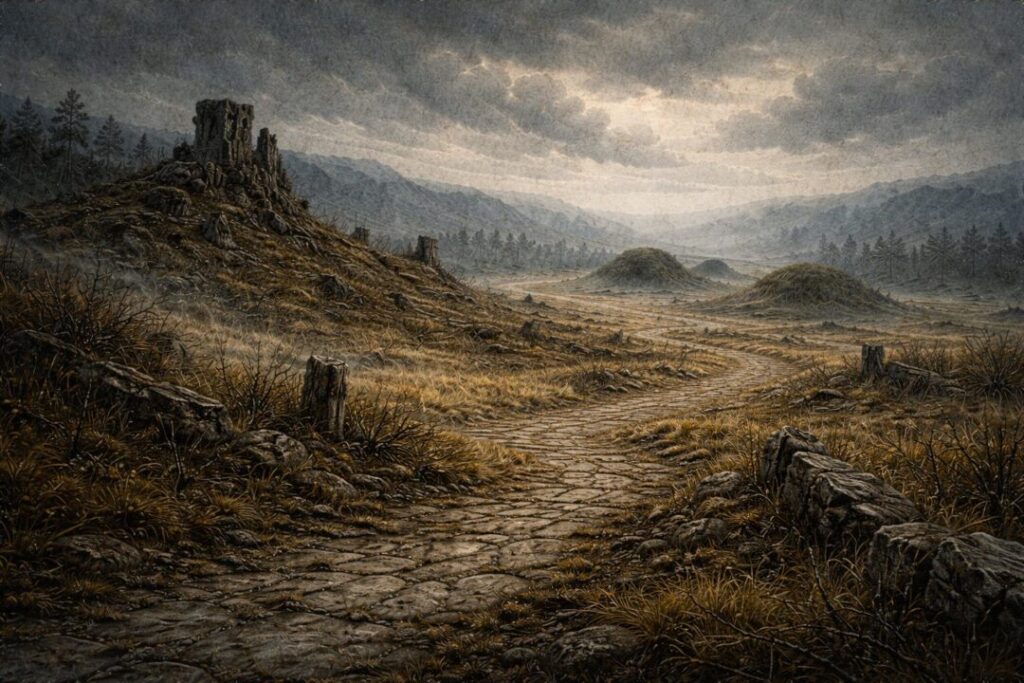
By the end of the Third Age, much of Eriador feels vast and underpeopled. The traveler crosses long roads, ruined watchtowers, abandoned barrows, and silent lands between the remaining centers of life. It is tempting to read this as mere atmosphere: a romantic frontier.
But Appendix history gives a harder explanation.
The Angmar wars devastated the North-kingdom. Cardolan was ravaged, and only remnants held out in places like the Barrow-downs and the Old Forest. Then the Great Plague struck in T.A. 1636, killing most of the people of Cardolan, especially in Minhiriath. After that, the Barrow-downs were infested by evil spirits sent from Angmar, and attempts to repopulate parts of the region failed. Tolkien Gateway’s summaries of Cardolan, Arnor, and Eriador all reflect this trajectory of war, plague, and lasting depopulation.
This is not wilderness in the Fangorn sense.
It is not land outside human control because no one ever reached it.
It is land that once belonged to kingdoms, roads, defenses, and remembered populations, and then lost them.
That is why ruins matter so much in Eriador.
A ruin is not just a scenic object. It is proof that a place has been emptied.
Middle-earth gives wildness and desolation different moral textures
One reason this distinction matters is that Tolkien gives these landscapes very different emotional and moral textures.
Ancient wild land is often unsettling, but it is not necessarily diminished. The Old Forest is threatening. Fangorn is strange and dangerous to outsiders. But both feel inhabited by their own order. Their wildness is not mere vacancy. It has agency and continuity.
Deliberately emptied land feels different.
The Brown Lands feel mute.
The abandoned regions of Cardolan feel haunted.
Deforested Eriador feels thinned out, as though history has passed through and taken more than it left behind.
In other words, Middle-earth distinguishes between land that resists being mastered and land that has already suffered mastery of the worst kind.
That is a profound difference.
The first kind of place may be perilous, but it is still whole in itself.
The second kind of place may look open and quiet, but it is marked by absence.
This is one reason the legendarium’s geography feels so emotionally layered. The land is not only physical setting. It preserves moral history.
Why this distinction changes the way Middle-earth looks
Once you notice the difference between wild land and deliberately emptied land, the map of Middle-earth begins to change.
Fangorn stops being just “a scary forest.”
It becomes a surviving fragment of a deeper world.
The Brown Lands stop being just “a barren area east of Anduin.”
They become a scar left where cultivation, growth, and memory were violently erased.
The empty regions of Eriador stop being generic fantasy distance.
They become the visible remains of kingdoms that failed, peoples who died, and roads that no longer hold the world together.
That, in the end, is the real difference.
Wild land is not simply land without people.
Sometimes it is older than people’s claims on it, and still alive in its own right.
Deliberately emptied land is something sadder.
It is land from which life, order, or habitation has been taken.
Middle-earth does not confuse those things.
And neither should we.
Because some places in the legendarium feel deep because they endured.
Others feel empty because they remember.
Sources & Notes
- J.R.R. Tolkien, The Lord of the Rings, Book III, Chapter 4, “Treebeard” — Treebeard’s memory of the old forests reaching westward and his account of the Entwives’ gardens becoming the Brown Lands support the article’s wild-land/desolated-land contrast.
- J.R.R. Tolkien, The Lord of the Rings, Book I, Chapter 6, “The Old Forest” — the Old Forest is presented as an active surviving remnant, not simply unused or vacant countryside.
- J.R.R. Tolkien, Unfinished Tales, “The History of Galadriel and Celeborn,” Appendix D, “The Port of Lond Daer” — describes Númenórean timber-felling around the Gwathló, the anger of local peoples, and later devastation in Minhiriath and Enedwaith.
- J.R.R. Tolkien, The Lord of the Rings, Appendix A, “Annals of the Kings and Rulers: Eriador, Arnor, and the Heirs of Isildur” — gives the Angmar wars, the fall of Cardolan, the Great Plague, and the Barrow-downs’ haunting as causes of Eriador’s lasting emptiness.