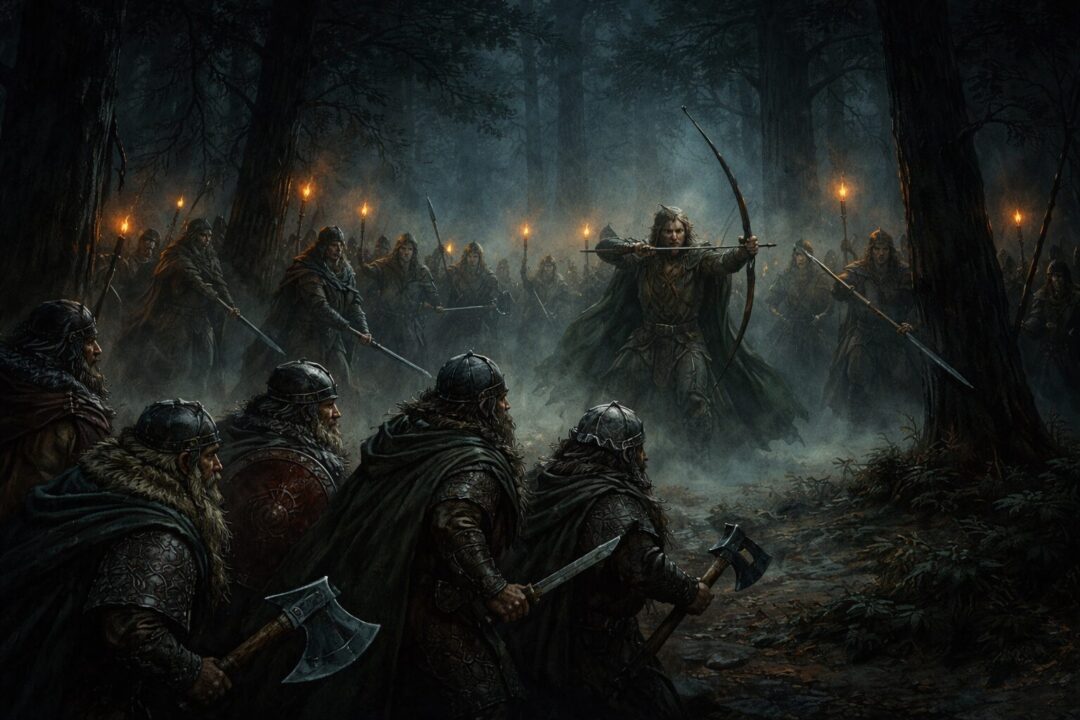
Most people know that Elves in Middle-earth can fight.
That part is not controversial.
They carry bows and spears. They forge famous swords. They defend hidden cities, woodland realms, and ancient borders. They stand in some of the greatest wars the world remembers.
And yet they do not feel like a people moving toward “modern” war.
That is the real tension.
Because once a story gives a people armies, armor, fortresses, and large-scale battles, we expect a certain logic to follow. We expect war to become increasingly technical, impersonal, and expansive. We expect organization to harden into system. We expect the demands of survival to turn beauty into utility.
But Elves never quite cross that line.
They wage war, sometimes on a vast scale, without seeming to become creatures of military modernity.
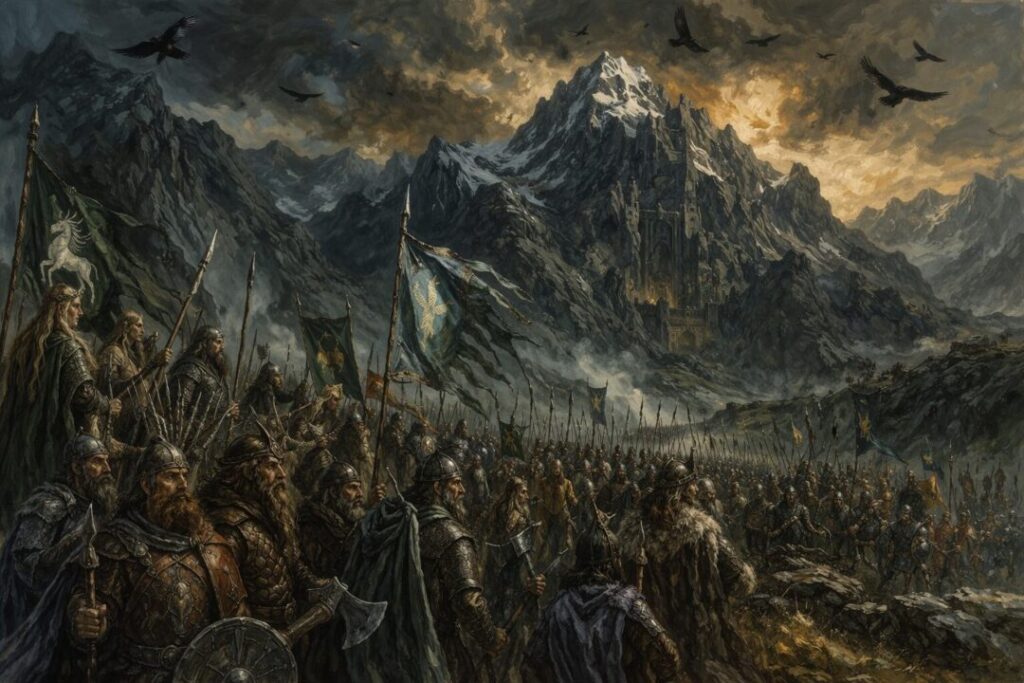
Elves Are Not Above War
A common mistake is to imagine Elves as beings who mostly sing, remember, and depart.
The texts do not allow that simplification.
In The Hobbit, the Wood-elves who seize the dwarves are not unarmed dreamers in the trees. They appear suddenly with bows and spears, and the narrative makes clear that resistance would have been hopeless. Later, in the Battle of Five Armies, Elves stand among the open military powers on the field beside Men and Dwarves. They are not ornamental. They are one of the armies.
The older tales make this even clearer.
The Noldor do not arrive in Beleriand as a peaceful civilization accidentally dragged into conflict. Their history becomes inseparable from great wars against Morgoth. They hold realms, fortify passes, gather alliances, and meet catastrophe in formal battle. Gondolin is remembered for beauty, but it is also a defended city with arms, armor, archers, and military order. The Last Alliance of Elves and Men is exactly what its name says: a vast war-making coalition formed to overthrow Sauron by force.
So the question is not whether Elves fight.
They do.
The question is why their warfare still feels old in the deepest sense of the word.
Their War Never Becomes Industrial
One answer lies in what Elvish war does not become.
The texts give us examples of warfare edging toward a darker, more modern logic elsewhere. Saruman’s assault on Helm’s Deep is marked by blasting fire and a kind of destructive ingenuity that feels corrosive even when described briefly. Sauron’s power is repeatedly associated with enormous hosts, engines, siege, domination, and scale. These are forms of war that push toward appetite, multiplication, and mechanism.
Elvish warfare is not presented that way.
Elves can be highly organized, but their organization does not read like industrial process. Their weapons are famous for lineage and craft rather than mass production. Their martial strength is tied to skill, memory, and individual excellence. Even when they field hosts, the stories keep them close to named lords, houses, and realms rather than anonymous systems.
This is partly an inference from the consistent way the legendarium frames them.
Elven war remains artisanal.
That does not make it less dangerous. It makes it differently ordered.
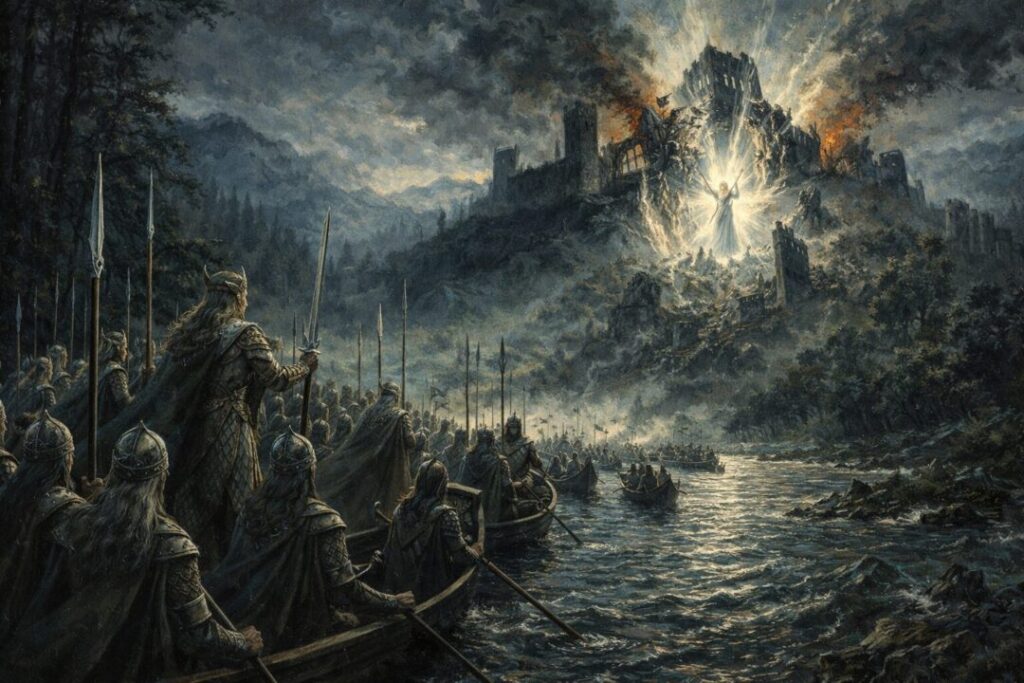
Place Matters More Than Expansion
Elves also fight for different ends.
Modern war, in the broad sense, tends to break ties to place. It can become abstract, logistical, and expansionary. Territory becomes a unit to be processed, measured, or consumed.
Elvish war stays attached to beloved ground.
The Woodland Realm fights as a woodland realm. Lórien resists invasion as a guarded wood whose life is part of what is being defended. Gondolin is not a capital built merely for command efficiency; it is a hidden city whose form expresses the people dwelling there. Even when Celeborn later crosses the Anduin against Dol Guldur, the action closes in cleansing and restoration rather than permanent conquest.
This matters.
Elves usually do not fight to create ever-larger machines of state. They fight to preserve realms, peoples, and ways of being that are already under threat.
That does not mean they are incapable of pride, conquest, or terrible error. The elder stories make plain that they are.
But even at their worst, the texts do not portray them as pioneers of an impersonal military future.
Beauty Does Not Disappear Under Pressure
Another striking feature is that war does not strip Elves of their aesthetic nature.
For Men in Middle-earth, and even more for the servants of the Enemy, war often narrows life. It hardens language, architecture, and imagination. Under the Shadow, things become uglier because they are reduced to function.
Elves do not work that way.
Their cities, arms, songs, and memories remain bound together. The same people who forge renowned blades also preserve lore, language, and beauty. Gondolin is the clearest example. Its splendor and its military readiness are not opposites. The city is beautiful and guarded at once. That combination feels strange to modern instincts, because we expect prolonged war to flatten a culture into necessity.
Elvish cultures resist that flattening.
They suffer from war. They can be destroyed by it. But they are not spiritually reorganized around efficiency alone.
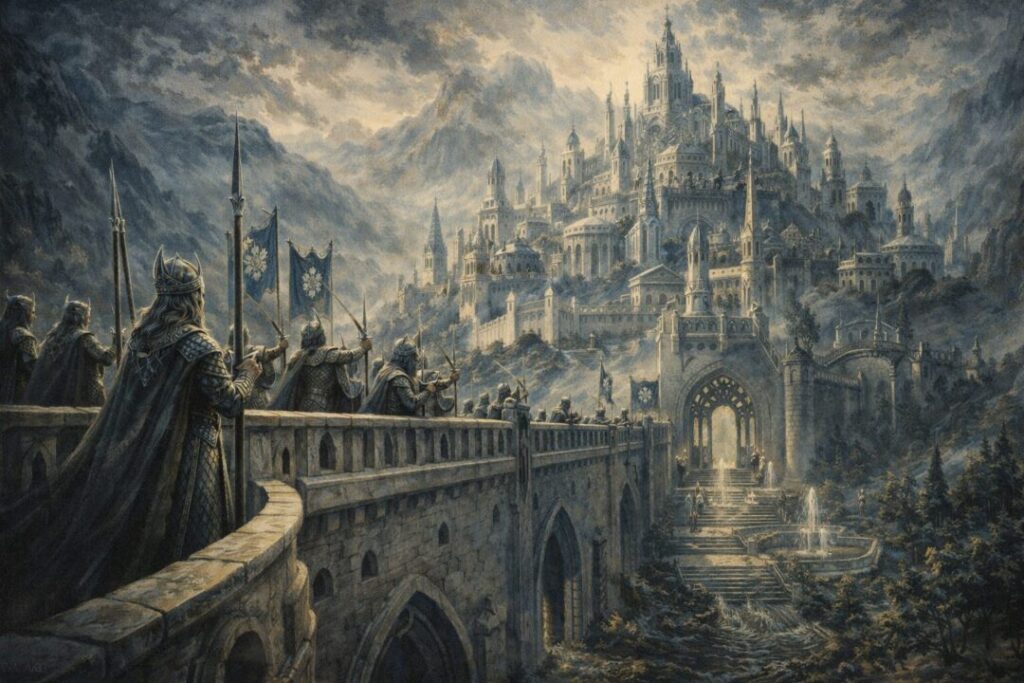
Their Leaders Still Fight as Persons, Not Functions
The stories also refuse to turn Elvish command into abstraction.
Again and again, Elven leaders are present as persons. Gil-galad does not vanish into the background of the Last Alliance; he stands at the center of it. Thranduil is not merely an administrator of troops; he is a king whose realm fights under his leadership. Celeborn leads the crossing against Dol Guldur. In the older legends, named captains and houses matter intensely.
This is not just decorative storytelling.
It shapes how war is imagined.
Modern war often feels like a machine into which persons are inserted. In Elvish war, persons remain legible. Loyalty runs through kinship, lordship, memory, and oath. Even when that structure fails disastrously, it does not become faceless.
The result is warfare that can be large without becoming anonymous in the same way.
The Shadow Is What “Modernizes” War
There is also a moral pattern underneath all this.
In Middle-earth, the powers most associated with domination tend to reduce living things to inputs. Forests become fuel. Creatures become units. Craft becomes production. Knowledge becomes technique for control.
That is why Saruman feels so alien even before his final downfall. He does not merely fight. He reorganizes the world toward use. Sauron does the same on a greater scale. Their wars do not just defend realms. They absorb and deform them.
Elves can kill, fortify, march, and besiege.
But they do not usually wage war by surrendering to that logic.
That may be the most important distinction of all.
Their warfare remains tragic, heroic, and sometimes doomed, but it is not built on the appetite to turn all creation into material.
This Is Why They Still Feel Ancient
So how do Elves fight wars without becoming “modern”?
Not by refusing organization.
Not by lacking weapons.
Not by standing outside history.
They avoid it because their war remains bounded by older loyalties: craft over manufacture, memory over expansion, defense over system, place over abstraction, persons over machinery.
That does not make them innocent.
The First Age alone forbids that conclusion.
But it does make them different from the military logic that gathers around the great powers of domination. Even when Elves are pressed into large and terrible conflict, they do not fully become what the age of machines would later recognize as a war-society.
And that may be why they are so compelling in battle.
They do not look weak.
They do not look naive.
They do not look unblooded.
They look like a people who can still carry weapons without letting weapons become the measure of what they are.
That is a rarer thing in Middle-earth than it first appears.
And it may be one of the quiet reasons Elven war still feels ancient even at its most formidable.
Sources & Notes
- J.R.R. Tolkien, The Hobbit, Chapter 8, “Flies and Spiders,” and Chapter 17, “The Clouds Burst” — presents the Wood-elves as armed woodland fighters and then as one of the armies at the Battle of Five Armies.
- J.R.R. Tolkien, The Silmarillion, “Of the Return of the Noldor” and “Of the Fifth Battle: Nirnaeth Arnoediad” — shows the Noldor holding fortified realms, mustering alliances, and fighting Morgoth in great formal wars.
- J.R.R. Tolkien, The Silmarillion, “Of Tuor and the Fall of Gondolin” — gives Gondolin as the clearest example of an Elven city where beauty, craft, secrecy, arms, and military order coexist.
- J.R.R. Tolkien, The Lord of the Rings, Appendix B, “The Tale of Years” — records Lórien’s resistance to assaults from Dol Guldur and Celeborn’s later crossing to cleanse the fortress, supporting the defensive/restorative pattern.
- J.R.R. Tolkien, The Letters of J.R.R. Tolkien, Letter 131 — explains Tolkien’s recurring contrast between sub-creation and the Machine, useful for the article’s reading of domination, mechanism, and war under the Shadow.