Middle-earth is full of dangerous places.
That by itself is nothing unusual. Mountains are hard to cross. Forests are easy to get lost in. Marshes swallow roads and armies alike. Any secondary world with a real sense of geography needs those things.
But Middle-earth does something more specific.
Again and again, some of its most memorable haunted places stand exactly where a frontier needs to hold.
That pattern matters.
The ghosts and dead things of the legendarium are not scattered at random. They gather in old barrows, mountain passes, drowned battlefields, and border forests. They appear where kingdoms have failed, where roads become uncertain, where settlement thins out, and where crossing from one realm into another becomes dangerous in more than a practical sense.
That does not mean every haunting in Middle-earth was consciously designed as a military system. The texts do not say that. But they do show something quieter and more interesting: ghost stories repeatedly do the work of border control.
They keep people out.
They keep places empty.
They turn thresholds into warnings.
And once that pattern becomes visible, several of Middle-earth’s strangest regions begin to make a different kind of sense.
Haunted places appear at the edges, not the center
One of the clearest things the texts show is that the truly haunted regions of Middle-earth are rarely the safe heartlands of functioning power.
They are marginal places.
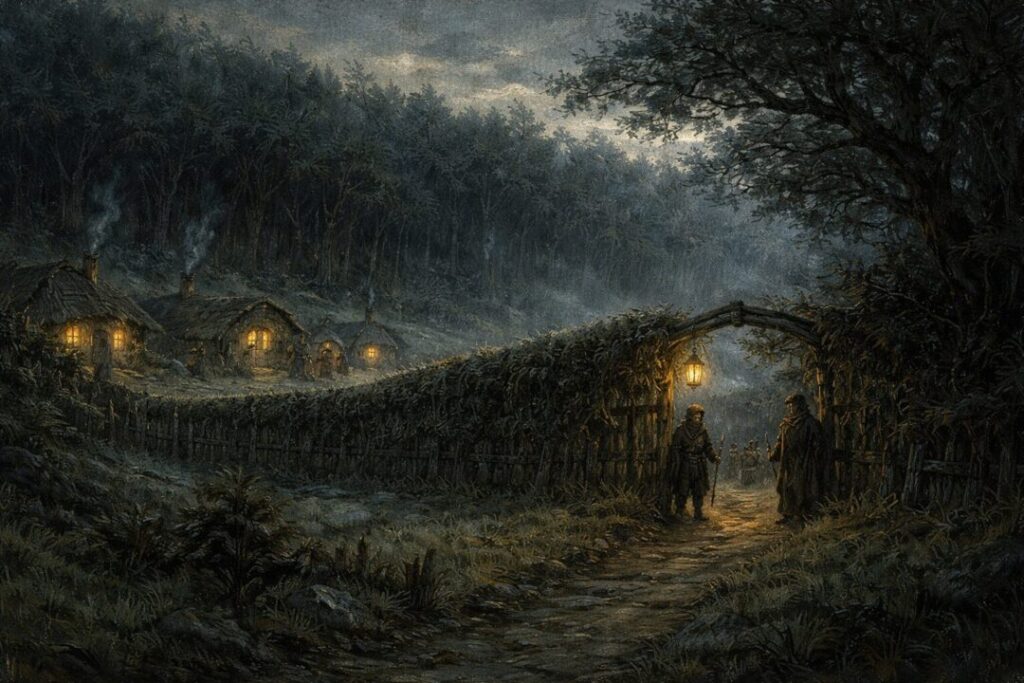
The Barrow-downs lie east of the Shire, near Bree, in a landscape already marked by the ruins of the lost North-kingdom. The Old Forest presses against Buckland closely enough that Bucklanders build the High Hay against it, lock their doors at night, and respond to danger from that direction almost as if invasion were a known possibility. The Paths of the Dead guard a passage through the White Mountains. The Dead Marshes lie on the dreadful approaches to Mordor.
That clustering is too consistent to ignore.
In Middle-earth, fear often settles where the map is thin.
The living center of a realm may be protected by rulers, law, memory, and custom. But its edges are another matter. Frontiers are where the state weakens, where old losses remain visible, and where something besides ordinary authority must keep the line intact.
Sometimes that “something” is the dead.
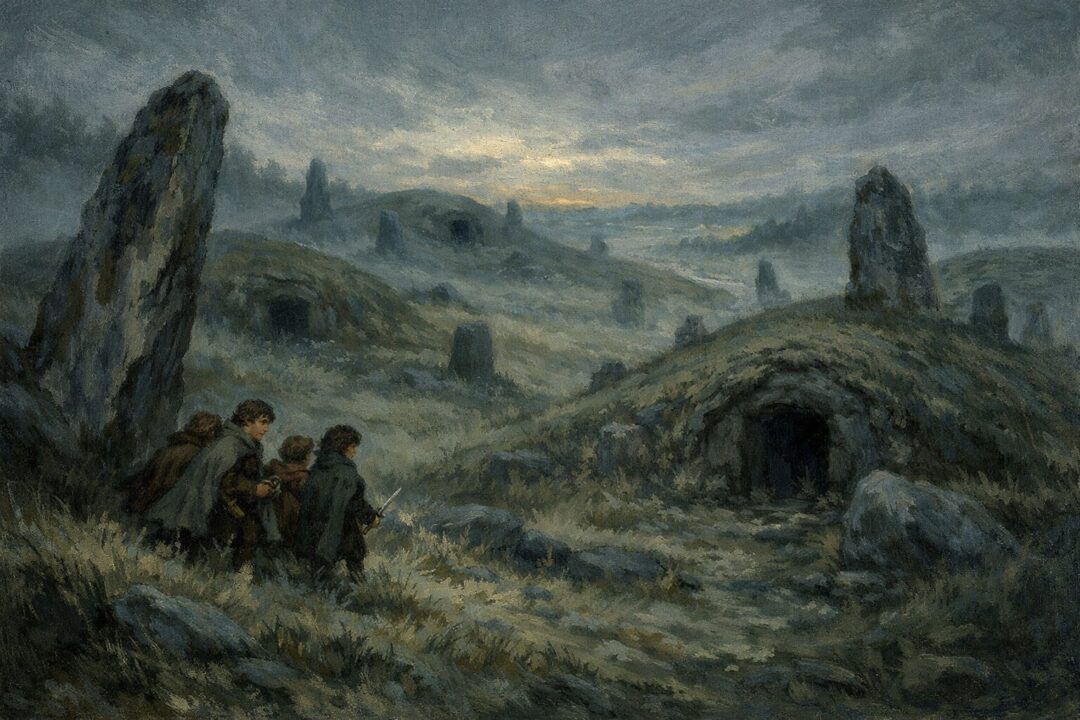
The Barrow-downs are an abandoned frontier made uninhabitable by terror
The Barrow-downs are the clearest example.
They are not just eerie hills placed in the hobbits’ path for atmosphere. They are old burial grounds bound up with the history of Arnor and Cardolan. After the Great Plague devastated Cardolan, the appendices state that evil spirits out of Angmar and Rhudaur entered the deserted mounds and dwelt there. Later tradition also preserves that when Araval tried to reoccupy Cardolan, the evil wights terrified those who attempted to dwell near the Barrow-downs.
That is an extraordinary detail.
The wights do not merely haunt tombs. They help prevent restoration.
A fallen kingdom does not recover simply because its enemies are gone. The land itself remains socially unusable. Fear stays behind and continues the work of war. In that sense, the Barrow-downs behave like a frontier that has been permanently poisoned—not by plague alone, and not by geography alone, but by memory weaponized into terror.
This matters even more because of where the Barrow-downs sit. They lie close to the roads and settled zones associated with Bree and the Shire, yet they remain outside normal habitation. They are near enough to matter and dreadful enough to avoid. That is exactly what a haunted borderland does best: it leaves the center intact by making the edge unusable.
The hobbits experience this pattern directly. Once they leave Tom Bombadil’s protection, they step into a place where the land no longer feels merely old. It feels forbidden. The horror is not just in the wight itself, but in the sense that they have crossed into a zone where ordinary social order has stopped applying.
Buckland shows that a border can be maintained by fear before anything supernatural appears
Buckland deepens the pattern in a revealing way.
Strictly speaking, Buckland is not a ghost-haunted realm in the same sense as the Barrow-downs. But it is a frontier society shaped by stories about what lies beyond its edge. Tolkien’s own worldbuilding emphasizes that Buckland exists pressed between the Brandywine and the Old Forest; the Bucklanders build the High Hay against the forest, keep their doors locked at night, and are noticeably harder and more suspicious than most Shire-hobbits because they live under constant danger from that side. When the alarm is raised at Crickhollow, the Bucklanders even fear an invasion from the Old Forest.
That is not incidental local color.
It shows how borders in Middle-earth are maintained not only by fences or rivers, but by inherited dread. Even before a visible ghost appears, the cultural logic is already in place: that side is dangerous, that threshold is not ordinary, and crossing it changes the rules.
In other words, the social mechanism of “ghost-story border control” begins before literal ghosts arrive.
People do not need perfect information. They only need enough shared fear to regulate movement.
Buckland becomes a useful comparison because it shows the same structure in a milder form. The Barrow-downs are what happens when frontier fear becomes supernatural and absolute. Buckland is what that same logic looks like while still inside the world of the living.
The Paths of the Dead turn a mountain passage into a forbidden threshold
If the Barrow-downs show a dead frontier in the North, the Paths of the Dead show the same principle in the South.
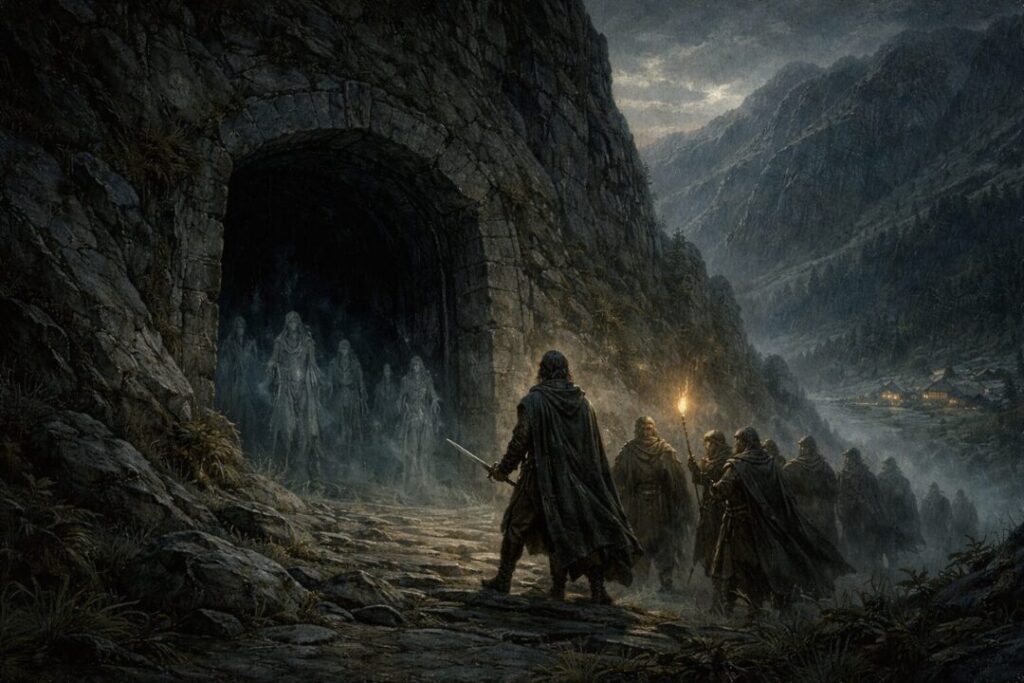
The route beneath the Dwimorberg is not merely difficult. It is taboo. The haunting is so powerful that the passage ceases to be a practical road for ordinary people. Tolkien makes that explicit through the repeated formula: “The way is shut. It was made by those who are Dead, and the Dead keep it, until the time comes.” The Oathbreakers also haunt Harrowdale and the region near Erech so dreadfully that local people lock themselves in their houses in fear in times of trouble.
This is border control in one of its purest narrative forms.
A strategic connection through the mountains exists, yet it is effectively closed because the dead hold it. No army needs to stand there. No garrison needs to be paid. Fear does the work of defense, or at least exclusion. The passage remains on the map, but for most of the living it might as well not exist.
What makes this example especially striking is that the haunting is tied to oath, kingship, and legitimacy.
Aragorn does not “defeat” the Dead in the ordinary sense. He passes because he is Isildur’s heir and can call them to fulfill the oath that left them unresting. The border yields not to brute strength, but to rightful authority.
That detail fits the larger political logic of Middle-earth perfectly.
A haunted border is not just about keeping people out. It is also about testing who has the right to pass.
Most people are turned back by fear.
The rightful claimant goes through.
The Dead Marshes make the very approach to Mordor feel forbidden
The Dead Marshes are slightly different, but they belong to the same pattern.
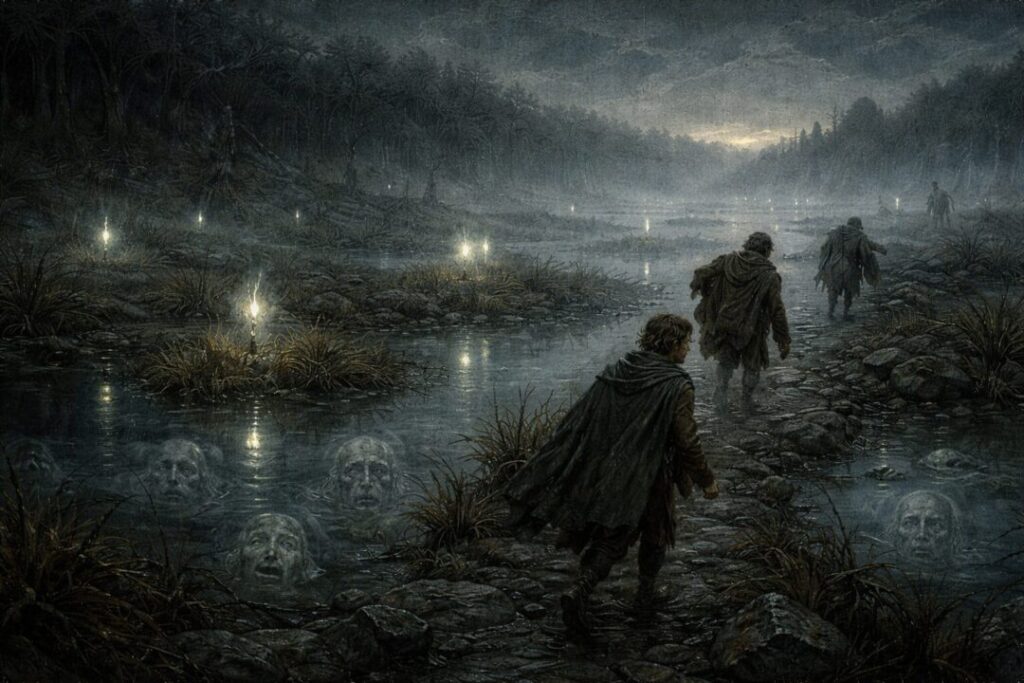
They are not described as a formal border in the same way as the Paths of the Dead, and the texts do not present the corpse-lights as an organized guard. So caution matters here. Still, the effect is unmistakable. The marshes lie on the approaches to Mordor, and they are filled with ghostly lights and the dead faces of long-fallen warriors. Gollum warns Frodo and Sam not to follow the “candles of corpses,” because they lure wanderers into the water.
That does not merely decorate the landscape with horror.
It transforms approach into taboo.
The living are not simply walking near enemy territory. They are passing through a place where the dead themselves seem to deny safe movement. The marshes become a moral and psychological threshold before Mordor proper is even reached. They announce that one is nearing a region where ordinary life, ordinary burial, and ordinary memory have all failed.
That is why the Dead Marshes feel larger than their immediate plot function.
They help turn Mordor into a zone of progressive exclusion. One does not arrive there all at once. The border begins earlier, in the mind, in the body, and in the stories told about the land ahead.
Why this works so well in Middle-earth
Ghost stories work as border control in Middle-earth because Middle-earth treats memory as a force that remains in the land.
Battles do not simply end.
Oaths do not simply disappear.
Ruined kingdoms do not simply become empty real estate.
What happened in a place keeps happening to those who pass through it.
That is why a barrow can remain politically active centuries after the men buried there are gone. That is why a broken oath can still close a mountain road. That is why a marsh can feel like a field of the dead long after the armies have rotted away.
This also explains why these regions are so effective narratively.
A wall tells you where a border is.
A ghost story tells you why people stop crossing it.
And the second is often stronger.
Walls can be breached.
Roads can be rebuilt.
Watchmen can be killed.
But inherited fear can preserve a frontier for generations.
That is exactly what happens in Cardolan. The kingdom falls, but the haunted barrows continue to keep settlement at bay. The political order vanishes, and yet its ruined edge remains defended by terror.
The deeper point is not horror, but control of movement
This is the final piece that makes the pattern so powerful.
The dead in Middle-earth are often less important as monsters than as regulators of movement.
They close routes.
They empty landscapes.
They slow trespass.
They separate the ordinary from the forbidden.
Even when they are not “controlling” a border by conscious design, they produce the same result. The living reroute themselves around haunted zones. Communities harden on one side of them. Memory thickens around them. The map becomes social before it becomes military.
And that is why these places linger so strongly in the imagination.
The Barrow-downs are frightening, but they are also a lesson in how a lost kingdom can remain defended by fear.
The Paths of the Dead are frightening, but they are also a test of rightful passage.
The Dead Marshes are frightening, but they are also the moment when Mordor begins before Mordor begins.
So the ghost stories of Middle-earth are not just there to make the world darker or older.
They mark where crossing becomes costly.
They turn history into geography.
And in a world where memory never fully dies, that may be the strongest border of all.
Sources & Notes
- J.R.R. Tolkien, The Lord of the Rings, Book I, Chapter 8, “Fog on the Barrow-downs” — the hobbits’ entry into a forbidden barrow-land and the Barrow-wight episode.
- J.R.R. Tolkien, The Lord of the Rings, Appendix A, “Eriador, Arnor, and the Heirs of Isildur” — Cardolan’s fall, the Great Plague, and evil spirits entering the deserted mounds.
- J.R.R. Tolkien, The Lord of the Rings, Book I, Chapters 5–6, “A Conspiracy Unmasked” and “The Old Forest” — Buckland, the High Hay, and fear of the Old Forest as a living frontier.
- J.R.R. Tolkien, The Lord of the Rings, Book V, Chapter 2, “The Passing of the Grey Company” — the Paths of the Dead, the closed way, Erech, and Aragorn’s rightful passage.
- J.R.R. Tolkien, The Lord of the Rings, Book IV, Chapter 2, “The Passage of the Marshes” — corpse-candles, dead faces, and the haunted approach toward Mordor.