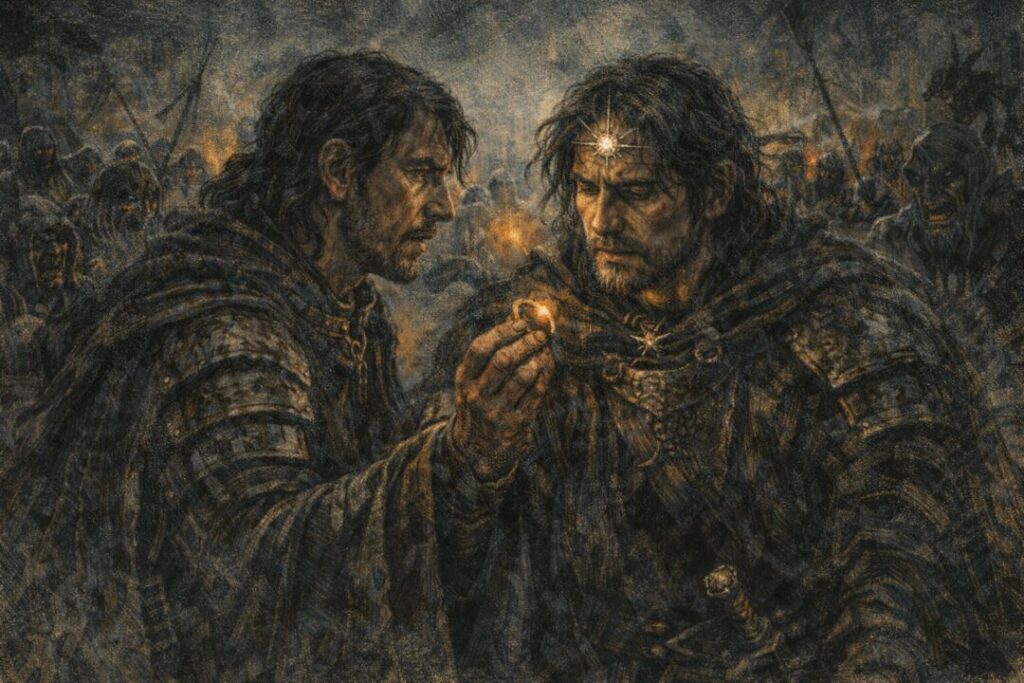
He cut the Ring from Sauron’s hand, kept it, and did not destroy it when the chance was near. Elrond later says plainly that Isildur took it “as should not have been,” and that it should have been cast into the fire of Orodruin then and there. That judgment stands. The text does not remove it.
But that is not the only thing the story preserves about him.
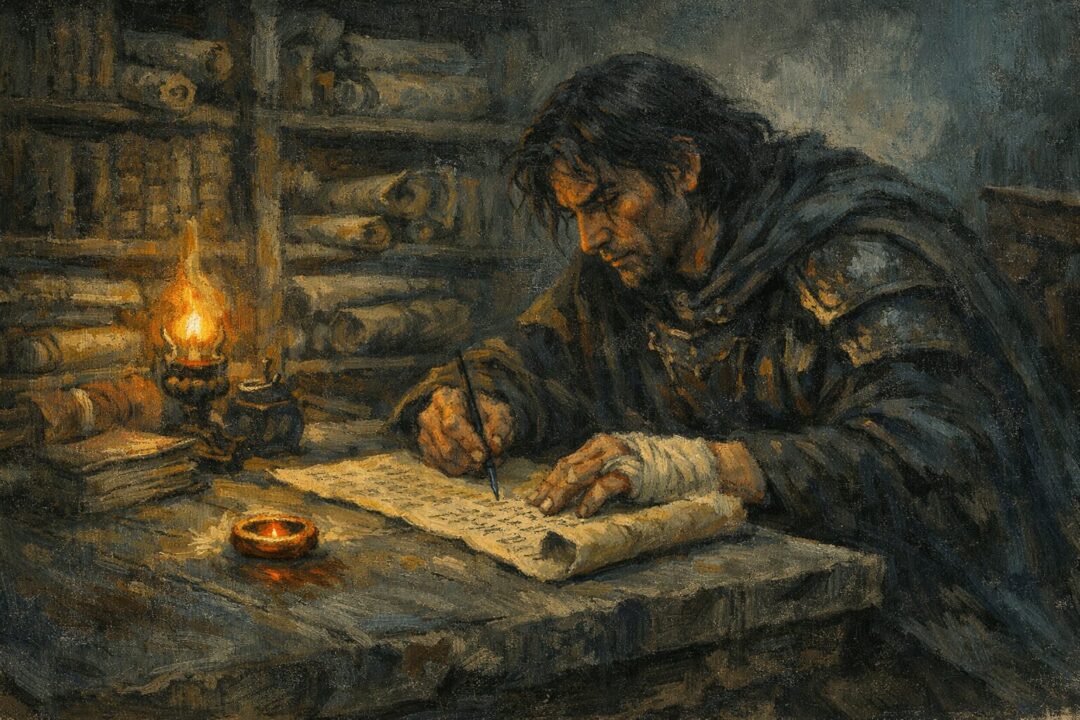
Buried inside the history of the Ring is a quieter detail, one that changes the shape of Isildur’s role in Middle-earth. He is not only the man who claimed the Ring. He is also the man who wrote it down. Gandalf discovers in Minas Tirith a scroll made by Isildur himself, left among ancient records that even Gondor had largely forgotten how to read.
That matters more than it first appears.
Because once Isildur becomes the keeper of a record, he stops functioning only as a warning. He begins to function as a historian inside the story: a man who understands that memory decays, that kingdoms forget, and that what has happened must be fixed in words before it vanishes.
The text does not let Isildur disappear into legend
One of the striking things about the Ring’s history is how often it almost vanishes.
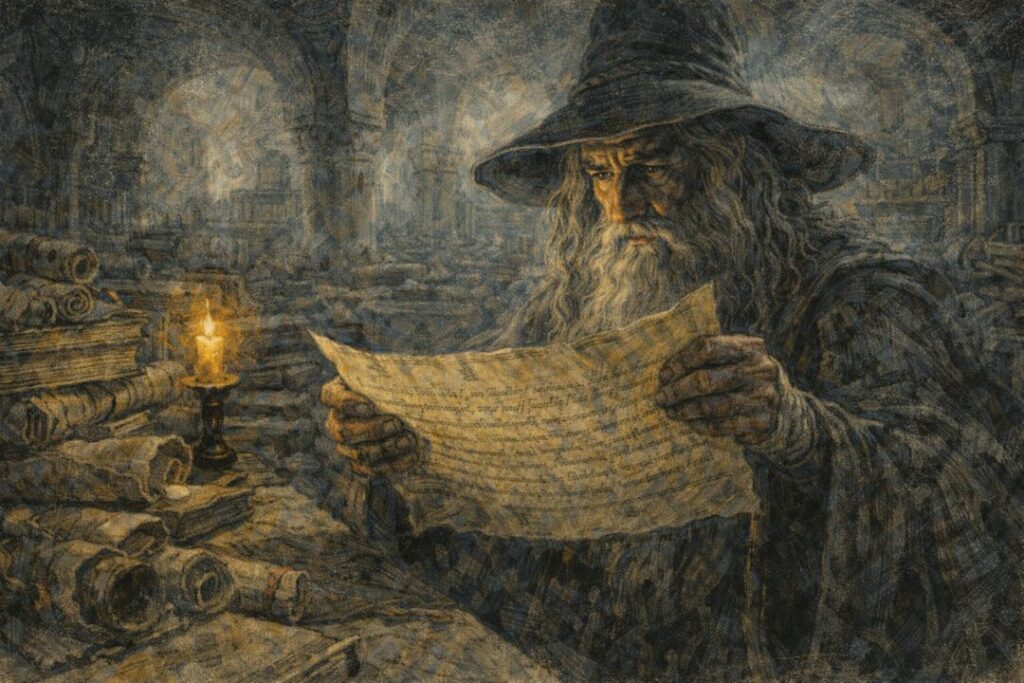
By the late Third Age, even in Gondor, the scroll survives more clearly than its memory. Gandalf tells the Council that Isildur’s document lay in Minas Tirith, probably unread by any save Saruman and himself since the kings failed. In other words, the record remained, but living knowledge thinned almost to nothing.
That is exactly the danger Isildur seems to anticipate.
His own words are unusually deliberate: “The Great Ring shall go now to be an heirloom of the North Kingdom; but records of it shall be left in Gondor, where also dwell the heirs of Elendil, lest a time come when the memory of these great matters shall grow dim.” That is not casual notation. It is an explicit statement about historical memory. He is not merely storing an object. He is preserving a trace of an event because he knows memory fades.
The phrasing is revealing.
Isildur does not assume that victory will guarantee remembrance. He assumes the opposite. Time will dim even “great matters.” The war against Sauron, the taking of the Ring, the fall of the Dark Lord’s bodily form: none of this is safe from erosion. So he writes.
That makes him, in this moment, more than a king and more than a survivor. He becomes an archivist of catastrophe.
Isildur writes like a witness, not like a conqueror
What Isildur records is just as important as the fact that he records it.
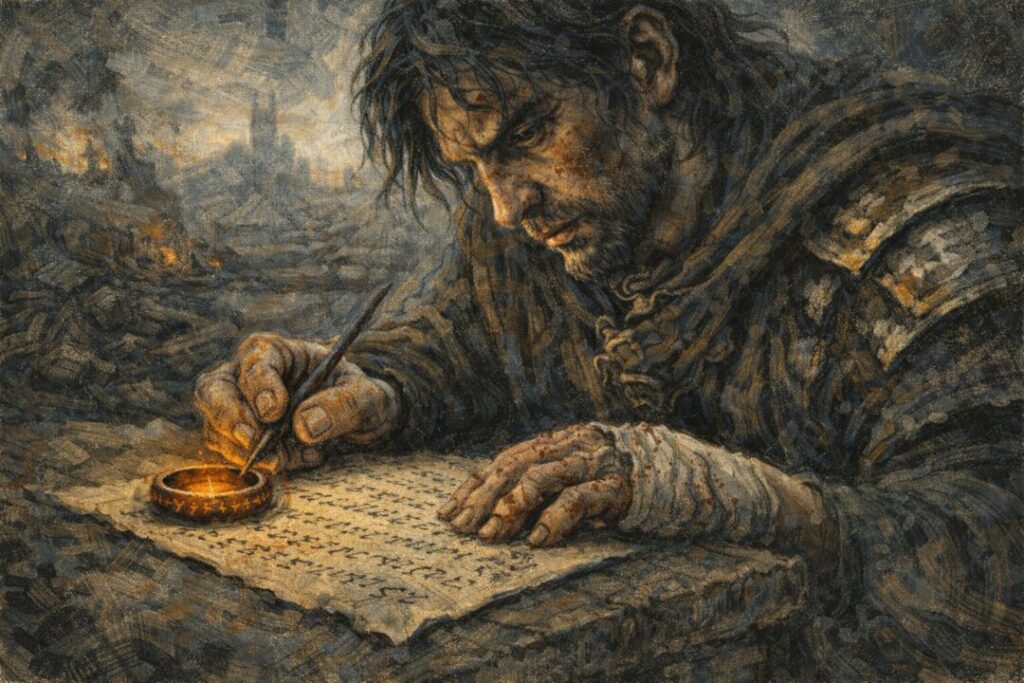
After declaring that records must remain in Gondor, he describes the Ring in careful detail. He notes that it was hot when he first took it and scorched his hand. He observes that it seemed to shrink as it cooled. He remarks that the letters, once clear as red flame, were already fading. Then he adds one of the most important lines in the entire chain of evidence: “What evil it saith I do not know; but I trace here a copy of it, lest it fade beyond recall.”
That is the action of a recorder of evidence.
He is not just admiring the Ring. He is documenting a transient phenomenon before it disappears. The inscription matters because it will later allow Gandalf to identify Bilbo’s ring as the One. Without Isildur’s record, Gandalf’s path to certainty becomes far less clear. The text makes that connection explicit: after reading the scroll, Gandalf says his quest was ended.
So the man whose failure helps doom later ages also leaves the evidence that helps save them.
That tension feels deliberate.
The story could easily have left the Ring’s identification to wizardly intuition, ancient rumor, or revelation from elsewhere. Instead, it depends on a written document preserved across millennia. The proof comes not from spectacle, but from archives.
And the archivist is Isildur.
This does not excuse Isildur’s failure
None of this turns Isildur into an innocent figure.
The same passage that gives us his care as a recorder also gives us his possessiveness. He calls the Ring “precious” and says he will risk no hurt to it, even though it causes him great pain. Elrond’s verdict remains severe: Isildur should not have taken it, and its destruction was near at hand.
So the point is not that the story secretly absolves him.
The point is that it refuses to flatten him.
He is proud enough to keep the Ring, perceptive enough to study it, disciplined enough to record it, and self-aware enough to sense both its beauty and its danger without fully mastering his response to either. That makes him much more unsettling than a simple moral example. He is neither merely wise nor merely foolish. He is both more responsible and more compromised than the simplified legend suggests.
That complexity becomes even sharper when later texts revisit his final days.
Unfinished Tales shows a different side of Isildur
In The Disaster of the Gladden Fields, Isildur is no longer presented as a man in easy possession of the Ring. During the ambush, his son Elendur asks whether the Ring’s power can not overawe their enemies and command them. Isildur answers with startling frankness: he cannot use it, dreads the pain of touching it, has not yet found the strength to bend it to his will, and says that it should go to the Keepers of the Three. He even says, “My pride has fallen.”
That does not erase his earlier claim on the Ring.
But it does complicate it.
By this stage, Isildur no longer sounds like a triumphant possessor of a prize. He sounds like a man discovering that the thing he kept is beyond him. The later text does not present him as spiritually clear or fully repentant in some simple way, but it does suggest that his understanding is changing. At the very least, the old image of pure self-confidence no longer holds.
This matters for the historian theme.
The man who recorded the Ring was not recording from a position of mastery. He was writing from within pain, uncertainty, and partial knowledge. He admits that he does not know what the inscription says. He guesses at its nature. He copies it anyway. That is what a witness does when certainty is incomplete but the evidence must still be preserved.
In that sense, Isildur’s record is not the confident proclamation of a victor. It is the anxious memorandum of someone who knows he is handling something dangerous and not fully understood.
Tolkien makes history itself fragile
This is why the scroll matters structurally, not just as trivia.
Middle-earth is full of memory, but it is also full of loss. Real knowledge survives in fragments, songs, annals, broken swords, fading lineages, half-remembered names, and records stored in places later generations no longer fully understand. Gandalf has to search through Denethor’s hoarded scrolls. Even there, the key text has effectively passed out of active knowledge.
So when Isildur writes “lest a time come when the memory of these great matters shall grow dim,” he is not only speaking about Gondor. He is speaking one of the deepest truths of the legendarium.
History does not remain alive on its own.
It must be kept.
Copied.
Stored.
Recovered.
Read again.
That is why Gandalf’s discovery of Isildur’s document feels so powerful. It is not simply a clue scene. It is a moment when lost memory returns through writing. The fate of the Ring is tied not only to courage and power, but to preservation.
And that makes Isildur’s role unexpectedly central. He becomes part of the chain that allows truth to survive its own near-erasure.
Why make Isildur a historian at all?
Because the story needs the Ring to be both forgotten and recoverable.
If everything about it remained common knowledge, later ages would feel less believable. If everything about it vanished completely, Gandalf’s certainty would arrive by convenience. The scroll solves both problems. It allows memory to survive in a fragile form: hidden, neglected, almost unreadable, but not gone.
But there is a deeper reason too.
Making Isildur a recorder prevents him from becoming only a symbol of failure. It keeps him human in a more difficult way. He is flawed enough to keep the Ring, lucid enough to know that what happened must be remembered, and limited enough not to understand all that he is preserving.
That is a far more tragic role.
He helps create the danger, but he also helps preserve the means by which later generations can recognize it.
He does not merely inherit history.
He writes it.
And in Middle-earth, that is never a small thing.
Isildur’s strangest legacy is not the Ring itself
The usual summary of Isildur is simple: he failed, and the world paid for it.
That is true, but incomplete.
His strangest legacy may be that he refused to let the moment pass undocumented. He left behind not only an heirloom, but a record. Not only possession, but testimony. Not only weakness, but evidence. Gandalf’s certainty in the Third Age rests in part on the words of the man who could not bring himself to destroy the Ring in the Second.
That irony feels entirely intentional.
The hand that failed to cast the Ring away is also the hand that copied its letters before they vanished.
And once you notice that, Isildur becomes harder to dismiss.
He is not only the man who kept the Ring.
He is the man who made sure history would remember what it was.
Sources & Notes
- J.R.R. Tolkien, The Lord of the Rings, Book I, Chapter 2, “The Shadow of the Past” — Gandalf’s research in Minas Tirith and Isildur’s scroll provide the evidence that Bilbo’s ring is the One Ring.
- J.R.R. Tolkien, The Lord of the Rings, Book II, Chapter 2, “The Council of Elrond” — Elrond’s judgment on Isildur’s taking of the Ring, and the wider account of how the Ring was lost rather than destroyed.
- J.R.R. Tolkien, The Lord of the Rings, Appendix A, “Annals of the Kings and Rulers: The Númenórean Kings” — outlines Isildur’s lineage, the Last Alliance, his claim on the Ring, and the disaster that followed.
- J.R.R. Tolkien, Unfinished Tales, “The Disaster of the Gladden Fields” — gives the fuller account of Isildur’s final journey, including his changing understanding of the Ring and his words to Elendur.
- J.R.R. Tolkien, The Silmarillion, “Of the Rings of Power and the Third Age” — summarizes the Last Alliance, Sauron’s overthrow, Isildur’s refusal to destroy the Ring, and the Ring’s loss in the Anduin.