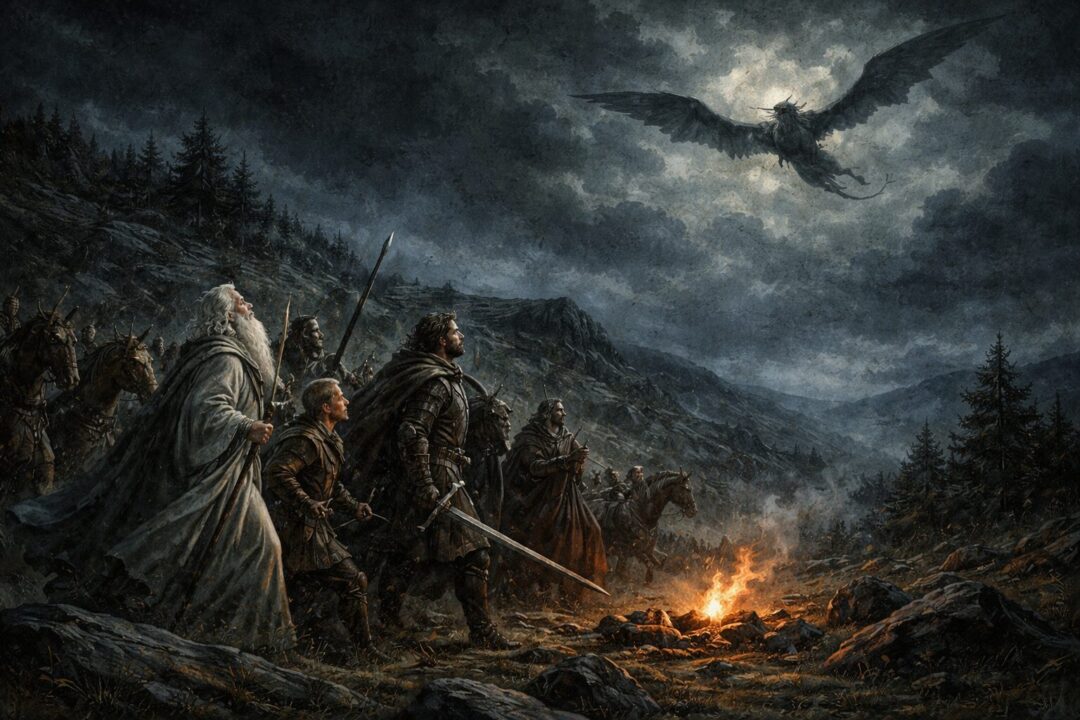
Most readers remember the flying Nazgûl as one of the moments when the War of the Ring suddenly becomes more frightening.
The Black Riders had already been dreadful enough.
They had hunted Frodo across the Shire.
They had ridden openly as servants of terror.
They had filled roads, borders, and dark places with dread.
But once the story turns toward Gondor, something changes.
Now the danger is not only on horseback.
It is in the sky.
And that raises an interesting question about Pippin.
When Gandalf hurries him toward Minas Tirith, the reality of airborne Nazgûl seems to be taken almost for granted. Gandalf acts on it immediately. Pippin does not stop to interrogate it. There is no long exchange in which he asks how this happened, when it happened, or why the Enemy has suddenly changed its method.
For a character as curious and talkative as Pippin, that silence can seem odd.
But the text gives enough to explain it.
Not by pausing to answer the question directly.
By making the chronology do the work.
The Nazgûl Were Not Always Flying
This matters first because the shift is real.
Earlier in The Lord of the Rings, the Nazgûl appear as Black Riders. They are mounted on black horses and move through the lands west of the Misty Mountains in that visible form. Even when their true nature is only partly understood, their outward mode is clear enough: they are riders, not creatures of the air.
That remains true for much of the story.
Their horses are later lost at the Ford of Bruinen, and the Nazgûl are temporarily swept away. After that, they do not simply resume the same form at once. The war is changing, Sauron is gathering his power, and the Ringwraiths return in a new and more terrible manner.
So if someone feels there is a transition here, that instinct is correct.
There is one.
The important point is that the story does not present it as a mystery for Pippin to solve in conversation. It presents it as part of the accelerating pressure of the war.
The Key Change Happens Around Dol Baran
The decisive moment comes after the parley with Saruman.
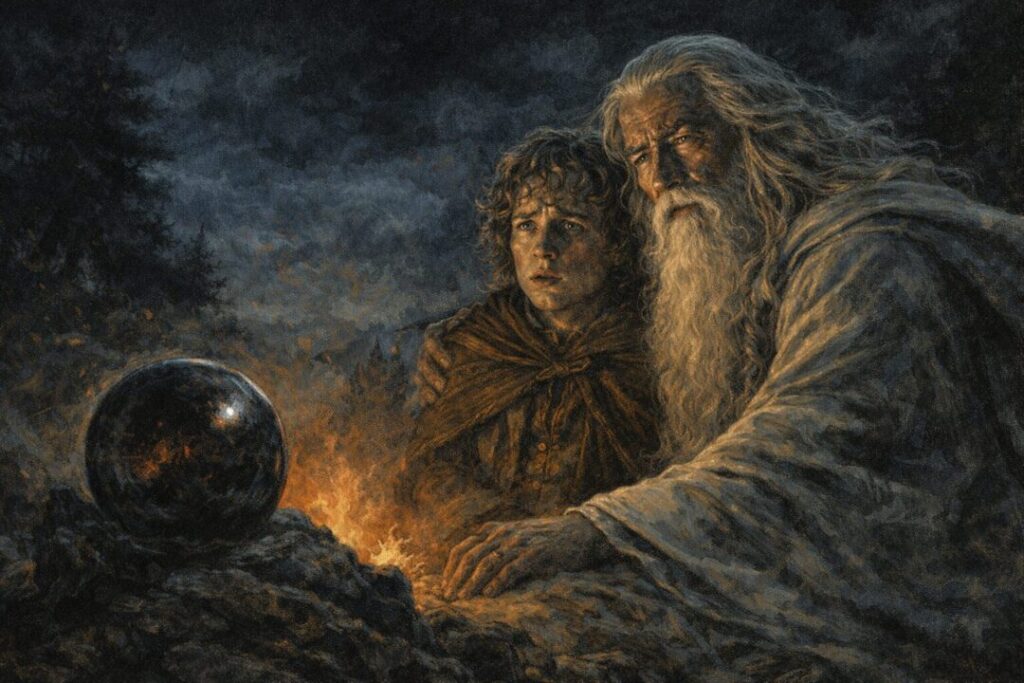
Pippin has already looked into the Orthanc-stone. Sauron now believes Saruman has in his hands a hobbit connected to the Ring. Gandalf realizes the situation has become urgent at once.
That same night, a winged Nazgûl passes over the camp at Dol Baran.
This is the critical detail.
By that point, Gandalf does not need to speculate. The threat has been seen. The form has changed. What had ridden before is now associated with aerial pursuit.
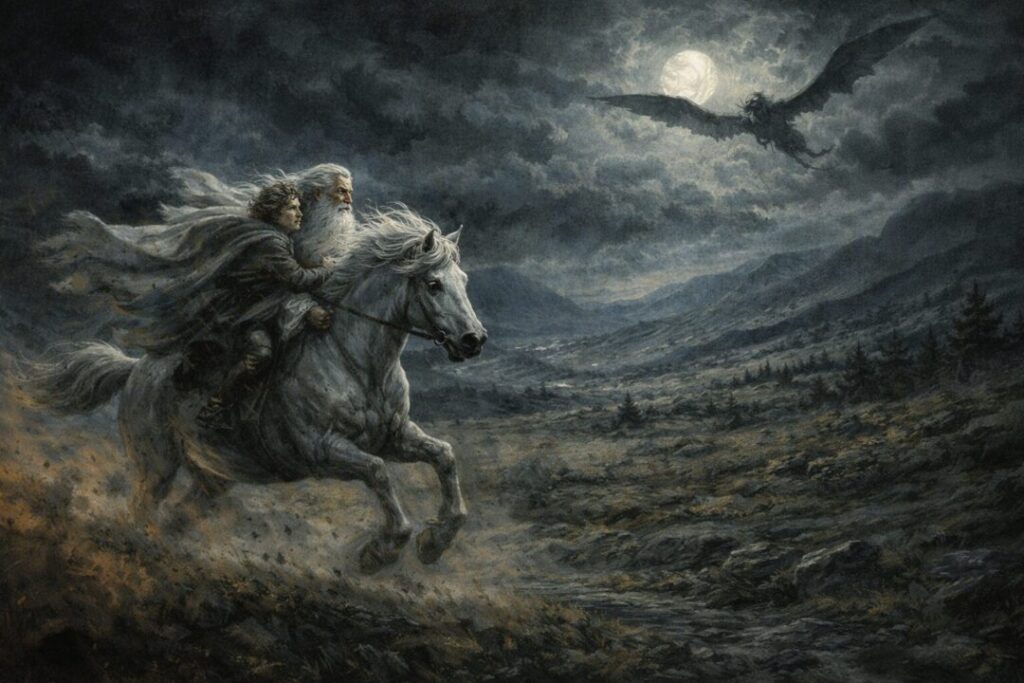
And immediately after that sighting, Gandalf departs with Pippin for Minas Tirith.
The sequence matters because it removes the need for a separate explanatory scene. Gandalf is not operating on unexplained intuition. The text places the evidence in the story just before the ride east begins.
In other words, the knowledge is not mysterious in context.
It is recent.
And it is urgent.
Gandalf’s Knowledge Is Not Presented as Guesswork
Once Gandalf and Pippin are on the road, the narrative strengthens this even further.
They do not ride in ignorance of what the Nazgûl can now do.
They travel by night to avoid them.
That is an important shift in the shape of the danger. If the Enemy’s servants are searching from above, ordinary road travel becomes far more perilous. Open movement in daylight is no longer merely risky in the old way. The sky itself has become hostile.
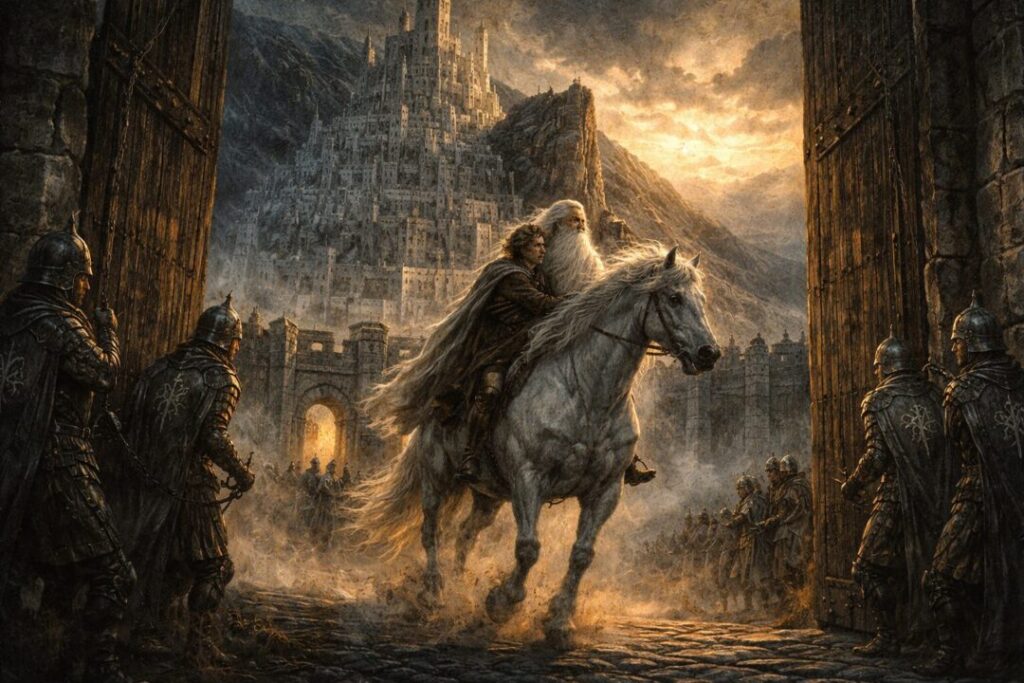
By the time they reach Minas Tirith, Gandalf speaks like someone who has not only heard of this danger but passed beneath it.
That tone fits the journey we have just been given.
So the simpler answer to “How did Gandalf know?” is this:
Because by then he had reason to know.
The story has already moved him past the stage of rumor and into direct response.
Why Pippin Does Not Stop to Ask
That leaves the more interesting part.
Why does Pippin not make more of it?
The text never says outright, “Pippin chose not to ask because of these exact reasons.” So any answer here has to stay modest. But the context strongly suggests why the story does not stop for that exchange.
First, Pippin has just undergone one of the most terrifying experiences of his life.
He has looked into the palantír.
He has been confronted by Sauron.
He has realized, however dimly, that he has nearly ruined everything.
That alone changes the texture of his behavior.
The Pippin who once asked questions out of idle curiosity is still himself, but he is no longer in a leisurely part of the story. He has been shaken into a sharper awareness of danger.
Second, Gandalf is in haste.
He does not ride with Pippin as a teacher explaining a distant subject.
He rides as someone trying to outrun the consequences of what has just happened.
The urgency is practical, not conversational. They must reach Minas Tirith. Gondor must be warned. Sauron’s misunderstanding must be used before it corrects itself. In that atmosphere, the exact mechanics of the Nazgûl’s new mobility are not the central issue.
Pippin does ask questions on the road, but the dominant mood is not one of leisurely exposition.
It is pressure.
The Story Treats the Flying Nazgûl as Escalation, Not Revelation
This is the deeper literary point.
The text does not stop to frame the flying Nazgûl as a neat reveal.
Instead, it lets them emerge as part of a larger transformation in the war. Mordor is no longer merely sending spies, riders, or raiding forces. Its power is spreading outward in every direction. Darkness begins to move over the land. Fear precedes armies. The Ringwraiths become not only hunters on roads but heralds of a more total war.
That is why the moment feels almost understated.
The narrative is not especially interested in explaining the novelty for its own sake.
It is interested in what the novelty means.
And what it means is simple:
the reach of the Enemy has grown.
The old boundaries are collapsing.
Pippin Is Also Learning by Experience
There is another reason the silence feels natural.
Pippin does not need a lecture to grasp that something terrible has changed.
He is experiencing it.
He is there when the urgency becomes absolute after the palantír.
He is there when Gandalf leaves at once.
He is there on the road under the shadow of searching Nazgûl.
So even if the text does not record him pausing to say, “Wait, since when can they fly?”, the practical answer is already unfolding around him.
Sometimes the story lets a character learn by exposure rather than explanation.
That seems to be what happens here.
Pippin is not being kept in the dark by the narrative.
He is being swept forward by events so quickly that the question no longer lands as a separate problem.
Did Gandalf Know Even Earlier?
Here the answer needs to be careful.
The text is clear that by the time Gandalf takes Pippin east, winged Nazgûl are already active. It is also clear that Gandalf responds accordingly.
What the text does not clearly lay out in one neat statement is a full earlier chain of intelligence explaining exactly when Gandalf first learned the Ringwraiths had taken to the air.
So it is safest not to overstate this.
We do not need to claim hidden knowledge, secret reports, or some long prior awareness. The immediate chronology already gives enough. A winged Nazgûl appears over Dol Baran, Gandalf leaves with Pippin, and the road to Minas Tirith is travelled under threat from Nazgûl on winged steeds.
That is sufficient.
Anything stronger should be treated as interpretation, not certainty.
The Real Point of the Silence
In the end, the most satisfying answer is not that Pippin somehow missed the significance.
It is that the story no longer has time for innocence of that kind.
Earlier chapters can linger over puzzlement, rumor, and incomplete knowledge. By this stage, events are moving too quickly. Pippin is being carried straight from Orthanc to the center of Gondor’s coming catastrophe. The enemy is no longer a distant fear on the edge of the world.
It is overhead.
So Pippin’s silence is not best understood as a mistake in the story.
It is part of the story’s tightening.
The war is now advancing faster than explanation.
Characters no longer get every answer before they must act.
And one of the clearest signs of that change is the way the flying Nazgûl enter the narrative: not with a pause, but with pressure.
That is why the moment feels so unsettling.
Not because the text forgot to ask the question.
But because the world has reached the point where the question itself is already being overtaken by events.
Sources & Notes
- J.R.R. Tolkien, The Lord of the Rings, Book I, Chapters 3 and 12, “Three Is Company” and “Flight to the Ford” — establishes the Nazgûl first as Black Riders on horses and ends that phase with the flood at Bruinen.
- J.R.R. Tolkien, The Lord of the Rings, Book III, Chapter 11, “The Palantír” — after Pippin looks into the Orthanc-stone, a winged Nazgûl passes over Dol Baran and Gandalf immediately rides east with Pippin.
- J.R.R. Tolkien, The Lord of the Rings, Book V, Chapter 1, “Minas Tirith” — follows Gandalf and Pippin’s urgent arrival in Gondor after the night ride, with the threat of the Nazgûl already active in the war.
- J.R.R. Tolkien, The Lord of the Rings, Book V, Chapter 4, “The Siege of Gondor” — shows the Nazgûl on winged steeds as instruments of aerial terror over Minas Tirith, supporting the article’s escalation reading.